
Game review
Luma Island
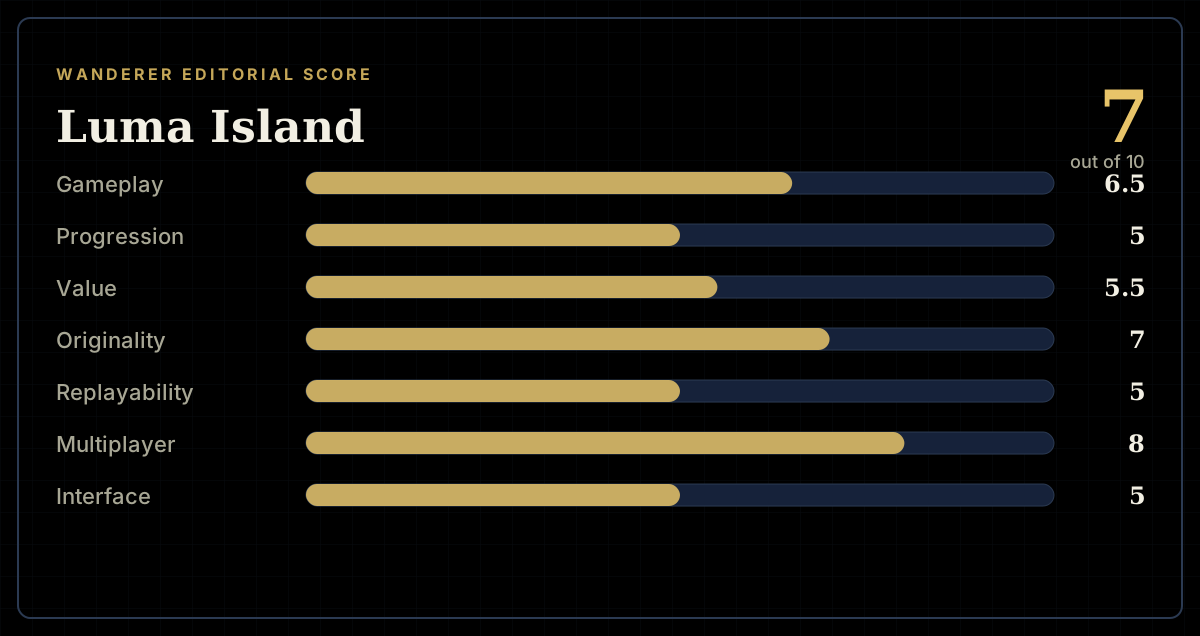
7 / 10
- Developer
- Feel Free Games
- Publisher
- Feel Free Games
- Released
- 20 November 2024
- Platforms
- Windows
- Genre
- Cozy farming RPG with creature collection and co-op exploration
- Monetisation
- One-time purchase, all major content updates (including the Pirates expansion) released free
- Players
- 1-4 player online co-op, drop-in/drop-out
The short version
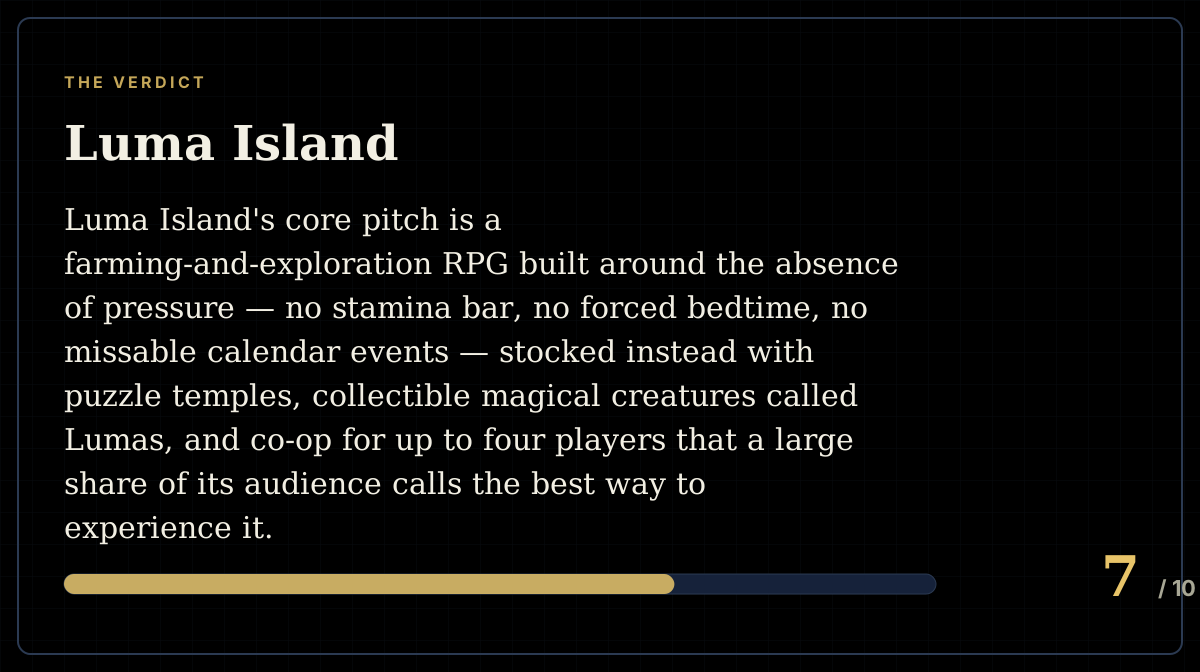
Luma Island's core pitch is a farming-and-exploration RPG built around the absence of pressure — no stamina bar, no forced bedtime, no missable calendar events — stocked instead with puzzle temples, collectible magical creatures called Lumas, and co-op for up to four players that a large share of its audience calls the best way to experience it. Nearly 13,000 Steam reviews back that pitch up at an 84% positive rate. Set against that is a substantial, well-documented minority complaint: profession systems that amount to disconnected money-grinding loops, resource costs that scale into what multiple long-time players call absurd territory, and a genuinely serious controversy over the game's 2025 Pirates expansion initially threatening to force players to abandon their existing saves entirely — on a game that had already left Early Access as a finished 1.0 release.
Biggest strengths
- The absence of a stamina bar, forced sleep, or missable calendar events is the single most repeatedly praised design decision in the review sample, explicitly framed by many reviewers as fixing what stressed them out about Stardew Valley and similar games
- Co-op is described by multiple reviewers as the definitive way to play, and the Pirates update's landmark-pinning feature — which draws a path to a friend's location — is singled out by name as one of the best co-op quality-of-life additions a reviewer says they've seen in any game
- Unlimited inventory space removes a common genre friction point entirely, cited approvingly across dozens of reviews regardless of their overall verdict
Biggest weaknesses
- The January 2025 announcement of the free Pirates expansion initially offered no way to carry existing saves forward, and multiple reviewers — including some with over 3,000 hours logged — say the developers' own announcement failed to disclose this clearly, causing a serious trust breach for a title that had already shipped as a finished 1.0 game rather than Early Access
- Even after a "Progress Transfer" feature was announced shortly before the Pirates launch, reviews dated at and after that launch continue to report full save loss, an unresolved discrepancy between the developer's stated fix and player experience this review cannot settle either way
- Profession systems are repeatedly described as disconnected money-grinding loops — you can't eat the food or wear the armour you craft in them, only sell it — leaving several reviewers questioning what the professions are actually building toward
Who it's for: Fans of cozy farming sims who specifically want the genre with the stress removed — no clock, no stamina, no missable relationships — and who value co-op highly enough that a companion playing alongside them matters more than a tightly-paced solo progression curve.
Our recommendation: A strong pick for co-op players and anyone burned out on Stardew Valley's time pressure, at a price justified many times over by the hundreds of hours top reviewers report. Go in aware that professions are shallow by design, the late game turns genuinely grindy, and the developer's handling of its biggest content update caused real, ongoing trust damage that a same-page "Progress Transfer" fix doesn't appear to have fully settled for every player affected.
7 / 10
Every cozy farming game since 2016 gets measured against Stardew Valley, and Luma Island's own reviewers spend an unusual amount of energy arguing about whether that comparison is even fair. Several reviewers insist it isn't — one says the better reference point is Fantasy Life on the Nintendo DS, another argues bluntly that "not every cozy life sim game that comes out has to be a Stardew Valley variant." What both camps agree on, whether they land positive or negative, is the game's central design bet: strip out the stamina bar, the bedtime deadline, and the missable calendar events that create Stardew's low-grade daily pressure, and replace that pressure with something else. Nearly 13,000 Steam reviews, sitting at 84% positive, suggest that bet mostly paid off. What they also document, in detail and at length, is where the replacement systems — professions, resource scaling, and one deeply controversial content update — didn't land nearly as cleanly.
Farming without the clock
The single most repeated compliment in the review sample isn't about art or writing, it's about what's missing. "No stamina/forced sleep requirements," reads one representative pro list; "just the more involved parts like growing crops, raising livestock, exploring caves and temples, beating monsters and finding treasure," as another puts it, describing the pitch approvingly before turning critical about what comes after. Reviewers describe getting "lost gathering things on day 1" and not finding their house again "until day 10" as a feature rather than a bug, and multiple explicitly frame this design as accessibility-minded — several credit it directly with letting them enjoy a farming game despite anxiety that made Stardew Valley's time pressure unplayable for them. This is a real, specific design choice with real appeal behind it, not incidental praise, and it's the throughline connecting almost every positive review in the sample regardless of what else that reviewer thought of the rest of the game.
Built for two, or four
Where Luma Island distinguishes itself further is co-op, supporting up to four players in drop-in/drop-out multiplayer, and reviewer accounts treat this as close to the definitive way to experience the game rather than a bonus mode bolted onto a single-player design. One reviewer calls it "probably the best way to play"; another, writing after the Pirates update added a landmark-pinning feature that draws a sparkling path to a partner's location, calls it "the single greatest quality of life feature in a co-op game I have ever received," specifically because it solves the common problem of one player racing ahead of a slower-paced partner. Multiple reviews describe buying a second copy, or in one case an entire second computer, specifically so a partner could join — a strong, concrete signal of how much weight the co-op experience carries for this game's most enthusiastic audience.
Professions: money loops without a destination
The clearest, most consistently argued weakness sits in the profession system — the game's version of skill specialisation, covering mining, fishing, cooking and crafting. Reviewer after reviewer describes the same structural problem: professions generate items to sell for gold, but the gold doesn't meaningfully feed back into character growth, and the crafted goods themselves generally can't be used. "You can't eat the food or armor or whatever else you craft in your job," one reviewer notes. "It is there to sell and to get you further in your job." Another, more pointed, calls the whole system "just money grinders, they don't actually affect your character or gameplay," concluding that "mastering your profession is meaningless" beyond an achievement pop-up. This complaint shows up independently across reviewers with wildly different overall opinions of the game, which is a stronger signal than any single account carries alone — it's describing a specific design gap, not general dissatisfaction dressed up as a systems critique.
When the grind turns punishing
That gap widens as resource costs scale up. One of the sample's most detailed accounts, from a reviewer with over 90 hours logged, describes a "fiendish approach to scaling" starting from the basics: a starting-tier copper pickaxe requiring 14 hits to break a single copper ore node, with subsequent tool tiers requiring proportionally more ore to craft even as each swing yields diminishing returns. Steam's own achievement data backs the shape of this complaint, if not the specific numbers: 99.7% of players clear the game's opening milestone, but "Mastered All Professions" sits at just 4.1%, and several Pirates-specific late-game achievements sit between 2.8% and 5.4%. That's a genuinely steep cliff, consistent with reviewer reports that the late-game capstone projects for each profession demand what one reviewer calls "absurd" resource quantities for comparatively modest payouts. None of this makes the early-to-mid game any less enjoyable by most accounts — it specifically describes where the wheels start to come off for players who push toward full completion.
A save-reset controversy the developer didn't fully put to rest
The most serious issue in the review sample isn't a design complaint at all — it's about trust. When Feel Free Games announced the free Pirates expansion in January 2025, several reviewers say the announcement did not clearly disclose that existing saves would not be compatible with it, meaning finishing the expansion would require starting over entirely on a game that had already shipped as a complete 1.0 release rather than Early Access. "Forcing save file resets on a non Early Access game is simply not acceptable," one reviewer writes; another, with over 3,000 hours logged, calls it "concerning that a fully released game's development is that undercooked." The Steam partner-events feed shows the developer responded to this pressure before launch, posting "Progress Transfer Unlocked | Release Date News" on 28 May 2025, roughly three weeks ahead of the Pirates launch on 20 June 2025. But that fix doesn't appear to have fully closed the issue for everyone: reviews dated at and after the Pirates launch, including one updated specifically on 20 June 2025 to address this exact point, continue to report full progress loss. This review can't resolve that discrepancy between the developer's stated fix and the player accounts contradicting it — only report both facts plainly, because they don't fully agree with each other, and a buyer weighing whether to invest hundreds of hours deserves to know that ambiguity exists rather than a tidier story in either direction.
Sustained support, in the developer's favour
It's worth stating the other side of that same coin clearly: whatever went wrong with the Pirates rollout, Feel Free Games has kept building on this game for nearly two years without resorting to paid DLC. The events feed shows a steady cadence of free updates — seasonal content drops, numbered patches, and a further free Summer Update as recently as August 2026 — none of it monetised beyond the original purchase price. That's a real, ongoing commitment most small studios don't sustain this long after a title's initial sales window closes, and it tempers the save-reset controversy without erasing it; a developer actively still updating a game two years on is a meaningfully different situation than one who shipped once and moved on.
Rougher edges away from the main controversy
A handful of smaller, more straightforward complaints round out the negative sample. Several reviewers describe navigation as a genuine frustration, citing the absence of a proper map or compass and getting lost repeatedly despite a rotatable camera. Inventory and chest management draw specific requests for drag-and-drop item placement and stack-splitting, with one reviewer directly citing Terraria as the bar the game doesn't clear. A mouse-and-keyboard player reports the interface feels tuned primarily for controller input, with on-screen actions not always matching what the mouse is actually hovering over. And a genuinely specific accessibility bug — Arabic-language text rendering reversed rather than properly right-to-left formatted — is raised by more than one Arabic-speaking reviewer, described as unresolved despite direct, polite requests to the developer to fix it.
Final verdict
Luma Island succeeds hardest at the thing it set out to prove: that a cozy farming game doesn't need a stamina bar or a bedtime deadline to work, and that co-op can be the main event rather than an afterthought. Its nearly 13,000-review sample backs that up at a scale few 2024 indie releases in this lane reach. But it's not a clean success story — profession systems that don't connect to real character growth, a back half that turns punishingly grindy by its own achievement data, and a save-reset controversy the developer's fix doesn't appear to have fully resolved for every player affected are all real, well-documented costs sitting alongside the goodwill. Go in for the exploration, the Lumas, and especially the co-op, and treat full profession mastery as a bonus rather than the point.
Pros and cons
Pros
- The absence of a stamina bar, forced sleep, or missable calendar events is the single most repeatedly praised design decision in the review sample, explicitly framed by many reviewers as fixing what stressed them out about Stardew Valley and similar games
- Co-op is described by multiple reviewers as the definitive way to play, and the Pirates update's landmark-pinning feature — which draws a path to a friend's location — is singled out by name as one of the best co-op quality-of-life additions a reviewer says they've seen in any game
- Unlimited inventory space removes a common genre friction point entirely, cited approvingly across dozens of reviews regardless of their overall verdict
- Puzzle-driven temple and ruin exploration gives the map genuine variety beyond farm upkeep, and reviewers who dislike the profession grind still frequently praise the exploration content specifically
- The developer has shipped free content updates roughly every one to two months for nearly two years after launch, including a large free Pirates expansion and continuing through an August 2026 Summer Update, rather than monetising expansions as paid DLC
Cons
- The January 2025 announcement of the free Pirates expansion initially offered no way to carry existing saves forward, and multiple reviewers — including some with over 3,000 hours logged — say the developers' own announcement failed to disclose this clearly, causing a serious trust breach for a title that had already shipped as a finished 1.0 game rather than Early Access
- Even after a "Progress Transfer" feature was announced shortly before the Pirates launch, reviews dated at and after that launch continue to report full save loss, an unresolved discrepancy between the developer's stated fix and player experience this review cannot settle either way
- Profession systems are repeatedly described as disconnected money-grinding loops — you can't eat the food or wear the armour you craft in them, only sell it — leaving several reviewers questioning what the professions are actually building toward
- Resource costs escalate sharply in the back half of the game; one heavily-invested reviewer describes a basic tool upgrade requiring "14 hits" to break a single ore node before scaling further, and Steam's achievement data shows full-profession-mastery and endgame Pirates achievements sitting below 5% completion against 99.7% for the game's opening milestone
- Multiple reviewers flag Arabic-language text rendering reversed and not right-to-left formatted, a specific, named accessibility bug reported as unresolved for an extended period despite direct developer-facing requests to fix it
Screenshots
-

Luma IslandImage: Feel Free Games via Steam -

Luma IslandImage: Feel Free Games via Steam -

Luma IslandImage: Feel Free Games via Steam -
How the review scores each part of the gameWanderer Editorial -
The short versionWanderer Editorial