
Game review
Monotony Idle
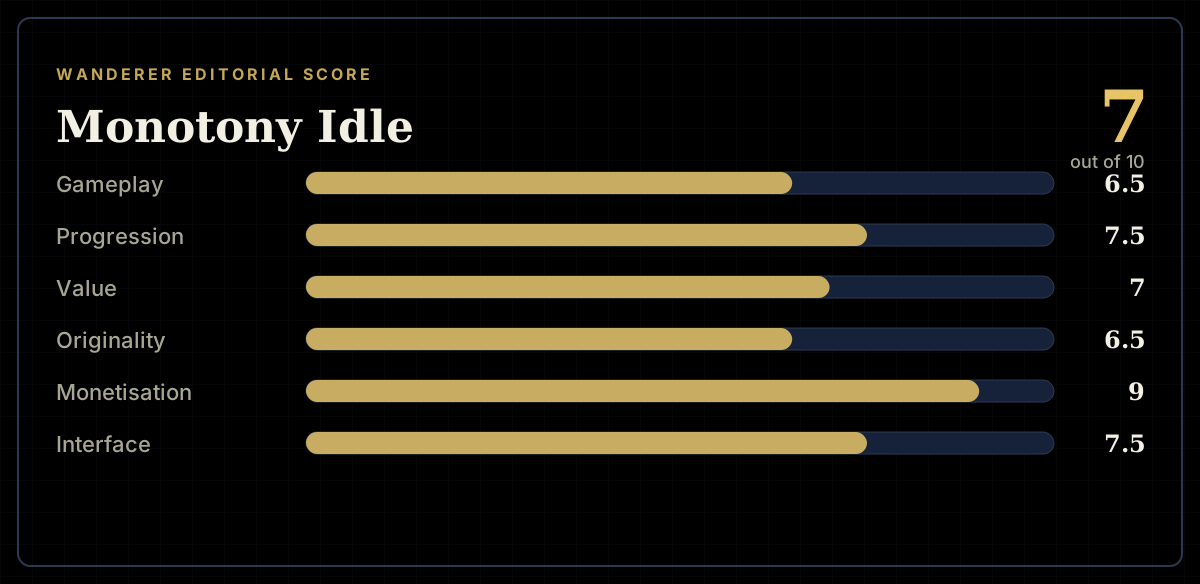
7 / 10
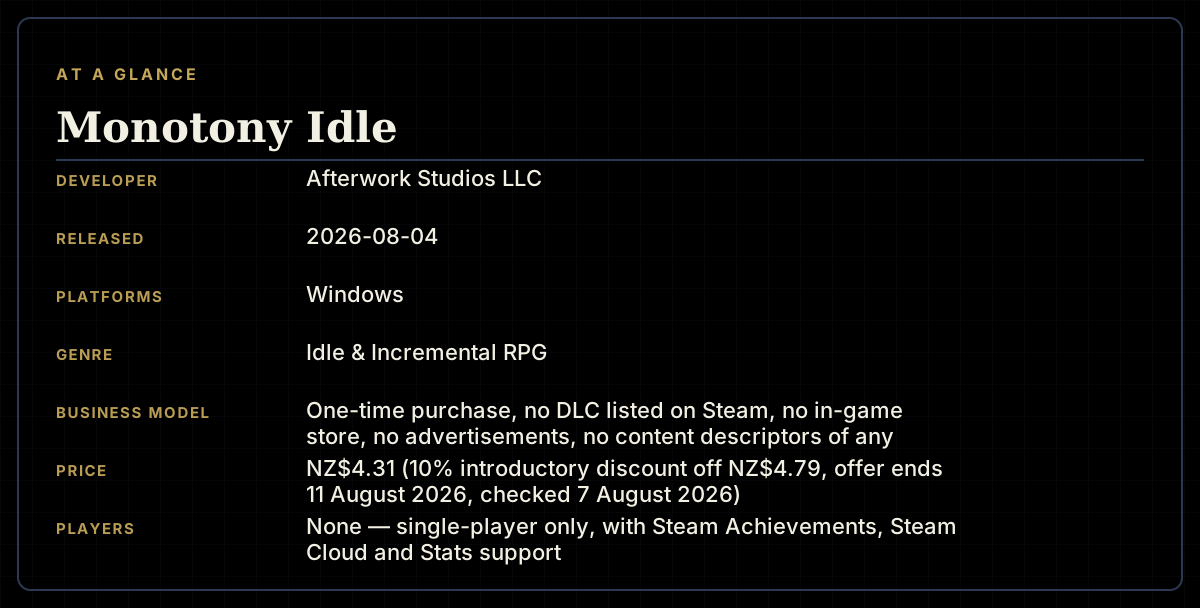
- Developer
- Afterwork Studios LLC
- Publisher
- Afterwork Studios LLC
- Released
- 4 August 2026
- Platforms
- Windows
- Genre
- Idle & Incremental RPG
- Monetisation
- One-time purchase, no DLC listed on Steam, no in-game store, no advertisements, no content descriptors of any kind
- Players
- None — single-player only, with Steam Achievements, Steam Cloud and Stats support
The short version
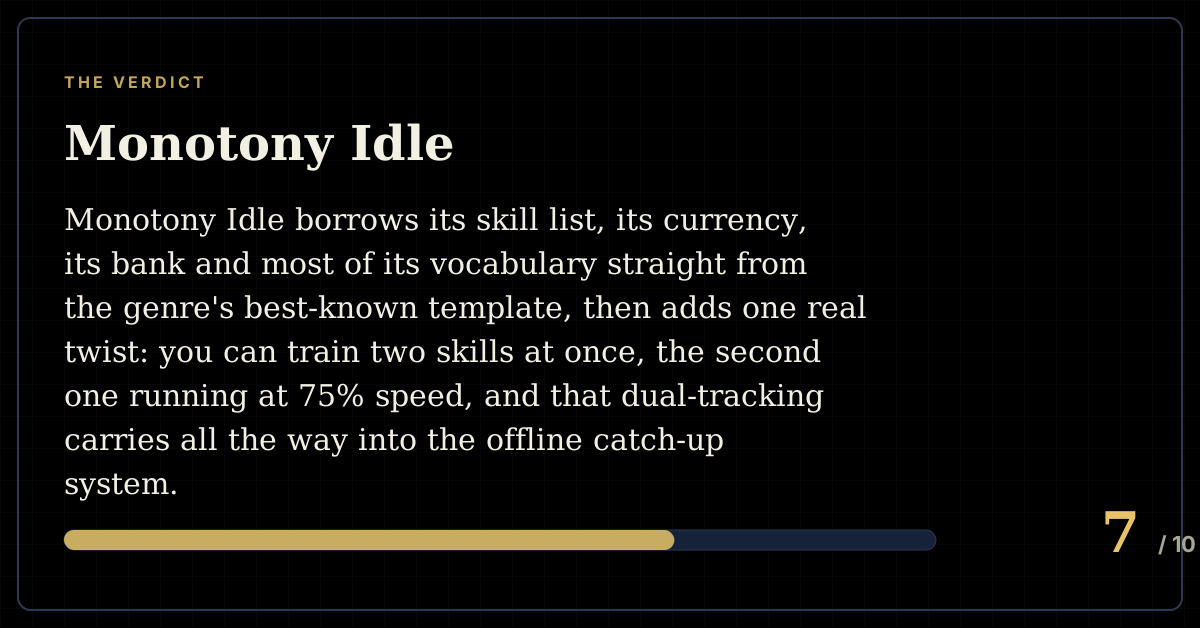
Monotony Idle borrows its skill list, its currency, its bank and most of its vocabulary straight from the genre's best-known template, then adds one real twist: you can train two skills at once, the second one running at 75% speed, and that dual-tracking carries all the way into the offline catch-up system. Thirteen separate trackers — eight gathering and crafting skills, Alchemy, and four combat stats — feed a tiered monster ladder that runs from Goblins up to a Green Dragon, all logged against a 135-item collection book and gated behind a prestige system the game calls Ascension. It's a genuinely more structured build than its self-deprecating title suggests. What it isn't, yet, is tested: the interface itself still reads "V0.1", the game has no Steam reviews, no meaningful concurrent player count and only three achievements to its name, one of which only 12% of players have reached.
Biggest strengths
- Thirteen separate skill trackers — Woodcutting, Carpentry, Mining, Smithing, Fishing, Cooking, Thieving, Farming and Alchemy alongside Attack, Strength, Defence and Hitpoints — give the loop far more shape than the store page's six-skill pitch describes
- A genuine dual-training system lets a second skill run at 75% speed alongside the primary one, and the official offline-progress screenshot shows XP landing in three skills from a single absence, which is a real structural difference from the genre's usual one-skill-at-a-time idling
- Offline catch-up is documented rather than left to guesswork: capped at 24 hours, itemised by resource and by skill in a return-summary popup with its own claim button
Biggest weaknesses
- The interface itself is labelled "V0.1", and a single-digit concurrent-player reading, zero Steam user reviews and only three achievements at time of writing mean there is no outside account yet of whether the pacing and balance hold up past the opening hours
- The developers' own Early Access FAQ admits balance and polish aren't finished, and only 12% of players have reached the Ascension prestige tier so far — consistent with a system nobody has had the time to stress-test
- Windows only, English only, and no controller support listed anywhere on the store page, a narrow footprint even by premium-indie standards
Who it's for: RuneScape-style idle RPG players who want the skill-grinding template with a genuinely new twist — training two skills in parallel — and who are comfortable buying into a two-person Early Access project on the strength of its systems rather than anyone else's experience with it.
Our recommendation: At NZ$4.31 for a system this dense — thirteen skills, a full equipment loadout, a farming plot with independent timers, a bestiary and a prestige layer — the price is fair for what the store page documents, and the developers' own pledge that the price will only rise from here removes the usual Early Access gamble of buying in too early. The catch is that almost none of it has been tested by anyone but the two-person studio: no reviews, single digits of concurrent players, and an interface that labels itself V0.1. Buy it for the systems and the honesty of the pitch, not for any outside confirmation that the balance holds up over a long session.
7 / 10
Idle RPGs live and die on one question: what am I actually watching go up, and how many things can go up at once? Monotony Idle answers that with thirteen separate trackers running off a template every fan of the genre will recognise on sight — a Bank, a GP currency, skills named Woodcutting and Smithing and Thieving, a combat system built on Attack, Strength, Defence and Hitpoints. What it adds on top of that borrowed foundation is a real mechanical idea: you can train two of those thirteen skills at the same time, the second one running at a reduced pace, and that pairing carries through into the offline system as well. Three days after launch, with a two-person credit on both developer and publisher lines, it's a more structured Early Access debut than its self-mocking name lets on.
Thirteen trackers, one shared clock
The store page's feature list mentions six activities — mining, fishing, smithing, cooking, thieving and farming — but the actual skill sidebar runs to thirteen: those same eight gathering and crafting skills, plus Alchemy, plus the four combat stats that drive the fight system. Each one levels independently and each one shows up as its own line in the offline-progress report, so the game is tracking far more simultaneous progression than a newcomer reading the store description would expect. That density is the strongest argument for the price. A player who wants number after number after number to watch climb gets thirteen of them from the very first session, not six.
The catch is that breadth isn't depth. Every skill screen examined follows the same shape — a progress bar, a level, an action button, sometimes a resource yield — and nothing in the available material suggests any one of them does something structurally different from the others. The farming plots are the partial exception: four independent timers running at different speeds, seed selection with bulk-planting, and a harvest button that reads the plot's current state rather than a single generic "collect" action. It's a small, sensible piece of interface design, and it's also the only skill screen that looks meaningfully different from the rest.
Training two things at once
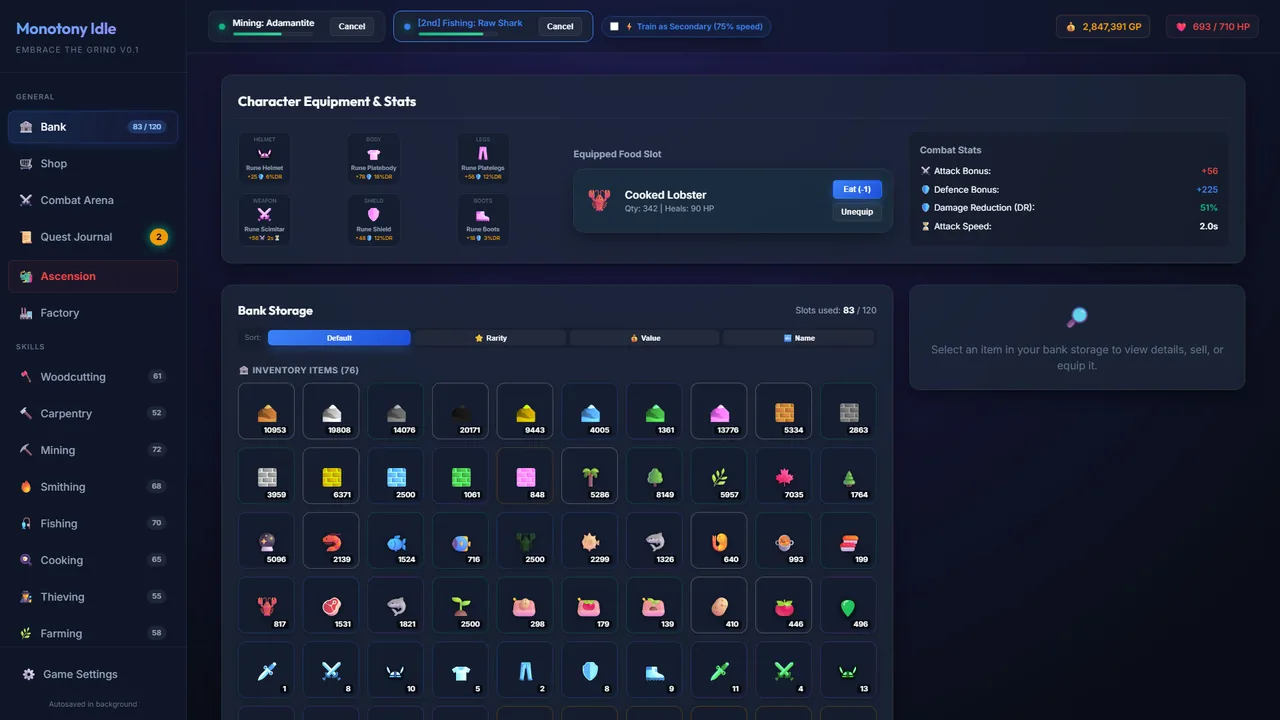
The one idea in Monotony Idle that genuinely departs from the genre's usual habits is the dual-training system. A checkbox marked "Train as Secondary (75% speed)" lets a second skill run alongside the primary one — the official screenshots show Mining and Fishing progressing together, each with its own bar in the header — and the offline-progress popup confirms the same split applies while the game is closed: a return after 23 hours and 36 minutes away shows XP landing in Mining, Fishing and Smithing from that single absence, not just the one skill that was queued when the window closed. Most idle RPGs in this space commit hard to one active skill at a time and treat that as the whole strategic layer; letting two run in parallel, even at a discount on the second one, is a real point of difference and the strongest evidence that this build has an idea of its own underneath the borrowed template.
The offline system itself is handled about as well as the genre asks for. It's capped at 24 hours rather than left open-ended, it's itemised by resource and by skill rather than compressed into a single lump sum, and it's presented as a report the player actively claims rather than a number that's already been quietly added to the total by the time the game loads. That directly answers the question this library keeps finding idle games either fumble or ignore outright: does it actually earn while it's closed, and can the player see what it earned. Here, plainly, yes.
A goblin-to-dragon ladder with real gear
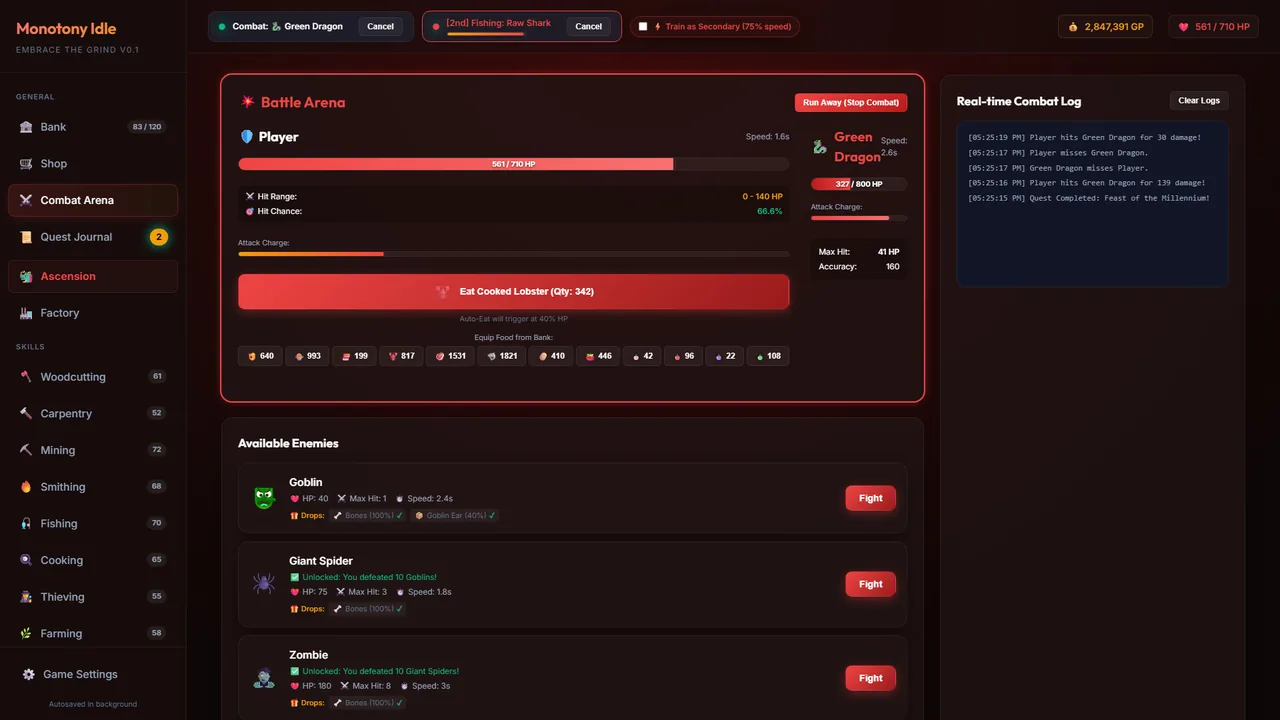
Combat runs on a visible unlock chain rather than an open enemy list — Goblins first, then Giant Spiders once ten Goblins are down, then Zombies, working up toward a Green Dragon boss fight that the store page singles out by name. Equipment follows a familiar six-slot loadout (helmet, body, legs, weapon, shield, boots) with bonuses to attack, defence and damage reduction, an auto-eat threshold that consumes stacked food once health drops below 40%, and a combat log that timestamps every hit, miss and quest completion in real time. None of that is inventive on its own — it's the same skeleton this entire sub-genre has run on for years — but it's implemented with enough surface detail (hit chance percentages, attack-charge bars, per-enemy drop tables) that the fighting doesn't read as an afterthought bolted onto the skilling loop.
Ascension, and what's still locked
Past the base loop sits a prestige system the game calls Ascension, and a 135-item collection log that tracks everything from crafting materials to unique monster drops, organised into filterable categories with a search bar. Both are real, working systems rather than promises — the Ascension achievement, Prestigious, sits at exactly 12% of players earned, and the collection log's own screenshot shows a player 86 items into it. What isn't verifiable yet is anything past that layer. The store page's "there's more to it" section is deliberately vague, and the only supporting evidence is a single hidden achievement, It's a Secret, sitting at 8% completion — enough to confirm something is genuinely gated behind play, not enough to say what it is or whether it's worth reaching.
The Early Access question
Afterwork Studios' own FAQ is unusually direct about where the build actually stands. Asked what's finished, the answer is blunt: "It's playable start to finish already. You can train your skills, work through the questline, and fight your way up to the Green Dragon... What's not done yet is the balance, some polish, and more content. So you're getting a complete loop that still has a few rough edges. I'm not going to pretend otherwise." That tracks with what the achievement numbers show — a full loop exists, but almost nobody has pushed far enough into it yet to have stress-tested the systems past the opening skills. The studio also commits to a timeline (six to twelve months) and a pricing promise that actually rewards early buyers rather than punishing them: the price is expected to rise as content is added, so NZ$4.31 today is described as the lowest it will ever be rather than an introductory teaser before a later markdown.
That leaves the title itself as the one thing the review can't settle for a reader. Monotony Idle, running under a UI banner reading "Embrace the Grind," is either a confident bit of genre self-awareness from a studio that knows exactly what it's selling, or an unusually candid admission about a loop that hasn't yet proven it can hold attention for the long haul the genre depends on. Thirteen skills, a dual-training system and a documented offline cap are real, substantial answers in the game's favour. The complete absence of outside data — no reviews, a handful of concurrent players, three achievements — means nobody has yet supplied the other half of that argument.
Final verdict
Monotony Idle earns a 7 for shipping more system than its pitch admits to — thirteen skills instead of six, a working prestige layer, a real bestiary, and a dual-training mechanic that actually changes how the offline math works rather than just decorating the same single-skill loop everyone else in the genre uses. It doesn't score higher because none of that has been tested by anyone outside the two-person studio yet, because the interface itself still carries a V0.1 label, and because the promised "more to it" beyond the base loop is currently backed by nothing but a single 8%-earned hidden achievement. The clean, honest monetisation and the studio's own pricing pledge make the NZ$4.31 asking price an easy call regardless of how the joke in the title is meant to land. Whether the grind itself is worth embracing is a question this build hasn't been open long enough for anyone else to answer yet.
Pros and cons
Pros
- Thirteen separate skill trackers — Woodcutting, Carpentry, Mining, Smithing, Fishing, Cooking, Thieving, Farming and Alchemy alongside Attack, Strength, Defence and Hitpoints — give the loop far more shape than the store page's six-skill pitch describes
- A genuine dual-training system lets a second skill run at 75% speed alongside the primary one, and the official offline-progress screenshot shows XP landing in three skills from a single absence, which is a real structural difference from the genre's usual one-skill-at-a-time idling
- Offline catch-up is documented rather than left to guesswork: capped at 24 hours, itemised by resource and by skill in a return-summary popup with its own claim button
- A one-time NZ$4.31 purchase with no DLC, no ads and no microtransactions, and an Early Access FAQ that explicitly promises the price will only go up from here rather than pushing players to buy before a sale ends
- A 135-item collection log, a tiered monster-unlock chain running from Goblin to Green Dragon, and a working quest journal give the loop visible landmarks beyond a single number going up
Cons
- The interface itself is labelled "V0.1", and a single-digit concurrent-player reading, zero Steam user reviews and only three achievements at time of writing mean there is no outside account yet of whether the pacing and balance hold up past the opening hours
- The developers' own Early Access FAQ admits balance and polish aren't finished, and only 12% of players have reached the Ascension prestige tier so far — consistent with a system nobody has had the time to stress-test
- Windows only, English only, and no controller support listed anywhere on the store page, a narrow footprint even by premium-indie standards
- A title like Monotony Idle, under a UI tagline reading "Embrace the Grind", is either a confident joke about the genre or a plain warning label, and with no player consensus recorded yet there is no way to know which one a given buyer is getting
- The "more to it" content the store page teases is backed by exactly one hidden achievement sitting at 8% completion — everything else verifiable about the game right now describes the base skilling-and-combat loop, not whatever is supposed to come after it
Screenshots
-
Monotony IdleImage: Afterwork Studios LLC via Steam -

Monotony IdleImage: Afterwork Studios LLC via Steam -
Monotony IdleImage: Afterwork Studios LLC via Steam -
How the review scores each part of the gameWanderer Editorial -
The game at a glanceWanderer Editorial -
The short versionWanderer Editorial