
Game review
Idle magic herb
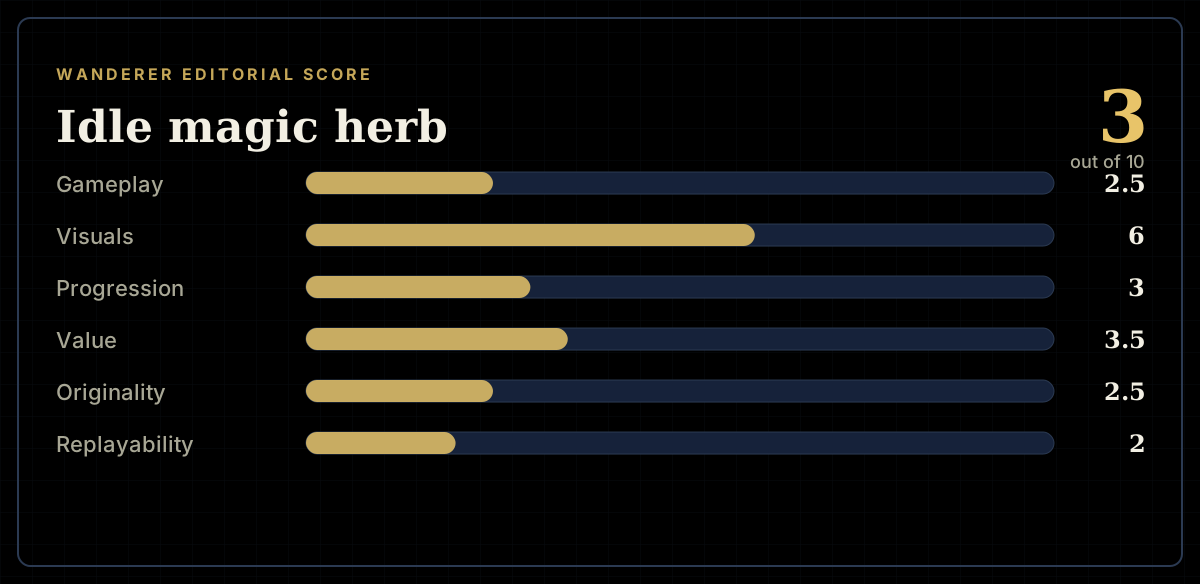
3 / 10
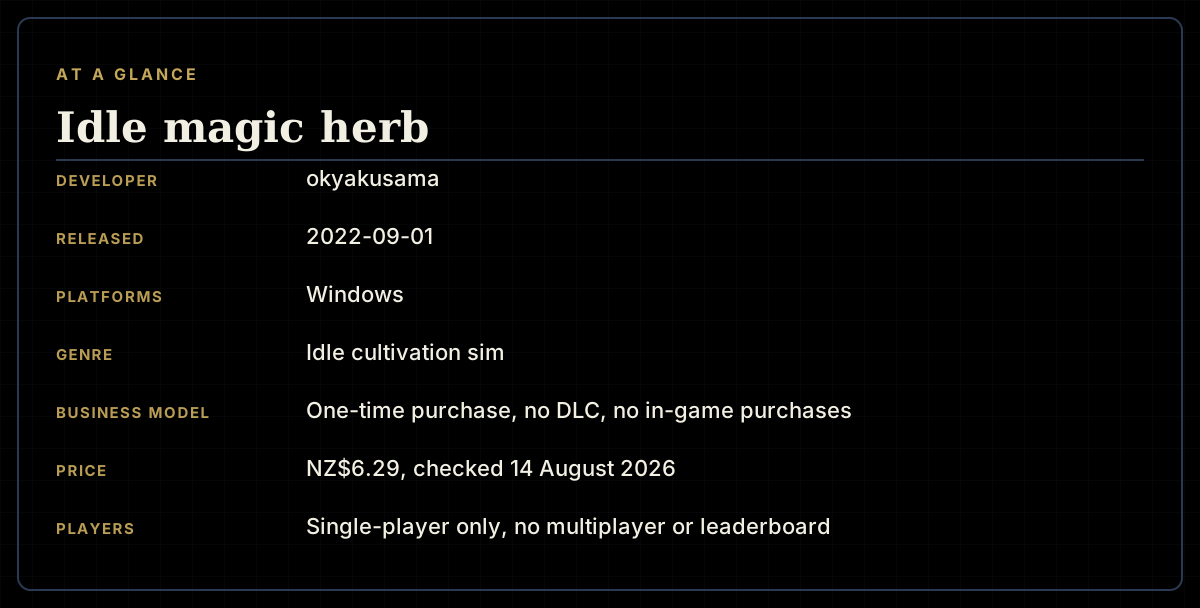
- Developer
- okyakusama
- Publisher
- okyakusama
- Released
- 1 September 2022
- Platforms
- Windows
- Genre
- Idle cultivation sim
- Monetisation
- One-time purchase, no DLC, no in-game purchases
- Players
- Single-player only, no multiplayer or leaderboard
The short version
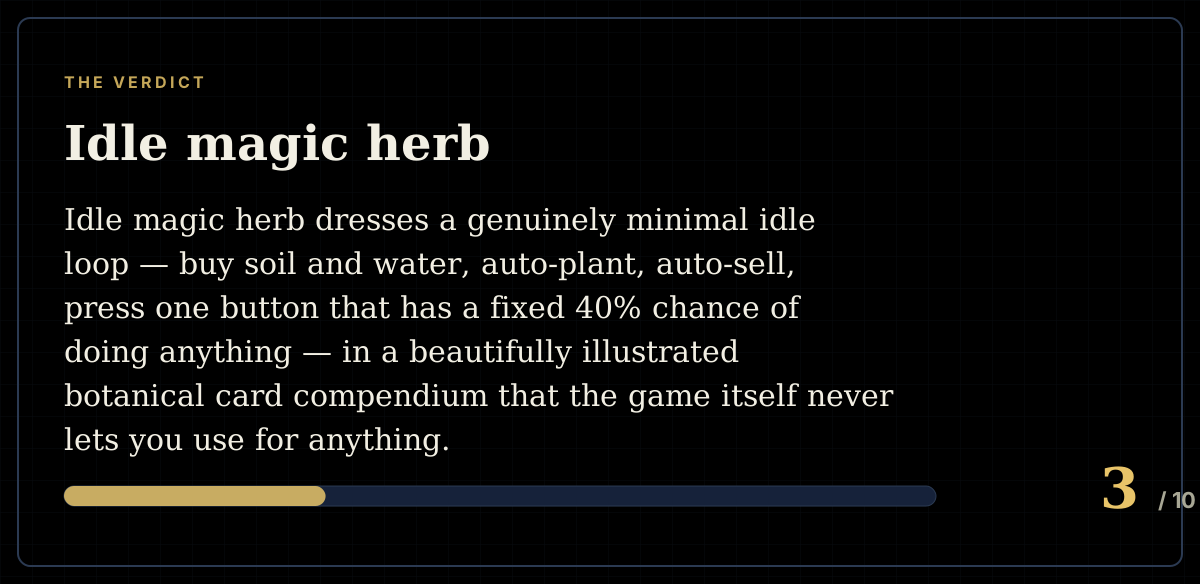
Idle magic herb dresses a genuinely minimal idle loop — buy soil and water, auto-plant, auto-sell, press one button that has a fixed 40% chance of doing anything — in a beautifully illustrated botanical card compendium that the game itself never lets you use for anything. Its own reviewers, almost all writing in Simplified Chinese, describe finishing everything the game has to offer within a single sitting, and the developer's own patch history backs them up: every fix Steam has on record lands within the first week of a September 2022 launch, then nothing.
Biggest strengths
- The herb and monster compendium uses genuinely detailed, painterly botanical illustrations across well over a thousand catalogued entries, and it's the one part of the game reviewers consistently single out as attractive
- The file size and interface are minimal enough that it runs on almost anything and never asks for more attention than a click
- Cheap at a deep discount (several reviewers mention paying the equivalent of two to four New Zealand dollars) as undemanding filler
Biggest weaknesses
- The core loop reduces to buying soil, water and fertiliser, watching a progress bar fill, and clicking one "breakthrough" button whose success chance reviewers report as a flat, never-improving 40% regardless of preparation
- The compendium that reviewers praise visually is purely decorative — cards can be viewed but not used, crafted with or spent, which multiple reviewers call out as wasted potential given the art on offer
- Steam's own patch history shows every recorded fix landing within the first week after the 1 September 2022 launch, matching reviewers' complaints that no further content ever arrived
Who it's for: Players who specifically want a zero-effort, background-window idle toy with a xianxia (immortal cultivation) skin and don't mind that the compendium art is the only part of the game that received real craft.
Our recommendation: Only at a steep discount, and only if the botanical illustration cards are genuinely what you're after. As a NZ$6.29 full-price purchase it asks more than the hour or two of content most reviewers describe actually delivers.
3 / 10
Idle magic herb's Chinese title translates to something like "I Cultivate Immortality Purely By Farming," and that's a more honest pitch than the English Steam listing gives it credit for. This is a xianxia idle game — the wuxia-adjacent Chinese fantasy tradition of cultivators chasing immortality through spiritual power, "breakthroughs" and increasingly grand cosmological ranks — built around a herb garden that plants and sells itself. It launched on 1 September 2022 from a solo Chinese developer, okyakusama, and outside a handful of day-one bug fixes it hasn't been touched since.
Three tabs, one decision
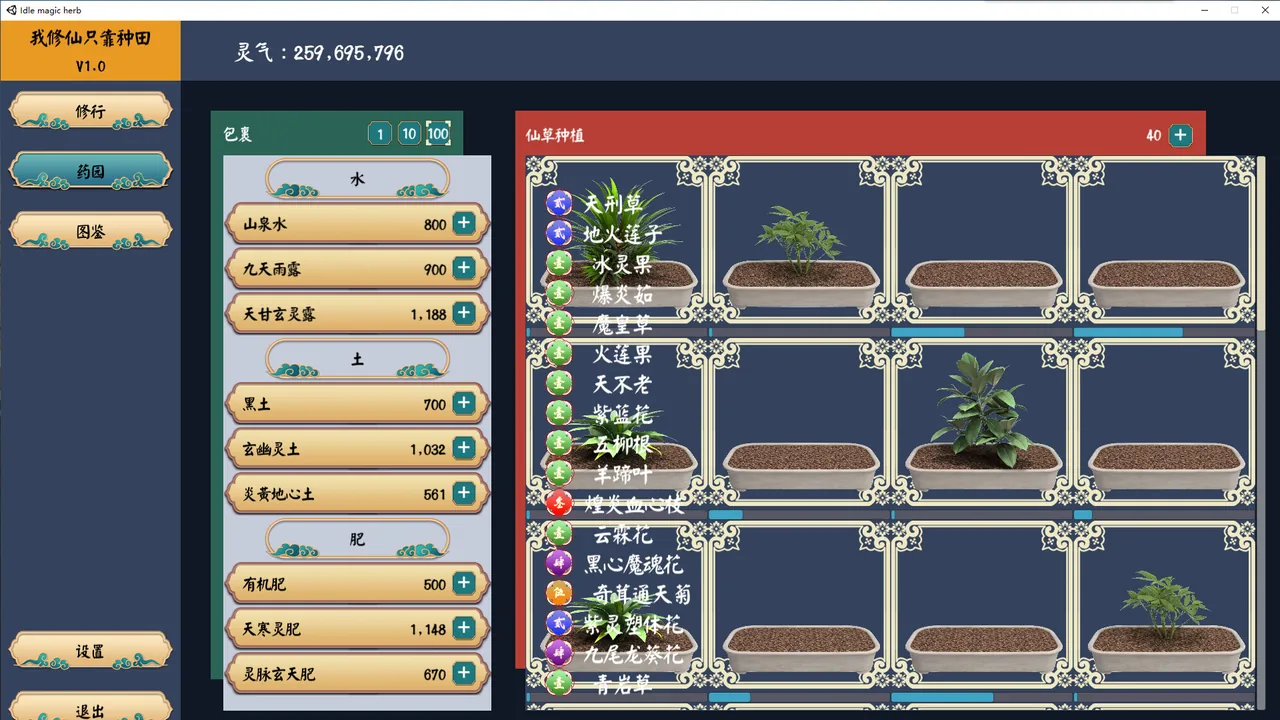
The game is organised around three panels: a garden where you spend a currency called Spirit Qi on water, soil and fertiliser to auto-plant and auto-sell herbs; a cultivation screen where a cartoon swordswoman levels up a list of named techniques automatically until they cap at level 100; and a compendium that catalogues everything the game has ever shown you, plants and monsters alike, as individually illustrated cards. Combat is similarly hands-off — a "demon slaying" panel ticks up kill counters against tiered monster lists on its own, with power numbers that climb as your cultivation rank climbs.
The one moment that asks anything of the player is the "breakthrough" button, which advances your cultivation rank if it succeeds. Reviewers who tracked it report the odds sitting at a flat 40% no matter how prepared you are, with no visible way to improve the chance and a multi-second delay after every attempt before the result appears. For a mechanic sold as the game's central progression gate, that's a strange thing to leave static — a scaling failure rate, or any lever to influence it, would have given the button a reason to exist beyond repeated clicking.
A compendium with nowhere to go
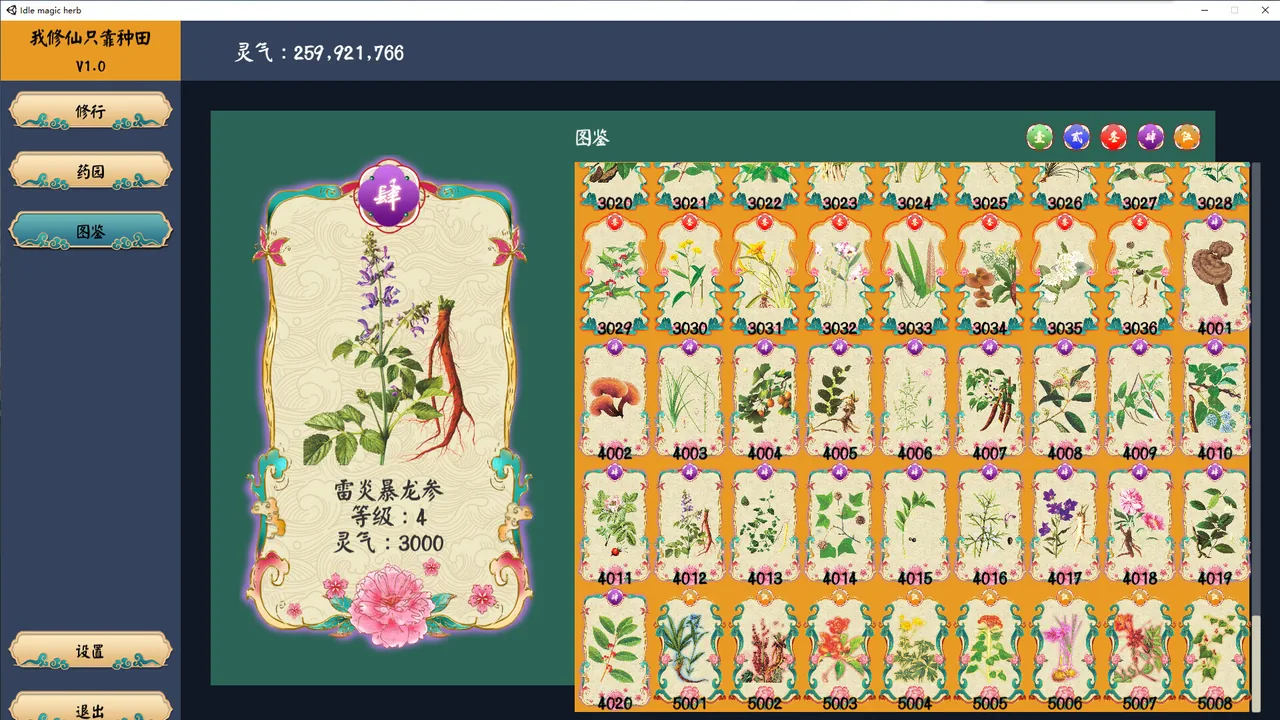
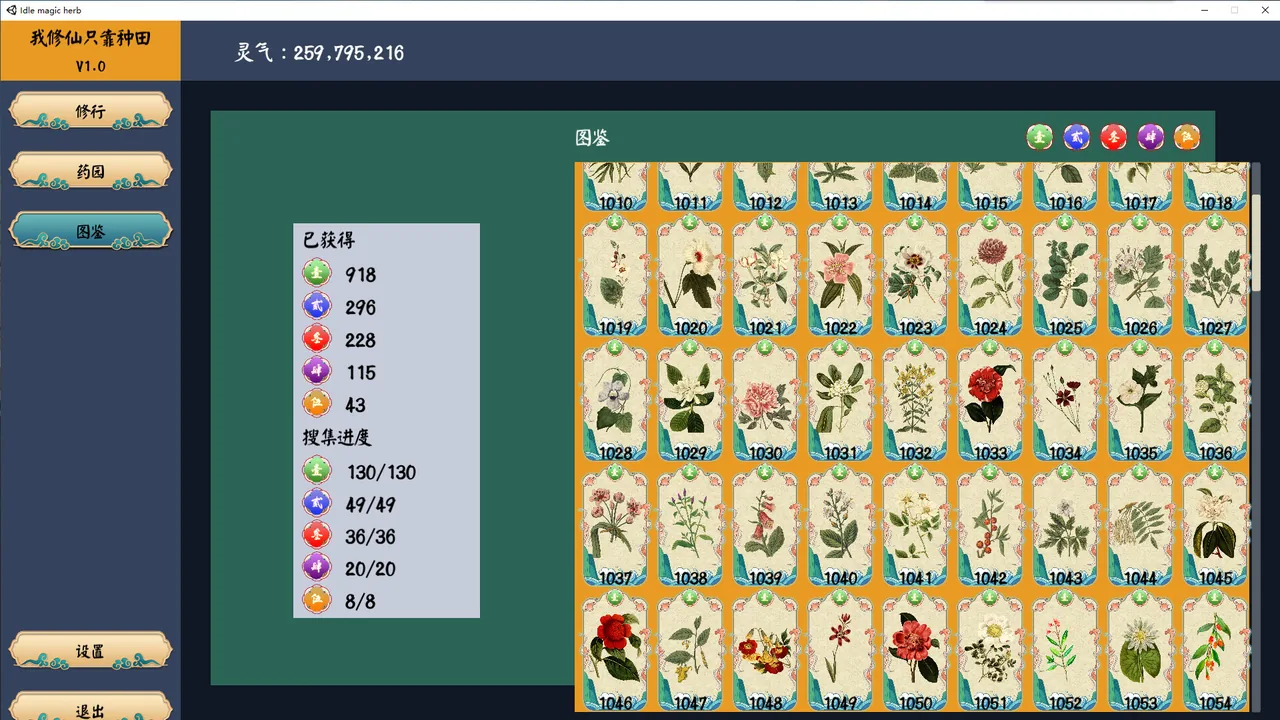
The best thing in Idle magic herb, by a wide margin, is its card art. The herb and monster compendium runs to well over a thousand entries, each rendered as a painterly botanical illustration or a stylised creature portrait, and it's the one element of the game that draws consistent, specific praise even from otherwise harsh reviews. The problem is that it does nothing. Cards can be viewed and counted, and that's the entire interaction — they can't be spent, combined, equipped or used to unlock anything else. Reviewers who dug into the numbers point out that hundreds of the plant entries share an identical in-game effect and differ only in the experience value they grant, meaning the compendium's apparent scale is mostly cosmetic variety layered over a handful of underlying mechanical templates. A dedicated illustrator did real work here, and the game built around it doesn't give that work anywhere to matter.
A five-week-old sibling, and a launch week that never continued
Idle magic herb isn't its developer's only 2022 release. Five weeks earlier, the same studio put out Idle Factory, a structurally similar idle game, and at least one reviewer of Idle magic herb frames the newer game explicitly as a minor variation on the older one rather than a fresh design — smaller in file size, with the background music stripped out, and only a modest improvement in their estimation. Steam's own patch history supports the picture of a short, single-developer production cycle: every fix on record — a spell-level overflow bug, a drag-and-drop glitch, a display error — is dated between 1 and 6 September 2022, the week of launch, with nothing since. Reviewers asking whether more content is coming were, as far as the public record shows, never answered.
The global achievement data is the most useful independent check on how much game is actually here. Idle magic herb ships 75 achievements, and the completion curve runs from 66% on the easiest down to roughly 16-19% on the hardest — a gentle slope rather than the steep cliff you'd expect from a game with real difficulty walls or deep content gating. Several Simplified Chinese reviews say outright that they earned every achievement within a single idle session or over the course of a day, and that curve doesn't contradict them.
Final verdict
Idle magic herb has one genuinely good idea in it — the compendium art — and builds almost nothing around it. The farming loop automates itself immediately, the combat system is a spectator sport, the one interactive decision never changes its own odds, and the developer moved on within a week of shipping. Its 37 lifetime reviews, 31 of them in Simplified Chinese, sit at Mostly Negative for exactly the reasons above, and reading them directly rather than relying on the tiny four-review English sample makes the pattern unmistakable: people bought it for the herb cards and found there wasn't a game attached to them. At full price it's hard to recommend; at the two-to-four-dollar sale price several reviewers mention paying, it's a short, undemanding curiosity and nothing more.
Pros and cons
Pros
- The herb and monster compendium uses genuinely detailed, painterly botanical illustrations across well over a thousand catalogued entries, and it's the one part of the game reviewers consistently single out as attractive
- The file size and interface are minimal enough that it runs on almost anything and never asks for more attention than a click
- Cheap at a deep discount (several reviewers mention paying the equivalent of two to four New Zealand dollars) as undemanding filler
- No in-game purchases, ads or timers layered on top of the base loop
Cons
- The core loop reduces to buying soil, water and fertiliser, watching a progress bar fill, and clicking one "breakthrough" button whose success chance reviewers report as a flat, never-improving 40% regardless of preparation
- The compendium that reviewers praise visually is purely decorative — cards can be viewed but not used, crafted with or spent, which multiple reviewers call out as wasted potential given the art on offer
- Steam's own patch history shows every recorded fix landing within the first week after the 1 September 2022 launch, matching reviewers' complaints that no further content ever arrived
- Hundreds of the compendium's plant and monster entries share identical effects and differ only in a numeric experience value, so the collection has far less depth than its size suggests
- The developer released a near-identical idle template, Idle Factory, five weeks earlier under the same studio name, and at least one reviewer of Idle magic herb explicitly frames it as a minor iteration on that same game rather than a new design
- Several reviewers say every achievement is earned within a single idle session or day, and the global achievement curve — a fairly gentle slope from 66% down to roughly 16-19% rather than a cliff — is consistent with a short, largely completable game rather than a deep one
Screenshots
-
Idle magic herbImage: okyakusama via Steam -
Idle magic herbImage: okyakusama via Steam -
Idle magic herbImage: okyakusama via Steam -
How the review scores each part of the gameWanderer Editorial -
The game at a glanceWanderer Editorial -
The short versionWanderer Editorial