
Game review
Aetherdrifter
7.2 / 10
- Developer
- SkyAnvil
- Publisher
- SkyAnvil
- Released
- 31 July 2026
- Platforms
- PC
- Genre
- Idle Incremental RPG
A spreadsheet with a soul
Aetherdrifter is an Early Access idle RPG from solo developer SkyAnvil, and it's easily one of the more structurally ambitious entries in the genre to come out of this sweep. The pitch, direct from the store page, places it explicitly in "the Melvor / OSRS lineage" — built to reward either a glance or a long session — but reframes the usual personal-inventory idle-RPG shape around a single conceit: you're not building a hero, you're rebuilding a derelict ship-mind called the Core, climbing from a Scout Skiff to a "world-sized Ark" a thousand years after a galaxy-wide communications collapse called the Severance. That framing carries through every system rather than sitting as flavour text bolted onto a generic incremental loop, and it's the single biggest thing setting this apart from the crowded idle-RPG shelf.
Eleven skills, one ship
The developer's stated structure is eleven interlocking skills split across a gather → refine → fabricate → fight → reclaim pipeline, and the game's own skill sidebar confirms all eleven directly: Mining and Salvaging under Gather, Reactor Burn, Refining, Reclamation, Forging, and Fabrication under Process, Hydroponics under Bay, Cartography under Support, and Warfare under Combat, plus Aetherweaving as an eleventh listed skill. Each skill screen follows a familiar Melvor-style layout — tiered resource nodes gated by level, with XP and time-per-action clearly listed — but the resources feed genuinely into each other rather than sitting in isolated silos: ore becomes alloy, alloy becomes components, components become ship parts.
That ship is the game's actual character sheet. The Ship screen shows a real fitting interface — weapon, plating, shield, reactor, drive, and utility slots against a mass-and-power budget (148/520 mass, 56/70 power in the captured screenshot) rather than an abstract stat sum, with a visible next-chassis unlock (Frigate to Cruiser, in this case, gated behind a specific material list and total level requirement). Combat itself plays out as ship-vs-sector encounters against named factions — Ashfleet Scavengers, Ironclad Raiders, Choir Zealots, and further factions gated by level, each with a stated elemental weakness across a kinetic/ballistic/aetheric damage triangle, escalating toward a marked boss encounter. It's a genuinely different skeleton for the genre to hang combat on, and it holds together mechanically rather than just reading as a reskin.
Story in the margins, not just numbers
Most idle RPGs treat narrative as decoration if they bother with it at all. Aetherdrifter runs a persistent "Adventure Log" alongside the skill grind, and the captured screenshot shows it delivering real, written narrative beats — a recurring character called the Hermit offering a found object with a choice attached, ambient environmental text about drifting cargo tags and a child's drawing found in a panel, small worldbuilding fragments rather than generic flavour text. The store page frames this as building toward a proper three-way-choice ending with New Game+ replayability, which can't be verified without reaching the endgame, but what's directly visible backs up the claim that this isn't lore-noise bolted on after the fact — it's woven into the same panel as the grind, one choice at a time.
What Early Access means here
Three Steam reviews are on record at time of writing, all positive, and notably backed by serious logged playtime — one reviewer at roughly 148 hours, another at roughly 525 hours, which for a game released in Early Access only weeks earlier is a strong signal of genuine hook, even from a very small sample. One reviewer specifically credits the solo developer as "quite responsive on discord to any feedback as they work through early bugs and balancing" — that's a single account of both the bugs and the responsiveness, not independently verified, but worth surfacing since it's consistent with what "Early Access" on a solo-developed idle RPG typically implies: real content, with rough edges still being sanded down. No negative reviews are on record to weigh against that read, though with only three data points that absence shouldn't be mistaken for a guarantee of a smooth experience.
Performance and stability specifically can't be assessed from documentation alone — that's exactly the kind of claim that needs sustained hands-on play to verify honestly, and this write-up doesn't claim to have logged that time. The lower performance score here reflects that gap and the Early Access status itself, not a confirmed problem.
Reading a dense screen
Worth flagging separately: this is a busy interface even by idle-RPG standards, and the screenshots make that plain. The skill screens alone juggle a header bar of total level, credits, achievements, cargo count, faction standing, relics, and active upgrades all at once, and the cargo-hold sidebar on the right runs an independently scrollable inventory across seven material categories while a narrative log updates in its own panel underneath. The store page explicitly promises the same dense layout scales down to "one-handed on a phone" from the same save, which would be a genuinely useful bit of design if it holds up, though that mobile-layout claim isn't something the desktop screenshots on hand can confirm either way. On desktop specifically, the density reads as organised rather than cluttered — distinct panels with clear headers rather than one wall of numbers — which is why it scores reasonably rather than being marked down as overwhelming, but newcomers to this style of idle game should expect a real onboarding curve before all of it clicks into place.
Where it lands
Aetherdrifter is doing more interesting design work than most idle RPGs bother with — a ship-as-character conceit that actually reshapes combat and progression rather than just re-skinning them, eleven skills that feed a single coherent economy instead of sitting in isolation, and an honest attempt at real narrative delivered in small doses alongside the grind. It's not finished — Early Access, a thin review base, and an unverified stability picture all come with that territory — but the foundation on display, and the unusually long playtimes from its earliest reviewers, both point toward a genuinely ambitious idle RPG rather than another disposable clicker. Worth watching closely as it develops, and a reasonable buy right now for anyone drawn to the Melvor school of idle game who wants a fresh setting to sink into.
Screenshots
-
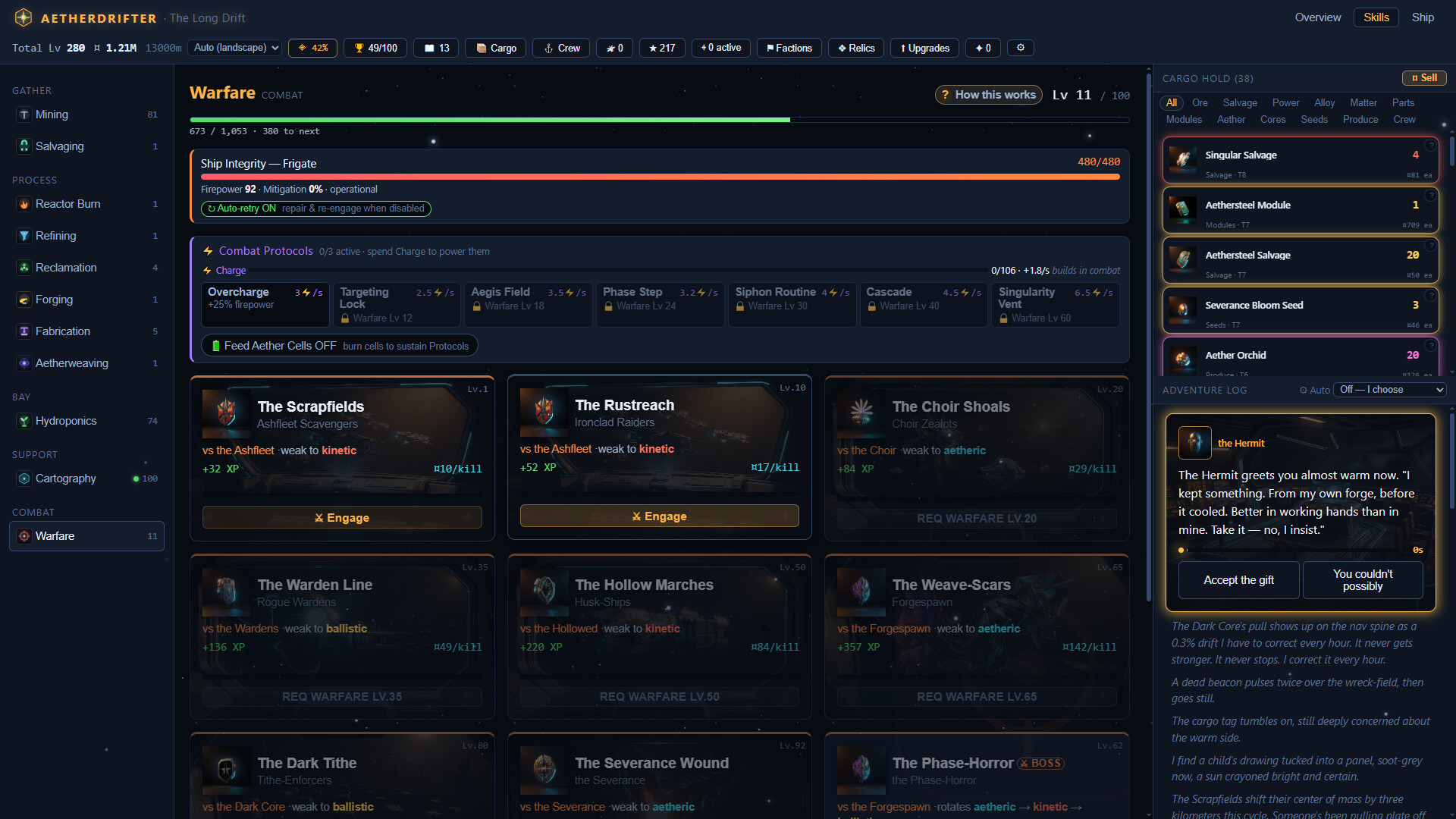
Combat is framed as ship-vs-sector encounters against named factions, each with a stated elemental weakness and an XP/credit payout per kill.Steam store page -
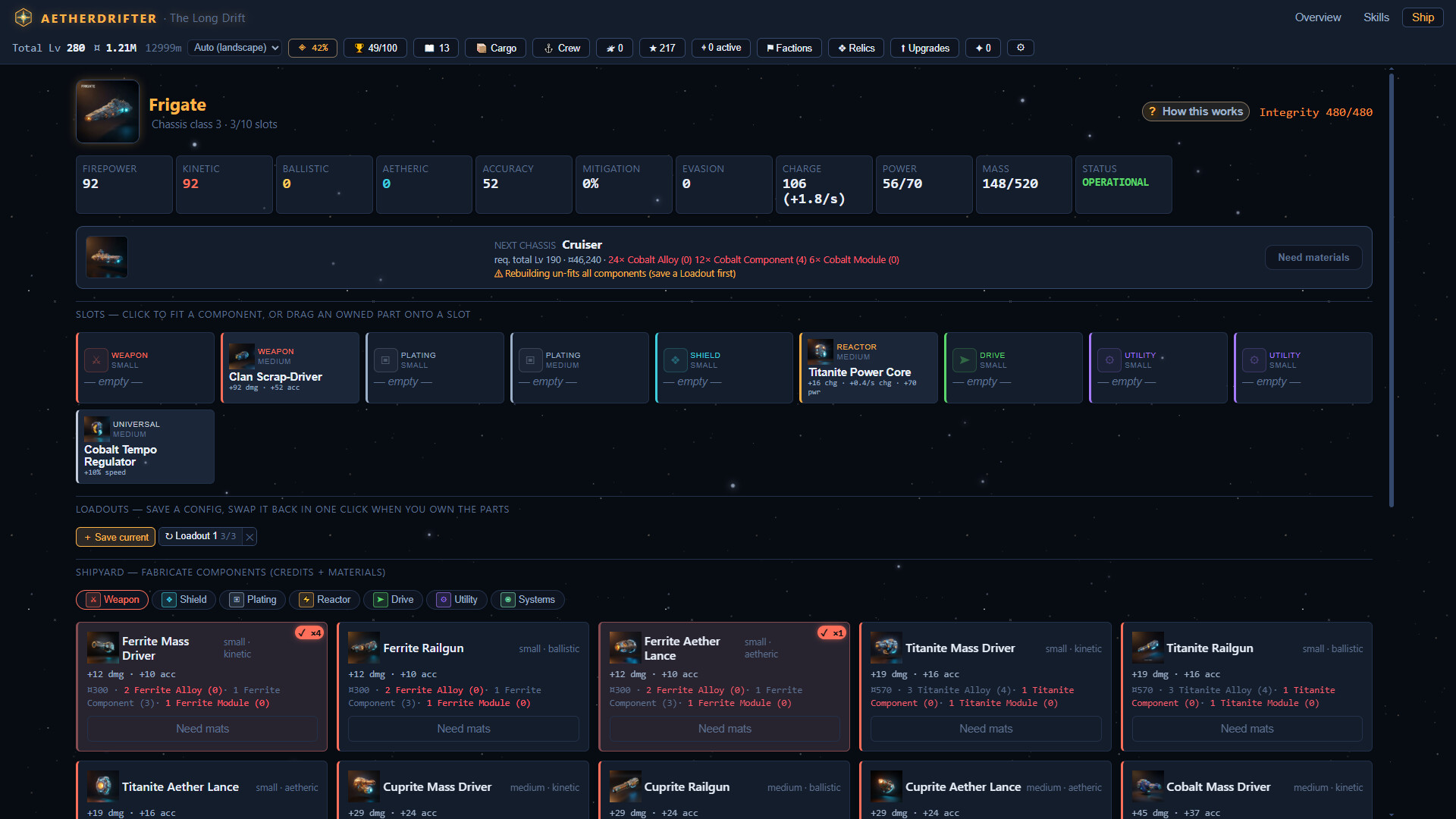
The player's ship, not a personal character, is the thing being built — with a real mass-and-power budget across six component slot types and a visible next-chassis upgrade path.Steam store page -
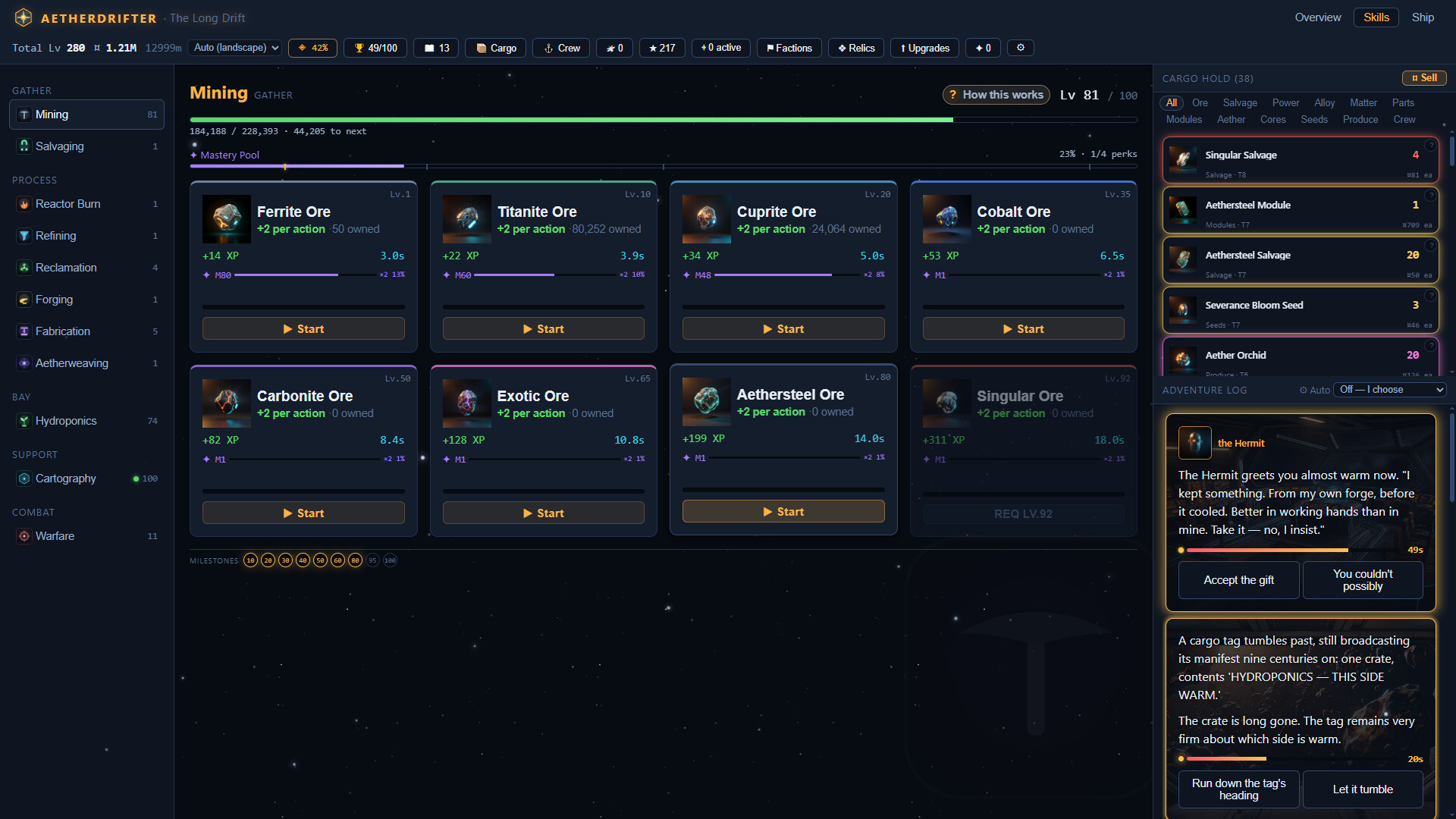
The sidebar confirms all eleven interlocking skills the store page describes, while a running Adventure Log delivers ambient narrative text alongside the numbers.Steam store page