
Game review
Idle Reincarnator
6.1 / 10
- Developer
- RyuseGames
- Publisher
- RyuseGames
- Released
- 18 June 2025
- Platforms
- PC
- Genre
- Incremental Reincarnation RPG
Idle Reincarnator is an incremental prestige game from solo-adjacent developer RyuseGames, first released on mobile before arriving on Steam on 18 June 2025. Players work jobs, train skills, explore dangerous areas and slowly climb the social ladder of a fantasy kingdom called Eldoria, all while racing against an in-game lifespan that eventually forces death and reincarnation — carrying forward permanent bonuses for the next life. It sits squarely in the "loop incremental" lineage established by the free browser game Progress Knight, a comparison drawn by an overwhelming share of its 89 Steam reviews, and its Mostly Positive reception reflects a genuinely well-liked game wrapped around one deeply contentious piece of false advertising: its own title.
Not actually idle, and reviewers are not shy about saying so
By far the single most common complaint across both positive and negative reviews is that Idle Reincarnator is not, in any meaningful sense, an idle game. "Despite the name, it is NOT an idle game. It's a time management sim," reads one of the most-upvoted negative reviews, and dozens of others echo the same correction almost word for word: "there's absolutely nothing idle about this game," "literally nothing idle about it," "not really IDLE." The consistent explanation is that real automation — the systems that let a player walk away and return to genuine progress — doesn't unlock until deep into a run, with reviewers citing anywhere from "40+ hours of active play" to roughly three-quarters of a full playthrough before the game starts to resemble its genre label. Several reviewers who initially left negative reviews over this issue later revised their opinion once automation kicked in, but the friction is real and clearly affects new players' first impressions disproportionately, given how many mention bouncing off the early hours specifically because of it.
A dense, Progress Knight-inspired prestige loop that rewards patience
Strip away the misleading genre tag, and what's underneath draws consistent praise. Reviewers repeatedly call it a meaningful expansion on the Progress Knight formula, with "quite a bit more depth," "more decision points," and "tons of hidden content and rewards for experimenting." The rebirth/reincarnation structure — dying at the end of a lifespan and starting over with permanent bonuses — is compared favourably to genre peers like Groundhog Life and Increlution, and several reviewers specifically praise the fact that the game has a defined ending: "values don't just go into infinity," as one put it, a deliberate design choice that stands out in a genre often built around infinite number growth. The exploration system layers in real stakes too, with area-specific death chances that force some genuine risk assessment rather than pure numbers-go-up passivity.
Exploration deaths and jank take a toll
That same exploration risk is also the game's most-cited design misstep. Multiple reviewers describe losing hours of progress to exploration deaths that felt unfair or poorly telegraphed, including one detailed account of losing 17 hours of progress at a major mid-game choice point despite an in-game warning. Beyond the death mechanic, a cluster of reviews — including several recommending the game overall — flag persistent jank: clicks that don't register, "new" notification badges that never clear, and a UI that multiple reviewers describe as feeling like an under-adapted mobile interface, with one specifically noting "the UI does not use screen on PC with lot of wasted space." The developer is described by several long-time players as active and responsive on Discord, with bugs "pretty quick" to get fixed, though the UI complaints persist across reviews spanning the game's full year-plus on Steam.
AI-generated art draws a handful of pointed complaints
A smaller but notable thread of criticism concerns the use of AI-generated artwork in some of the game's illustrated job and exploration panels. "I'd enjoy it if not for the generative AI," reads one negative review, while another questions whether the "AI art" adds anything and speculates the game began as a mobile project reusing stock assets. This isn't a majority complaint — most reviews don't mention it at all — but it's specific enough and repeated enough across independent reviews to note as a real point of friction for a subset of the audience, rather than dismiss as an isolated objection.
Mobile roots show, including one frustrating gap
Idle Reincarnator started life as a mobile game, and that history surfaces in both good and bad ways. On the positive side, reviewers who logged 80 or 90-plus hours on mobile before buying the Steam version generally describe the game as content-rich for its roughly five-dollar price, with several calling it worth every penny. On the negative side, mobile progress doesn't carry over: multiple reviewers note that mobile saves can't be imported into the Steam release, a limitation one review attributes to the developer reworking the early game's balance in ways that made the two versions' save data incompatible. The writing itself draws mixed marks too — one reviewer bluntly described it as reading "like someone still trying to learn English," while others call the lore and lifetime-spanning story genuinely engaging once it gets going, particularly the way small narrative beats are doled out as milestone rewards rather than dumped all at once.
Verdict
Idle Reincarnator earns its Mostly Positive rating on the strength of a genuinely well-built prestige loop, a defined endgame that respects players' time, and content dense enough that many reviewers list 40, 50, even 90-plus hours played. What keeps it from scoring higher is a first impression actively worsened by its own marketing: a game billed as an idler that, by its own players' overwhelming consensus, demands hours of active micromanagement before it becomes one, layered with UI jank and an exploration-death mechanic that has cost more than one player their entire run. For genre fans willing to push through a rough opening stretch, the depth underneath is real; for anyone shopping specifically for a walk-away idler, the title is a trap worth knowing about before buying.
Screenshots
-
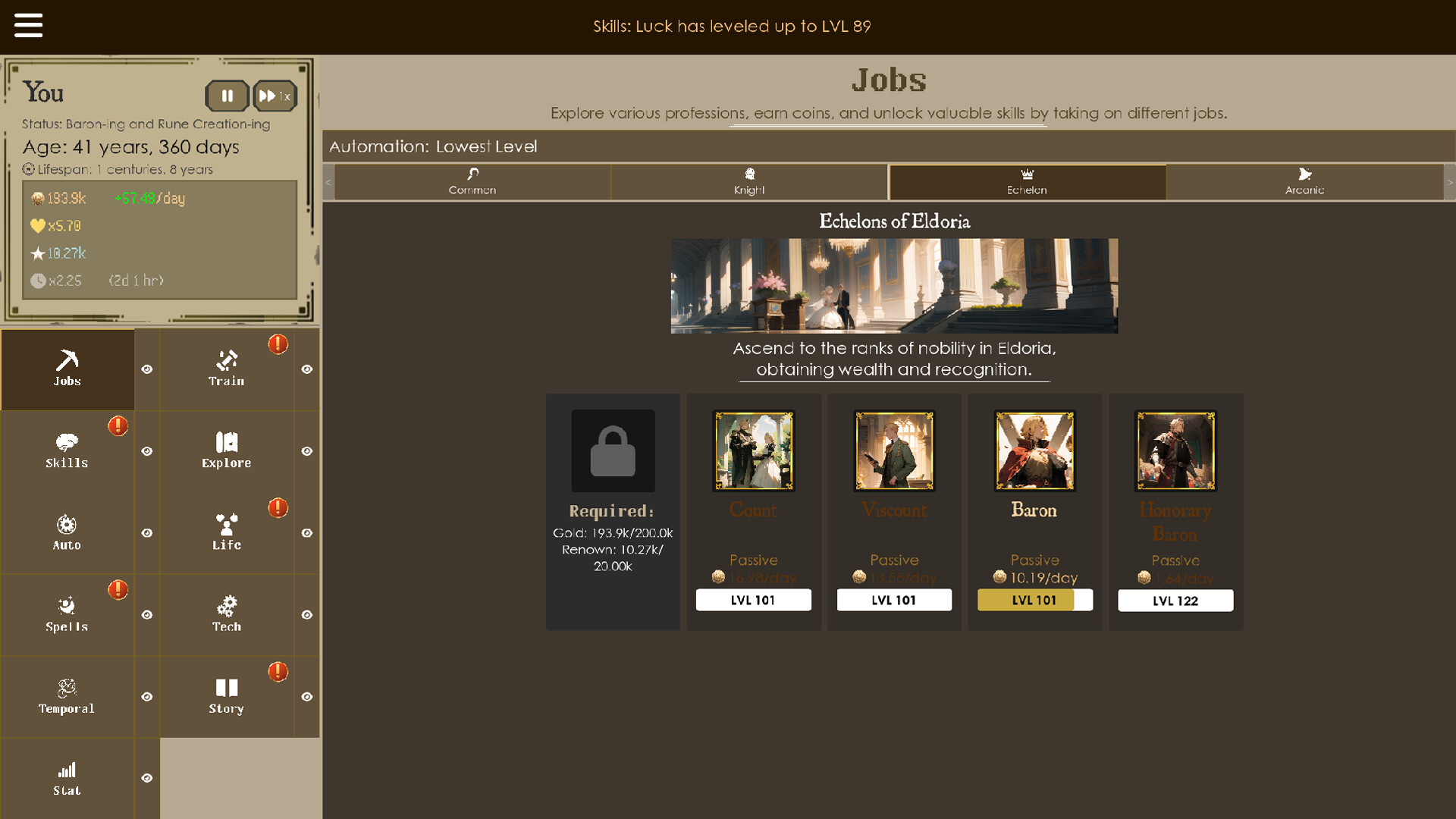
The interface packs in jobs, skills, automation, spells and a temporal/prestige system, all gated behind age and lifespan limits that force a rebirth.Image: RyuseGames via Steam -
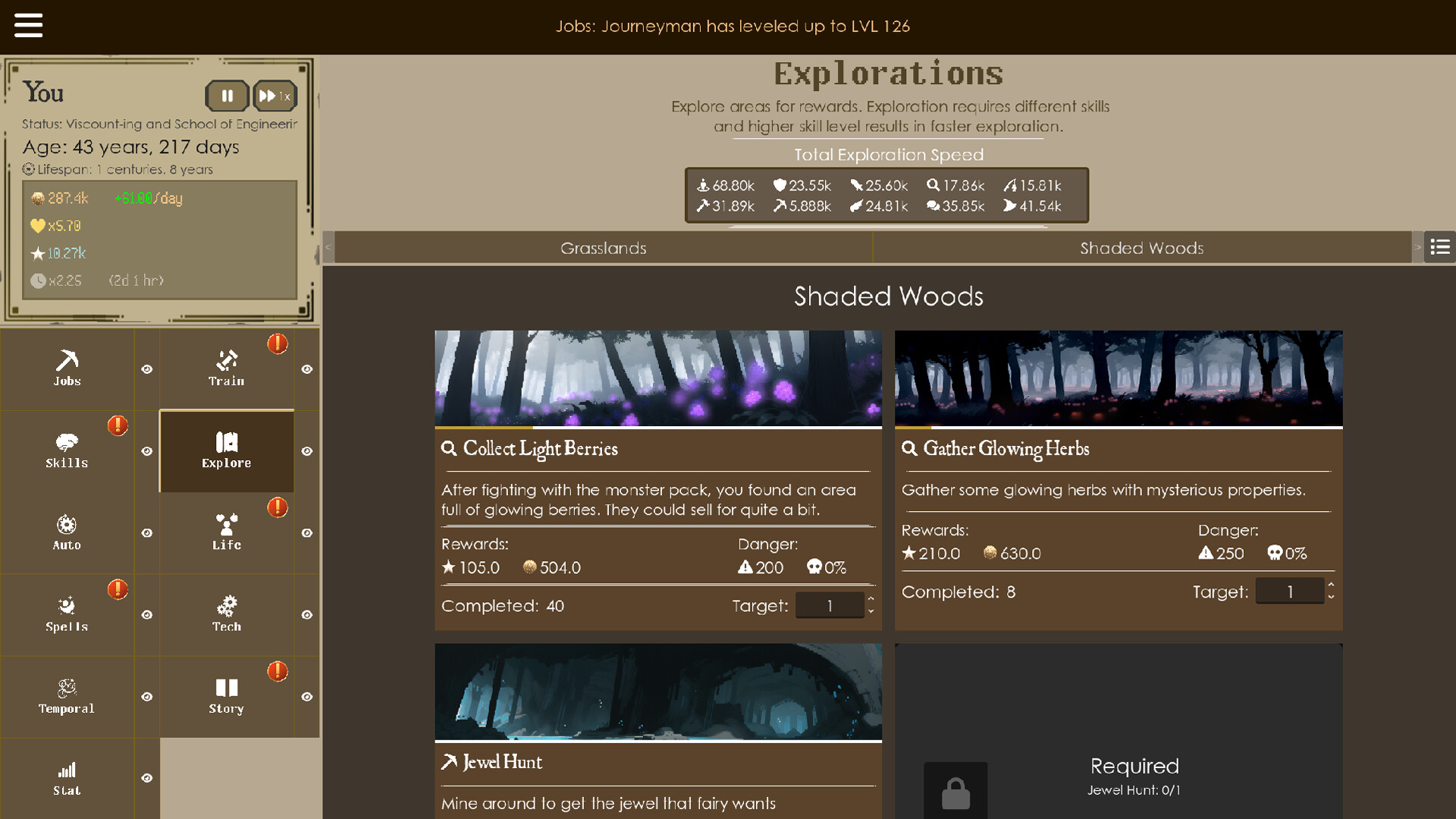
Exploration missions carry a stated death chance; several reviewers describe losing hours of unsaved progress when a supposedly safe run killed their character anyway.Image: RyuseGames via Steam -

Companions, lifestyle choices and a happiness stat sit alongside the job and exploration systems, adding to a genuinely dense web of interlocking mechanics.Image: RyuseGames via Steam