
Game review
Alnico Smithery
6.5 / 10
- Developer
- Pinapl
- Publisher
- Pinapl
- Released
- 25 October 2024
- Platforms
- Windows
- Genre
- Physics-based forging simulator
- Monetisation
- One-time purchase, no in-game store or additional currency purchases
- Players
- Single-player only
The short version
Alnico Smithery hands you your grandfather's abandoned forge and a genuinely deep physics sandbox: mine twelve base metals, smelt them into over a hundred named alloys with real metallurgical ratios behind them, and hand-craft tools and oddities through more than forty recipes, all with no penalty for making a mess or ruining a batch. Reviewers who compare it favourably to Potion Craft describe exactly that low-stakes, experiment-freely appeal, and a small recurring detail — named spiders living in the workshop that players go out of their way not to kill — has become an unusually specific, repeated point of affection across the review sample. Set against that charm is the honest reality of a nearly two-year-old Early Access release: real, still-reported crash bugs, a documented set of Steam achievements that sit at 0% completion, and a support cadence that went quiet for roughly seven months in 2025 before picking back up.
Biggest strengths
- The physics-based crafting loop — mining, smelting, pouring, hammering — draws consistent praise for its level of tactile detail, with one reviewer who has tried "a fair amount of blacksmithing games" calling this one clearly above the genre average
- Alloy experimentation is grounded in real metallurgical ratios, and multiple reviewers specifically say they learned something about real-world metallurgy while playing, a rare and genuine point of distinction from more abstract crafting sims
- A cast of small, named spiders living in the workshop has become an unusually specific and consistent point of affection across the review sample, with players going out of their way to avoid swinging hot metal through them
Biggest weaknesses
- Multiple reviewers report game crashes, including at least one describing a crash on a fresh tutorial start "with bugs from a year ago," suggesting some issues have persisted across a long stretch of the game's Early Access life rather than being newly introduced
- Steam's own achievement data confirms a specific, documented problem: several tracked achievements sit at exactly 0.0% to 0.1% completion, consistent with player reports that some achievements are currently unobtainable rather than merely difficult
- Support went quiet for roughly seven months between December 2024 and July 2025, a gap at least one reviewer flagged directly in an edited review before the developer resumed posting substantive updates that summer and again toward the end of 2025
Who it's for: Fans of low-stakes, physics-based crafting sandboxes like Potion Craft who want a relaxing, consequence-free loop to tinker in, and who are comfortable buying into an Early Access game that's still finding its final shape after nearly two years of development.
Our recommendation: Worth buying for the core forging loop and its genuine charm, provided Early Access volatility and occasional crashes don't bother you. Check the most recent patch notes before buying if a fully finished, bug-free experience matters more to you than getting in early.
6.5 / 10
Alnico Smithery's pitch is disarmingly simple: your grandfather's forge sits abandoned, and it's your job to bring it back — mining ore, smelting it into one of over a hundred named alloys, and hammering the results into tools, trinkets, and whatever else a customer happens to request. What that simple pitch is built on, according to a review sample that repeatedly reaches for the same comparison, is something closer to Potion Craft's low-stakes experimentation than a typical crafting-management sim, and it's landed well enough to hold a Very Positive rating nearly two years into an Early Access run that, by the developer's own recent posts, still has real distance left to travel.
A forge built on real chemistry, not abstraction
The detail reviewers keep returning to is that Alnico Smithery's alloys aren't arbitrary game systems dressed up as metallurgy — they're built on real ratios. "The level of detail here is amazing," one reviewer writes, having tried "a fair amount of blacksmithing games" and finding most of them "average at absolute best" by comparison. Another puts it more personally: "I love that the alloys are based on real life ratios... and that I actually learn a little bit about metallurgy as I go." That's a genuine point of distinction in a genre that usually treats crafting systems as pure game logic, and it's clearly part of why longer-session reviewers — several logging past 5,000 minutes, one past 8,000 — keep coming back rather than treating the game as a one-and-done novelty.
The spiders, specifically
An oddly specific detail recurs often enough across the review sample to be worth reporting on its own terms: small spiders live in the workshop, they have names, and a meaningful number of reviewers describe actively trying not to kill them while swinging hot metal around. "I try as hard as I can not to kill the spiders, but sometimes you accidentally swing a red-hot bar of metal through them," one reviewer writes, adding "I let them thrive." Another jokes about having "finally harnessed the true power of spiders as a metal." It's a small, low-cost detail for a solo or small studio to include, and the fact that it's become a genuine, repeated talking point says something real about how much care and personality reviewers feel is baked into the rest of the game.
No consequences, by design, and reviewers say it works
A recurring structural point in the positive reviews is the complete absence of punishment for failure. Materials are effectively unlimited, ruined batches cost nothing beyond the time spent, and several reviewers credit this directly for the game's relaxed feel. "There is no pressure whatsoever. There are no time limits and if you mess up an alloy there will always be more materials," one writes, calling it "perfect for messing around with all the game has to offer." This is a deliberate design choice rather than an oversight, and it's consistent with how the game is marketed and how its fans describe playing it — as a stress-free tinkering space rather than a game with a win condition to optimise toward.
Real bugs, and a specific, documented achievement problem
Set against that goodwill are genuine technical complaints that this review can partially verify independently. Multiple reviewers report crashes, including one who describes a crash "starting a new game with the tutorial" caused by "bugs from a year ago" — language suggesting some issues have persisted across a long stretch of the game's development rather than being newly introduced. More specifically, one reviewer opens their account with a direct disclaimer: "this game contains unobtainable Steam achievements." Steam's own achievement data backs this up precisely — three separate achievements sit at exactly 0.0% to 0.1% completion, a pattern far more consistent with a broken unlock condition than simply very high difficulty, since a genuinely hard-but-achievable goal would still show some nonzero completion rate across tens of thousands of players.
A real quiet stretch, now resumed
One reviewer's account, updated after the fact, offers the clearest single data point on the game's support history: "since I wrote this review, not a single update dropped. Last update was in December of 2024." This review can confirm that gap happened and roughly how long it lasted using the developer's own public record: after a dense run of Early Access patches through December 2024, the events feed goes quiet until a "State of the Game" post and a substantial version 3.30 update in July 2025 — a real stretch of about seven months. Importantly, that's not where the story ends: the feed shows continued, substantive activity afterward, including a one-year anniversary roadmap post that October and a rebalancing patch in December 2025. The honest read is that both critical and defensive reviewers have a point — there was a real, extended quiet period, and it did eventually end with the developer visibly still working on the game rather than having walked away for good.
Final verdict
Alnico Smithery is a genuinely charming, well-loved physics sandbox that earns its comparisons to Potion Craft honestly, built on real metallurgical detail and small, specific touches — like a workshop full of named spiders — that reviewers keep singling out unprompted. It's also, honestly, still an Early Access game nearly two years into development, with real crash reports, a documented unobtainable-achievement bug, and a support history that includes a genuine seven-month quiet stretch before picking back up. Buy it for the core forging loop, which is good enough on its own to justify the price, but go in with Early Access expectations rather than assuming a finished, bug-free product.
Pros and cons
Pros
- The physics-based crafting loop — mining, smelting, pouring, hammering — draws consistent praise for its level of tactile detail, with one reviewer who has tried "a fair amount of blacksmithing games" calling this one clearly above the genre average
- Alloy experimentation is grounded in real metallurgical ratios, and multiple reviewers specifically say they learned something about real-world metallurgy while playing, a rare and genuine point of distinction from more abstract crafting sims
- A cast of small, named spiders living in the workshop has become an unusually specific and consistent point of affection across the review sample, with players going out of their way to avoid swinging hot metal through them
- No real penalty exists for ruined batches or workshop chaos, letting players embrace experimentation freely rather than optimise defensively, a design choice several reviewers credit directly for the game's relaxing feel
- Long-session reviewers report genuinely large amounts of playtime, including accounts past 5,000 and 8,000 minutes, still recommending the game as a satisfying, low-stakes way to unwind
Cons
- Multiple reviewers report game crashes, including at least one describing a crash on a fresh tutorial start "with bugs from a year ago," suggesting some issues have persisted across a long stretch of the game's Early Access life rather than being newly introduced
- Steam's own achievement data confirms a specific, documented problem: several tracked achievements sit at exactly 0.0% to 0.1% completion, consistent with player reports that some achievements are currently unobtainable rather than merely difficult
- Support went quiet for roughly seven months between December 2024 and July 2025, a gap at least one reviewer flagged directly in an edited review before the developer resumed posting substantive updates that summer and again toward the end of 2025
- At least one reviewer reports the game runs poorly on average consumer hardware as of late 2025, requiring notably better-than-entry-level specifications to perform well
- A vocal minority describes the core crafting loop as repetitive once its systems are understood, with one reviewer stating that after the first hour "you've pretty much done everything" and later variety is limited mostly to different end results rather than a meaningfully different process
Screenshots
-

Alnico SmitheryImage: Pinapl via Steam -

Alnico SmitheryImage: Pinapl via Steam -

Alnico SmitheryImage: Pinapl via Steam -
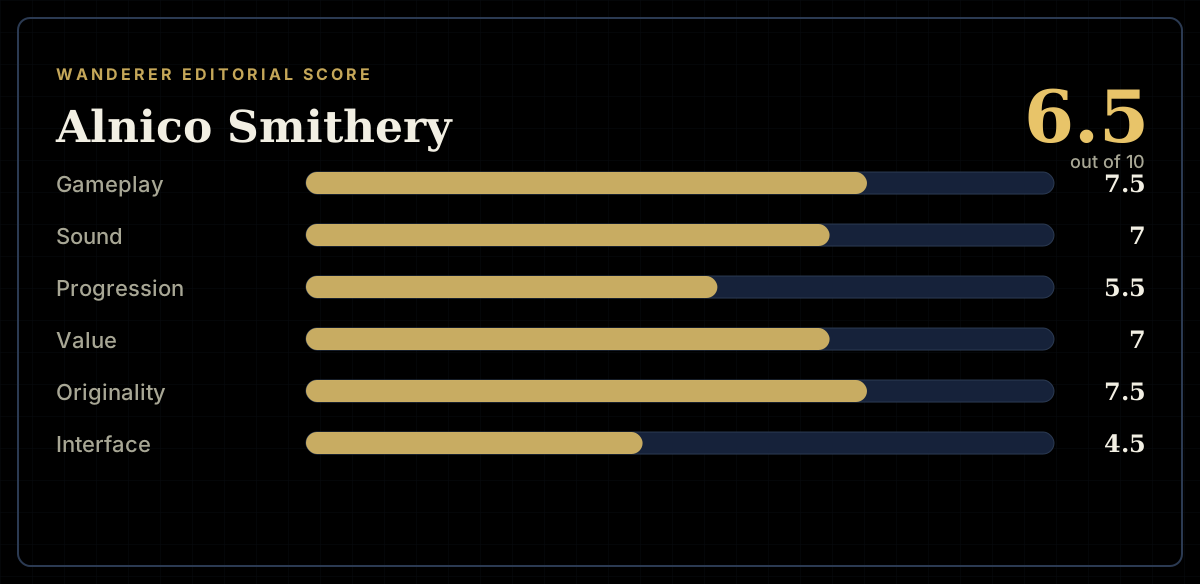
How the review scores each part of the gameWanderer Editorial -
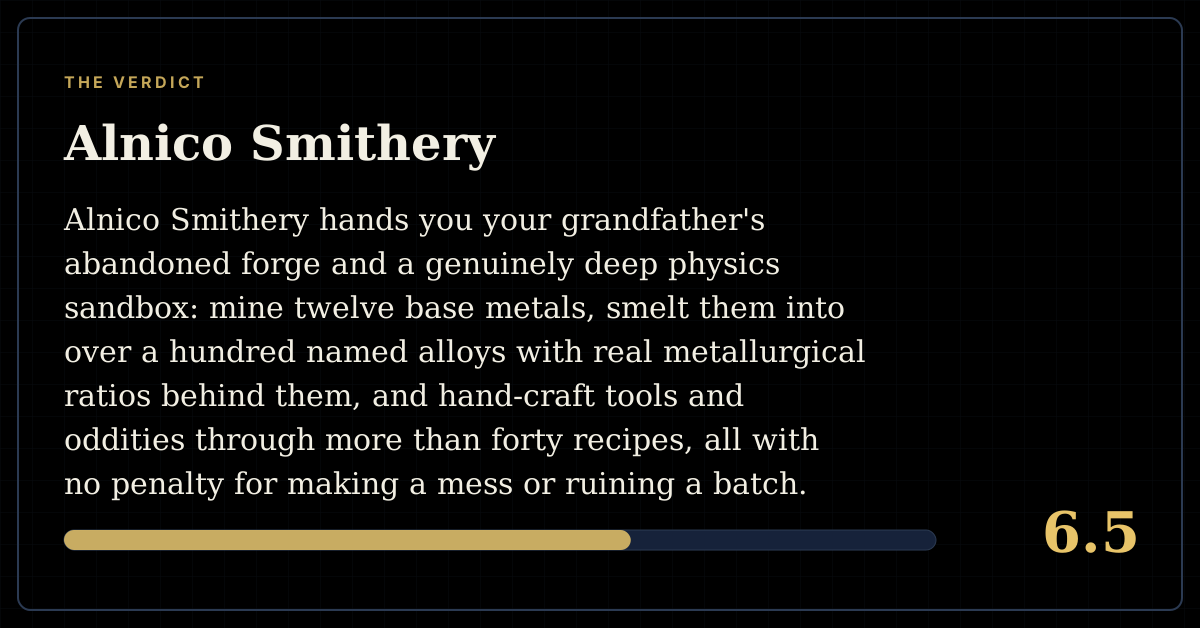
The short versionWanderer Editorial