
Game review
Age of History 3
6 / 10
- Developer
- Łukasz Jakowski
- Publisher
- Łukasz Jakowski Games
- Released
- 23 October 2024
- Platforms
- Windows, macOS
- Genre
- Grand strategy map-painter
- Monetisation
- One-time purchase, with a free map-size DLC and paid cosmetic scenario packs available
- Players
- Single-player, with peer-to-peer multiplayer added in beta after launch
The short version
Age of History 3 lets one player build and defend a civilization across a scenario range spanning the ancient world to the far future, condensing the scope of a Paradox-style grand strategy game into something built almost entirely by a single developer. Reviewers who came in as fans of the genre describe a real, distinctive achievement — real-time combat, a genuine technology tree, and dozens of playable scenarios covering more of history in one package than most competitors attempt. Set against that achievement is a specific, well-documented complaint about AI-generated leader portraits, confirmed directly by the store page's own AI Generated Content Disclosure, alongside a real and detailed set of feature gaps compared to the developer's own previous game. Several reviewers describe the developer as having abandoned the project, but this review's own check of the game's update history directly contradicts that specific claim — patches and new systems have continued arriving at a steady pace well into 2026, even if progress on some long-requested features has been slower than fans would like.
Biggest strengths
- The scenario range is genuinely unusual for the genre, letting players start a campaign anywhere from the ancient world through to a speculative far future, which multiple reviewers specifically praise as offering more historical breadth than most direct competitors
- The shift to real-time combat and a genuine technology tree draws consistent praise from reviewers who played the developer's earlier, turn-based predecessor, several describing it as a meaningful evolution rather than a lateral change
- At its price, value is repeatedly and specifically praised, with reviewers comparing the scope and content on offer favourably against significantly more expensive genre entries from larger studios
Biggest weaknesses
- AI-generated leader portraits draw widespread, specific criticism, and this review confirms the store page carries an explicit AI Generated Content Disclosure, directly substantiating reviewer complaints rather than leaving the claim unverified
- A detailed cluster of reviewers lists specific missing features relative to the developer's previous game, including weaker vassal management, limited trade systems, and the absence of coalition-forming diplomacy, several explicitly requesting these be added back
- Multiple reviewers describe the mid-to-late game as becoming repetitive "map-painting" busywork, with one specifically criticising the lack of a way to mass-manage province upgrades without extensive manual clicking
Who it's for: Grand strategy fans who want an accessible, real-time alternative to titles like Hearts of Iron or Europa Universalis, and who are specifically drawn to playing across an unusually wide span of historical eras in one game. Less suited to players expecting the depth of trade, vassal, and diplomatic systems that genre veterans take for granted.
Our recommendation: A genuinely strong value at its price for grand strategy fans willing to accept a simplified, still-evolving feature set in exchange for breadth of scenarios and real-time pacing. Go in aware of the AI-generated portrait issue if that specifically bothers you, and temper expectations around trade, vassal, and diplomacy systems relative to the genre's biggest names.
6 / 10
Age of History 3 is a genuinely ambitious proposition for a solo developer: a grand strategy game letting one player pick any of dozens of civilizations, starting anywhere from the ancient world to a speculative far future, and manage technology, armies, and diplomacy in real time. It's the third entry in a series with real history and a genuinely devoted fanbase behind it, and this review's sample reflects exactly that mix — reviewers who've sunk hundreds of hours into the earlier games arrive with high expectations, strong opinions about what's missing, and, in a meaningful number of cases, real frustration about a specific and confirmable issue with the game's presentation.
Real scope, built by one person
The praise in this sample isn't vague enthusiasm — it's specific about what makes the game's scale unusual. "The one man army Łukasz basically made EU4 lite... all by himself," one reviewer writes, comparing the shift from the previous game's turn-based structure to real-time combat as a genuine evolution rather than a lateral move. Another frames the target audience precisely: "for fans of Grand Strategy and map-painting who prefer a simplified, accessible scale over the complexity of titles like Crusader Kings or Hearts of Iron." That's a fair and useful positioning — this was never trying to out-depth the genre's biggest studio-backed titles, and reviewers who understand that going in describe genuine satisfaction with what the game does offer.
A specific, confirmed complaint about AI art
The single most concrete and easily verified criticism in the sample concerns the game's leader portraits, which multiple reviewers independently describe as AI-generated and jarring. "Everything is AI generated, which looks incredibly goofy and soulless," one writes, and another states plainly they "instantly hated the AI pictures" for looking out of place against the rest of the game's presentation. This review can confirm the underlying claim directly rather than leave it as reviewer opinion: the store page carries an explicit "AI Generated Content Disclosure" section, meaning the complaint isn't a mistaken assumption — the portraits genuinely are AI-generated, exactly as reviewers describe.
A real gap against the developer's own previous game
A second, more detailed cluster of complaints concerns specific systems that reviewers say were present in the developer's earlier title but remain thin or missing here. "There's almost no trade other then selling provinces and giving gifts, core features for roleplayers like creating vassals... are missing," one reviewer with over 10,000 minutes logged writes, and several others separately request the same specific features: releasing vassals, forming coalitions, and deeper trade mechanics. These aren't vague "needs more content" complaints — they're precise, comparative, and consistent across independent reviewers who clearly know the series well, which makes them a credible signal about where the game's actual systems fall short of what returning fans expected.
Repetition in the mid-to-late game
A related complaint concerns pacing once a civilization grows large. "You need hundreds if not thousands of upgrades by one run" with no efficient way to mass-manage them beyond a single middle-mouse-button shortcut, one reviewer writes, describing the mid-to-late game as devolving into repetitive clicking rather than meaningful strategic decisions. This is a specific, actionable interface complaint rather than a fundamental design objection, and it's the kind of quality-of-life gap that's realistic for a solo developer to eventually address, though it remains a real friction point as of this review.
The "abandoned" claim, checked directly
Several reviewers state outright that they believe the developer has moved on from the project. "This game is fun but it seems like the developer has abandoned it after less than a year," one writes, and another accuses the developer of prioritising a separate "Definitive Edition" of the earlier game instead. This review can check that claim directly against the partner-events feed, and the claim does not hold up: updates have continued at a steady pace well past the "less than a year" mark these reviewers describe, including a new diplomacy system and scenario editor additions posted as recently as March and August 2026 — nearly two years after launch. That doesn't mean every specific feature request above has been fulfilled, and reviewers frustrated by the pace of particular systems have a fair complaint about priorities, but the broader claim of outright abandonment is not accurate as of this review.
What the achievement data suggests about how far a typical run goes
Steam's own completion figures add a useful, independent data point to the "repetitive late game" complaint above. Early diplomatic and event-based achievements sit around 70-78%, showing most players engage meaningfully with the opening hours of a campaign. But dozens of achievements tied to playing as specific historical nations and nation-groups — Durrani, Ghazna, Gajapati, Franconia, and many others — sit at a nearly identical 1.2% each, suggesting relatively few players return to replay the game as a wide variety of different starting civilizations compared to how many finish a single campaign. That's consistent with a game whose early hours land well but whose replay incentive across its huge scenario range may not be pulling players back as often as its scope alone would suggest it should.
Final verdict
Age of History 3 is a genuinely impressive achievement for a single developer, offering real-time grand strategy across an unusually wide span of history at a price that undercuts most genre competitors by a wide margin. Its AI-generated leader portraits are a real, confirmed flaw rather than an exaggerated complaint, and its feature set still lags behind its own predecessor in specific, well-documented ways that returning fans are right to flag. But claims that the developer has abandoned the project don't match the visible update history, which shows continued, meaningful work well into 2026. Worth its price for grand strategy fans who want breadth and real-time pacing over the genre's usual depth — just go in aware of exactly which systems still need work.
Pros and cons
Pros
- The scenario range is genuinely unusual for the genre, letting players start a campaign anywhere from the ancient world through to a speculative far future, which multiple reviewers specifically praise as offering more historical breadth than most direct competitors
- The shift to real-time combat and a genuine technology tree draws consistent praise from reviewers who played the developer's earlier, turn-based predecessor, several describing it as a meaningful evolution rather than a lateral change
- At its price, value is repeatedly and specifically praised, with reviewers comparing the scope and content on offer favourably against significantly more expensive genre entries from larger studios
- Steam Workshop support and an active modding community are specifically noted as extending the game's content well beyond what the base scenarios offer on their own
- The developer has maintained a genuinely sustained, multi-year patch and content cadence, including new diplomacy systems, a scenario editor, and beta multiplayer testing, running from launch through August 2026
Cons
- AI-generated leader portraits draw widespread, specific criticism, and this review confirms the store page carries an explicit AI Generated Content Disclosure, directly substantiating reviewer complaints rather than leaving the claim unverified
- A detailed cluster of reviewers lists specific missing features relative to the developer's previous game, including weaker vassal management, limited trade systems, and the absence of coalition-forming diplomacy, several explicitly requesting these be added back
- Multiple reviewers describe the mid-to-late game as becoming repetitive "map-painting" busywork, with one specifically criticising the lack of a way to mass-manage province upgrades without extensive manual clicking
- Several reviewers state directly that they believe the developer has abandoned the project in favour of other titles; this review's own check of the partner-events feed found this specific claim to be inaccurate as of the current date, though it's understandable why players judging by the pace of specific long-requested features might feel that way
- At least one reviewer reports encountering a flagged, not-fully-confirmed trojan detection alongside launch-period bugs, a concerning report worth flagging directly even though this review cannot independently verify it
Screenshots
-

Age of History 3Image: Łukasz Jakowski Games via Steam -

Age of History 3Image: Łukasz Jakowski Games via Steam -

Age of History 3Image: Łukasz Jakowski Games via Steam -
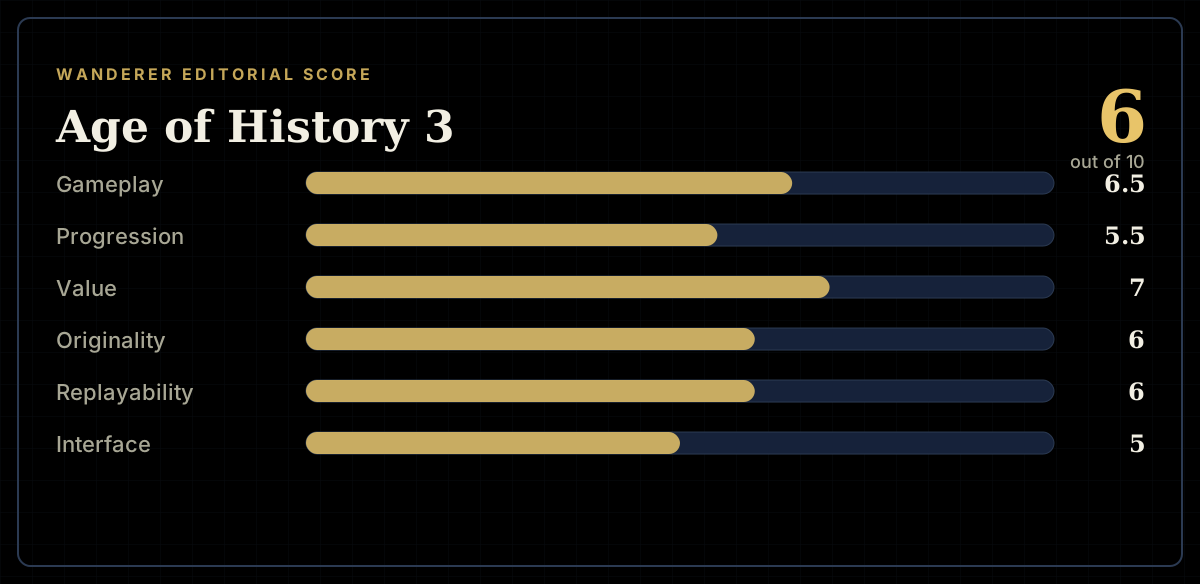
How the review scores each part of the gameWanderer Editorial -
The short versionWanderer Editorial