
Game review
Citadelum
6 / 10
- Developer
- Abylight Barcelona
- Publisher
- Abylight Studios, Gamersky Games
- Released
- 17 October 2024
- Platforms
- Windows
- Genre
- Roman mythology-themed city builder
- Monetisation
- One-time purchase, with three free post-launch campaign expansions
- Players
- Single-player only
The short version
Citadelum sets out explicitly to resurrect the specific pleasure of Sierra's late-90s Impressions Games city-builders — Caesar III and Zeus: Master of Olympus chief among them — pairing modernised graphics and interface with the same core loop of resource chains, housing evolution, and temperamental gods who reward devotion and punish neglect. Reviewers who grew up on those original games describe the nostalgia hit as genuine and well-earned, and this review's sample is full of players specifically crediting the developer with understanding what made those decades-old games beloved. What tempers that goodwill, repeated with striking consistency across a large share of the same nostalgic audience, is a shared verdict that the challenge underneath the loving presentation doesn't hold up: maps that play out nearly identically regardless of region, a difficulty curve several call trivially easy once basic systems are understood, and a campaign structure that doesn't meaningfully build on itself mission to mission. The developer has responded with a genuinely sustained, free-content-driven support record spanning multiple full campaign expansions and a major rebalancing update, though the core "too easy, too repetitive" critique persists in reviews posted well after those additions.
Biggest strengths
- The visual presentation, atmosphere, and overall production values draw near-universal, specific praise, with reviewers repeatedly describing the experience as a genuine, heartfelt homage to Caesar III and Zeus: Master of Olympus rather than a cheap cash-in on nostalgia
- Several genre veterans with deep knowledge of the Impressions Games catalogue specifically credit the developer with capturing the classic feel accurately, including production chains, housing evolution, and building placement mechanics
- The developer has released three free post-launch campaign expansions since the original release, alongside a major "Rubicon" gameplay update, delivering substantial additional content at no extra cost
Biggest weaknesses
- The single most repeated and detailed complaint concerns a lack of real difficulty or strategic depth, with numerous reviewers independently describing every map as playing out nearly identically regardless of region once basic production chains are established
- Multiple reviewers with deep familiarity with the genre's classics describe Citadelum as failing to capture the specific strategic tension that made Caesar III and Zeus memorable, several explicitly calling it "Caesar III light" or a "pale imitator" despite loving the presentation
- Combat and the overworld map are described by several reviewers as feeling disconnected from the core city-building loop, implemented in a way multiple find gimmicky rather than meaningfully integrated
Who it's for: Fans of classic Impressions Games city-builders like Caesar III and Zeus: Master of Olympus who want a lovingly modernised revival of that specific formula, and who prioritise nostalgic atmosphere over a demanding strategic challenge. Less suited to players seeking the depth and difficulty of the genre's classic high points.
Our recommendation: Worth it for genre nostalgia and presentation alone, especially given three free campaign expansions added since launch at no extra cost. Temper expectations about strategic depth and difficulty — a large, consistent share of the game's own target audience says this falls short of the classics it's explicitly modelled on in exactly that respect.
6 / 10
Citadelum wears its inspirations proudly, and it doesn't take long playing it to understand why. This is a deliberate, loving attempt to resurrect the specific pleasure of Sierra's Impressions Games city-builders from the late 1990s — Caesar III, Zeus: Master of Olympus, Pharaoh — updated with modern graphics and interface conveniences while keeping the core loop of resource chains, housing tiers, and a pantheon of gods who reward devotion and punish neglect. This review's sample is unusually full of reviewers with deep, specific nostalgia for exactly those decades-old games, and their verdict is remarkably consistent in shape even when it diverges sharply in overall recommendation.
A tribute genre veterans recognise immediately
The praise for atmosphere and presentation borders on unanimous. "If you grew up loving the Caesar series (especially Caesar III), Citadelum feels like a heartfelt modern love letter to that era of city-building," one reviewer writes, and another goes further: "these developers took Zeus and Poseidon, Pharaoh, and Ceasar series pillar concepts and modernized them to our present standards... What a breath of fresh air!" These aren't casual observations — they're coming from reviewers who clearly know the specific games being honoured in detail, and their consistent recognition of the tribute as sincere rather than superficial is a genuine point in the game's favour.
The complaint that follows the praise almost every time
What makes this review sample distinctive is how often that same praise pivots directly into a specific, shared disappointment. "It's a prettier Caesar 3 without that game's strategic depth," one reviewer writes, and another, having felt genuine early joy, describes it fading fast: "It only lasted a few hours as said. After that, well that was it. There isn't much actually." A particularly detailed account frames the structural problem precisely: "every map plays out the same way, with how the tech tree is built. Unlike Caesar, you cannot be missing any resources, or the whole map doesn't work." This is a specific, mechanically grounded critique — not simply "it's too easy," but a description of how the game's own systems remove the resource-scarcity tension that made the genre's classics genuinely tense to play.
Combat and the overworld feel bolted on
A second, related complaint concerns the game's attempt to add something the classics lacked: an overworld map and tactical combat layer. Reviewers are broadly unimpressed with the execution. "External combat was added, which the original was missing, but unfortunately implemented in a way that feels rather gimmicky," one writes, while another separately notes combat feels "disconnected from your settlement." This reads as a reasonable, good-faith attempt to modernise the formula that several reviewers feel doesn't yet land, rather than a fundamentally flawed idea.
A specific frustration with the deity system's demands
Beyond the broader depth complaint, at least one reviewer raises a pointed, specific gripe with the game's central new mechanic: "Why does every god demand 3 whole temples? This alone literally ruined the game for me. I am not building 15 temples for a town of a few hundred people, this is so stupid," they write, arguing the mechanic needed a prestige-style system rewarding fewer, more meaningful temples rather than simply demanding volume. That's a specific, actionable design critique rather than a vague balance complaint, aimed at the one system meant to distinguish Citadelum from its direct inspirations.
A developer that kept building, with real free content
To its considerable credit, this review can confirm Abylight Barcelona backed the October 2024 launch with a genuinely sustained, generous support record. The partner-events feed documents three free campaign expansions released through mid-2025 — covering Britannia, Germania, and the Gallic Wars — alongside a major "Rubicon" gameplay-overhaul update in April 2025 addressing core systems directly. At least one reviewer specifically returned to the game after these additions to praise the expanded content. That's real, substantial post-launch investment, though the persistence of the core depth complaint in reviews posted after these updates suggests the fundamental difficulty and repetition concerns weren't the primary target of that additional work.
What the achievement data suggests about the difficulty complaints
Steam's own completion figures lend some independent weight to the "too easy" critique. An early milestone sits at 60.2%, a healthy completion rate for an opening objective, but the curve doesn't fall as steeply as many titles in this lane before flattening out around the 3-7% range for the hardest achievements — consistent with a game whose difficulty ceiling, once reached, doesn't demand the kind of sustained mastery that would naturally thin out a completion curve more severely at the top.
A reviewer's own precise diagnosis of the identity problem
One particularly considered review deserves direct quotation, since it captures the sample's central tension better than any summary could: "Citadelum has a lot of good ideas. I really like the idea that you are in control of a city that is part of a much larger map... Really, it is almost there. But what we have is the classic situation of a game not being quiet sure what it wants to be." That's a fair, specific read on the whole project — not a failure of craft or ambition, but a game caught between faithfully recreating a beloved formula and meaningfully expanding it, without fully committing to either path. The overworld map, the combat layer, and the deity system are all genuine attempts at that expansion; the review sample's consistent verdict is that none of them yet integrate tightly enough with the core building loop to justify their addition on their own strategic merits.
Value that holds up regardless of the depth debate
Whatever the disagreement over strategic depth, value is one area where this review's sample shows little friction. At its price, and especially accounting for three free campaign expansions added since launch, reviewers consistently describe feeling they got a fair or generous amount of content for their money, even among those ultimately disappointed by the difficulty curve. That's worth weighing directly: a game whose core complaint is "not enough challenge to sustain interest" is a meaningfully different, less severe problem than one lacking basic content or support, and Citadelum's post-launch track record puts it clearly in the former category.
Final verdict
Citadelum succeeds completely at one specific, difficult task: making players who grew up on Caesar III and Zeus: Master of Olympus feel that same particular nostalgic pull again, with presentation and atmosphere that reviewers across the board describe as a sincere, well-crafted tribute. It falls short, according to a large and specific share of that exact same nostalgic audience, at the harder task of recapturing the strategic tension and difficulty that made those originals endure. Worth playing for the atmosphere and the three free campaign expansions added since launch; go in with tempered expectations about how much genuine challenge you'll find once the initial nostalgia wears off.
Pros and cons
Pros
- The visual presentation, atmosphere, and overall production values draw near-universal, specific praise, with reviewers repeatedly describing the experience as a genuine, heartfelt homage to Caesar III and Zeus: Master of Olympus rather than a cheap cash-in on nostalgia
- Several genre veterans with deep knowledge of the Impressions Games catalogue specifically credit the developer with capturing the classic feel accurately, including production chains, housing evolution, and building placement mechanics
- The developer has released three free post-launch campaign expansions since the original release, alongside a major "Rubicon" gameplay update, delivering substantial additional content at no extra cost
- The deity/pantheon system introduces a genuinely new mechanical layer beyond the classic formula, with gods offering gifts for devotion and punishments for neglect, adding a fresh wrinkle several reviewers specifically enjoy engaging with
- The game runs on modern hardware with quality-of-life improvements over its decades-old inspirations, including flexible building placement and clearer visual feedback that several reviewers specifically praise as genuine improvements over the originals
Cons
- The single most repeated and detailed complaint concerns a lack of real difficulty or strategic depth, with numerous reviewers independently describing every map as playing out nearly identically regardless of region once basic production chains are established
- Multiple reviewers with deep familiarity with the genre's classics describe Citadelum as failing to capture the specific strategic tension that made Caesar III and Zeus memorable, several explicitly calling it "Caesar III light" or a "pale imitator" despite loving the presentation
- Combat and the overworld map are described by several reviewers as feeling disconnected from the core city-building loop, implemented in a way multiple find gimmicky rather than meaningfully integrated
- A specific, repeated complaint concerns the temple/deity system requiring what several reviewers consider an excessive number of temples per god, with at least one describing needing 15 temples for a modest town as a design decision that actively worked against enjoying the mechanic
- At least one reviewer reports the game becoming genuinely broken at scale after 45 hours of play, describing specific systems failing to function as intended despite otherwise strong presentation
Screenshots
-

CitadelumImage: Abylight Studios via Steam -

CitadelumImage: Abylight Studios via Steam -

CitadelumImage: Abylight Studios via Steam -
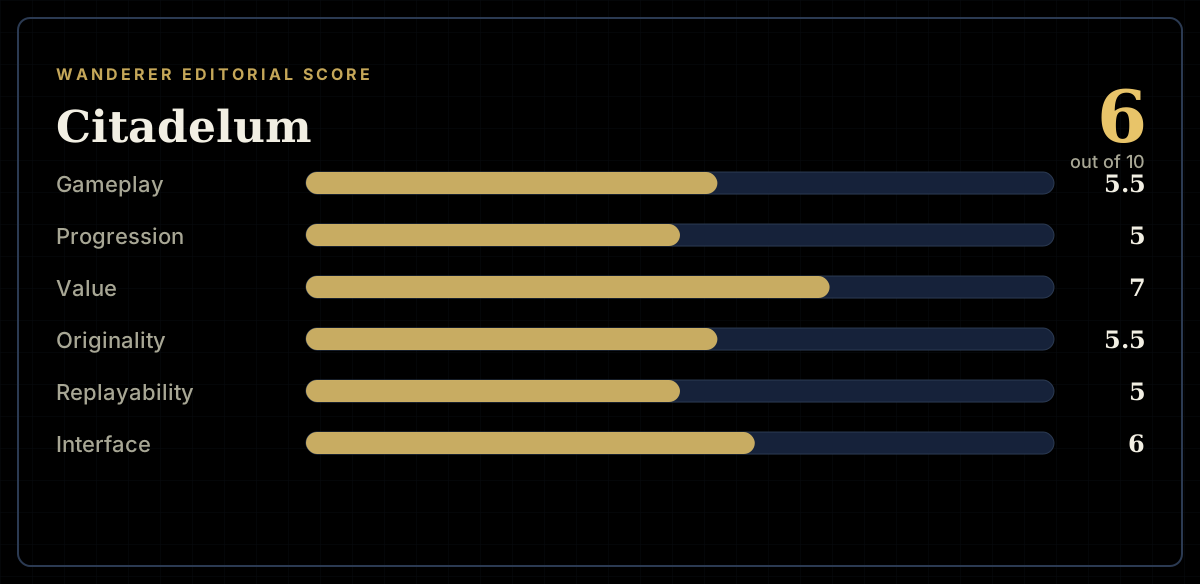
How the review scores each part of the gameWanderer Editorial -
The short versionWanderer Editorial