Game review
Balatro
9 / 10
- Developer
- LocalThunk
- Publisher
- Playstack
- Released
- 20 February 2024
- Platforms
- Windows, macOS, Nintendo Switch, Nintendo Switch 2, PlayStation 4, PlayStation 5, Xbox One, Xbox Series X/S, iOS, Android
- Genre
- Poker Roguelike / Deckbuilder
- Monetisation
- Premium one-off purchase on every platform; no ads, no in-app purchases, no subscriptions required, ongoing free content updates
- Players
- Single-player only
The short version
Balatro's real trick isn't the poker skin, it's what sits underneath: chips times multiplier, an exponential formula that jokers, tarot cards and vouchers all exist to warp in your favour. Building a chain of triggers that turns a pair of nines into an eight-figure score is one of the cleanest number-go-up loops on the market, and it's wrapped in a synthwave-and-CRT presentation that never gets in its own way.
It isn't a game without limits. A run that's found its winning combination stops being a discovery and starts being an execution, the mid-to-late Ante spikes can lean harder on the shop's random offers than on anything the player did, and the celebrated endless mode breaks outright once the numbers involved outgrow floating-point math. None of that undoes what the core loop gets right, but the score below accounts for all of it.
Biggest strengths
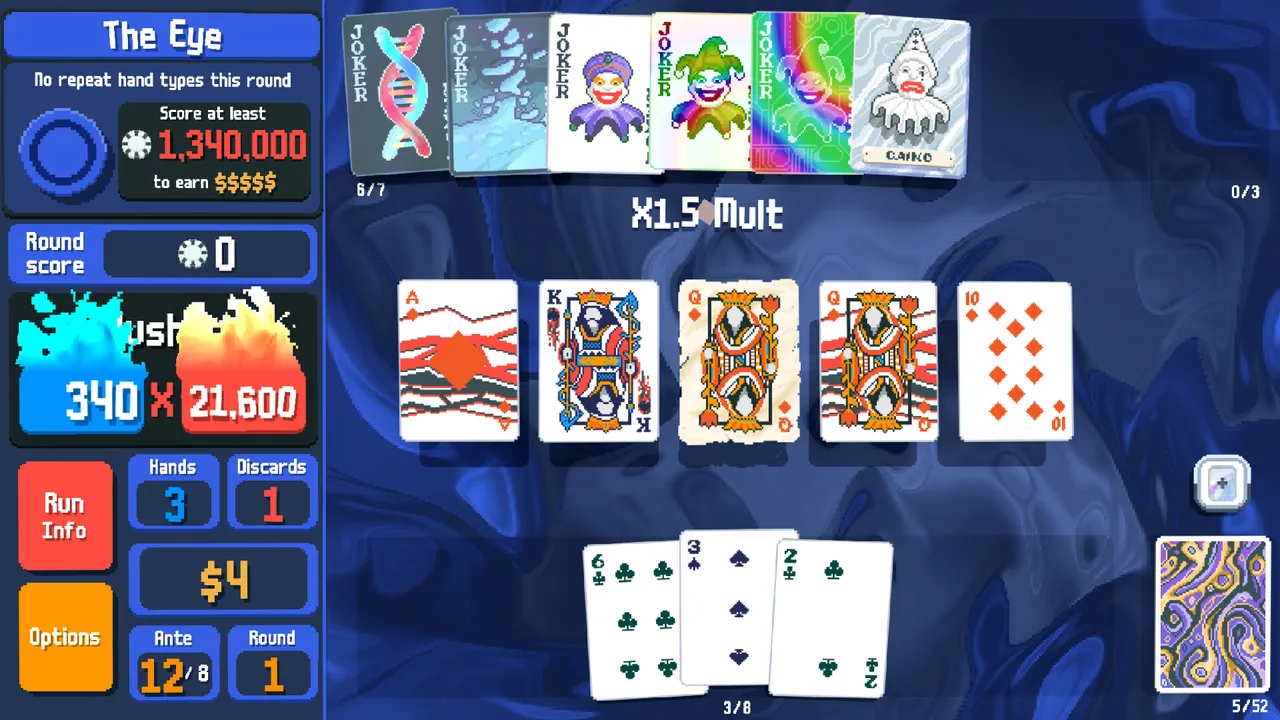
- Scoring a poker hand only starts the round — multiplicative joker triggers turn a modest pair into an eight-figure chip total, and reading that chain is the entire skill test
- Vouchers, tarot and spectral cards let a run bend its own rules instead of just scaling numbers upward on a fixed hand
- Fifteen decks and eight escalating stakes create genuinely different starting conditions instead of a flat health-and-damage multiplier
Biggest weaknesses
- Once a favourite joker combination clicks into place, later runs on the same deck start feeling like execution rather than discovery
- Mid-to-late Ante spikes lean on drawing the right shop offers, and a genuinely bad shop can end a strong-looking run regardless of how well it was played
- Endless mode's chip requirements overflow into unplayable numbers past Ante 39, which reads less like a feature than an unfinished edge case
Who it's for: Deckbuilder and roguelike players who want their tension to come from reading a multiplier chain rather than reflexes, anyone who likes optimising a system until it breaks in their favour, and players who want a short, session-friendly game that respects a phone as much as a PC.
Our recommendation: Buy it on whatever platform you'll actually return to — the mobile port is a full, faithful copy of the PC version at a lower one-time price, and there's no subscription or IAP trap waiting on any of them.
9 / 10
Most card games ask you to win the hand. Balatro asks you to win the number. A pair of nines is worth almost nothing on its own — what matters is the chain of jokers sitting beside it that multiply, add to, and retrigger that hand until a beatable blind turns into a formality and an unbeatable one turns into a puzzle you haven't solved yet. That's the whole pitch, and it's a better one than "poker roguelike" makes it sound: this is a game about building an engine that turns small inputs into obscene outputs, wearing a deck of cards as its interface.
It's also, notably, the work of one person. LocalThunk, an anonymous Canadian developer, built and balanced the entire thing solo before Playstack picked it up to publish, and that authorship shows in how tightly the systems interlock — nothing here feels like a design-by-committee compromise.
Chips times multiplier is the actual game
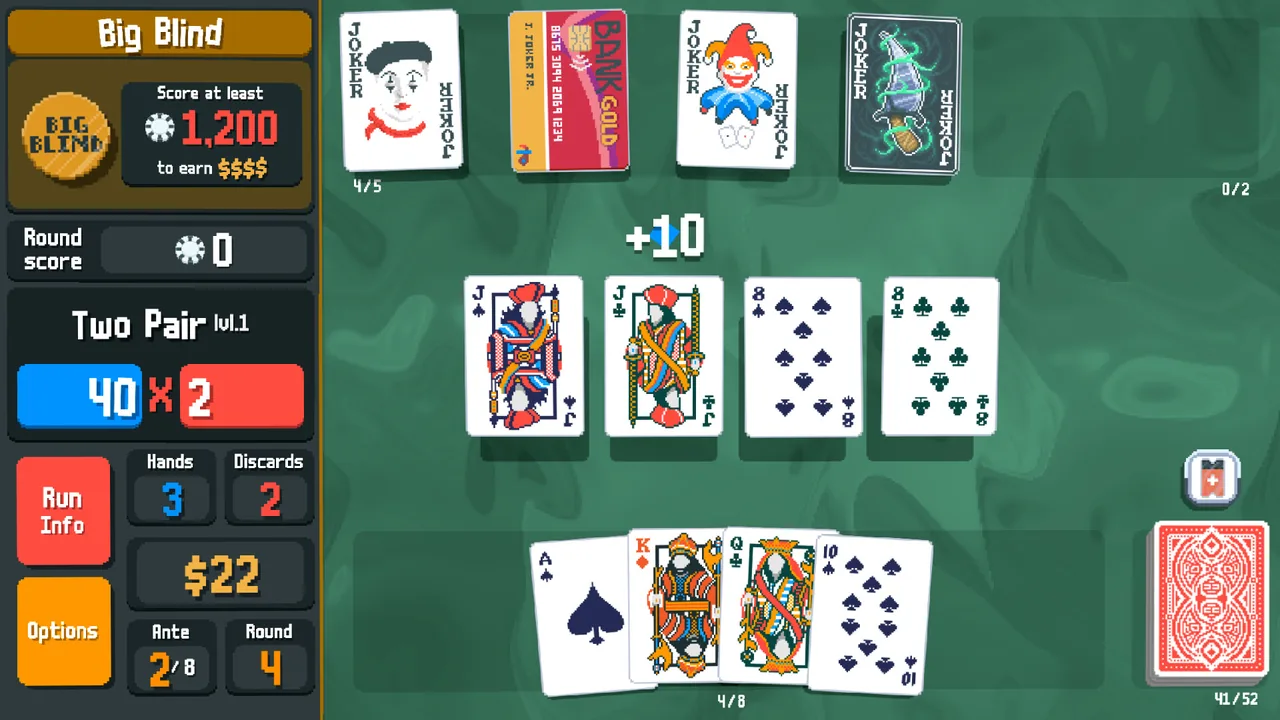
Every poker hand you play produces two numbers: a chip value, and a multiplier. The final score is those two multiplied together, and almost nothing in Balatro exists to change your hand-reading skill — it exists to warp one or both of those numbers in your favour before the multiplication happens. A joker might add flat chips for every heart in a scoring hand. Another might multiply the whole total if you play exactly four cards. A third retriggers a card's effect a second time for no reason other than that it's placed next to a specific enhancement. None of this is additive in the way a normal RPG's damage stat is additive — it compounds, and reading which compounding order actually produces the biggest number is the real game hiding behind the poker dressing.
This is worth being precise about, because it's the detail that separates Balatro from being "just a card game with modifiers." A run isn't judged by how good your final hand is. It's judged by how much of an exponential curve you built underneath an ordinary hand. Two pair with the right jokers outscores a straight flush with the wrong ones, and learning to see that — to stop rating cards by poker rank and start rating them by what they trigger — is the actual onboarding curve the game puts a new player through in the first few hours.
Jokers are the deckbuilder; the cards are just the delivery mechanism
Playing cards in Balatro are closer to a resource than a hand of poker in the traditional sense. What you're really building, run over run, is a board of up to five jokers (more with certain decks and vouchers), each one a passive ability purchased from a shop between rounds. A hundred and fifty of them exist, several with five collectible editions layered on top, and the design space between them is where the game earns its reputation. Some jokers want a specific suit. Some want you to discard aggressively rather than play cards. Some do nothing until a very particular condition triggers, then swing an entire run. Finding two jokers that interact in a way the game never explicitly tells you about — and realising you've built something that shouldn't work as well as it does — is Balatro's best moment, and it repeats often enough in the opening dozens of hours to justify the game's reputation as something you sit down with for "one more run" and look up two hours later.
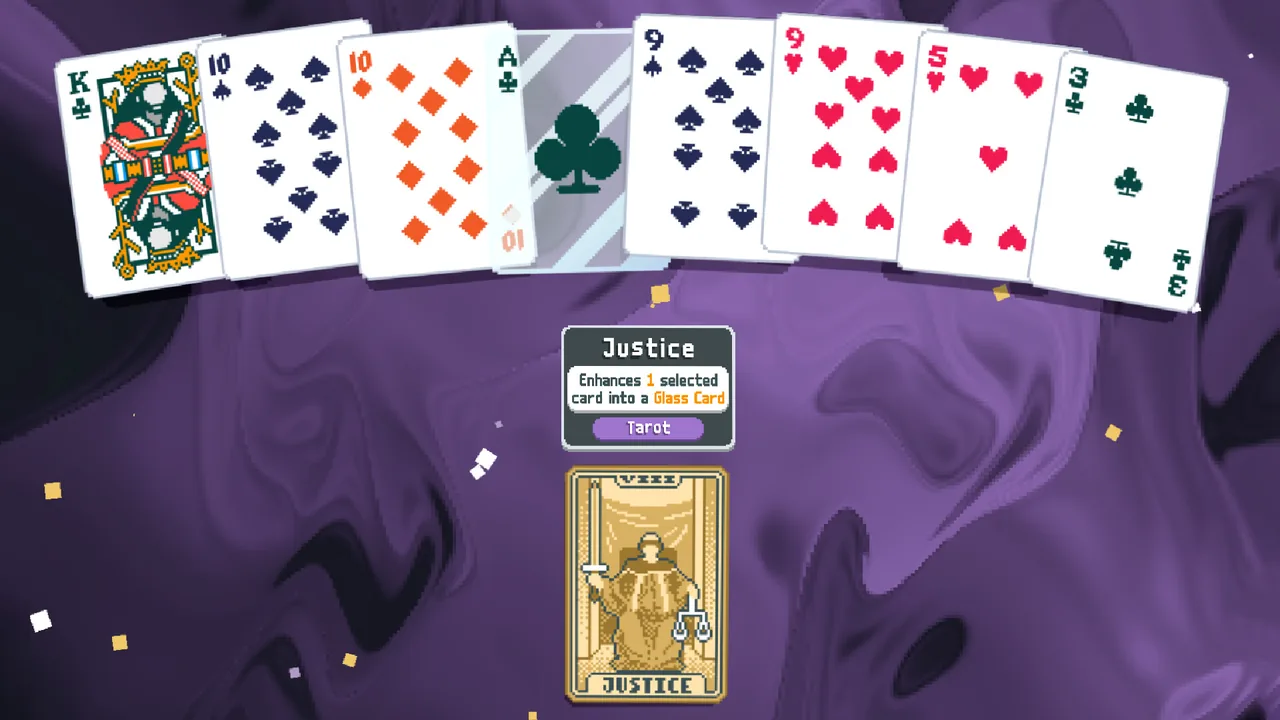
Tarot, planet and spectral cards sit underneath the joker layer and do something distinct: tarot cards permanently enhance or convert the playing cards in your deck, planet cards level up which poker hands score more per level, and spectral cards do stranger, riskier things — copying a joker, destroying cards for a payoff, adding wild negative-cost jokers to the shop. None of this is filler. It's what stops "collect good jokers" from being the entire strategic surface, and it's also where a run can go wrong in ways that feel earned rather than random: over-investing in a tarot strategy that a bad shop then refuses to support is a real, self-inflicted mistake, not just bad luck dressed up as one.
Decks and stakes: difficulty as a different starting condition, not a bigger number
Fifteen starting decks change the rules before a run even begins — one deck starts you with four hands and three discards flipped from the default, another removes face cards from the deck entirely and compensates with a permanent joker slot, another starts every run with a random negative joker already in play. Layered on top, eight stakes per deck escalate the difficulty by adding standing modifiers: boss blinds hitting harder, shop prices rising, specific card types disabled outright. The combined effect is a genuine difficulty ladder built from qualitative changes rather than the blunt "enemies have more health" scaling most roguelikes reach for. Gold stake, the hardest tier, isn't just a harder version of white stake's Ante 8 — it's a different game built on the same board, and clearing it with a given deck is a real, specific achievement rather than a grind checkpoint.
That's the ladder working as intended. Where it stops feeling like design and starts feeling like completionist busywork is in how many decks-times-stakes combinations exist to clear — 120 in total — before the game considers you "done" in any formal sense. Most players will never chase all of them, and Balatro doesn't punish you for stopping early. But the achievement structure nudges hard in that direction, and it's worth knowing going in that the difference between "played Balatro" and "finished Balatro" is a much longer tail than the core loop's first, best hours suggest.
How much of a run is skill, and how much is the shop's mood
This is the honest question any run-based deckbuilder has to answer, and Balatro's answer is more mixed than its review scores might suggest. Early antes are almost entirely skill and planning — which jokers to buy, which to skip, when to reroll a shop versus save the money. By the mid-to-late Antes, especially on higher stakes, the boss blinds start demanding specific counters (a blind that disables a whole suit, one that halves your hand size, one that debuffs face cards) and whether you happen to own the right answer when it shows up is largely down to what the shop has offered you across the run so far. A player who's built a genuinely strong engine can still lose to a boss blind that specifically punishes the one thing their build depends on, with no in-run way to see it coming and prepare. That's not a flaw unique to Balatro — it's the luck floor every roguelike deckbuilder accepts as the cost of variance being interesting in the first place — but it's real, and a review that only credits the game's skill expression without naming the ceiling that variance puts on it isn't being straight with the reader.
Endless mode's kill screen
Clearing Ante 8 "wins" a run, and endless mode lets you keep going past it on an escalating ladder of required chip scores. It's a genuinely clever bit of post-game content for players chasing the absolute limit of a build — right up until Ante 39, where the required score outgrows what floating-point numbers can represent cleanly and the game effectively breaks, producing scores that read as invalid rather than simply "very large." It's a strange thing to flag in a review of a game otherwise this polished, but it's the clearest evidence that endless mode was built as a bonus rather than a fully realised system: a mode that exists to let obsessive optimisers push a build as far as it goes technically fails before most of them will ever get close to needing it to.
Presentation that knows exactly what job it has
The CRT-scanline pixel art and the synthwave soundtrack aren't there to be admired — they're there to make a screen full of scrolling chip totals and joker triggers feel good to watch rather than like a spreadsheet update. It works. The chunky, hand-drawn card and joker art reads clearly at a glance even when five or six jokers are stacked on the board, and the sound design leans into a satisfying tactile click on every card played and every joker trigger, which matters more than it sounds like it should when half of a run's tension comes from watching a chain of triggers resolve in sequence. None of it is trying to be a visual showcase, and that restraint is the right call for a game whose real spectacle is a number getting absurdly large, not the art around it.
The mobile port, and the text-size problem nobody's quite solved
Balatro's iOS and Android release, which followed the PC and console launch by seven months, is about as faithful a mobile port as this kind of game gets: every joker, deck, stake and shop mechanic carries over intact, touch-based card dragging suits the game better than a mouse cursor ever did, and the app includes a High Contrast Cards accessibility option that helps distinguish similar suits at a glance. It's also, notably, cheaper than the PC and console versions as a straight one-time purchase, with no ads or in-app purchases layered on top and an Apple Arcade option for players who'd rather access it through a subscription they already have.
The genuine limitation is legibility. Joker descriptions are dense by design — a lot of a joker's identity has to be communicated in two or three lines of small text — and a board with four or five jokers active on a phone under roughly six inches asks a player to read a wall of tiny conditional text to understand what their own build is currently doing. It's not unplayable, and larger phones and foldables handle it comfortably, but it's a real strain point on smaller or older devices that the accessibility options don't fully solve, and anyone planning to play primarily on a compact phone should know that going in.
Value and an unusually clean business model
At NZ$21.99 on PC and console and US$9.99 on mobile, with no expansion packs, no season pass and no currency to buy, Balatro's pricing is refreshingly simple for a game this decorated. The four Friends of Jimbo updates — cosmetic card-art collaborations with franchises including The Witcher 3, Vampire Survivors, Dave the Diver, Cyberpunk 2077, Stardew Valley and a dozen others — have shipped free, change nothing about balance, and never gate anything behind a purchase. That's a deliberate choice, not an accident: LocalThunk has been explicit about opposing gambling-adjacent monetisation in a game whose entire aesthetic borrows from a casino, and the game's ownership terms reportedly include protections against a future owner adding that kind of system. It's rare for a review to be able to say a hit game's business model has no asterisk, and this is one of the few that earns it.
Verdict
Nine out of ten. The core idea — that the interesting part of a poker roguelike isn't the poker, it's the exponential engine you build to break the poker's own scoring — is executed about as well as this kind of design gets, and it's wrapped in presentation, pricing and post-launch support that never once undercuts it. What keeps it from higher is the honest accounting this review insists on: a solved build stops being a discovery and starts being a routine, the higher Antes lean on shop luck more than the marketing lets on, endless mode breaks before it finishes what it promises, and small-screen mobile play asks a lot of a player's eyesight. None of that changes who this is for. Anyone who likes watching a system compound in their own favour, on a schedule they control rather than one dictated by reflexes, should own this on whatever platform they'll actually pick back up. Players who already like watching numbers grow through a system that keeps working while they're away from the screen — the kind of loop Wanderer builds its own progression around — will recognise the appeal immediately, even without the poker skin.
Pricing and platform details checked 30 July 2026.
Pros and cons
Pros
- Scoring a poker hand only starts the round — multiplicative joker triggers turn a modest pair into an eight-figure chip total, and reading that chain is the entire skill test
- Vouchers, tarot and spectral cards let a run bend its own rules instead of just scaling numbers upward on a fixed hand
- Fifteen decks and eight escalating stakes create genuinely different starting conditions instead of a flat health-and-damage multiplier
- The mobile port keeps every joker, deck and stake from PC and console and adds a High Contrast Cards accessibility option, at a lower one-time price than Steam
- Four free Friends of Jimbo collaboration updates have shipped new cosmetic card art without ever touching balance or asking for a repurchase
- The developer wrote explicit anti-gambling protections into how the game can be sold in future, and the business model backs that up with no loot boxes, currencies or IAP on any platform
Cons
- Once a favourite joker combination clicks into place, later runs on the same deck start feeling like execution rather than discovery
- Mid-to-late Ante spikes lean on drawing the right shop offers, and a genuinely bad shop can end a strong-looking run regardless of how well it was played
- Endless mode's chip requirements overflow into unplayable numbers past Ante 39, which reads less like a feature than an unfinished edge case
- Joker text is dense and small by design, and a phone screen under about six inches makes reading a crowded five-joker board a real strain
- The eight-stake difficulty ladder rewards completionists chasing unlocks far more than it rewards someone who just wants one clean, satisfying run
Screenshots
-
BalatroImage: Playstack via Steam -
BalatroImage: Playstack via Steam -
BalatroImage: Playstack via Steam -
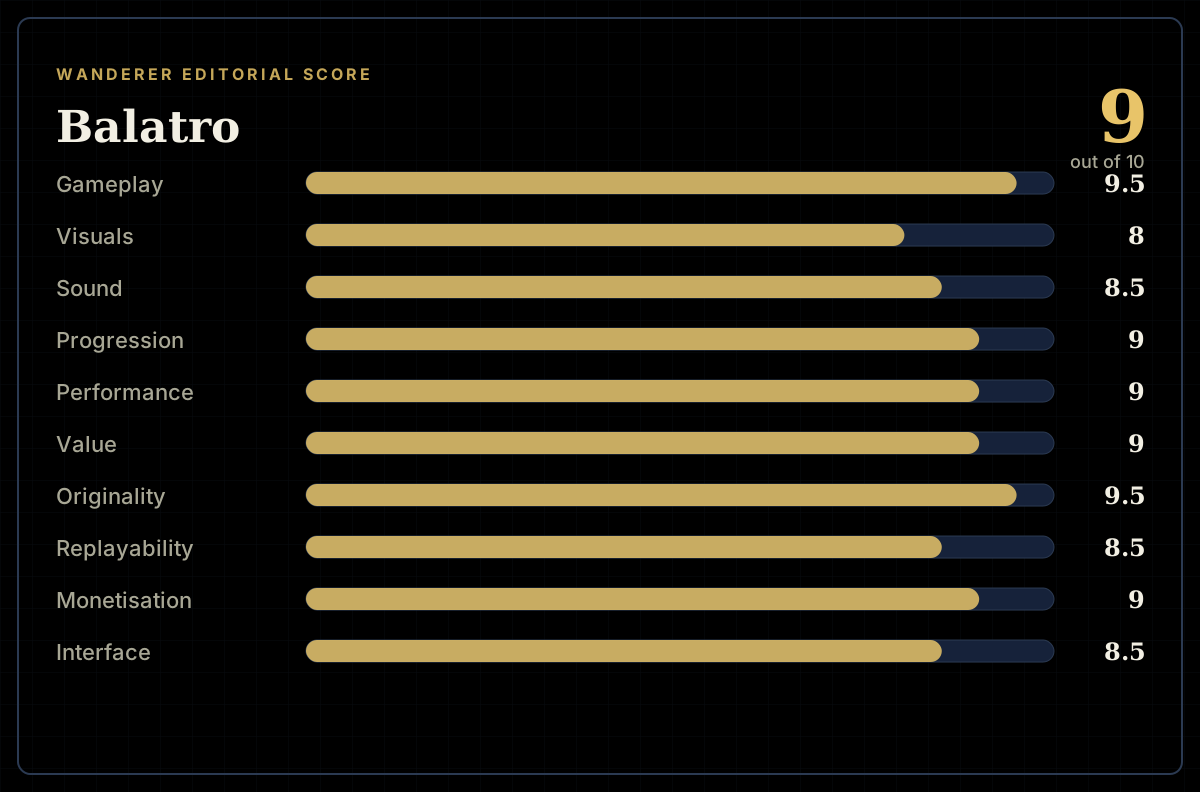
How the review scores each part of the gameWanderer Editorial -
The short versionWanderer Editorial