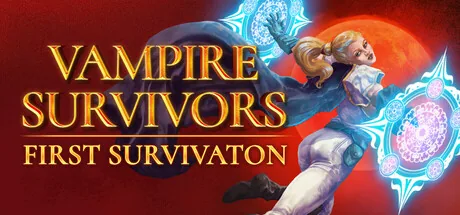
Game review
Vampire Survivors
9 / 10
- Developer
- poncle
- Publisher
- poncle
- Released
- 20 October 2022
- Platforms
- Windows, macOS, iOS, Android, Xbox One, Xbox Series X/S, Nintendo Switch, PlayStation 4, PlayStation 5, Meta Quest
- Genre
- Action Roguelite
- Monetisation
- Premium on PC/console with cheap optional DLC; free-to-play with ads and IAP on mobile
- Players
- Single-player, local co-op, and online co-op (added October 2025)
The short version
Vampire Survivors took away the two things action games are supposedly built on — aiming and attacking — and proved the genre didn't need either. What's left is a drafting game wearing a bullet-hell costume: which weapons you pick, which evolutions you chase, and where you stand while a screen-filling storm of damage numbers does the rest.
It's not flawless. The screen becomes borderline unreadable at full power, a chunk of the appeal is unlock dopamine rather than deep systems, and once a build is locked in for the run there's very little left to actually do with your hands. But at a few dollars a DLC pack and two of them free outright, it remains one of the most generous, well-tuned things on Steam.
Biggest strengths
- Turning off manual aiming and attacking removes friction rather than depth — the tension moves entirely into positioning and build choice
- Evolution recipes reward remembering which passive pairs with which weapon rather than just picking the biggest number
- A single run is a tidy thirty minutes with a real beginning, middle and escalating end
Biggest weaknesses
- Late-run screens turn into a wall of light and numbers that actively works against readability, not just aesthetics
- Character unlocks and early achievements produce a rush of progress that thins out once the roster and arcana are exhausted
- A run that's going well becomes a waiting game — once the build is set there's little left to decide
Who it's for: Anyone who likes the feeling of a build coming together, players who want a game that respects short sessions, and genre skeptics who haven't tried the thing that started the "survivors-like" wave.
Our recommendation: Buy the base game at full price without hesitation, then pick up Ode to Castlevania if you want the single richest DLC on offer. The rest can wait for a sale.
9 / 10
Take away the two verbs an action game usually asks of you — aim, attack — and on paper you have nothing left. Vampire Survivors made that subtraction its entire premise, and four years on it's worth asking plainly why removing player agency from combat made the genre it spawned more compelling rather than less. The short answer: because it never removed agency, only relocated it. You stop choosing where the damage goes and start choosing what damage exists in the first place, and that turn out to be the more interesting decision.
What's actually left once you can't aim
Your character walks wherever you push it and fires automatically at whatever's nearest. That's the entire input surface for offence. Everything else — which weapon you picked up, which passive item you grabbed instead of the other one, whether you circled left around a chokepoint or held still near a healing shrine — is where the game happens. It sounds like a small design move. It isn't. Remove the twitch-reflex layer that most action games treat as the whole test, and what's underneath is a drafting game: fifteen to thirty minutes of picking from a shrinking menu of level-up choices while an enormous, procedurally thickening storm of monsters tries to corner you.
The tension that's left has three real components, and the review lives or dies on being honest about how much weight each one carries.
Build drafting is the strongest of the three. Every level-up throws four random options at you from your currently held or eligible weapons and passives, and the choices genuinely diverge — a run built around Bloody Tear and its evolution reads nothing like one built around the Runetracer and Clock Lancet, both in what it looks like on screen and in how you have to move to keep it alive. This is where Vampire Survivors earns comparisons to deckbuilders more than to twin-stick shooters: you're not aiming better, you're assembling a kit, and a kit with a bad combination of item slots will lose to the clock even with perfect movement.
Evolution recipes are the game's cleverest single system. Most weapons cap out unless paired with a specific passive item and levelled to maximum, at which point they transform into something categorically stronger. Knowing that the Garlic needs Pummarola, or that the Whip wants Hollow Heart, turns the level-up screen from "pick the biggest number" into "protect the slot for the thing I'm building toward," which is a much better kind of decision to be making forty times in one run. It's also the system doing the most work to keep veteran players engaged once the initial roster of forty-plus weapons has been seen — chasing an unfamiliar evolution combination is still the best reason to start a fresh run years after launch.
Positioning is real but thinner than the other two. Because your character can't be hurt while invulnerable-framed dashing through most enemies (a design choice that keeps the pace frantic rather than fiddly), the actual skill of staying alive reduces to reading which side of the screen is about to be dangerous and drifting the other way. It matters, especially against the game's elite spawns and end-of-stage reapers, but it's closer to weather-avoidance than to the kind of spatial puzzle a bullet-hell shooter usually demands. This is the part of the loop that thins out fastest, and it's the honest answer to where the tension goes once you've played enough runs to know the drill.
The thirty-minute clock is the real architecture
Every stage runs on a fixed timer, typically thirty minutes, and the game paces its threat almost entirely around that number rather than around your build's actual power. Reapers and timed elite waves arrive on schedule regardless of how strong you've become, which does two useful things at once: it gives a run a shape (early scramble, mid-run snowball, late-run survival check) and it stops strong builds from just idling out a victory. A run that's going too well still has to survive the 15-, 20- and 30-minute checkpoints, which is where a lot of overconfident builds actually die.
That fixed structure is also the game's best argument for why "no aiming, no attacking" doesn't collapse into nothing. A run has an arc. It escalates on a schedule you can learn and plan around. The absence of manual combat isn't absence of structure — the structure just moved into the clock and the level-up screen instead of into your reflexes.
Where the loop genuinely thins
Be honest about the back half of a good run: once your build has clicked into place — the right weapons evolved, the right passives stacked, damage numbers big enough that most regular enemies die on contact — there's very little left to actually decide. You're walking in patterns, watching a fireworks display of your own making, and waiting for the clock. Player feedback converges on exactly this complaint, and it's fair. The genre this game founded has a well-known "afk-able" problem in its own community shorthand, where a strong enough build makes the last third of a run something you watch rather than play. Vampire Survivors is far from the worst offender — the reaper timers force real decisions even in a dominant run — but it doesn't escape the pattern, and no amount of visual noise disguises that the interesting decisions front-load into the first half of each attempt.
It's also worth separating two different kinds of appeal that get lumped together as "the game is addictive." A meaningful share of the pull, especially in the first several hours, is straightforward unlock dopamine: new characters, new stages, new weapon combinations gated behind achievements and in-run gold, arriving fast enough that there's almost always something new to chase. That's legitimate design, but it's not the same thing as durable systems depth, and it's the part that runs out first. What's left once the unlock sheet is mostly full is the evolution-chasing and build-drafting core described above — genuinely well built, but a noticeably smaller game than the one the first few hours advertise.
The readability problem nobody's fixed
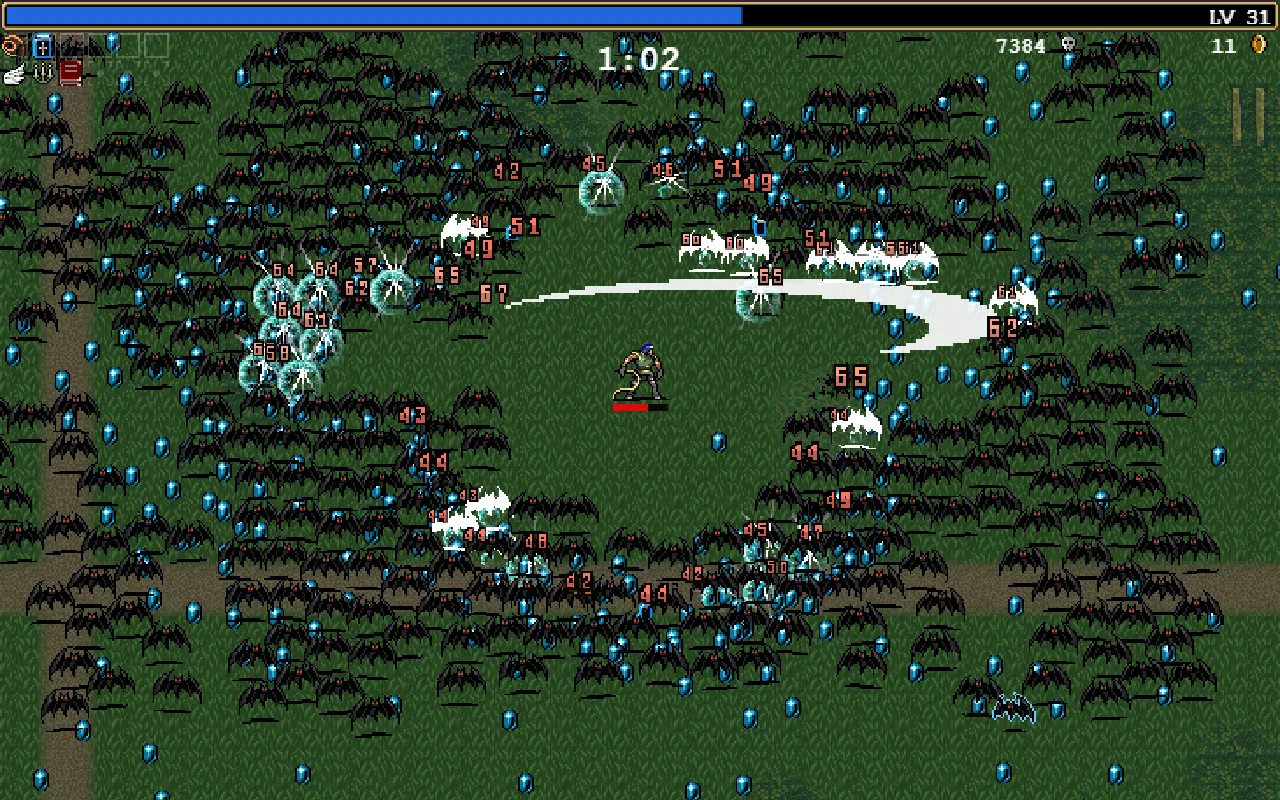
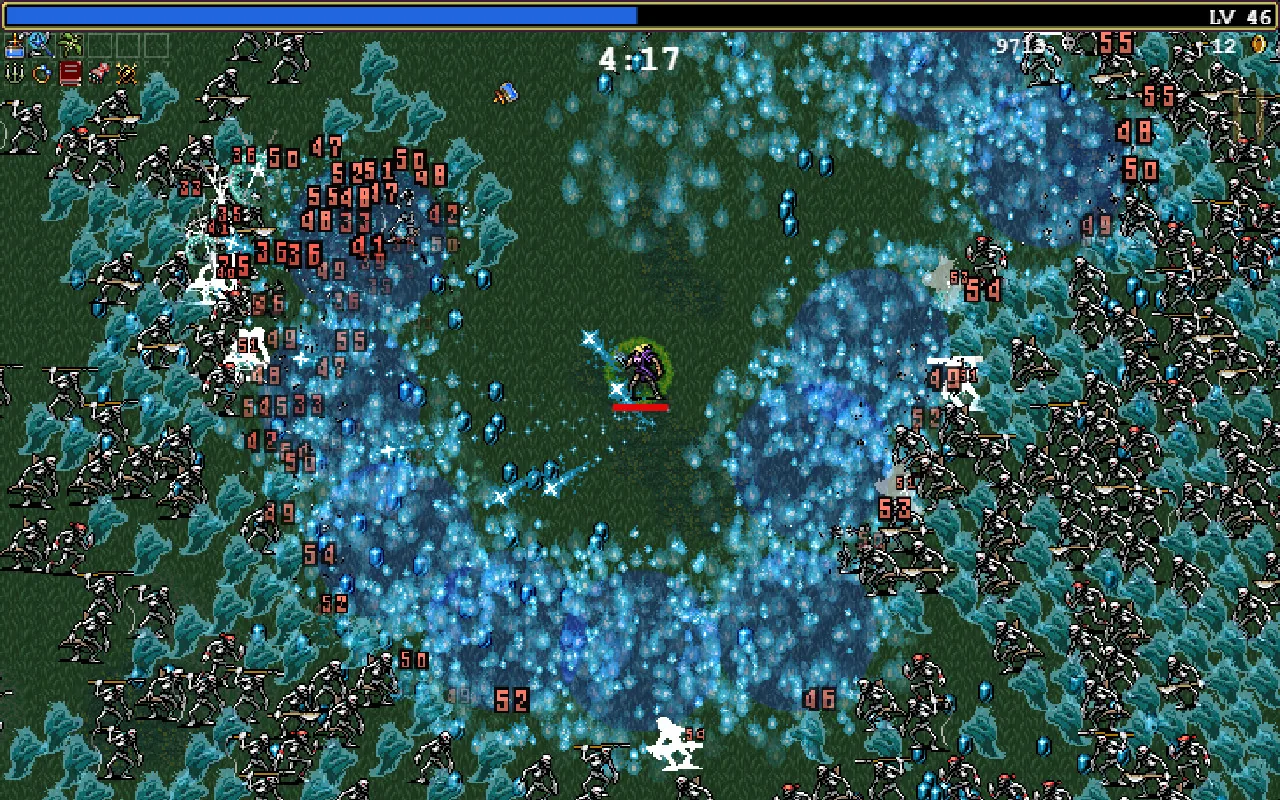
At full power in the back half of a run, the screen is not readable in any conventional sense. Whip strikes, garlic auras, knives, axes, holy water, lightning rings and dozens of enemy corpses overlap into a single field of light and particle effects, and your character — the thing you're supposedly tracking — can vanish under it entirely. This is presented as the game's signature spectacle, the "bullet heaven" payoff after the early minutes of relative calm, and it is genuinely satisfying the first dozen times. It's also a real accessibility problem the game has never seriously addressed: there's no clarity option that thins the particle load, no colourblind-aware redesign of the increasingly similar projectile effects, and no way to reduce visual density without simply building a weaker character. Players sensitive to screen clutter or light flicker are given no accommodation, and that's a fair critique to weigh against the presentation's obvious charm.
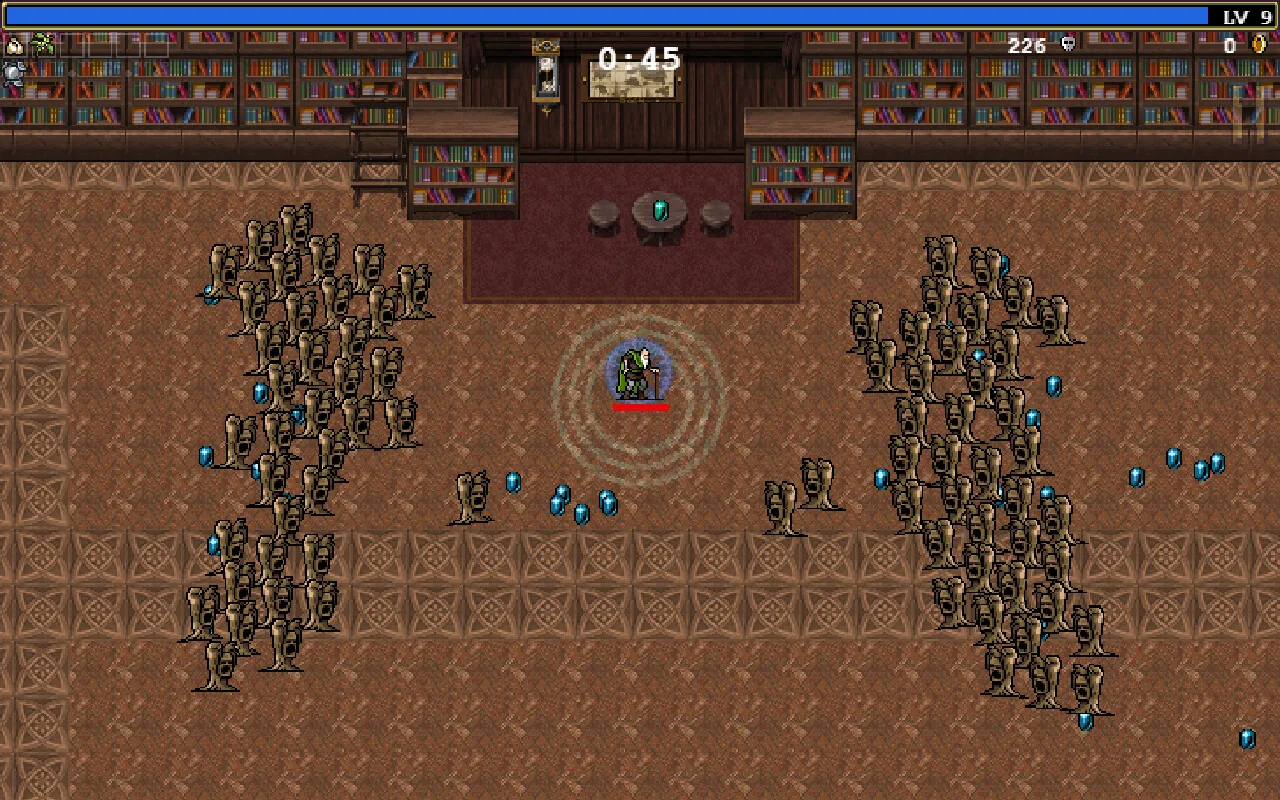
The pixel art itself is functional rather than remarkable — competent gothic-horror sprite work that does its job of reading enemy silhouettes at a glance, which matters more than detail once the screen fills up. It was never going to be the reason to play this game, and it isn't.
Six years of support, and an unusual value case worth stating plainly
Vampire Survivors launched into Early Access in December 2021 and reached its 1.0 release on 20 October 2022, and poncle has kept building since without turning it into a live-service subscription. The DLC list, checked 30 July 2026: Legacy of the Moonspell (December 2022, small Japanese-folklore expansion, currently around NZ$1.59), Tides of the Foscari (April 2023, around NZ$3.00), Emergency Meeting (December 2023, an Among Us crossover, around NZ$4.00), Operation Guns (May 2024, a Contra crossover, around NZ$4.00), Ode to Castlevania (October 2024, around NZ$6.29 and the biggest single expansion — dozens of Castlevania characters, weapons and a full new map), Emerald Diorama (April 2025, a SaGa crossover, released free) and Ante Chamber (October 2025, a Balatro crossover, also free). A further expansion, Legacy of the Bloodmoon, is announced for later in 2026 but hadn't shipped as of this writing. None of that is locked behind a subscription, a season pass or a premium currency — each pack is a one-off purchase or free, and the base game itself currently sits at a 20% discount, NZ$6.39 down from NZ$7.99. Buying literally everything gameplay-related released so far comes to under twenty New Zealand dollars on top of the base price. For a genre this saturated with cheap imitators, that's an unusually honest deal, and it deserves to be said without qualification rather than buried under caveats.
The console and PC version's monetisation model is worth contrasting with the mobile release, which took a different path entirely: free-to-play with ads and in-app purchases on iOS and Android from December 2022. That's a legitimate business decision for a different platform's economics, but it means the "cheap and honest" pitch above applies specifically to the Steam, Xbox, Switch and PlayStation versions. Anyone buying on mobile expecting the same flat-price deal should check which version they're getting before assuming parity.
Ode to Castlevania is worth calling out specifically, because it's the DLC that best demonstrates what this team is capable of when they're not just recolouring existing systems. Full Castlevania character rosters, faithfully reskinned weapons, a large bespoke map and enough content to function as a second game bolted onto the first — it's the strongest evidence that poncle treats these crossovers as real content rather than reskins sold at a markup, and it's the single DLC purchase worth prioritising if you're only buying one.
Multiplayer and the platform spread
Online co-op arrived in October 2025, three years after the game's full release, on top of the local co-op that had existed since August 2023. That's a genuinely late but genuinely welcome addition — it turns what was designed as a solo power fantasy into something you can share, though the core loop of drafting a build and reading a screen full of damage numbers translates less cleanly to a shared, chaotic screen than a single-player run does. The platform spread by mid-2026 is close to total: Steam and macOS at launch, Xbox in November 2022 (Game Pass day one), mobile in December 2022, Switch in August 2023, PlayStation 4 and 5 in August 2024, and a Meta Quest VR version in November 2025. Few games this size have chased that much platform coverage without the core experience visibly suffering for it, and the controls translate to a gamepad without any of the friction you'd expect from a game built around keyboard-and-mouse movement.
Verdict
Nine out of ten. The thesis holds up: taking aiming and attacking away from an action game didn't strip out the tension, it relocated it into build drafting and evolution-chasing, and both of those systems are sharp enough to carry thirty-minute runs on their own. The clock structure gives every run a shape regardless of how strong you've become, and the DLC and free-update history shows a small studio that kept investing in the thing it built rather than milking it.
What keeps it from higher is the honest accounting the brief above insists on: a real chunk of the appeal is front-loaded unlock dopamine that thins fast once the roster's exhausted, a dominant build turns the back half of a run into something you watch rather than play, and the signature screen-filling spectacle is also a readability and accessibility problem the game has never seriously tried to solve. None of that undoes what works. It just means the ceiling isn't quite as high as the concurrent-player numbers and the awards shelf might suggest.
Buy the base game without hesitation — at a fraction of most full-price releases, it's one of the easiest recommendations on Steam. Add Ode to Castlevania if one DLC purchase is all you're making. Everything else can wait for a sale, because there will be one; poncle discounts generously and often. Players who like the idea of a build coming together on its own, and who'd rather manage a system than aim a reticle, are the exact audience this game was built for. Anyone who needs manual combat to feel like they're playing at all should look elsewhere — nothing here is going to change their mind, and it was never trying to.
Price and DLC details checked 30 July 2026.
Pros and cons
Pros
- Turning off manual aiming and attacking removes friction rather than depth — the tension moves entirely into positioning and build choice
- Evolution recipes reward remembering which passive pairs with which weapon rather than just picking the biggest number
- A single run is a tidy thirty minutes with a real beginning, middle and escalating end
- Six years of updates and collaborations (Castlevania, Among Us, Contra, SaGa, Balatro) have been folded in as paid or free DLC instead of a live-service treadmill
- Runs on essentially anything, including phones several years old
- Online co-op added three years after launch shows poncle is still actively supporting a game most studios would have shelved
Cons
- Late-run screens turn into a wall of light and numbers that actively works against readability, not just aesthetics
- Character unlocks and early achievements produce a rush of progress that thins out once the roster and arcana are exhausted
- A run that's going well becomes a waiting game — once the build is set there's little left to decide
- Fifteen-plus playable characters share the same handful of starting archetypes, so the roster reads bigger than it plays
- The mobile version's free-to-play model sits at a different, worse value point than the flat-price PC and console releases
Screenshots
-
Vampire SurvivorsImage: poncle via Steam -
Vampire SurvivorsImage: poncle via Steam -
Vampire SurvivorsImage: poncle via Steam -
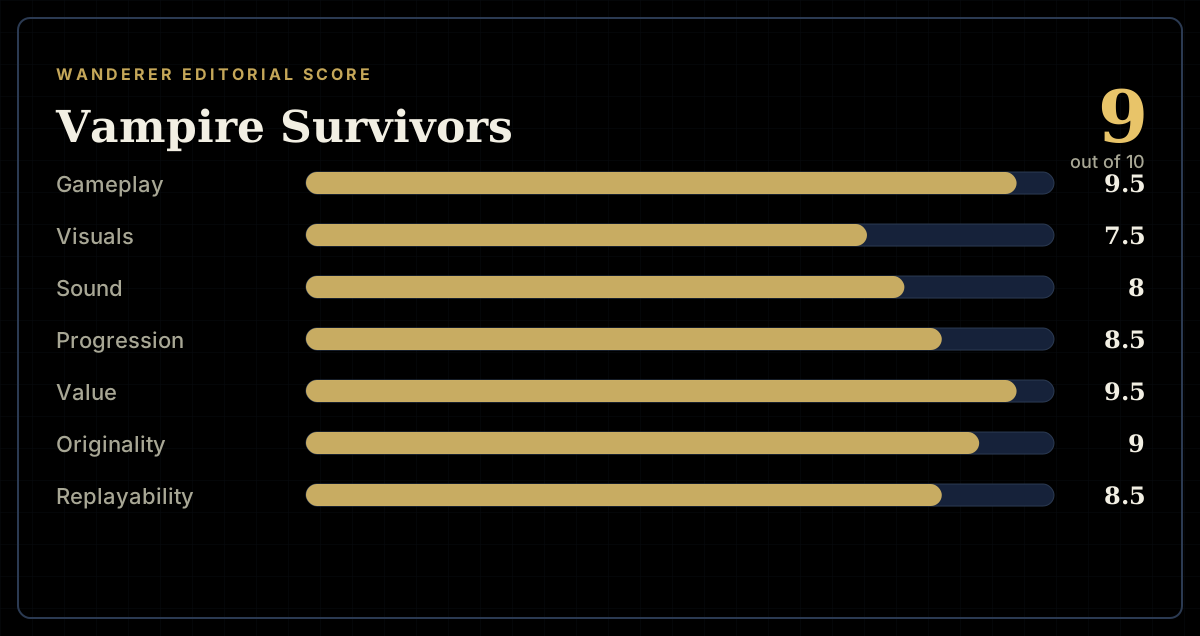
How the review scores each part of the gameWanderer Editorial -
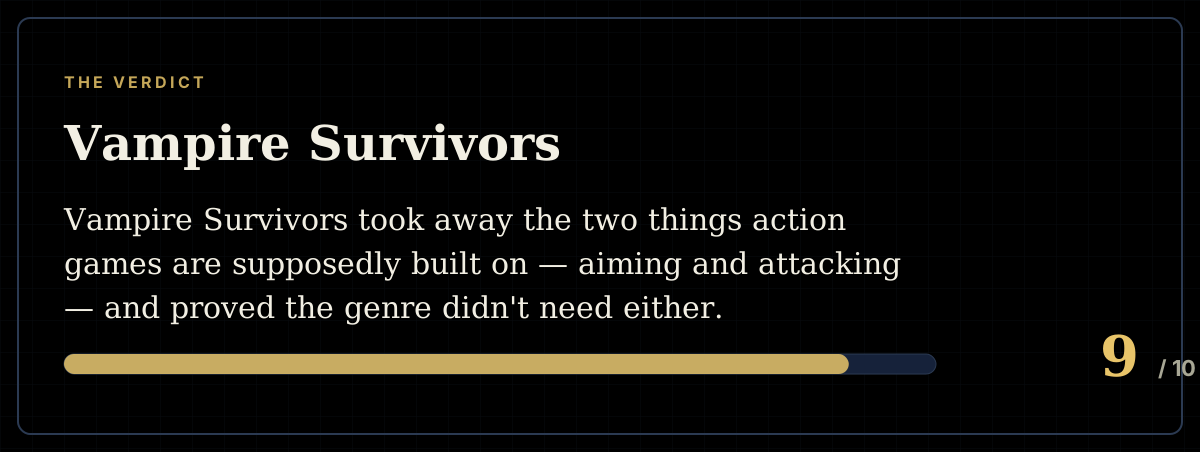
The short versionWanderer Editorial