Game review
Brotato
8 / 10
- Developer
- Blobfish
- Publisher
- Blobfish
- Released
- 23 June 2023
- Platforms
- Windows, macOS, Linux, iOS, Android, Nintendo Switch, Nintendo Switch 2, PlayStation 4, PlayStation 5, Xbox One, Xbox Series X/S
- Genre
- Arena Shooter Roguelite
- Monetisation
- Premium one-off purchase on every platform, no ads, no in-app purchases, no subscription; three DLC entries, two of them priced
- Players
- Single-player and local/split-screen co-op for up to 4 players, with Steam Remote Play Together support; no online netcode co-op
The short version
Brotato's whole design fits in one sentence: hold up to six weapons, survive a wave, spend what you collected in a shop, repeat twenty times. That simplicity is the point — every interesting decision in the game happens in the fifteen or so seconds between waves, not during them, and the shop's reroll-lock-freeze economy turns shopping into the actual skill test.
It is also a rougher, less considerate game than its reputation suggests. The presentation is plain even by the genre's low bar, a small set of community-known builds solve most of the difficulty ladder once you know them, the game explains almost none of its own stat interactions, and a run that's cooking often ends at wave twenty exactly when the build gets fun. None of that erases what works, but it keeps this out of the top tier its Steam rating implies.
Biggest strengths
- The between-wave shop's reroll, lock and freeze economy is the actual skill test, not the combat itself
- Forty-plus characters change starting stats and unlock conditions enough to force real strategic pivots, not just cosmetic reskins
- Waves run 20 to 90 seconds and a full run clears in well under thirty minutes, making it one of the most bingeable roguelites available
Biggest weaknesses
- The presentation is plain, function-first programmer art even by survivors-like standards, with little visual identity of its own
- A handful of community-known builds around turret stacking, elemental damage-over-time and lifesteal loops solve most of the difficulty ladder once a player knows them
- Tooltips rarely explain how attack speed, engineering, harvesting and elemental chance actually interact, leaving the real mechanics to community wikis
Who it's for: Players who want the tightest, cheapest possible entry into the survivors-like genre, anyone who enjoys optimising a shop economy more than dodging bullets, and groups looking for a low-commitment couch co-op game.
Our recommendation: Buy the base game without much thought at this price — it's one of the cheapest ways into the genre on any platform. Abyssal Terrors is worth adding once you've exhausted the base roster; skip the soundtrack DLC unless you specifically want it detached from the game.
8 / 10
A potato cannot dodge particularly well. It cannot aim especially precisely, either, since most of its weapons fire on their own the moment something wanders into range. What a potato can do, in Blobfish's arena shooter, is carry six weapons at once and let a spreadsheet of stats decide how devastating that becomes. Brotato's entire pitch lives in that gap between a silly premise and a genuinely serious numbers game sitting underneath it, and four years after its Early Access debut it's worth being precise about which half of that pitch still holds up.
Six weapons is the headline, the shop is the actual game
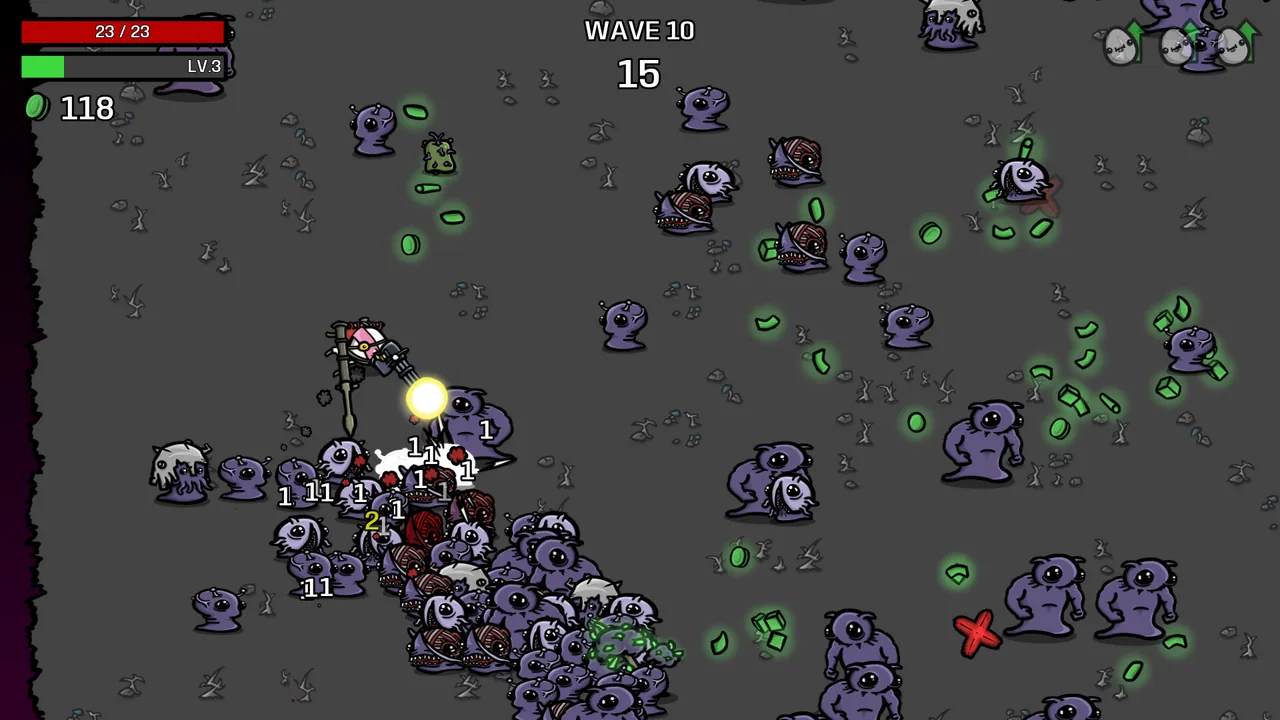
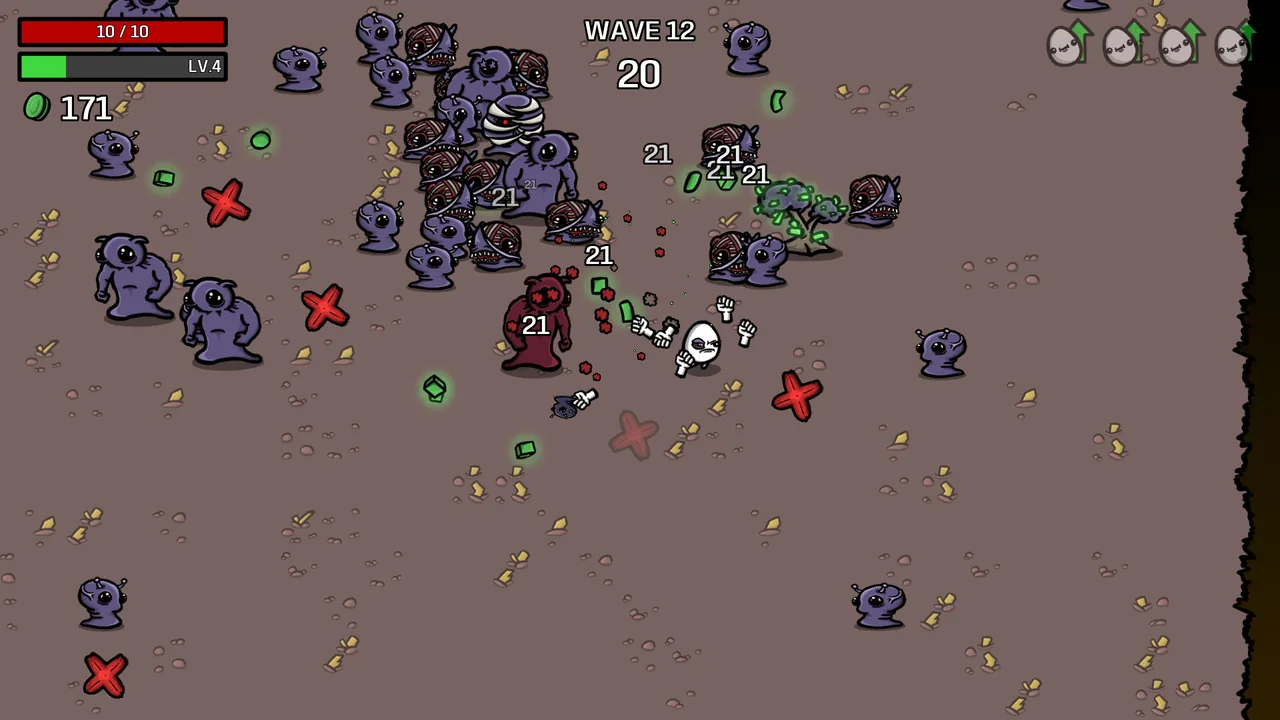
The combat loop is almost aggressively simple: pick a character, drop into a wave that lasts somewhere between twenty seconds and a minute and a half, and try not to die while your equipped weapons — up to six of them, mixing melee and ranged — fire automatically at whatever wanders closest. There's an optional manual-aim toggle, but most builds barely need it. The real decisions happen in the pause between waves, when the game hands you a shop of four random items and a currency you earned by killing things and picking up the materials they drop.
That shop is where Brotato actually asks you to think. Every offer can be rerolled for a material cost that rises as the run goes on, every item slot can be locked to guarantee it reappears, and every unwanted item can be sold back for a fraction of its price — so the question every wave boils down to is whether you spend your materials pushing your current build further, banking them for a bigger reroll later, or cutting your losses on a weapon that isn't working out. It's a tight little economy, and it's tighter than the "just buy the biggest number" logic that a lot of games in this genre lean on, because a weapon or stat item's actual value depends entirely on what else is already in your six weapon slots and four stat-item slots. A flat damage item is worth very little to a build already stacked on elemental chance; an armor item matters enormously to a melee-heavy build and barely at all to a ranged one sitting at the edge of the arena. Reading that interaction, wave after wave, is the whole game in miniature.
Stat stacking, and the six-weapon myth
Brotato's stat sheet is deep for a game that looks this unassuming: max HP, HP regeneration, armor, dodge, speed, attack damage, attack speed, elemental chance, life steal, engineering, harvesting and luck all sit on the character screen at once, and nearly every item in the shop touches at least one of them. The interesting design decision is that weapons don't scale off a single generic "damage" stat — melee weapons care about different multipliers than ranged weapons, elemental weapons care about entirely separate ones, and structures placed by engineering-focused items scale off a stat most builds never touch at all. That's a genuinely clever piece of design, because it means the item you're looking for in the shop changes completely depending on which of those weapon families you've committed to, not just how far into a run you are.
It also exposes the game's one persistent bit of false advertising: six weapon slots sound like an invitation to run six different guns, but the strongest loadouts almost never work that way. Picking up a duplicate of a weapon you already own merges it into a stronger, higher-level copy instead of adding a seventh source of variety, and a levelled-up weapon reliably outperforms a fresh unlevelled one taking up the same slot. The result is that most winning runs consolidate around two or three weapon types pushed to their maximum level rather than six distinct ones, and the headline "six weapons at once" framing oversells a loadout that, in practice, rewards narrowing your focus rather than diversifying it.
Characters as build modifiers, not skins
The roster, now well past forty characters, is the game's cleverest piece of long-term design. Each one changes your starting stats, adds a passive rule and often locks or unlocks entire categories of item — a character built around melee weapons starts with ranged damage penalised into uselessness, one built around engineering starts with almost no personal combat stats and leans entirely on turrets and structures instead, and several restrict which items can even appear in your shop at all. That's a meaningfully different design ask each time, and it's the reason Brotato holds up to dozens of hours better than a game with this plain a combat loop has any right to: the character select screen is doing real strategic work, not just cosmetic work, and a new character regularly forces you to relearn which stats actually matter for that run.
Danger tiers and where the difficulty actually comes from
Difficulty is set before a run begins, through five Danger tiers that scale enemy health, damage and spawn density rather than changing enemy behaviour. That's a defensible design choice for a game this short — it lets a returning player jump straight to a real challenge instead of replaying an already-solved easy difficulty — but it also means the higher tiers rarely feel tactically different from the lower ones. Enemies don't gain new attack patterns or smarter movement as Danger rises; they just hit harder and die slower, so a lot of the game's late difficulty is really an endurance test on whether your build's damage output outpaces a bigger health bar, rather than a test of reading a genuinely new threat. It's a real limitation, and one the higher Danger tiers never quite talk their way around.
The run-length problem
A standard run is twenty waves, and it's a deliberately short structure — most complete runs land comfortably under half an hour. That works in the game's favour for exactly the reason Brotato's whole audience plays it: it's a phone-in-one-hand, one-more-run kind of game, and a short, tight loop is the right shape for that. But it also means the moment a build actually comes together — when the elemental ticks are stacking, the turrets are covering the whole arena, the numbers are finally doing what you built them to do — is very often somewhere around wave sixteen or seventeen, with only a handful of waves left to enjoy it before the run simply ends. There's a continuation past wave twenty for players chasing a higher score, but it adds escalating enemy stats rather than new content, and it reads as a bonus for optimisers rather than a real second half of the game. The core loop's biggest structural weakness is that its own pacing works against the payoff its systems are built to deliver.
A game that explains almost none of itself
Brotato's tooltips tell you a stat's name and its current value. They very rarely tell you how that stat interacts with anything else — what threshold turns a flat elemental chance into a guaranteed proc, how harvesting actually converts into shop discounts, or why an armor stat feels far more valuable on some characters than others. None of that is hidden as a deliberate mystery to be discovered; it reads as a game that simply never got around to explaining its own systems, and the community wikis exist because the in-game information genuinely isn't enough to build confidently from. That gap is also how the game ends up with a small set of dominant, widely known builds — turret-stacking engineering runs, elemental damage-over-time stacking, and lifesteal-heavy melee loops chief among them — that comfortably clear the highest Danger tier once a player has looked them up, in a way the game's own tutorial never points toward. A player who never reads outside the game will have a noticeably harder and less informed time than one who spends ten minutes on a wiki first, and that's a fair criticism of a game that otherwise respects a player's time everywhere else.
Presentation and performance
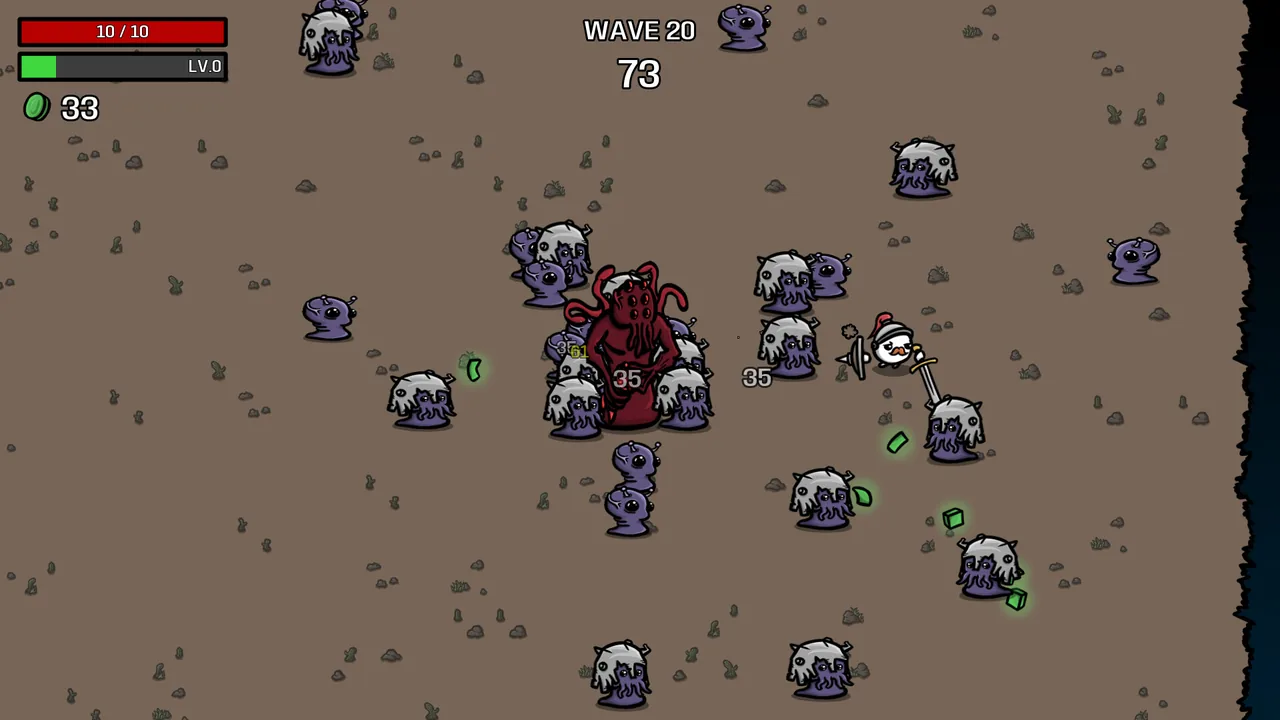
Visually, Brotato is unapologetically plain: flat top-down sprites, a muted arena, and enemy silhouettes that mostly read by shape and colour rather than any real character design. It does its job — you can tell what's about to hit you even when a wave's screen fills with a dozen enemy types and every weapon's projectile trail at once — but it has no visual identity of its own, and it's a noticeably rougher look than most of the genre's better-known entries. The soundtrack fares better: a synth-driven, faintly retro score that suits the arena's chaos without demanding attention, composed well enough that Blobfish sells it separately as its own DLC. Performance holds up cleanly even once a wave is thick with enemies, structures and projectiles, which matters more than the art style does once a run is thirty seconds from a wave's end and the whole screen is moving.
DLC and value
Brotato's base price is NZ$7.39 on Steam, currently discounted 40% to NZ$4.43, and that alone undercuts nearly everything else in the survivors-like space. Two DLC packs exist alongside it: Abyssal Terrors, released October 2024 at NZ$5.99 (now NZ$4.79 at 20% off), adds an underwater biome with twenty new waves, fourteen new characters, sixteen new weapons and dozens of new items, and shipped alongside a free local co-op patch — it's a substantial, genuinely build-altering expansion rather than a reskin. A Brotato Soundtrack DLC at NZ$7.39 (NZ$5.91 discounted) is a pure music purchase with no gameplay content attached. A third expansion, Primal Dread, was announced for 2026 with a dinosaur-themed map, a new character, new weapons and another twenty waves, but it remains unreleased and unpriced as of this review. None of it sits behind a subscription or a premium currency, and the base game alone comfortably justifies its asking price before any DLC purchase is considered.
Verdict
Eight out of ten. Brotato's shop economy and character roster do a lot of quiet, clever design work underneath a presentation that never bothers to sell itself, and the result is a genuinely strong twenty-minute loop that's hard to beat for the price. What holds it back from the top tier its review numbers suggest is specific rather than vague: the visuals are plain even for this genre, a short list of known builds solves most of the difficulty ladder once discovered, the game explains almost none of its own stat interactions, and the pacing of a standard run means the moment a build finally clicks is usually the moment it's about to end. Buy it — at this price there's barely a reason not to — but go in knowing a wiki tab open in the background will teach you more about your own build than the game ever will. Players who like watching a system compound through careful, deliberate choices between short bursts of action, rather than through idle ticks on a clock, will find a familiar kind of satisfaction here even without any away-time progression attached to it.
Pricing and DLC details checked 30 July 2026.
Pros and cons
Pros
- The between-wave shop's reroll, lock and freeze economy is the actual skill test, not the combat itself
- Forty-plus characters change starting stats and unlock conditions enough to force real strategic pivots, not just cosmetic reskins
- Waves run 20 to 90 seconds and a full run clears in well under thirty minutes, making it one of the most bingeable roguelites available
- Five Danger tiers scale enemy stats independently of your own progress, so a veteran can find a real fight without waiting for a harder unlock
- Local co-op for up to four players plus Remote Play Together turns wave-clearing into a genuine couch activity
- At under five New Zealand dollars discounted, it undercuts almost every other premium entry in its own genre
Cons
- The presentation is plain, function-first programmer art even by survivors-like standards, with little visual identity of its own
- A handful of community-known builds around turret stacking, elemental damage-over-time and lifesteal loops solve most of the difficulty ladder once a player knows them
- Tooltips rarely explain how attack speed, engineering, harvesting and elemental chance actually interact, leaving the real mechanics to community wikis
- Standard runs end at wave twenty just as a snowballing build starts to feel unstoppable, and continuing past it offers little beyond a higher death count
- Six weapon slots read as the headline feature, but the strongest loadouts usually consolidate into two or three duplicated weapons levelled up rather than six different guns
- Higher Danger tiers mostly multiply enemy health and damage rather than introduce new attack patterns, so harder difficulty can feel like the same fight with bigger numbers
Screenshots
-
BrotatoImage: Blobfish via Steam -
BrotatoImage: Blobfish via Steam -
BrotatoImage: Blobfish via Steam -
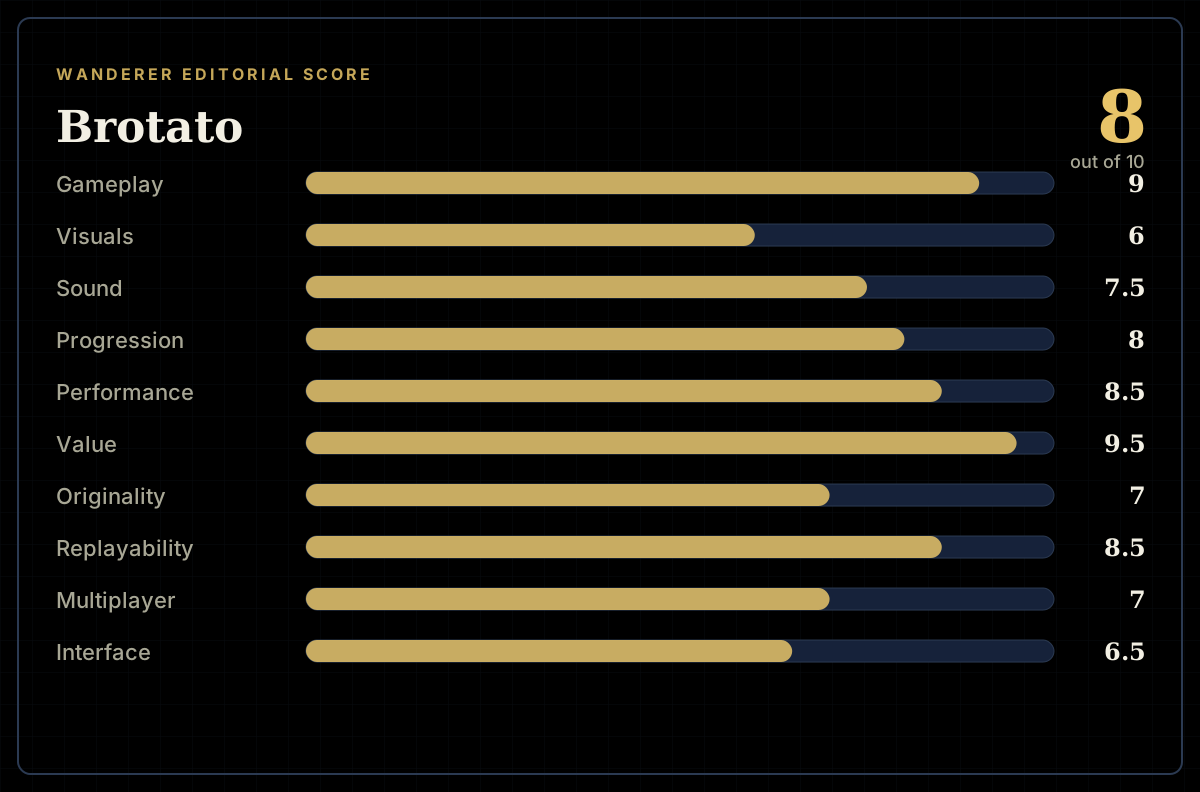
How the review scores each part of the gameWanderer Editorial -
The short versionWanderer Editorial