
Game review
Moose Miners
6 / 10
- Developer
- Lingon Studios
- Publisher
- Lingon Studios
- Released
- 10 May 2024
- Platforms
- Windows
- Genre
- Automation and idle mining-tycoon simulator
- Monetisation
- One-time purchase, no in-game store or additional currency purchases
- Players
- Single-player only
The short version
Moose Miners hands you a mining operation staffed entirely by moose, who dig, cart, and process gems and lumber while you decide where profits go: better gear, deeper rails, more moose, or faster processing. It's a genuinely charming spin on the automation-idler template, and reviewers with enormous playtimes — several past a thousand hours — describe real, sustained enjoyment watching their operation grow. The review sample is deeply split on whether that enjoyment actually lasts, though, with a large, detailed cluster of reviewers describing the exact same structural gap: no prestige or reset system, and no offline progression, meaning the game's content runs out within hours for some players despite the developer's own nearly two-year history of continued updates and unusually hands-on individual bug support.
Biggest strengths
- The core moose-run mining and automation loop is repeatedly described as genuinely charming and satisfying, with reviewers specifically enjoying watching their operation visually grow as more moose, minecarts, and rail lines are added
- The developer has maintained an exceptionally sustained support record, with the events feed showing continuous updates from a 2023 demo period through mid-2026, including a major "New Depths" content expansion and a further "Deeper" update years after launch
- At least one reviewer describes a specific, personal support interaction where the developer directly requested and diagnosed a corrupted save file after roughly 2,500 moose vanished from their game, resolving the issue individually rather than leaving it unaddressed
Biggest weaknesses
- The single most repeated and detailed complaint concerns the total absence of a prestige, ascension, or reset mechanic common to the incremental genre, with multiple long-session reviewers stating directly that once every upgrade is unlocked, there is genuinely nothing further to do
- The game requires being left open and running to make progress, with no offline progression system, an unusual omission for the idle genre that several reviewers specifically flag as a design choice working against the game's own "idler" framing
- Moose pathfinding and positioning are described by multiple reviewers as genuinely poor, with units described as randomly relocating across the map or clustering inefficiently in ways that undermine the automation the game is supposed to be about
Who it's for: Fans of automation and optimisation games who want a charming, visually satisfying "watch it run" experience for a few hours to a few dozen hours, rather than players specifically seeking the long-term prestige-loop structure that defines most incremental games.
Our recommendation: Worth trying, ideally at a discount, for a genuinely charming and often very long first stretch of automation-building satisfaction. Don't expect a prestige system or offline progress to extend that satisfaction indefinitely — reviewers with hundreds of hours logged consistently say the content has a real ceiling.
6 / 10
There's something disarming about the specific image at the center of Moose Miners: a workforce entirely made of moose, digging, hauling, and processing gems while you decide where to spend the proceeds. It's a small, silly hook for what is, underneath, a fairly standard automation-idler structure — hire more workers, upgrade their gear, expand the network, watch the numbers climb. Reviewers describe genuinely losing hours to that structure, sometimes an enormous number of hours. What the review sample argues about, in detail and at length, is whether the game gives those hours anywhere to go once the initial charm wears off.
A loop that genuinely hooks people
The praise in the sample isn't vague. One reviewer, having put in enough time to question their own "mental well-being," describes the appeal precisely: moose that "mine an endless supply of gems, so I can upgrade them... to mine even more gems." Another compares the satisfaction directly to watching an ant colony work, appreciating the game specifically as a "second monitor" companion they check in on periodically rather than a game demanding full attention. Multiple reviewers separately praise how visually legible the automation is — you can watch your rail network, your moose, and your processing stations all working simultaneously, which several describe as more satisfying than idle games that abstract their systems into pure numbers.
The complaint that dominates the negative sample
Set against that appeal is a remarkably consistent structural criticism, repeated across reviewers with wildly different playtimes. "There's zero depth to this game. After about ~2 hours, you've seen everything the game has to offer," one reviewer writes, checking achievements specifically to see "if there's any ascendancy or something to keep me going" and finding nothing. A reviewer with over 64,000 minutes — more than 1,000 hours — logged, having 100% completed the game more than once, states plainly: "the game doesn't scale between getting started and mid to late stages," describing themselves as simply "waiting for the moose to mine the entire map" once every upgrade is exhausted. This isn't a complaint from players who bounced off quickly — it's coming specifically from the most invested people in the entire sample, which makes it a harder complaint to dismiss than if it came only from short-session reviews.
No offline progress, in a genre built around it
A related, more specific design choice draws its own separate criticism: the game requires being left open and running to make any progress at all, with no offline accumulation system. "This game calls itself an idle game, but it requires constant human input," one reviewer writes, noting that "not even the most important function, the rail building, has an auto buy." Another frames the absence of a reset mechanic as the clearest sign the game skipped a genre fundamental: "the dev skipped everything that makes other idlers good and called it a" finished product. Whether or not that framing is fair to a small studio's first release, it reflects a real and specific expectation gap between what "idle game" tends to promise and what this particular game delivers.
Real, specific technical friction
Beyond the structural complaints, reviewers raise concrete interface and AI problems. Moose positioning and pathfinding draw repeated criticism, with one detailed account describing units that "randomly just pick up and trek to the opposite side of the map" without clear cause, undermining the manual optimisation the automation genre is built around. Separately, dialog boxes are reported to have close buttons that don't reliably work, and clicking a buy menu can sometimes select an item positioned behind the panel rather than the one actually intended. None of these read as severe on their own, but their specificity and repetition across independent reviewers suggests real, reproducible issues rather than isolated bad luck.
A support record that genuinely complicates the "abandoned" narrative
Whatever else is true about the game's content depth, this review can confirm directly that Lingon Studios has not walked away from it. The events feed shows a dense, nearly continuous cadence of patches and content updates stretching from a pre-launch demo period in late 2023 through a spin-off game announcement in June 2026 — nearly two and a half years of visible activity, including a substantial "New Depths" content update in December 2024 and a further "Deeper" expansion in February 2026. One reviewer goes further than the patch notes alone can show, describing a personal support interaction: after roughly 2,500 moose vanished from their save for no apparent reason, they raised the issue directly with the developer, who requested the save file and diagnosed the problem individually. That's a specific, verifiable-sounding account of hands-on support well beyond what a small studio is typically expected to provide, and it stands in real tension with reviewer complaints elsewhere in the sample that the developer "skipped" fundamentals — the studio has clearly kept working, even if the specific fundamentals some players want most, a prestige loop and offline progress, haven't arrived.
A cautionary account about a "fix" that made things worse
Not every update in that long history landed cleanly. One extremely long-session reviewer, with over 32,000 minutes logged, describes a specific regression: a content update intended to add depth instead introduced scaling problems severe enough that reaching upgrade costs became effectively unachievable, forcing "almost 5 weeks of leaving my desktop on" just to re-reach the 100% completion they'd already had before the update. That's a serious account of a patch actively making the experience worse for a dedicated player, not just failing to add enough — worth weighing directly against the broader praise for the developer's support record above.
Final verdict
Moose Miners is a genuinely charming, often deeply engaging automation game hobbled by one specific, well-documented structural choice: no prestige system, no offline progress, and — according to a wide and detailed cluster of its most invested players — a content ceiling that arrives faster than the genre's conventions would lead you to expect. The developer's support record is unusually strong for a small studio, including hands-on individual bug fixes and nearly two and a half years of continued content, which makes the "abandoned" framing some reviewers reach for inaccurate even as their underlying complaint about missing genre fundamentals remains fair. Buy it for a genuinely fun first stretch — for many players, a very long one — but go in aware that the incremental genre's usual answer to "what happens after you unlock everything" isn't really here yet.
Pros and cons
Pros
- The core moose-run mining and automation loop is repeatedly described as genuinely charming and satisfying, with reviewers specifically enjoying watching their operation visually grow as more moose, minecarts, and rail lines are added
- The developer has maintained an exceptionally sustained support record, with the events feed showing continuous updates from a 2023 demo period through mid-2026, including a major "New Depths" content expansion and a further "Deeper" update years after launch
- At least one reviewer describes a specific, personal support interaction where the developer directly requested and diagnosed a corrupted save file after roughly 2,500 moose vanished from their game, resolving the issue individually rather than leaving it unaddressed
- Reviewers report the game runs unusually smoothly even at very large scale, with one specifically praising its stability compared to other idle games that tend to crash the longer they're left running
- Genuinely enormous playtimes appear throughout the sample, including multiple reviewers past 15,000 minutes and at least one past 64,000 minutes (over 1,000 hours), a strong signal the core loop has real staying power for a meaningful share of its audience
Cons
- The single most repeated and detailed complaint concerns the total absence of a prestige, ascension, or reset mechanic common to the incremental genre, with multiple long-session reviewers stating directly that once every upgrade is unlocked, there is genuinely nothing further to do
- The game requires being left open and running to make progress, with no offline progression system, an unusual omission for the idle genre that several reviewers specifically flag as a design choice working against the game's own "idler" framing
- Moose pathfinding and positioning are described by multiple reviewers as genuinely poor, with units described as randomly relocating across the map or clustering inefficiently in ways that undermine the automation the game is supposed to be about
- Specific, repeated interface bugs are reported, including dialog close buttons that don't reliably work and buy-menu clicks that can select the wrong item positioned behind an open panel
- At least one detailed, extremely long-session reviewer reports that a major content update intended to add depth instead introduced poor scaling and unachievable upgrade costs, describing nearly five weeks of leaving the game running just to re-reach 100% completion after the change
Screenshots
-

Moose MinersImage: Lingon Studios via Steam -

Moose MinersImage: Lingon Studios via Steam -

Moose MinersImage: Lingon Studios via Steam -
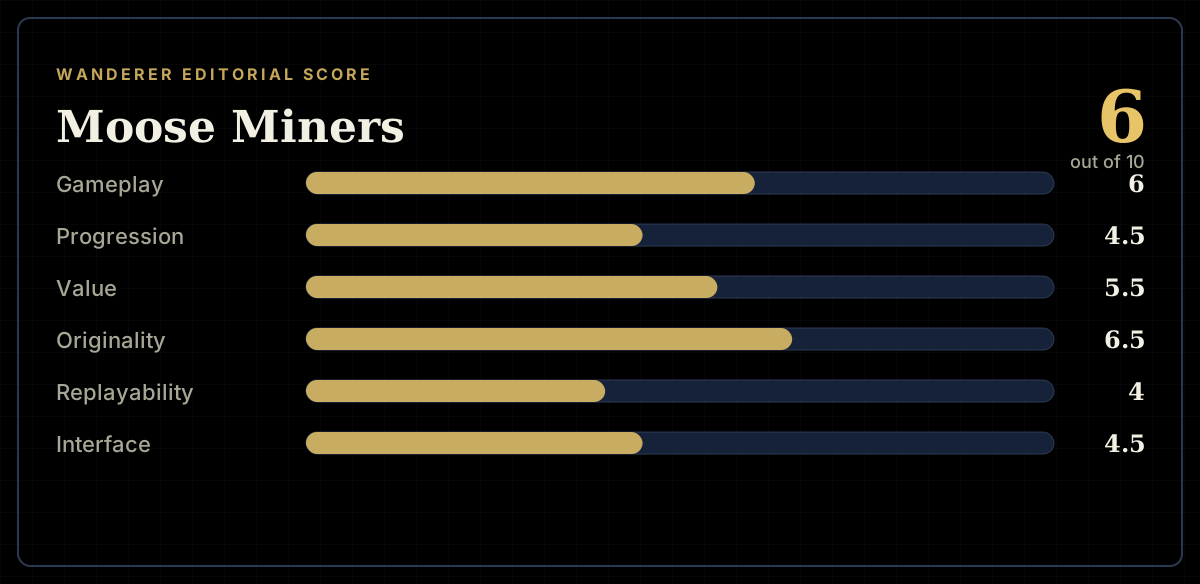
How the review scores each part of the gameWanderer Editorial -
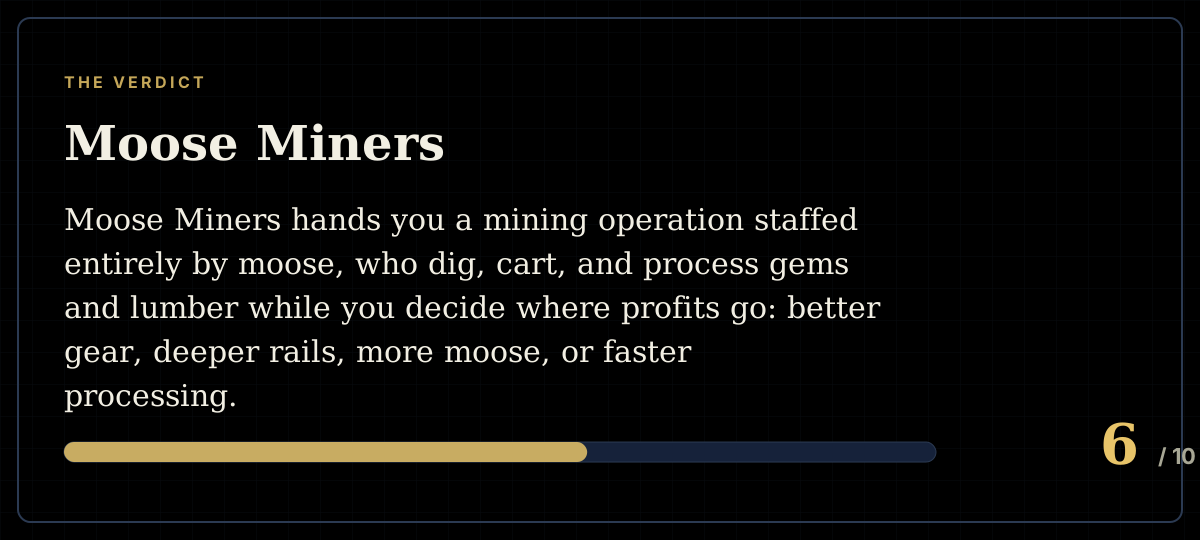
The short versionWanderer Editorial