
Game review
Deep Space Tavern
6 / 10
- Developer
- World Away Games
- Publisher
- World Away Games
- Released
- 27 September 2024
- Platforms
- Windows
- Genre
- Clicker management sim
- Monetisation
- One-time purchase, no in-game store found in official materials or player reviews
- Players
- Single-player only
The short version
Deep Space Tavern casts you as the sole manager of a desert-planet space cantina, firing drinks at patrons with a wall-mounted blaster and mopping up the inevitable mess while a Scottish AI robot narrates. That single joke carries the game a long way, and reviewers who stuck around praise the presentation, the voice acting and the satisfaction of automating drink service as more rooms unlock. What holds it back is a pattern reviewers describe consistently and Steam's own achievement data confirms objectively: the systems that decide what actually attracts new patrons are left unexplained, and the number of players reaching even the mid-tier milestones falls off a cliff well before full completion.
Biggest strengths
- The core hook — firing drinks at patrons with a wall-mounted blaster, then cleaning up the vomit that follows — is repeatedly described as charming and immediately addictive, several reviewers reporting they meant to play five minutes and stayed much longer
- Scottish voice acting for the tavern's AI assistant draws specific, repeated praise across the review sample, alongside a stylised art direction reviewers call polished for what appears to be a small or solo-developed project
- Automation unlocks — auto drink-servicing and auto coin-collecting as rooms are built out — give the mid-game a real sense of progression that several reviewers single out as the most satisfying part of the loop
Biggest weaknesses
- Multiple reviewers, including one with over nine hours logged, say the game never clearly explains what actually attracts new patrons, leaving furnishing and decoration choices feeling like guesswork rather than strategy
- Steam's own achievement data shows a severe drop-off rather than a gradual taper — 93.8% of players fire their first ten drinks, but only 6.7% ever buy all the rooms and as few as 2.5% reach the seventieth-patron milestone
- A specific complaint calls the loop "too simple for the asking price," arguing that free-to-play clickers offer comparably more content, a criticism echoed by a second reviewer who found the game "empty and boring" within about an hour despite buying every available entertainment item
Who it's for: Players who want a short, funny, low-stakes management clicker for an afternoon rather than a deep systems game, and who don't mind a loop that plateaus once the initial charm wears off.
Our recommendation: Worth the low asking price for a couple of enjoyable, genuinely funny hours, especially if the Theme Hospital-style humour and Scottish narration appeal — just don't expect the patron-growth and unlock systems to be clearly explained or to hold up much past the first several rooms.
6 / 10
The pitch for Deep Space Tavern is almost entirely contained in one sentence on its own store page: "here in the Deep Space Tavern you can pick up, play and expand with the click of a button." You run a bar on a desert planet, firing drinks at patrons from a wall-mounted blaster, expanding into new rooms as cash rolls in, and periodically mopping up the vomit that comes with running any halfway-successful cantina. It's a small, silly premise executed with a level of polish reviewers repeatedly call surprising for what several believe is a solo or small-team project — and it's also, by the same reviewers' own accounts, a game whose systems stop rewarding attention well before most players would consider it finished.
A joke that earns its charm
The drink-firing mechanic is the game's calling card, and it lands. One reviewer compares the whole experience to "the Star Wars Mos Eisley bar," another to "Tapper mixed with the Sims and Roller Coaster Tycoon with all the vomit," and a third explicitly credits the comedic tone to the Theme Hospital and Theme Park lineage. What ties those comparisons together is a shared appreciation for a management game that leans fully into chaos and mess rather than playing bar ownership straight — "cleaning up puke has never been so rewarding," as one review puts it. The single most-repeated specific compliment across the sample is the voice acting: a Scottish AI assistant narrates the whole affair, and reviewer after reviewer calls it out by name as a highlight, alongside a stylised art direction and sound design that multiple reviews describe as "crisp" and "on point."
Automation is where the loop actually clicks
Beyond the initial gag, the game's structure follows a familiar clicker shape: cash from served drinks funds new rooms, furnishings and eventually automation upgrades that let drinks serve and coins collect themselves. Reviewers who played longer sessions single this progression out specifically — one describes building out six rooms and setting each up to run "as efficient as I can with auto drink servicing and coin collecting" as the appeal of longer play, and another calls the automation options "very satisfying" as they layer in. That's the strongest evidence the core loop has real legs beyond its opening joke, at least for the stretch of content most reviewers actually experienced.
The part nobody can quite explain
Set against that is a specific, recurring complaint that shows up independently in multiple reviews rather than as an isolated gripe: the game doesn't clearly communicate what actually draws new patrons in. One reviewer, who backed their account with a full video review after 558 minutes of play, puts it directly: "the purpose of the game is to gather customers, but we do not know exactly what they want from us. We can add tables, entertainment or decorations that may attract new people, but we really [don't know if it's working]." A second reviewer describes building an entire "arcade" of every available entertainment item and still waiting with no clear payoff, concluding the game "seems empty and boring" within about an hour despite investing in the systems as instructed. This is a specific, checkable gap in the design rather than a vague complaint about difficulty, and it's echoed by two reviewers independently rather than resting on one account alone.
The numbers back the thinning-out complaint
Steam's own achievement data gives this an objective backbone. Early milestones are cleared by almost everyone — 93.8% of players fire ten drinks, 92.1% burn ten pieces of trash — but the curve doesn't taper gently from there, it collapses. Only 57% ever collect ten patrons, just 24.7% reach twenty, and by the seventieth-patron milestone only 2.5% of the playerbase remains. Buying every room in the tavern, the game's closest thing to full completion, has been done by just 6.7% of players. That's a much steeper drop than a well-paced clicker typically shows, and it lines up precisely with the reviewer complaints above: if the systems that grow your patron count aren't legible, most players plausibly stall out at a comfortable early plateau rather than pushing toward the game's stated endgame.
A quieter case for value
The price-versus-content argument shows up directly in the negative reviews, and it's worth stating plainly rather than dismissing. One reviewer with only 27 minutes logged calls it "too simple for the asking price," pointing out that "some free-to-play clickers offer more" for nothing at all. That's a fair comparison to raise for a genre where the free tier is enormous, even if it undersells what the automation-driven mid-game offers to players who push past the first half hour. A more measured version of the same critique comes from a reviewer who enjoyed their time but explicitly hopes "in future update more stuff like furniture and stuff will be added," calling the current release "a very good solid base" rather than a complete package — a generous read from someone who liked the game, but one that still concedes the content on offer is limited.
No visible follow-through since launch
One factual data point is worth reporting on its own terms: Deep Space Tavern's Steam events feed contains exactly three posts as of this review — a January 2024 "coming in 2024" announcement and two developer livestreams in June 2024, all before the September 2024 release. No post-launch update, patch note or content announcement appears on the feed at all. That doesn't necessarily mean the game hasn't been quietly patched — smaller studios sometimes skip the news-post step entirely — but it does mean there's no public record confirming the additional furniture and content that at least one enthusiastic early reviewer was hoping for, and it's consistent with the achievement curve's evidence that most players' experience ends well short of the tavern's full room count.
Final verdict
Deep Space Tavern gets its central joke right: shooting drinks at aliens and cleaning up the aftermath, narrated by a deadpan Scottish robot, is genuinely funny and the presentation backing it up is better than its modest price tag would suggest. The automation-driven mid-game gives that joke somewhere to go for an hour or two. But the systems governing what actually grows your tavern are left unclear rather than merely challenging, and both reviewer testimony and Steam's own achievement completion data agree that most players' interest — and progress — runs out well before the content does. At its current price it's a reasonable, low-risk pick for an entertaining afternoon; just don't expect the patron-growth loop to hold up to close scrutiny, or for the game to keep giving you reasons to stay much past that.
Pros and cons
Pros
- The core hook — firing drinks at patrons with a wall-mounted blaster, then cleaning up the vomit that follows — is repeatedly described as charming and immediately addictive, several reviewers reporting they meant to play five minutes and stayed much longer
- Scottish voice acting for the tavern's AI assistant draws specific, repeated praise across the review sample, alongside a stylised art direction reviewers call polished for what appears to be a small or solo-developed project
- Automation unlocks — auto drink-servicing and auto coin-collecting as rooms are built out — give the mid-game a real sense of progression that several reviewers single out as the most satisfying part of the loop
- A comedic tone in the Theme Hospital/Theme Park tradition, leaning into the mess and chaos of running a bar rather than playing it straight, comes through as a deliberate and successful choice for multiple reviewers
- No reviewer in the sample reports any in-game store, premium currency or monetisation pressure beyond the upfront purchase price
Cons
- Multiple reviewers, including one with over nine hours logged, say the game never clearly explains what actually attracts new patrons, leaving furnishing and decoration choices feeling like guesswork rather than strategy
- Steam's own achievement data shows a severe drop-off rather than a gradual taper — 93.8% of players fire their first ten drinks, but only 6.7% ever buy all the rooms and as few as 2.5% reach the seventieth-patron milestone
- A specific complaint calls the loop "too simple for the asking price," arguing that free-to-play clickers offer comparably more content, a criticism echoed by a second reviewer who found the game "empty and boring" within about an hour despite buying every available entertainment item
- One early, enthusiastic reviewer explicitly hopes future updates will add more furniture and content, describing the current release as "a very good solid base" rather than a finished feature set
- The game's own Steam events feed shows no post-launch update announcements at all as of this review — only two pre-release developer livestreams and a "coming in 2024" announcement — leaving no visible evidence of the further content reviewers were hoping for
Screenshots
-

Deep Space TavernImage: World Away Games via Steam -

Deep Space TavernImage: World Away Games via Steam -

Deep Space TavernImage: World Away Games via Steam -
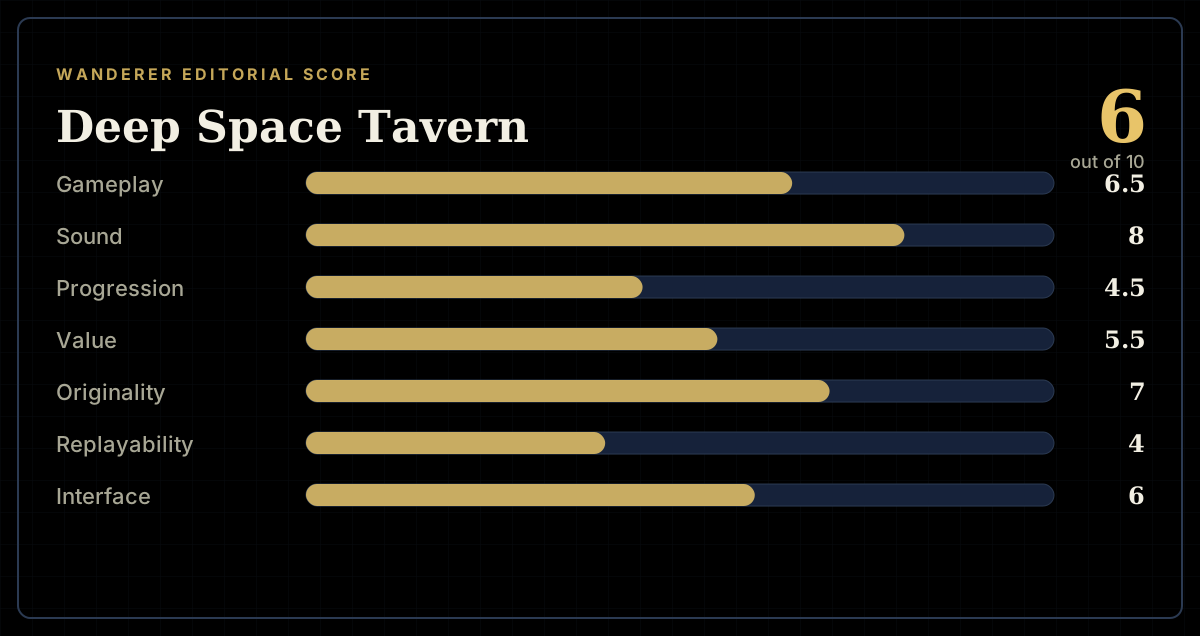
How the review scores each part of the gameWanderer Editorial -
The short versionWanderer Editorial