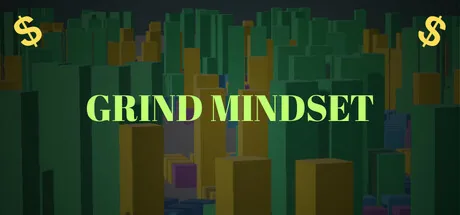
Game review
Grind Mindset
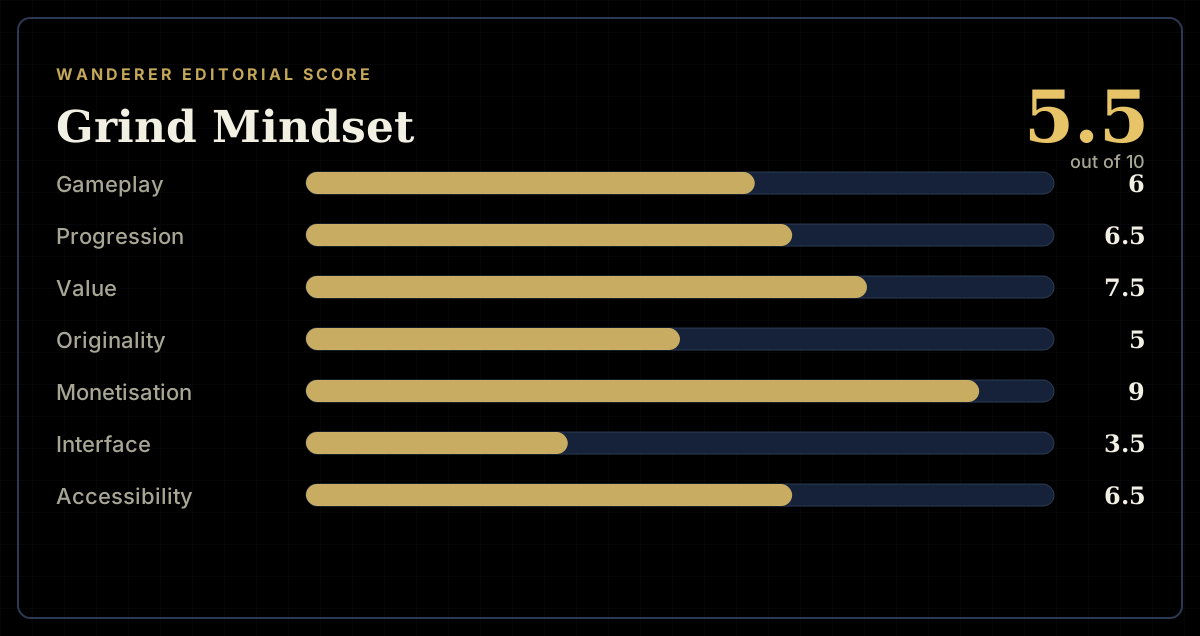
5.5 / 10
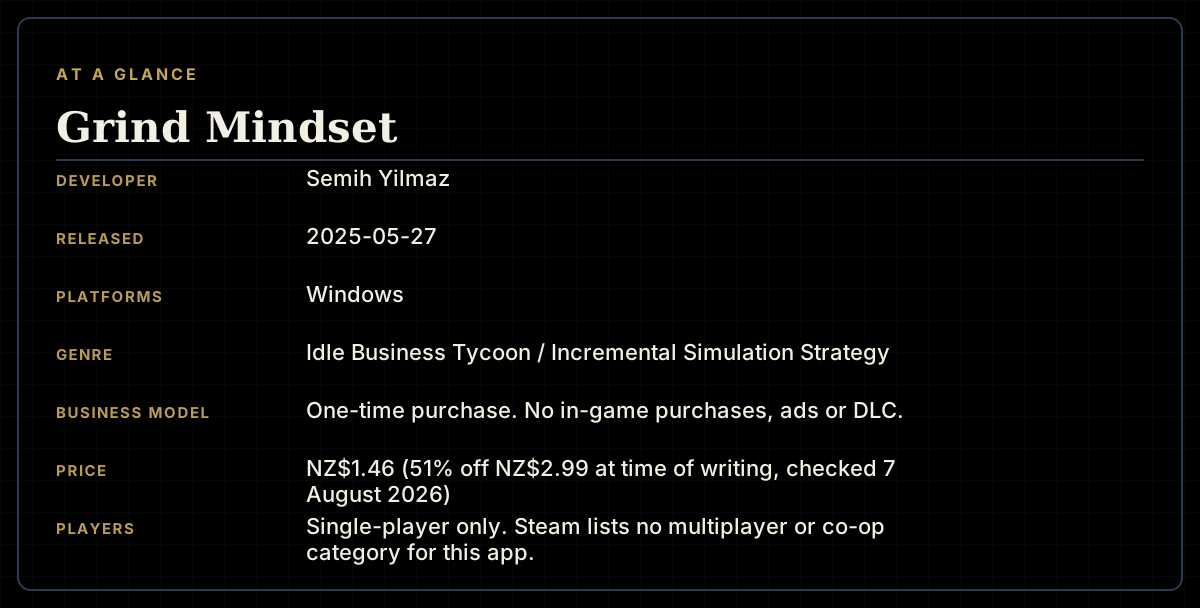
- Developer
- Semih Yilmaz
- Publisher
- Semih Yilmaz
- Released
- 27 May 2025
- Platforms
- Windows
- Genre
- Idle Business Tycoon / Incremental Simulation Strategy
- Monetisation
- One-time purchase. No in-game purchases, ads or DLC.
- Players
- Single-player only. Steam lists no multiplayer or co-op category for this app.
The short version
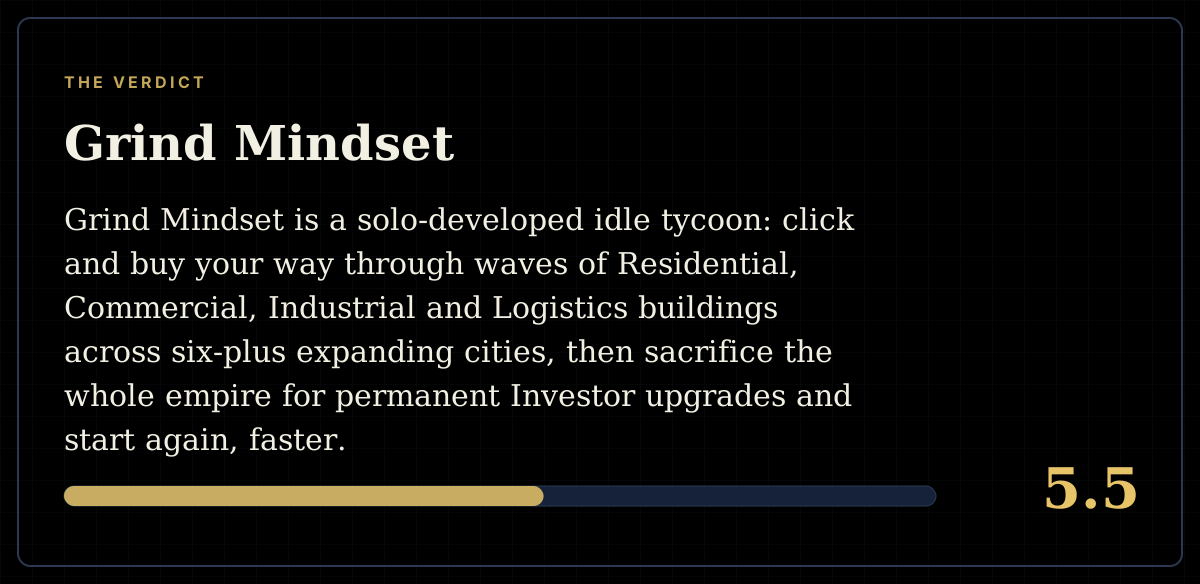
Grind Mindset is a solo-developed idle tycoon: click and buy your way through waves of Residential, Commercial, Industrial and Logistics buildings across six-plus expanding cities, then sacrifice the whole empire for permanent Investor upgrades and start again, faster. The official Steam genres — Casual, Indie, Simulation, Strategy — undersell it; the store's own vote-weighted tags put **Simulation (53)**, **Incremental (48)** and **Idler (42)** at the top, which is the honest description. The systems are more thoughtfully built than the price suggests, including an inflation mechanic that visibly raises building costs after every purchase, exactly as the store page promises.
The real review corpus is minuscule — **7 total, 5 in English** — every one of them read for this piece. The single most-upvoted review is a credible, specific complaint: the game never autosaves, and skipping the manual Save Game button can cost hours of progress. Valve's achievement API returns an empty schema; there are no achievements at all, something a second reviewer asked for in the first week. The developer shipped three patches in the 48 hours after launch and nothing since — over fourteen months of silence on both problems.
Biggest strengths
- An inflation mechanic that genuinely raises a city's prices after your own purchases, matching what the store page promises rather than just naming it
- The Inherit prestige loop hands out permanent, stacking Investor upgrades (three levels each, across four building categories) rather than a cosmetic reset
- Four distinct building types across expanding cities give the ladder more shape than a single number going up
Biggest weaknesses
- No autosave — the game's own top-voted review reports losing hours of progress from forgetting to click Save Game, and nothing has addressed it since
- Zero achievements exist; Valve's global achievement API returns an empty schema, and a review requesting them a week after launch went unanswered
- Development stopped after three patches inside the first 48 hours; the game has had no updates in over fourteen months
Who it's for: Idle-genre regulars who want a cheap, honest AdVenture-Capitalist-style building ladder with a real prestige loop, and who will remember to hit Save Game before they close it. Not for anyone who wants achievements, a tutorial, or any confidence that a bug will ever be patched.
Our recommendation: Worth the NZ$1.46 asking price for the systems it actually has — the inflation mechanic and the Investor prestige tree are more than a cash-grab clicker usually bothers with. Save constantly and don't expect anything to change; this is a finished-and-abandoned product, not a live one.
5.5 / 10
Six screenshots is all Grind Mindset's Steam page offers, and one of them is worth more than the store description. It shows a modal window titled "Inflation Alert" warning that building prices in City 1 have gone up because of a purchase the player just made. That's not a vague flavour line — it's the exact mechanic the store page promises ("manage inflation caused by your own success") actually wired into the game and visible on screen. A lot of NZ$1.46 idle games promise systems they don't build. This one, mostly, did.
What it actually is
The aggregator tag on this one is Idler, and the library's genre priority puts idle games near the top of the queue regardless. Steam's official genre line — Casual, Indie, Simulation, Strategy — is accurate but generic enough to describe half the store. The vote-weighted community tags, pulled from the store page's own tag-modal script rather than the ordered pills under the screenshots, settle it more precisely:
| Tag | Votes |
|---|---|
| Simulation | 53 |
| Incremental | 48 |
| Idler | 42 |
| Casual | 41 |
| Strategy | 39 |
| Capitalism | 39 |
| Minimalist | 36 |
| Singleplayer | 27 |
| 2D | 25 |
| Modern | 23 |
| Indie | 21 |
| Procedural Generation | 17 |
Unlike several other small releases this week, the framing holds up: Simulation, Incremental and Idler are the top three tags, tightly clustered, and Capitalism sits right behind them. This is a business-empire clicker in the AdVenture Capitalist mould — buy buildings, watch income tick up, click to accelerate the early game, eventually prestige — and the tags describe exactly that. The "Idler" aggregator tag for once wasn't wrong; it just wasn't the whole picture, since Incremental and outright Capitalism-flavoured tycoon design carry equal weight.
The loop, screenshot by screenshot
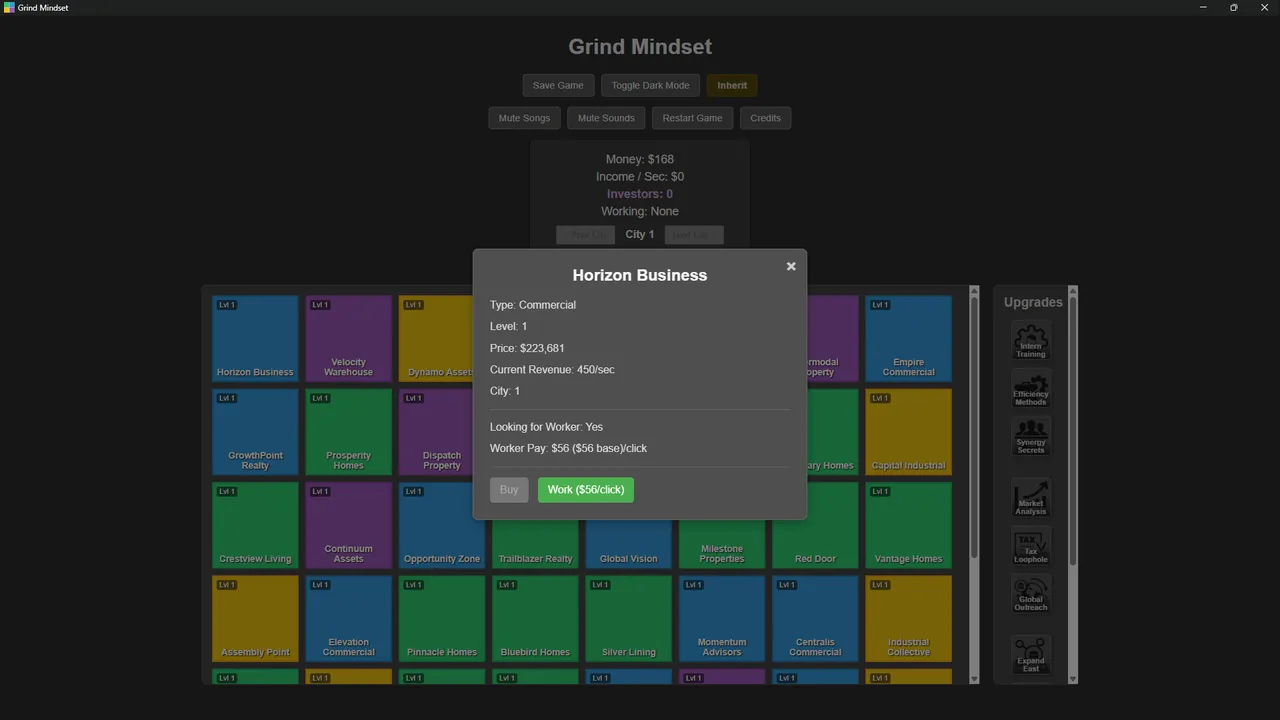
The opening screen drops the player into City 1 with a grid of unowned buildings — Horizon Business, Velocity Warehouse, Dynamo Assets — each colour-coded by type: blue and green for different Commercial and Residential mixes, purple for Logistics, gold for Industrial. Money starts at $168 and income at $0 per second, so the earliest minutes are pure clicking: a "Work ($56/click)" button on an unbought building lets the player manually earn toward their first purchase before any passive income exists.
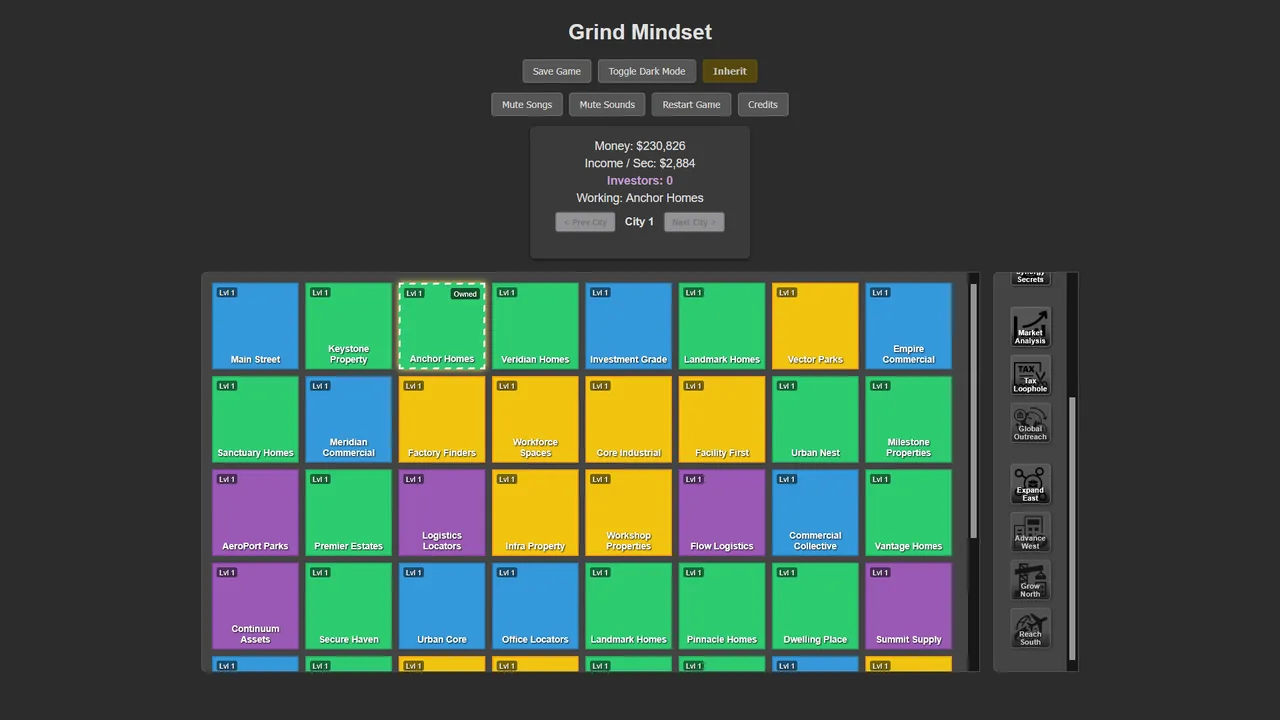
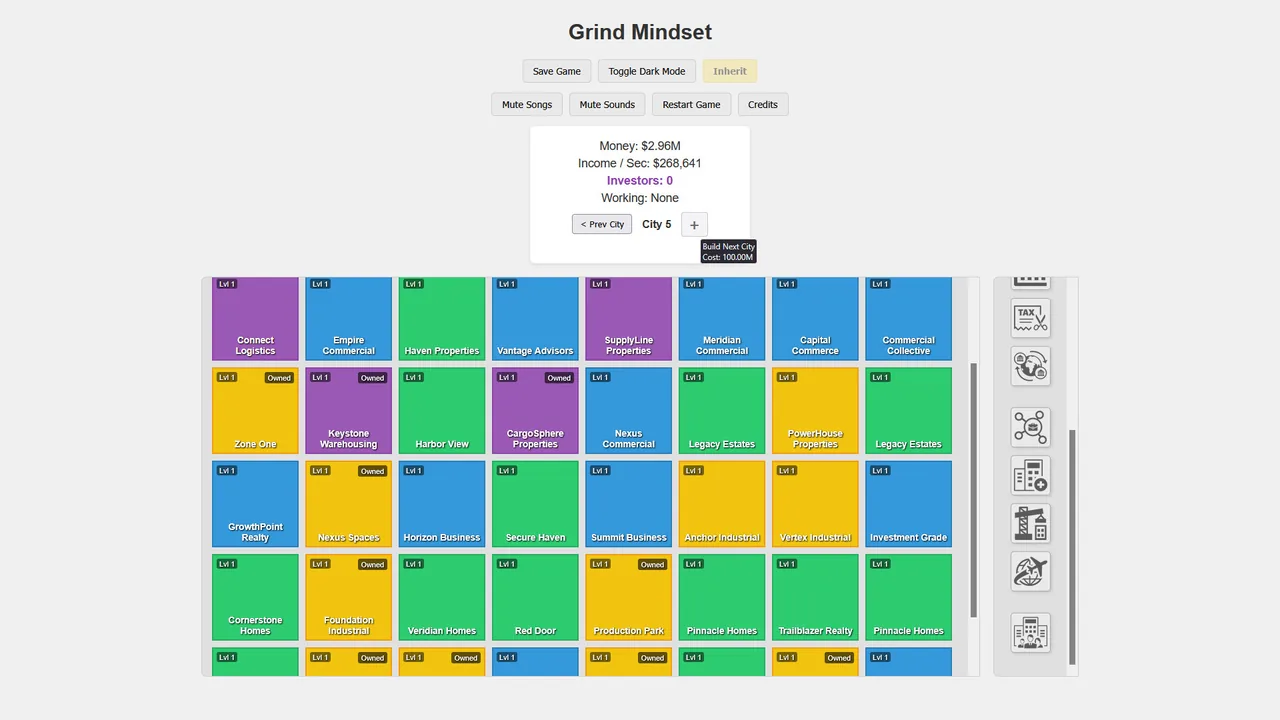
By the time a save file has a few owned buildings, income starts compounding — one screenshot shows $2,884 a second with a single building actively worked for bonus pay. Five cities in, that number is $268,641 a second against a bank of $2.96 million, and building a sixth city costs a flat $100 million. New cities start nearly empty — Grind Mindset's sixth screenshot shows City 6 with exactly two buildings placed and a "+" button waiting for more — so the ladder resets in miniature every time the player expands geography, which is a real design decision rather than an afterthought.
A right-hand upgrade rail runs alongside the building grid the whole time: Intern Training, Efficiency Methods, Synergy Secrets, Market Analysis, Tax Loophole, Global Outreach, and then a second row — Expand East, Advance West, Grow North, Reach South — that unlocks more grid space within a city rather than just multiplying a number. Individual buildings have their own upgrade path too: one screenshot shows SeaLink Logistics, a Level 1 Logistics building worth $4.56 million, offering a further $1.94 million upgrade for a flat +20% revenue boost, alongside a "Work (+5.0% Base Boost)" button that rewards actively clicking a specific building instead of leaving everything on autopilot.
The prestige system is the best-built part
Grind Mindset's "Inherit" button is a genuine prestige reset, not a cosmetic label. Triggering it in the captured screenshot grants 1 Investor and opens an Investor Upgrades panel: Commercial Focus, Residential Boom, Industrial Revolution and Logistics Network, one multiplier per building category, each capped at level 3 and each costing Investors rather than in-run cash. The panel states plainly that these upgrades "persist through every new beginning" — permanent power that survives a reset, spent on choosing which of the four economies to specialise in on the next run. That's a properly-designed incremental prestige tree, the kind of system AdVenture Capitalist built its whole design around, present here in a game that costs less than a bus fare.
A corpus too small to hide anything
Grind Mindset has 7 Steam reviews in total, 5 of them in English, and every single one was read for this piece — there's no meaningful way to sample a corpus that size, so completeness isn't a boast, it's the only option. All-language sentiment is 6 positive to 1 negative; English alone is 4 to 1. Two more reviews are Turkish, both positive, which is a plausible thread to pull given the developer's own name — but two reviews is nowhere near the scale that turned a language split into a real finding elsewhere in this library, so the honest conclusion is that there isn't one here.
The one negative review is also the most-upvoted review the game has, in any language, at four votes: "Nothing to it and it never autosaves. Make sure you hit save or you will lose hours of progress. 1/5 - Nothing to it, broken saves." Its author had played 253 minutes — over four hours, longer than the median of the six positive reviews (129 minutes, a little over two hours) — which matches this library's usual pattern that the more invested a negative reviewer is, the more the complaint is worth taking seriously rather than discounting as a bounce-off.
A second review, from a player who logged 697 minutes (over eleven hours, the longest playtime in the corpus and clearly the most invested account here), still recommends the game but adds: "the game is good but a tutorial section needs to be added because the game is too complicated." A third, at 31 minutes, separately asks for achievements and clearer upgrade descriptions. Every one of these is a specific, actionable, unaddressed request — not vague grumbling.
Nothing was ever fixed
Valve's GetGlobalAchievementPercentagesForApp endpoint returns a bare empty object for this appid — not a small sample, not a skewed curve, an empty schema. Grind Mindset shipped with no achievements and still has none, which lines up exactly with the reviewer asking for them in the first week.
The news feed backs up the "nothing was ever fixed" reading with dates. Grind Mindset released 27 May 2025 and posted three updates: a hotfix the same day for a launch failure on some configurations, a "First update!" the next day adding a City Demand feature, and a second hotfix the day after that for an income-tracking bug the first update introduced. All three land within 48 hours of release. Nothing has shipped since — over fourteen months of silence, covering the entire window in which the autosave complaint, the tutorial request and the achievements request were all raised and none were answered. This isn't a slow-burn abandonment after a promising first year; the support window was two days long from the start.
The interface problem underneath the review
The screenshots make the "too complicated" complaint easy to believe even without playing a minute of it. The building grid, the four-category colour code, the per-building Work/Buy/Upgrade modal, the separate Investor-upgrade panel and the four-directional city-expansion icons are all functional but explained nowhere on screen — there's no in-game legend for what blue versus green versus purple versus gold means, and a first-time player has to infer it from clicking around. Add a save system that requires a manual click rather than protecting progress automatically, on a genre whose whole appeal is walking away and coming back, and the interface becomes the review's real soft spot rather than the economic design underneath it.
To its credit, several of the accessibility categories Steam lists for this game are real and verifiable rather than boilerplate: Color Alternatives directly addresses the colour-coded building system, Mouse Only Option and Touch Only Option match a UI built entirely from clickable tiles and modals, and Playable without Timed Input is consistent with a game that has no reflex component at all. A one-person developer thought about at least this much before shipping.
The verdict
Grind Mindset earns a 5.5. That's a genuinely mixed number rather than a hedge: the underlying tycoon design — four building categories, a working inflation mechanic, multi-city expansion, and an Investor prestige tree that persists through resets — is more ambitious than a NZ$1.46 idle game needs to be to sell copies, and at this price the systems alone are close to worth it even with the rough edges. But a numbers-go-up genre without autosave is a real defect, not a nitpick, and a developer who stopped answering feedback 48 hours after launch has left every reported problem — the save bug, the missing tutorial, the absent achievements — exactly as it was in May 2025.
Buy it if a cheap AdVenture-Capitalist-style building ladder with a real prestige system sounds appealing and you're willing to click Save Game religiously. Skip it if you want any assurance that a bug will get fixed, because the evidence says it won't.
Pros and cons
Pros
- An inflation mechanic that genuinely raises a city's prices after your own purchases, matching what the store page promises rather than just naming it
- The Inherit prestige loop hands out permanent, stacking Investor upgrades (three levels each, across four building categories) rather than a cosmetic reset
- Four distinct building types across expanding cities give the ladder more shape than a single number going up
- NZ$1.46 with no ads, no in-app purchases and no DLC of any kind
- Steam's accessibility categories (Color Alternatives, Mouse Only Option, Playable without Timed Input) are backed up by the actual colour-coded building UI in the screenshots
Cons
- No autosave — the game's own top-voted review reports losing hours of progress from forgetting to click Save Game, and nothing has addressed it since
- Zero achievements exist; Valve's global achievement API returns an empty schema, and a review requesting them a week after launch went unanswered
- Development stopped after three patches inside the first 48 hours; the game has had no updates in over fourteen months
- A second reviewer calls the systems too complex without a tutorial, a fair read of a UI that dumps building types, worker pay and city-expansion currencies on the player with no explanation
- The review corpus is close to nonexistent (0 current concurrent players at time of writing), so anyone buying today has almost no community to lean on if they get stuck
Screenshots
-
Grind MindsetImage: Semih Yilmaz via Steam -
Grind MindsetImage: Semih Yilmaz via Steam -
Grind MindsetImage: Semih Yilmaz via Steam -
How the review scores each part of the gameWanderer Editorial -
At a glanceWanderer Editorial -
The short versionWanderer Editorial