
Game review
Dungeon Tycoon
6 / 10
- Developer
- Lunheim Studios
- Publisher
- Goblinz Publishing, Maple Whispering Limited
- Released
- 25 September 2024
- Platforms
- Windows
- Genre
- Dungeon-management tycoon
- Monetisation
- One-time purchase, plus one paid DLC ("Necropolis Rising") released over a year after launch
- Players
- Single-player only
The short version
Dungeon Tycoon flips the dungeon-crawler formula: you design the traps, hire the monsters, and profit as heroes fight their way through, spending their loot at your in-dungeon shops before they leave. It's a genuinely clever premise, and reviewers describe the opening hours as addictive and creative. Where it runs into trouble is almost everywhere else: a long, largely-passive "day" phase that several reviewers say turns the game into an idle title whether they wanted that or not, a full-release product that a striking number of its own players describe as feeling more like an early access build or even a demo, and — most seriously — a paid DLC that arrived over a year after launch at the same time as a patch explicitly framed by the developer as fixing "core systems" rather than adding new content, exactly the moment reviewers say they were asking for free fixes instead.
Biggest strengths
- The core resource loop — heroes defeat your monsters, loot the gold that drops, then spend it in your shops before leaving — is repeatedly singled out as a clever, distinctive twist on the tycoon genre, with one reviewer describing it memorably as "conning heroes into laundering your money"
- The opening several hours draw consistently strong praise for creative dungeon layout design and a satisfying early progression curve, with multiple reviewers reporting they played far longer than intended on their first sitting
- At least one reviewer reports the developer working directly and diligently with them to resolve a technical issue tied to an unusually old system, a positive, specific data point about support responsiveness
Biggest weaknesses
- A striking number of reviewers, independently and using nearly identical language, describe the finished 1.0 release as feeling like "a demo," "early access," or "incomplete," citing shallow late-game content and systems that exist mostly as decoration rather than mechanics with real impact
- The game's own "day" phase — when heroes explore and the player can't build — is widely reported as long, largely passive, and something several reviewers say turns the game into "an idle game, 100%" whether that was the design intent or not, forcing players to run at maximum speed and step away
- The Steam partner-events feed confirms a genuinely slow post-launch cadence: after active weekly bugfixes through October 2024, updates arrived roughly every four to five months (February 2025, July 2025, December 2025), a pace multiple reviewers cite by name as too slow for a game they say needed more
Who it's for: Fans of tycoon and management sims who want something with a fantasy dungeon-keeper premise and don't mind a shorter, front-loaded experience — best enjoyed for its clever early hours rather than bought expecting a deep, long-tail management game.
Our recommendation: Worth a shot at a discount for the first several hours of genuinely creative dungeon design, but temper expectations around depth, pacing, and how much content survives past the midgame. Check recent reviews before buying the "Necropolis Rising" DLC specifically, since it launched alongside a patch the developer describes as a bug-fixing foundation rather than new content.
6 / 10
Dungeon Tycoon's pitch inverts the dungeon-crawler completely: you're not the hero fighting through a maze of traps and monsters, you're the landlord profiting from it. Heroes wander in, fight the monsters you've hired, loot the gold that drops from the fight, and — if you've built things right — spend that gold back at your own in-dungeon shops before they leave with whatever's left. One reviewer describes the whole system memorably as "conning heroes into laundering your money," and that's about as sharp a one-line summary of a tycoon game's core loop as this genre gets. The trouble is that a large, specific, and consistent share of the game's own reviewers say the rest of the experience doesn't live up to that opening idea, and the game's own public patch history gives a fairly clear account of why.
A clever loop, genuinely well-received early
The praise for Dungeon Tycoon's first several hours is specific rather than vague. Reviewers describe creative freedom in dungeon layout design, a satisfying pace of unlocking new monsters and rooms, and a resource loop that rewards planning — heroes need enough gold flowing through the dungeon to actually spend it at your shops, so a purely murderous dungeon design can leave you with nothing to show for a hero's death. One reviewer who expected to bounce off after an hour reports playing twelve hours straight in one sitting; another compares the appeal directly to running your own Overlord-style evil kingdom. This isn't faint praise scattered across an otherwise negative sample — it's the specific, recurring reason players give for getting hooked at all, which makes what happens after those opening hours more notable by contrast.
"It feels like a demo," repeated independently and often
The single most common phrase in the negative review sample, appearing in review after review using strikingly similar language, is some version of "this feels incomplete" or "this feels like early access" — applied to a game that shipped as a full 1.0 release with no Early Access period at all. "This is just not a fully fleshed out game," one reviewer writes. "This feels like a demo of something that could be great." Another, more pointed: "Despite being fully released, the game still feels like it's early access." A third calls the vast majority of unlockable content "just ornaments to beautify the dungeon with little to no impact on the actual gameplay." This complaint isn't confined to players bouncing off quickly, either — several of the reviewers making it report dozens of hours invested, describing a game whose systems stop growing well before their interest does.
An idle game by accident, several reviewers say
A specific structural complaint compounds the content concern: the game's day-and-night cycle, where heroes explore during an "open hours" phase the player mostly can't interact with, is repeatedly described as long, slow, and effectively passive. "This game is an idle game. 100%," one reviewer states flatly, describing watching "5 minutes of idle animation every day" once the dungeon grows large enough. Another calls it "a waiting sim with a little bit of city building sprinkled in," reporting running every day at maximum speed and still finding sessions dominated by watching a clock rather than making decisions. This isn't a case of players disliking idle mechanics on principle — several who make this complaint say they'd have been fine with an idle game if that's what they'd bought, but feel the tycoon-management marketing on the store page doesn't prepare them for how much of a session is spent simply waiting.
The patch cadence backs up the "abandoned" feeling
Steam's own partner-events feed gives an objective account of Dungeon Tycoon's support pace, and it matches reviewer complaints closely. After a genuinely active run of bugfix patches through October 2024 — six updates in under a month following the 25 September 2024 launch — the cadence slows dramatically: the next major update, version 1.1, doesn't arrive until February 2025, four months later. Version 1.2 follows in July 2025, another five months on. Version 1.3 arrives in December 2025, five months after that. One reviewer, evidently tracking this pattern directly, writes that "the roadmap picture they posted shows they have updated the game 3 times in almost 2 years," calling the actual content added in those updates "veryyyyyyyyyyyyyy little." The multi-month gaps are real and verifiable; whether the content within each update matched player expectations is more subjective, but the pattern reviewers describe and the pattern the events feed shows are the same pattern.
The DLC timing, and the developer's own explanation
The most pointed accusation in the negative sample concerns the December 2025 release of a paid DLC, "Necropolis Rising," which launched alongside patch 1.3. Multiple reviewers frame this as the developer choosing to monetise new content rather than finish or fix the base game — "instead of updating it you're releasing $4 DLC that should just be a free update," one writes. This review can add useful context the reviewers themselves may not have had at the time: the developer's own 5 December 2025 announcement, titled "A Note From The Team," states directly that patch 1.3 "isn't flashy" and was focused on "fixing core systems - particularly the AI, which has been one of your biggest complaints," explicitly promising that "everything we want to build next" will arrive "as free updates." Read alongside the DLC's simultaneous release, this is a genuinely mixed signal: the base-game patch that shipped that same day was, by the developer's own account, corrective rather than content-adding, which somewhat undercuts the "paying for content instead of fixing bugs" framing — but it doesn't change that a paid DLC and a bug-focused patch landed on the same day, which is an unusual choice a studio in this position might have anticticipated would look bad regardless of intent.
Specific mechanical friction
Beyond the broader complaints, a few detailed reviews raise narrower, more technical points worth noting on their own terms. One reviewer describes traps — a headline feature on the store page — as functionally pointless in the current economy, since traps that harm or slow heroes generate no gold themselves, leaving them mechanically inert compared to monster placement. Others describe persistent hero pathing issues, with adventurers frequently getting stuck navigating dungeon layouts, and at least one reviewer reports being unable to delete or move certain placed rooms once built, complicating redesigns later in a playthrough.
Final verdict
Dungeon Tycoon has a genuinely clever central idea, and its opening hours deliver on that idea well enough to explain why 76% of its English-language reviewers still recommend it. But a wide, specific, and independently-corroborated slice of that same audience describes a game that stops growing well before it should, a day-cycle structure that quietly turns into idle-game waiting many didn't sign up for, and a post-launch support pace the developer's own event history confirms has been genuinely slow — capped by a paid DLC landing at almost exactly the moment players were asking for free fixes instead. The developer's own public explanation for that timing is more reasonable than the angriest reviews suggest, but it doesn't erase the pattern. Buy this for a clever few hours of dungeon design, at a discount if you can manage it, and don't expect the back half to match the promise of the front.
Pros and cons
Pros
- The core resource loop — heroes defeat your monsters, loot the gold that drops, then spend it in your shops before leaving — is repeatedly singled out as a clever, distinctive twist on the tycoon genre, with one reviewer describing it memorably as "conning heroes into laundering your money"
- The opening several hours draw consistently strong praise for creative dungeon layout design and a satisfying early progression curve, with multiple reviewers reporting they played far longer than intended on their first sitting
- At least one reviewer reports the developer working directly and diligently with them to resolve a technical issue tied to an unusually old system, a positive, specific data point about support responsiveness
- The developer's own December 2025 "A Note From The Team" post directly acknowledges player frustration and states the reworked AI systems in patch 1.3 lay groundwork for further updates that will ship free, rather than remaining silent on the criticism
- A free public demo and prologue were available well before release, giving buyers a genuine way to sample the core loop before committing to the full price
Cons
- A striking number of reviewers, independently and using nearly identical language, describe the finished 1.0 release as feeling like "a demo," "early access," or "incomplete," citing shallow late-game content and systems that exist mostly as decoration rather than mechanics with real impact
- The game's own "day" phase — when heroes explore and the player can't build — is widely reported as long, largely passive, and something several reviewers say turns the game into "an idle game, 100%" whether that was the design intent or not, forcing players to run at maximum speed and step away
- The Steam partner-events feed confirms a genuinely slow post-launch cadence: after active weekly bugfixes through October 2024, updates arrived roughly every four to five months (February 2025, July 2025, December 2025), a pace multiple reviewers cite by name as too slow for a game they say needed more
- A paid DLC, "Necropolis Rising," launched in December 2025 bundled with patch 1.3 — a patch the developer's own announcement describes as reworking "core systems" like AI rather than adding new content — landing at almost exactly the moment several reviewers say they wanted free content fixes instead of a new purchase
- Traps, one of the game's headline advertised features, are described by at least one detailed reviewer as functionally pointless in the current economy because they generate no income themselves, undercutting a system the store page markets prominently
Screenshots
-

Dungeon TycoonImage: Goblinz Publishing via Steam -

Dungeon TycoonImage: Goblinz Publishing via Steam -

Dungeon TycoonImage: Goblinz Publishing via Steam -
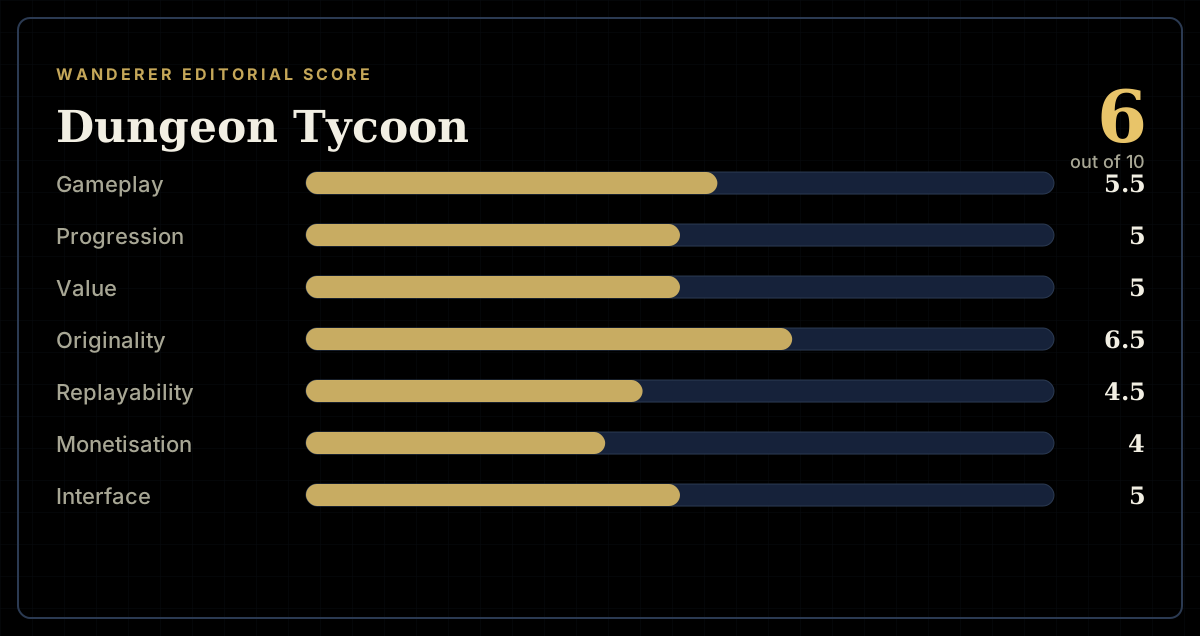
How the review scores each part of the gameWanderer Editorial -
The short versionWanderer Editorial