
Game review
Dungeon Dev
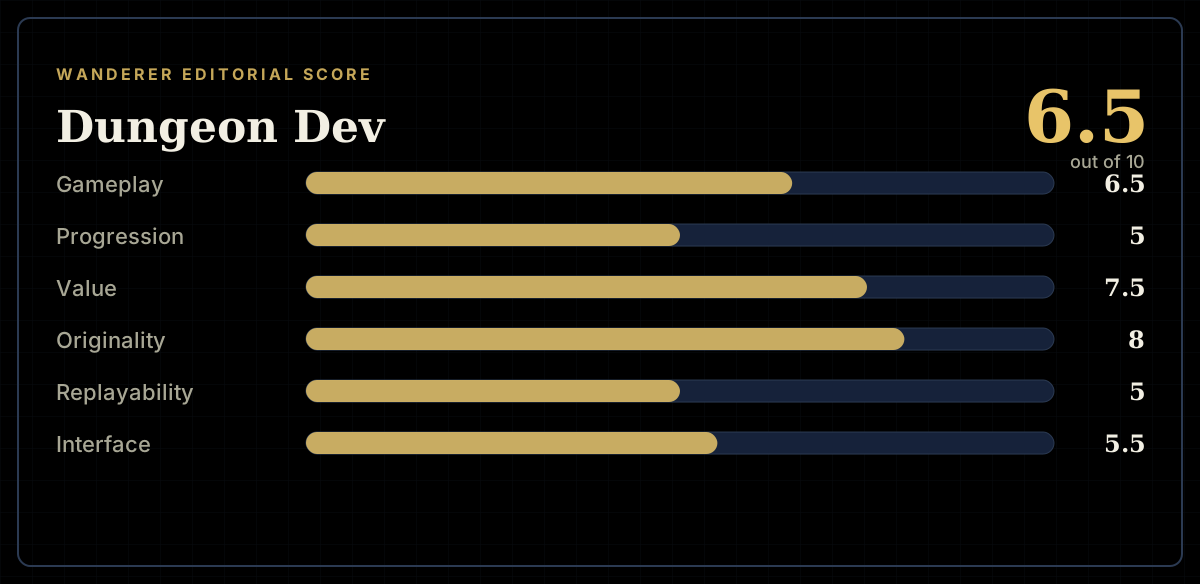
6.5 / 10
- Developer
- Team ETTU
- Publisher
- Team ETTU
- Released
- 14 November 2024
- Platforms
- Windows
- Genre
- Puzzle dungeon-design simulator
- Monetisation
- One-time purchase, no in-game store or additional currency purchases
- Players
- Single-player only
The short version
Dungeon Dev inverts the usual dungeon-defense premise entirely: working secretly for a Demon Lord who's struck a deal with the human king, your job is to design a dungeon that heroes can successfully clear, while also satisfying each hero class's specific hidden desire — the tank wants to take a certain amount of damage, the healer wants to heal a certain amount, and so on. Reviewers across Japanese, Korean, Chinese and English reviews independently praise this as a genuinely fresh idea, rare enough in the genre to be worth the low asking price alone. The trouble, according to a detailed and consistent cluster of reviews, is that the puzzle-solving this premise is built on breaks down partway through: once unpredictable enemy behaviours are introduced from the third chapter onward, several reviewers say solving a level stops being logical deduction and becomes closer to exhaustive trial and error, a shift Steam's own achievement data backs up with a genuinely steep completion cliff.
Biggest strengths
- The core premise — secretly designing dungeons that satisfy invading heroes' specific class-based desires while still letting them win — draws consistent, independent praise across multiple languages as a genuinely original spin on dungeon-management games
- A recurring Demon Lord mascot character is repeatedly singled out by name as charming and a highlight of the presentation, with several reviewers citing "how cute the Demon Lord is" as a direct, specific reason they enjoyed their time
- The price is consistently described as generous for the amount of content on offer, with reviewers reporting six to twenty hours depending on whether they pursued full achievement completion
Biggest weaknesses
- Multiple reviewers, independently and in different languages, describe the puzzle-solving degrading from genuine logical deduction into exhaustive trial and error once later chapters introduce less predictable enemy behaviours, with one detailed account describing chapters one and two as a 9/10 experience that drops to a 3/10 once this shift occurs
- Steam's own achievement data confirms a genuinely steep difficulty curve: even the first story-mode stage clear sits at only 46.5% completion, and the hardest "Master" tier clears for later stages fall to between 2.4% and 4.0%
- Quality-of-life gaps are raised by more than one reviewer, including the absence of an undo/redo system and no confirmation prompt before clearing a placement layout, both of which increase the cost of experimentation mistakes
Who it's for: Puzzle fans drawn to unusual, inverted premises who don't mind some trial-and-error grinding in exchange for genuine novelty, and who appreciate a charmingly presented mascot character carrying an otherwise modest production.
Our recommendation: Worth its low price for the first two chapters alone, which multiple reviewers rate highly on their own terms. Go in aware that later content is reported to demand patience for brute-force experimentation rather than continued clever insight, and that full "Master" tier completion is a genuinely rare achievement even among dedicated players.
6.5 / 10
Most dungeon-design games ask you to stop the heroes. Dungeon Dev asks you to lose to them — specifically, satisfyingly, and without letting anyone catch on that you're secretly in on it. Working for a Demon Lord who's struck a hidden deal with the human kingdom, your job is to place monsters and traps so that invading heroes clear each level, while also privately fulfilling each hero class's own hidden desires: the tank wants to soak up a certain amount of damage, the damage dealer wants to deal a certain amount, and so on. It's a small, clever inversion of a familiar genre, and reviewers across four languages independently describe it as genuinely fresh — right up until a specific, well-documented point partway through the game, where a meaningful share of that same audience says the cleverness runs out.
Losing on purpose, and doing it with style
The core loop draws real, specific praise in its early stages. One reviewer frames the appeal directly: designing "a dungeon that is fun to lose in" is a concept that's "difficult to develop but interesting to play" — an accurate description of the tension the whole game is built on. Layered on top is a mascot Demon Lord character reviewers can't stop mentioning; one simply writes "the Demon Lord is so cute" as a standalone point in the game's favour, and several others echo the sentiment independently enough that it clearly isn't a fluke of translation or coincidence. Combined with a built-in speed-up mode for iterating on failed placements quickly, the early chapters draw consistently strong marks — one detailed review explicitly rates the first two chapters a 9 out of 10 on their own terms.
Where the puzzle stops feeling like a puzzle
The most substantive and consistent criticism concerns what happens after that strong opening. Multiple reviewers, writing independently in Japanese, Korean and Chinese, describe a specific shift once later chapters introduce less predictable enemy behaviours — described by one reviewer as "wild animals" whose reactions can't be reliably forecast run to run. One detailed account explains the mechanism precisely: certain traps can be triggered by different party members unpredictably from attempt to attempt, meaning the same placement can produce different outcomes on different tries, "a butterfly effect" that undermines the predictability a puzzle needs to be solvable through reasoning rather than luck. That reviewer rates the same game a 9 out of 10 for its first two chapters and a 3 out of 10 from the third onward — a striking, specific collapse in a single review rather than a vague overall complaint. A Japanese reviewer makes a related, more philosophical point: "a puzzle game is one where you find the means to derive an answer," and once solving requires repeated trial-and-error recalculation rather than genuine deduction, they concluded there was "no longer a reason to keep playing."
The numbers back up a real difficulty wall
This review can confirm the shape of that complaint independently through Steam's own achievement data. Even the very first story-mode stage clear sits at only 46.5% completion — meaning more than half of everyone who owns the game never finishes even the opening content — and the hardest "Master" tier clears, which reward minimal-cost optimal solutions, fall to between 2.4% and 4.0%. That's a considerably steeper drop than a well-paced puzzle game typically shows, and it's consistent with reviewers describing a specific difficulty wall rather than a smoothly escalating challenge.
Smaller, more conventional gaps
Beyond the central difficulty complaint, several reviewers raise more ordinary quality-of-life gaps. There's no undo or redo function, and no confirmation prompt before clearing an entire placement layout, both of which raise the cost of an accidental misclick during experimentation. Feedback after a failed trial run is described as limited — showing partial results rather than detailed per-unit combat statistics — making it harder to reason precisely about what went wrong and adjust accordingly. A more specific balance complaint targets archer-type units directly, with one reviewer describing them as fragile and comparatively low-damage while still being expected to match melee units' output, a criticism that dovetails with the broader "trial and error rather than strategy" pattern others describe.
A developer who responded quickly, then moved to a sequel
This review can confirm the developer treated launch-week feedback seriously. The events feed shows a dense cluster of fixes in the days immediately following the 14 November 2024 release, including a patch specifically titled "Sound Overlap Fix" — directly addressing a complaint about stacked sound effects becoming too loud — and a separate fix for a button display bug during the placement phase. A further Challenge Map content update followed in December 2024. After that, the public record shows the studio's attention shifting toward a sequel, "Debugging Hero," announced in January 2025 — a reasonable trajectory for a small, complete puzzle game rather than a sign of neglect, though it does mean the specific balance and difficulty-curve complaints raised above are unlikely to see further tuning in this particular release.
Final verdict
Dungeon Dev's central idea — designing a satisfying loss rather than a victory, tuned to each hero's private expectations — is genuinely clever, charmingly presented, and cheap enough that the first two chapters alone arguably justify the price. Where it runs into real trouble, according to a consistent, well-reasoned cluster of reviews and backed up by Steam's own achievement data, is exactly where the game asks players to keep applying logic to encounters that have stopped rewarding it, relying instead on repeated experimentation against genuinely unpredictable outcomes. Buy it for a delightful few hours with a very charming Demon Lord, and don't feel obligated to chase full Master-tier completion if the later chapters start to feel like guesswork rather than insight.
Pros and cons
Pros
- The core premise — secretly designing dungeons that satisfy invading heroes' specific class-based desires while still letting them win — draws consistent, independent praise across multiple languages as a genuinely original spin on dungeon-management games
- A recurring Demon Lord mascot character is repeatedly singled out by name as charming and a highlight of the presentation, with several reviewers citing "how cute the Demon Lord is" as a direct, specific reason they enjoyed their time
- The price is consistently described as generous for the amount of content on offer, with reviewers reporting six to twenty hours depending on whether they pursued full achievement completion
- The developer shipped a dense, responsive run of launch-week fixes, including patches specifically addressing a sound-effect overlap bug and a button display issue during the placement phase, directly matching complaints raised in early reviews
- A built-in speed-up mode for trial runs is specifically praised for making the game's inherent experimentation loop faster and less tedious than it would otherwise be
Cons
- Multiple reviewers, independently and in different languages, describe the puzzle-solving degrading from genuine logical deduction into exhaustive trial and error once later chapters introduce less predictable enemy behaviours, with one detailed account describing chapters one and two as a 9/10 experience that drops to a 3/10 once this shift occurs
- Steam's own achievement data confirms a genuinely steep difficulty curve: even the first story-mode stage clear sits at only 46.5% completion, and the hardest "Master" tier clears for later stages fall to between 2.4% and 4.0%
- Quality-of-life gaps are raised by more than one reviewer, including the absence of an undo/redo system and no confirmation prompt before clearing a placement layout, both of which increase the cost of experimentation mistakes
- Combat feedback after each trial run is described as limited, showing only partial results rather than detailed statistics on which unit dealt or received how much damage, making it harder to reason precisely about why an attempt failed
- At least one detailed reviewer specifically criticises archer-type units as underpowered and fragile relative to melee units while being expected to match their damage output, a specific class-balance complaint echoed by the broader "trial and error over strategy" critique
Screenshots
-

Dungeon DevImage: Team ETTU via Steam -

Dungeon DevImage: Team ETTU via Steam -

Dungeon DevImage: Team ETTU via Steam -
How the review scores each part of the gameWanderer Editorial -
The short versionWanderer Editorial