
Game review
Dawnmaker
7 / 10
- Developer
- Arpentor Studio
- Publisher
- Acram Digital
- Released
- 31 July 2024
- Platforms
- Windows, Mac
- Genre
- Turn-based city-building deckbuilder
- Monetisation
- One-time purchase, no in-game store or additional currency purchases
- Players
- Single-player only
The short version
Dawnmaker plays like a solo board game translated faithfully to a screen: draft cards, place buildings on a limited city grid, and race an escalating resource drain while repairing magical lighthouses to push back a toxic smog. Reviewers repeatedly reach for Terraforming Mars' solo mode as the closest comparison, and the tile-placement-meets-deckbuilding core draws consistent praise for real strategic depth. The most consistent reservation, raised across positive and negative reviews alike, is that the game runs out of new things to try faster than that comparison implies — most players report a first campaign clear somewhere between five and twenty hours, after which build variety narrows sharply. The developer has responded with real, sustained support since launch, including a difficulty-tier system added specifically to counter the game's tendency to collapse into one dominant winning strategy.
Biggest strengths
- The core loop — drafting resource and building cards into a tightly space-constrained city grid while a lighthouse holds back an encroaching smog — draws consistent, specific praise for its puzzle depth, with multiple reviewers directly comparing it to Terraforming Mars' well-regarded solo mode
- The developer added a difficulty-tier system after launch specifically to address complaints about one dominant winning strategy, and at least one reviewer credits this update directly with "highlighting the game's best mechanics" by forcing players away from the easiest path to victory
- Steam Deck compatibility is strong despite no native controller support, with multiple reviewers describing the mouse-emulation control scheme as fully sufficient for a turn-based game that never demands quick reflexes
Biggest weaknesses
- The single most repeated reservation across the review sample, appearing in both recommended and non-recommended reviews, is that build variety narrows quickly once a winning combination is found, with several reviewers explicitly saying they lost interest once they'd cleared a first campaign
- Losing a mission is described by multiple reviewers as unusually punishing, with at least one describing being effectively locked out of further progress on a map after a single failed attempt, without an easier retry option at launch
- Reported campaign completion times vary widely, from roughly five hours for confident players to nearly twenty for others, and several reviewers explicitly question whether the price matches the shorter end of that range
Who it's for: Fans of solo-mode board games and deckbuilders like Terraforming Mars or Wingspan who want a tightly designed, turn-based puzzle they can finish in an evening or two, rather than a long-tail strategy game meant to be replayed for hundreds of hours.
Our recommendation: A confident pick for genre fans at its regular price, especially those who enjoy the genre for a single well-crafted campaign rather than endless replayability. Play the free demo first to confirm the core loop clicks, since most of what the full game offers is present in miniature there already.
7 / 10
Dawnmaker's own store page describes itself plainly as feeling "like playing a solo board game," and that's the most useful framing for what the two-person team at Arpentor Studio actually built: a tight, turn-based puzzle about drafting cards, placing buildings on a cramped city grid, and repairing magical lighthouses to push back a toxic smog covering the land. Reviewers reach for Terraforming Mars' celebrated solo mode as the natural comparison point, and on a mechanical level that comparison is earned — the tile-placement-and-deckbuilding hybrid at the center of the game draws real, specific praise. Where the comparison gets more complicated is longevity, and it's the one point nearly every reviewer, whether recommending the game or not, ends up addressing directly.
A puzzle that rewards careful play
The core tension is between building efficiently within limited city space and racing an escalating resource drain before it overwhelms your progress. One reviewer summarises the appeal precisely: "lots of hard choices to make that felt meaningful, but still enough randomness to keep you on your toes." Another pushes back on the "city builder" label the store page uses, arguing it undersells what's really happening: "you do not manage population, jobs, housing... you place buildings via an rng progressive card system into tiles with strategic positioning to increase value." Whichever framing a reviewer prefers, the mechanical praise is consistent — this is a genuinely well-designed puzzle system, with several reviewers specifically noting that a "just one more turn" pull kept sessions running long past what they'd planned.
The variety problem, named the same way by nearly everyone
Set against that praise is a remarkably consistent structural complaint: once a player finds an effective card-and-building combination, subsequent runs tend to collapse toward that same strategy rather than opening up new approaches. "There isn't enough variance — between levels, between characters, between runs," one reviewer writes bluntly, adding "I can pick the strategy I'm going to use for the rest of the game" almost immediately after a first successful run. Another, more measured, frames it as a wish list rather than a dealbreaker: "it would be more interesting with about 5x the cards and a progression where you unlock them to potentially change the theme of your runs." This isn't a complaint limited to players who bounced off quickly, either — several of the reviewers raising it logged well over a thousand minutes before concluding the game had shown them most of what it had to offer.
A punishing failure state, and RNG that can decide a run late
A second, more specific complaint concerns what happens when a mission goes wrong. Multiple reviewers describe losing as unusually costly, with one stating that a failed map attempt left them "locked out" of further progress without an accessible retry path at launch. A detailed account from a reviewer who completed one full playthrough describes failing the final mission specifically because "rank-granting cards" needed to hit a late scoring target simply didn't appear in the deck in time, closing five hours of otherwise successful play on what reads as bad luck rather than a misplay. These are two related but distinct problems — punishing failure states, and randomness that can override skilled play late in a run — and both show up often enough across the sample to be treated as real rather than incidental frustrations.
A studio that kept iterating rather than walking away
What sets Dawnmaker apart from several other small releases in this lane is how much the developer appears to have listened to exactly this feedback. The clearest example is a difficulty-tier system added after launch specifically to combat the dominant-strategy problem; one reviewer credits it directly, writing that the update "introduced difficulty levels, which were important in highlighting the game's best mechanics and forced players to deviate from the easiest winning strategies." The events feed backs this pattern of continued attention up with a longer timeline: a substantial "Characters" content update in October 2024, a publishing partnership with Acram Digital that same December, a confirmed fix for macOS performance issues — which at least one reviewer flagged directly — by July 2025, and a full mobile port launched in December 2025, all well past the point where a studio content to coast on initial sales would typically have stopped.
Comfortable on unusual hardware
A smaller but consistently positive note concerns portability. Despite lacking native controller support, multiple reviewers describe the game as excellent on Steam Deck via its built-in mouse emulation, framing the turn-based, no-time-pressure structure as ideal for picking up in short bursts. "Turn based so if the kids require attention you can put it down," one reviewer writes approvingly, a small but real point in the game's favour for anyone weighing it as a handheld pickup-and-play option.
Where the price sits against the genre
At NZD 25.99, Dawnmaker sits toward the middle of what small-studio deckbuilders typically ask, and reviewer opinion on whether that's fair splits along the same line as the replayability debate above. Players who measure value by total hours tend to find the math discouraging — one explicitly frames it as "$10 for 6 hours isn't enough," extrapolating that ratio up to the full asking price. Players who measure value by the quality of a single well-designed campaign are considerably more generous, with one calling it "definitely worth its price" specifically because of how tightly the systems fit together, rather than because of raw playtime. Both readings are internally consistent; which one applies to a given buyer mostly comes down to whether they're shopping for a long-tail strategy game or a shorter, more considered puzzle experience closer to a board game's typical playtime.
Final verdict
Dawnmaker earns its Very Positive standing the honest way: a tightly designed, genuinely challenging tile-placement deckbuilder that rewards careful play across a well-paced first campaign, built by a two-person team that's kept refining it for well over a year after launch rather than moving on immediately. The consistent complaint about narrowing build variety after that first campaign clear is real and worth taking seriously if long-term replayability is what you're specifically shopping for — this is closer to a great single or double playthrough than an endlessly replayable roguelite. But for players who approach it the way its own marketing suggests, as a well-made solo board game rather than a hundred-hour strategy sandbox, it delivers exactly what it promises.
Pros and cons
Pros
- The core loop — drafting resource and building cards into a tightly space-constrained city grid while a lighthouse holds back an encroaching smog — draws consistent, specific praise for its puzzle depth, with multiple reviewers directly comparing it to Terraforming Mars' well-regarded solo mode
- The developer added a difficulty-tier system after launch specifically to address complaints about one dominant winning strategy, and at least one reviewer credits this update directly with "highlighting the game's best mechanics" by forcing players away from the easiest path to victory
- Steam Deck compatibility is strong despite no native controller support, with multiple reviewers describing the mouse-emulation control scheme as fully sufficient for a turn-based game that never demands quick reflexes
- The developer's own events feed shows an unusually long and active support record for a small studio: a major "Characters" content update in October 2024, a confirmed macOS performance fix in July 2025, and a full mobile port launched in December 2025, all well over a year after the initial release
- Multiple reviewers describe genuinely difficult, meaningful decisions within a single run — one calls it "hard choices that felt meaningful, but still enough randomness to keep you on your toes" — rather than a game that solves itself once its systems are understood
Cons
- The single most repeated reservation across the review sample, appearing in both recommended and non-recommended reviews, is that build variety narrows quickly once a winning combination is found, with several reviewers explicitly saying they lost interest once they'd cleared a first campaign
- Losing a mission is described by multiple reviewers as unusually punishing, with at least one describing being effectively locked out of further progress on a map after a single failed attempt, without an easier retry option at launch
- Reported campaign completion times vary widely, from roughly five hours for confident players to nearly twenty for others, and several reviewers explicitly question whether the price matches the shorter end of that range
- A handful of reviewers describe specific mission failures driven by card-draw RNG late in a run rather than a misjudged strategy, including one detailed account of failing a final mission because rank-granting cards simply didn't appear in time
- Early reports of macOS performance problems and at least one report of missing in-game music point to some technical rough edges at and shortly after launch, though the developer's events feed confirms the macOS issue specifically was resolved by mid-2025
Screenshots
-

DawnmakerImage: Acram Digital via Steam -

DawnmakerImage: Acram Digital via Steam -

DawnmakerImage: Acram Digital via Steam -
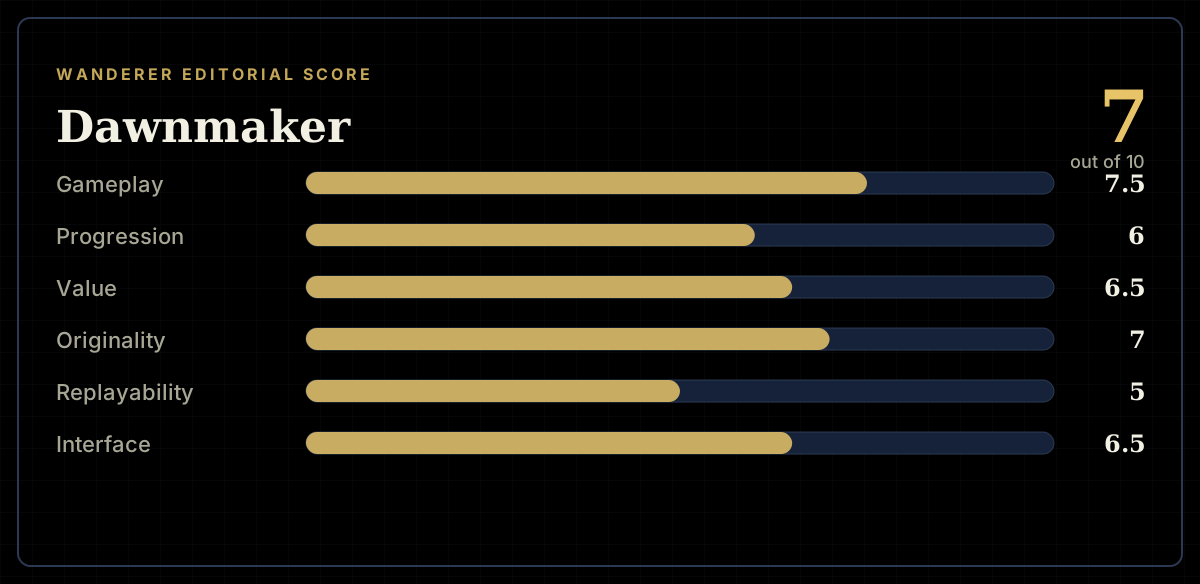
How the review scores each part of the gameWanderer Editorial -
The short versionWanderer Editorial