
Game review
Tetra Dungeon
6 / 10
- Developer
- 套鹿工作室 (Taolu Studio)
- Publisher
- 寻鹿计划 (Xunlu Project)
- Released
- 19 December 2024
- Platforms
- Windows, Mac
- Genre
- Tetris-inspired deckbuilding roguelike
- Monetisation
- One-time purchase, no in-game store or additional currency purchases
- Players
- Single-player only
The short version
Tetra Dungeon combines two things reviewers say they've never seen paired before: Tetris-style block placement and Slay the Spire-style card-drafting roguelike combat. Weapon, spell, and minion cards come in different shapes and sizes, and where and how you place them on a 5x5 battlefield grid determines which rows, columns, or single targets take damage. Reviewers across several languages independently praise this as a genuinely fresh combination worth the low asking price. Set against that novelty is a specific, detailed criticism from an experienced deckbuilder fan: despite its roguelike billing, the sequence of combat encounters and two of the game's three bosses don't actually vary between runs, and the whole experience can be fully explored and speed-cleared in under two hours by a player already fluent in the genre. This review found no evidence of any update since the game's first week on sale.
Biggest strengths
- The core hook of Tetris-shaped cards occupying a 5x5 combat grid, where block orientation determines whether an attack hits a full row, a column, or a single tile, draws consistent, specific praise across English, Chinese, Japanese, Turkish and Russian reviews as a genuinely original combination
- Three distinct classes — a row-focused swordsman, an elemental-combination mage, and a tower-defense-style puppet master continuously repositioning summoned units — give real mechanical variety across a single playthrough
- Individual runs are short, typically 20 to 45 minutes, making the game well suited to quick sessions, with reviewers describing "just one more run" appeal despite the format's other limitations
Biggest weaknesses
- A detailed, experienced reviewer states plainly that most of the game's node sequence and combat content, including two of its three bosses, follow a fixed order rather than genuinely randomizing between runs, arguing this undercuts the roguelike label the game is marketed under
- The same reviewer raises a specific audience-mismatch concern: a player already fluent in genre touchstones like Slay the Spire or Vault of the Void can reportedly clear all three classes and understand the game's full strategic depth within about two hours, calling into question who the game's difficulty and pacing are actually tuned for
- A specific, reproducible softlock bug is reported against one particular boss encounter, where killing it before it attacks can freeze the game entirely, requiring a return to the main menu and a workaround of intentionally taking damage first to avoid triggering it
Who it's for: Deckbuilder and roguelike fans looking for a cheap, short, mechanically inventive session rather than a deep, long-tail game, especially those curious to see Tetris and card-based combat combined for the first time.
Our recommendation: Worth the low price for the novelty and for a handful of genuinely satisfying short sessions, but go in expecting a light, fixed-structure experience rather than the high-replayability roguelike its genre tags imply, and don't expect further content given the apparent lack of updates since December 2024.
6 / 10
Deckbuilding roguelikes and Tetris have both been done to death individually, which makes Tetra Dungeon's central idea land as genuinely fresh: cards aren't just abstract effects, they're Tetris-shaped blocks that occupy space on a 5x5 battlefield grid, and how you rotate and place them determines whether an attack sweeps a full row, a column, or lands on a single target. Reviewers writing in Chinese, English, Japanese, Turkish and Russian all independently reach for the same word — novel — to describe this combination, and at a price under ten dollars, that novelty alone has carried the game to a Positive rating. What's harder to ignore is a specific, detailed criticism from an experienced genre fan arguing the roguelike structure wrapped around that novel idea doesn't hold up under real scrutiny.
Cards that are also puzzle pieces
The three-class structure gives the core hook real range. A swordsman uses straight-line blade cards for row-based attacks; a mage combines elemental spell shapes for flexible row, column, or single-target damage; a puppet master plays closer to tower defense, continuously repositioning summoned units across the grid rather than attacking directly. One detailed Chinese-language review lays out the appeal precisely: weapons deal immediate damage based on shape and placement, spells trigger row or column effects instantly, and summoned minions act every turn from wherever they're placed — meaning victory comes from maximising how these three card types interact spatially rather than simply accumulating the biggest numbers. Reviewers who enjoy this loop describe genuinely satisfying moments discovering a combo that "one-shots" a boss once fully assembled, and multiple reviewers across different languages compare the underlying rush directly to Slay the Spire.
A serious, specific challenge to the "roguelike" label
The most substantive criticism in the sample comes from a reviewer who identifies as an experienced card-game player, having spent time with Slay the Spire, Inscryption, Dicey Dungeons and Balatro. Their core argument, translated, is structural rather than emotional: the game's business and event nodes, and the sequence of combat encounters within a run, are largely fixed rather than genuinely randomised, and of the three bosses, only the first has any real variation — the other two are always the same encounter in the same order. They estimate that a player already fluent in the genre's conventions could clear all three classes and understand essentially the entire strategic depth of the game within about two hours, at which point, in their telling, refunding becomes a live option rather than continuing to a natural stopping point. That's a pointed claim, and it's worth taking seriously specifically because it comes from someone evaluating the game against real genre benchmarks rather than judging it in isolation.
Short runs, by design and by necessity
A second, related reviewer — this one with over seventeen hours logged, clearly someone who stuck around — makes a more measured version of the same point. They describe the game as, in their words, closer to a "小品游戏" — a light, vignette-scale release — rather than a fully realised roguelike, noting each run contains only nine combat encounters total (two regular fights and one boss per zone, three zones) and typically runs about twenty minutes. They're careful to frame this as an honest assessment of scope rather than outright condemnation, but the throughline connects directly to the more pointed criticism above: this is a small, tightly-scoped game, and reviewers disagree mainly on whether that scope was communicated honestly by the "roguelike" tag rather than on whether the core combat itself is any good.
A specific bug, and uneven balance
Beyond structural concerns, one reviewer reports a reproducible technical problem: killing a specific boss — described as a "Male Fire Dragon" — before it gets to attack can freeze the game entirely, requiring a return to the main menu, with the same softlock recurring on retry unless the player deliberately takes damage from that boss first before finishing it off. A second, unrelated performance issue is reported with a card called "Ghost Dagger." Separately, several reviewers describe class balance as rough: a particular sword-and-assistant combination can trivialise encounters, the mage is described by more than one reviewer as simply stronger than the puppet master, and the puppet master itself is described as prone to falling apart entirely once its board position goes wrong.
No visible support since launch week
This review found nothing in the game's public patch history beyond a short cluster of five posts, all dated to the week of the 19 December 2024 launch — a Mac beta release and two minor bugfix patches. Nothing has followed since, as far as this review can confirm, despite at least one reviewer expressing direct hope for "more characters, more maps" in future content. Given the specific bug reports above, and the detailed structural criticism of the game's fixed node sequence, it's reasonable to read the current build as close to its final state rather than one still actively evolving.
Final verdict
Tetra Dungeon's central idea — cards as literal Tetris pieces determining combat geometry — is a genuinely clever, well-executed hook that easily justifies its low asking price for a handful of short, satisfying sessions. But the detailed, credible criticism that its roguelike structure is mostly fixed rather than randomised, paired with an apparent lack of any post-launch content updates, means this is a small, complete experience rather than the deep, replayable card-roguelike its genre tags might suggest. Buy it for a clever afternoon or two with Tetris and Slay the Spire in mind, and don't expect it to hold up to the scrutiny genre veterans will inevitably apply.
Pros and cons
Pros
- The core hook of Tetris-shaped cards occupying a 5x5 combat grid, where block orientation determines whether an attack hits a full row, a column, or a single tile, draws consistent, specific praise across English, Chinese, Japanese, Turkish and Russian reviews as a genuinely original combination
- Three distinct classes — a row-focused swordsman, an elemental-combination mage, and a tower-defense-style puppet master continuously repositioning summoned units — give real mechanical variety across a single playthrough
- Individual runs are short, typically 20 to 45 minutes, making the game well suited to quick sessions, with reviewers describing "just one more run" appeal despite the format's other limitations
- At roughly five to seven dollars, reviewers consistently describe the price as fair to generous for what's delivered, with several explicitly saying they don't regret the purchase despite raising other complaints
- Clean, uncluttered UI and a short, functional tutorial are specifically praised by at least one detailed reviewer as respecting the player's time from the opening minutes
Cons
- A detailed, experienced reviewer states plainly that most of the game's node sequence and combat content, including two of its three bosses, follow a fixed order rather than genuinely randomizing between runs, arguing this undercuts the roguelike label the game is marketed under
- The same reviewer raises a specific audience-mismatch concern: a player already fluent in genre touchstones like Slay the Spire or Vault of the Void can reportedly clear all three classes and understand the game's full strategic depth within about two hours, calling into question who the game's difficulty and pacing are actually tuned for
- A specific, reproducible softlock bug is reported against one particular boss encounter, where killing it before it attacks can freeze the game entirely, requiring a return to the main menu and a workaround of intentionally taking damage first to avoid triggering it
- Class balance is described as uneven by multiple reviewers, with the mage and a specific sword-and-assistant combo both singled out as capable of trivialising fights, while the puppet master class is separately described as prone to collapsing entirely under pressure
- This review found no partner-events activity beyond a short burst of patches in the week following the 19 December 2024 launch, with nothing since, despite at least one reviewer expressing hope for more characters and maps in future updates
Screenshots
-

Tetra DungeonImage: 寻鹿计划 via Steam -

Tetra DungeonImage: 寻鹿计划 via Steam -

Tetra DungeonImage: 寻鹿计划 via Steam -
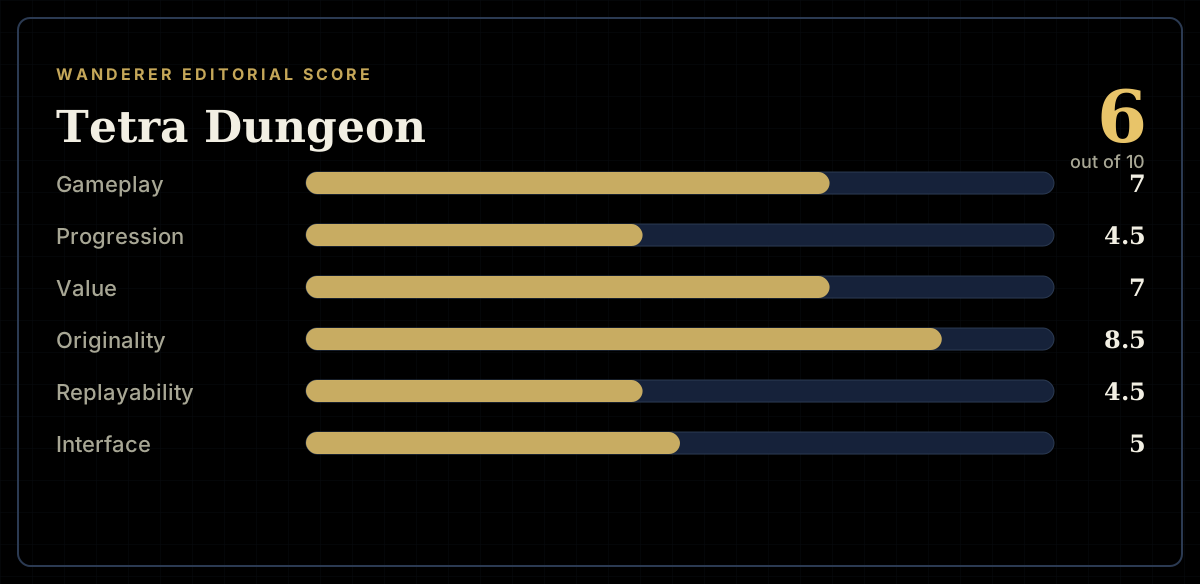
How the review scores each part of the gameWanderer Editorial -
The short versionWanderer Editorial