
Game review
Cardstronaut
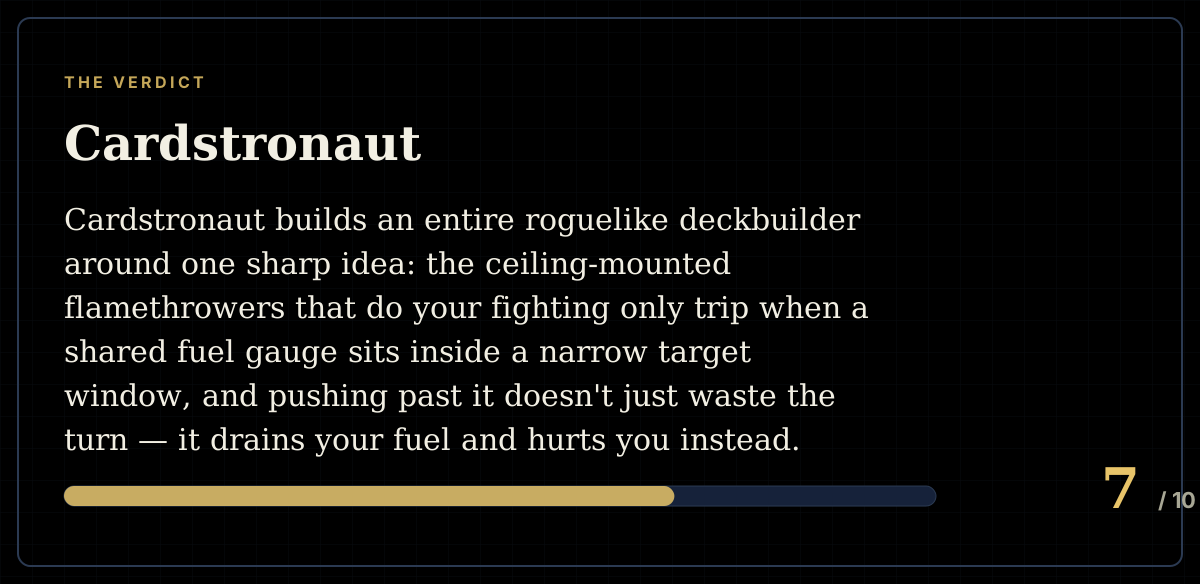
7 / 10
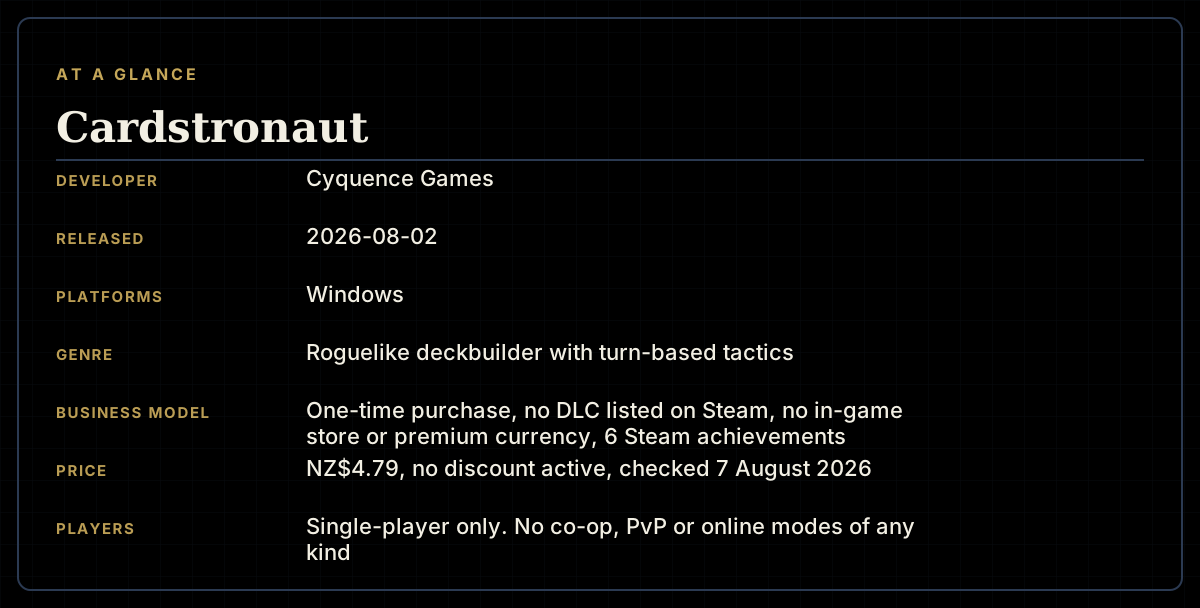
- Developer
- Cyquence Games
- Publisher
- Cyquence Games
- Released
- 2 August 2026
- Platforms
- Windows
- Genre
- Roguelike deckbuilder with turn-based tactics
- Monetisation
- One-time purchase, no DLC listed on Steam, no in-game store or premium currency, 6 Steam achievements
- Players
- Single-player only. No co-op, PvP or online modes of any kind
The short version
Cardstronaut builds an entire roguelike deckbuilder around one sharp idea: the ceiling-mounted flamethrowers that do your fighting only trip when a shared fuel gauge sits inside a narrow target window, and pushing past it doesn't just waste the turn — it drains your fuel and hurts you instead. Layered with turret positioning, enemy-movement prediction and an installable mod system for each flamethrower, it's a genuinely distinctive spin on a crowded genre, backed by a branching run map with shops, events and a card-removal economy that will feel instantly familiar to anyone who's played this style of game before. What it doesn't have, five days after launch, is a single Steam user review, a news post, or an achievement curve with enough data behind it to say how the back half of a run actually plays. This is a review of a real, well-realised idea shipped by a small studio into total silence — worth a look for genre fans willing to be early, with the caveat spelled out plainly.
Biggest strengths
- The core rule — flamethrowers only fire inside a narrow fuel window, and overshooting drains your gauge and hurts you instead of the enemy — turns every card play into a real risk calculation instead of a bigger-number-wins formula
- Turret positioning and predicting where enemies will stand when a flamethrower finally triggers add a genuine tactical layer on top of the deckbuilding itself
- An installable mod system lets you customise each flamethrower's synergies separately from your deck, giving the run two build layers instead of one
Biggest weaknesses
- Steam's own achievement data implies a tracked population small enough to resolve to whole numbers of players, and not one of them has yet earned the achievement for clearing the game's first area
- With only six achievements gating two named areas, the confirmed scope reads modest for the genre, and there's no outside data yet on how long a full run takes or how the back half is paced
- Steam's official genre field lists only "Strategy," which undersells what the vote-weighted community tags show is a much more specific roguelike, deckbuilding and card-battler hybrid
Who it's for: Roguelike deckbuilder fans looking for a genuinely new central mechanic rather than another reskin of card-cost-and-combo math, who don't mind being among the very first people to actually report back on it.
Our recommendation: At NZ$4.79 with no DLC, no premium currency and nothing else to buy, the price is low enough that the risk is mostly about your time rather than your wallet. The mechanic itself is the strongest reason to try it; the complete absence of outside opinion is the reason to go in with modest expectations about how much game is actually here.
7 / 10
Most roguelike deckbuilders dare you to go big — stack enough damage, enough draw, enough synergy, and the numbers take care of the rest. Cardstronaut dares you to stop early. Its ceiling-mounted flamethrowers only fire when a shared fuel gauge sits inside a narrow green window, and if your hand pushes it past that ceiling, the overflow doesn't fizzle politely. It drains the gauge back to nothing and burns you instead of the aliens standing in the blast radius. That one rule, more than the astronaut-with-amnesia setup around it, is what Cardstronaut is actually about.
The fuel window is the whole fight
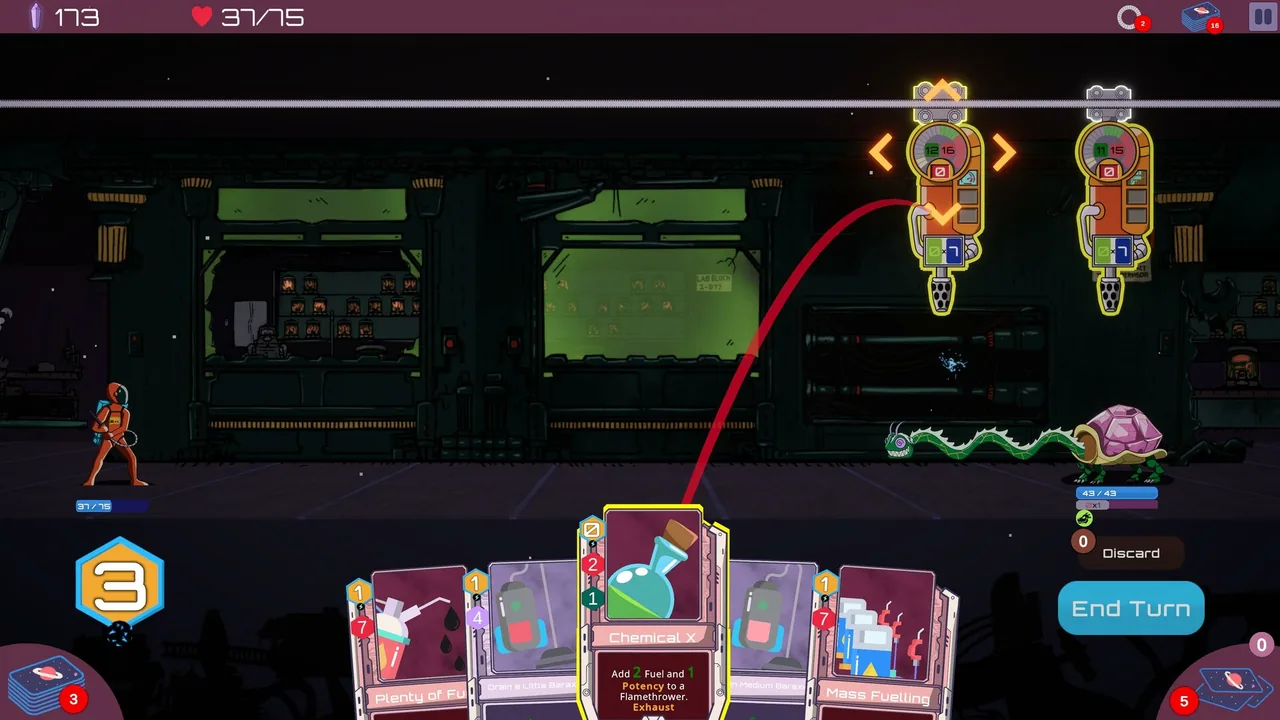
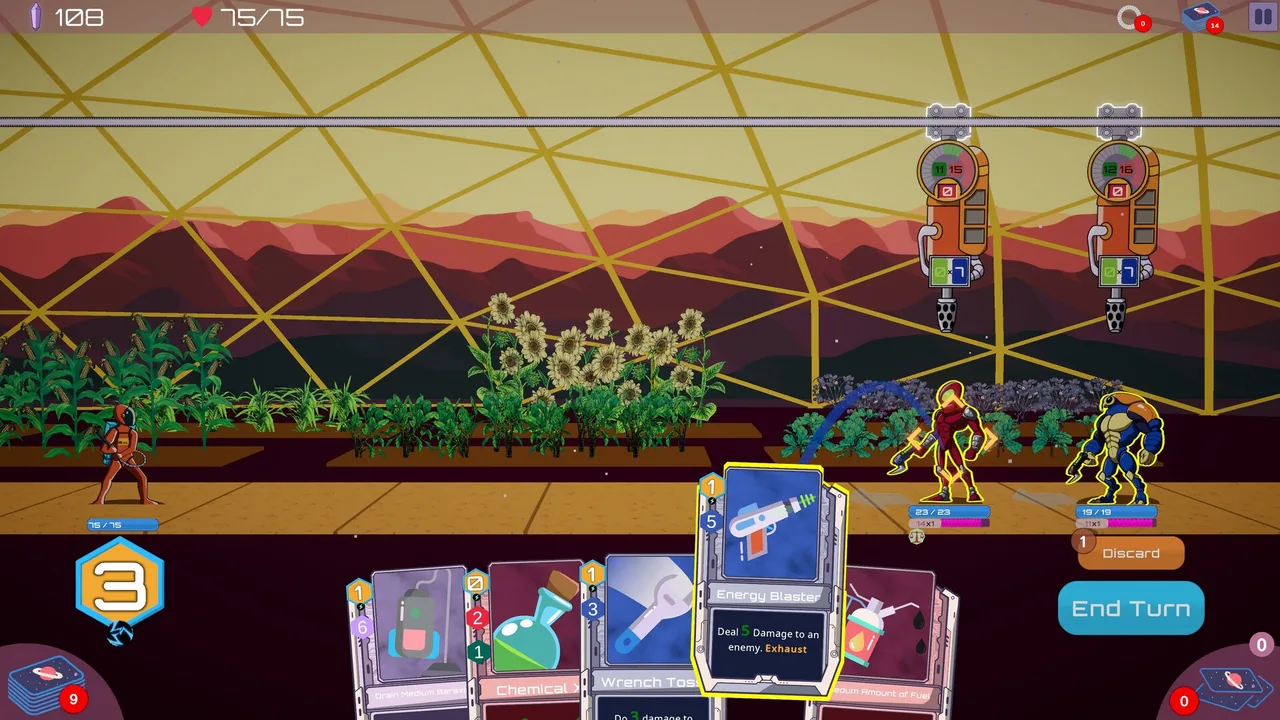
The premise is simple enough on the surface: you play a cloned astronaut with no memory of the alien-infested base you've woken up in, feeding cards that add or drain fuel to activate flamethrowers bolted to the ceiling above two fixed lanes. Each turret displays its target range as a pair of numbers on a dial — something like a low and high threshold — and your job every turn is to land the shared gauge somewhere inside that band before you end it. Undershoot and nothing happens. Overshoot and the mechanism dumps its fuel and turns on you. It's a deceptively narrow design space for an entire deckbuilder to sit inside, and the screenshots make clear Cyquence Games built the rest of the card pool to push against it deliberately: cards that add small, precise amounts of fuel sit alongside ones that drain fuel from an enemy first, cards that raise the gauge's maximum ceiling, and blunt instruments that just deal flat damage when timing the window isn't worth the risk.
Positioning compounds the tension. The aliens — a rogues' gallery that ranges from a segmented worm-and-shell creature to armoured mech-suited humanoids to a small wheeled robot — advance and retreat along the same lane the flamethrowers cover, and one screenshot shows arrows on a turret that suggest you can nudge which zone it covers before committing. Since a flamethrower only hits what's standing under it when it finally triggers, predicting where an enemy will be a turn from now matters as much as getting the fuel math right in the first place. It's the kind of system that's easy to describe in one sentence and considerably harder to have actually built well, and on the evidence of six promotional screenshots showing consistent, legible turret gauges and clear damage numbers, Cyquence Games appears to have landed it.
Mods, a shop, and the rest of the run
Underneath the fuel-window puzzle sits a second, separate customisation layer: each flamethrower can have mods installed at the start of a fight, unlocking what the store page describes as "complex synergies" for extra cards, extra fuel capacity, or straight bonus damage, and one of the game's six achievements is earned specifically for installing one. That gives a run two build axes running in parallel — the deck you're drawing from, and the pair of mod loadouts sitting above your head — rather than funnelling every decision through card choice alone, which is where a lot of genre entries stop.
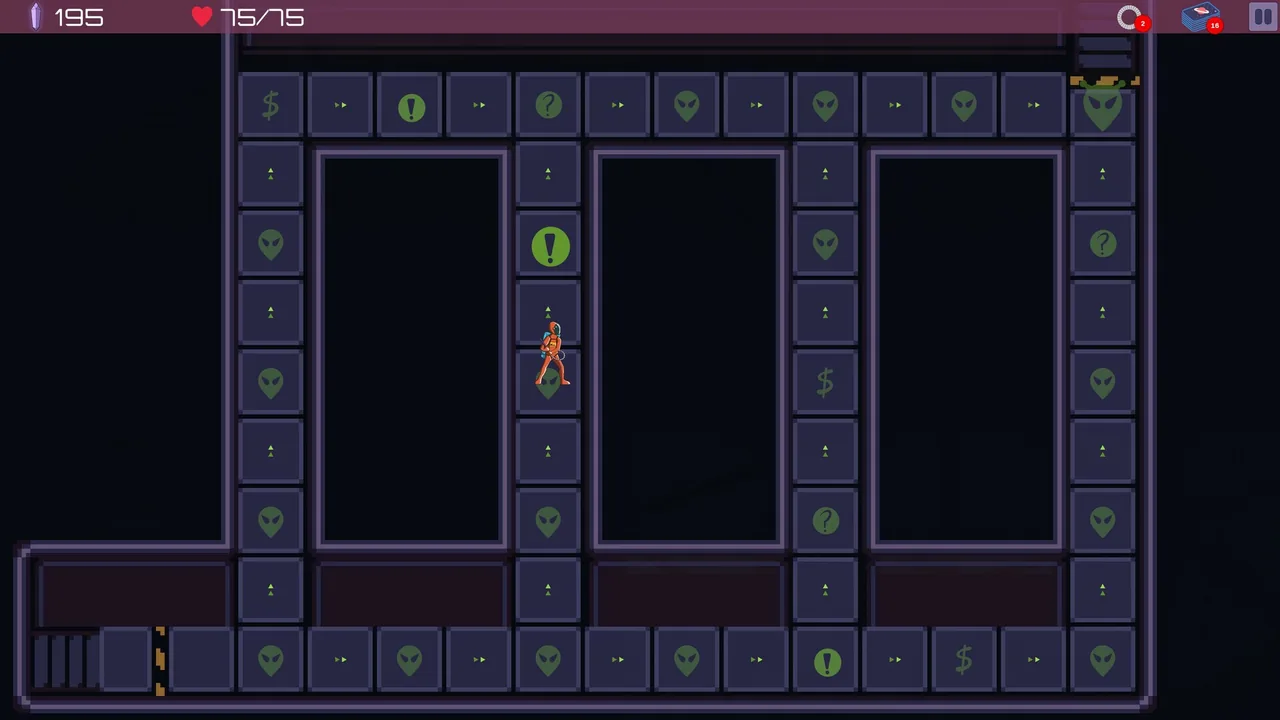
The run structure itself will be instantly familiar to anyone who's played this style of game: a branching node map with combat encounters, shop stops, question-mark mystery nodes and event nodes leading toward a boss icon at the far end, exactly the Slay the Spire-descended shape the genre has standardised on. The shop screenshot shows two vending machines selling both new cards and passive stat upgrades — a speed boost, a health boost, extra energy, bonus weapon damage — for a resource that accumulates during the run, alongside a flat option to pay down and permanently remove a card from your deck. None of that is new to the genre, and Cardstronaut doesn't pretend otherwise; it's the fuel-window combat sitting on top of that familiar chassis that's actually doing the distinctive work.
Presentation and accessibility
Visually, Cardstronaut goes for a flat-shaded, slightly cartoonish sci-fi look — a lived-in space base with cracked viewports, warning stencilling and greenhouse domes, populated by a small orange-suited astronaut and a varied cast of alien and mech designs that read clearly against the darker backgrounds even in a still image. It's not a showcase of technical ambition, but it's coherent and legible, which matters more in a game asking you to track a fuel gauge under time pressure than raw fidelity would.
The one interface concern worth flagging from the screenshots themselves is density. A single combat screen stacks a fuel-window gauge pair per turret, a top-left resource counter, a health total, an energy allowance for the turn, and separate deck and discard pile counts, on top of cards that already carry two numbers each — a cost hexagon and a fuel or damage value. It's not unreadable, but it's a lot of simultaneous numbers for a genre that already asks players to do arithmetic in their head, and it's worth knowing going in if dense HUDs aren't your thing.
Set against that, Cardstronaut's Steam listing carries real accessibility groundwork: it's tagged playable without timed input, playable at your own pace, mouse-only capable, and ships with custom volume controls. None of that is marketing copy — they're Steam's own store categories, which means the turn-based pace has no hidden timer forcing decisions, a genuinely welcome baseline for a mechanic built entirely around careful, considered math.
A launch nobody has weighed in on yet
Here's the part of this review that has to be said plainly rather than hedged around: as of five days after its 2 August 2026 release, Cardstronaut has zero Steam user reviews — checked twice, several minutes apart, to rule out the review API simply lagging — and zero posts on its own news feed. There is no Metacritic score, no review-bomb, no launch controversy, no sentiment to weigh at all. That's not a red flag by itself; plenty of small, honestly-made games launch into silence. But it does mean this review can't tell you what other players think of the back half of a run, because as far as the public record shows, nobody has said anything yet.
The closest thing to hard data is Steam's global achievement API, and it's worth reading carefully rather than dramatically. The percentages resolve neatly to whole numbers against a population of roughly a dozen tracked players: half have moved a turret, a quarter have damaged multiple enemies in one hit, and about one player in twelve has installed a flamethrower mod. Two specific achievements — for clearing the game's first and second named areas — and one for triggering a fuel overflow, sit at exactly 0.0%. Read against a sample that small, a single achievement earned would already move the percentage off zero, so this isn't proof the first area is unbeatable or even unusually hard — it's proof that almost nobody has played long enough yet for the number to move at all. Combined with a scope of only six achievements total, gating two areas rather than a longer campaign, the honest read is that Cardstronaut is a genuinely small, early release, and anyone buying it now is buying ahead of any outside confirmation of how the whole thing holds together.
It's also worth noting Cardstronaut isn't quite as brand-new as its 1.0 date implies — press coverage from mid-2025 describes a free public demo under the same premise, meaning Cyquence Games has had a public build out for roughly a year before committing to a full release. That's a point in the game's favour: this isn't a rushed first cut, even if the review corpus hasn't caught up to say so yet.
Final verdict
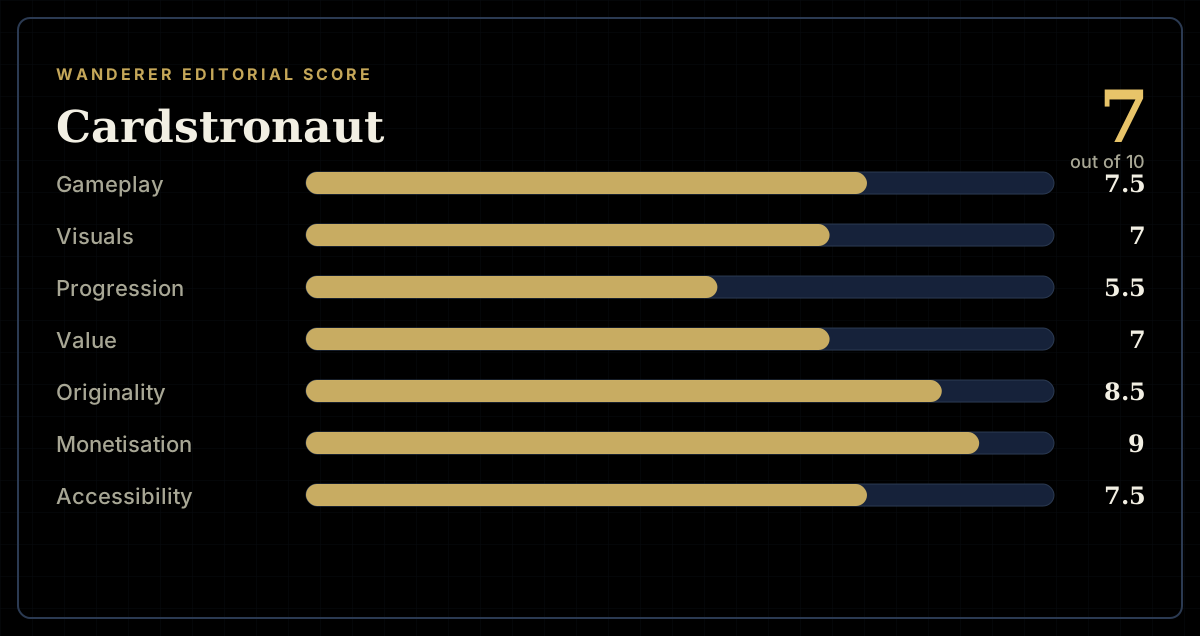
Cardstronaut earns a 7.0 for a genuinely distinctive central mechanic — a shared fuel gauge with a punishing overflow, wrapped in turret positioning and a second mod-based build layer — executed cleanly enough across six promotional screenshots to trust the pitch. It doesn't score higher because there's simply nothing yet to corroborate how well that idea holds up over a full run: no reviews, no news, and an achievement curve too small to read as anything but "very few people have gotten far." Steam's own single-word "Strategy" genre tag underrates it, and the vote-weighted community tags make clear this is a proper roguelike deckbuilder in the tradition the genre's fans already know. If you want a fresh hook at a low price and don't mind being one of the first people to actually report back on the late game, that's a reasonable trade at NZ$4.79. If you'd rather wait for even a handful of other players to confirm the back half works, that's the more cautious and entirely fair call too.
Pros and cons
Pros
- The core rule — flamethrowers only fire inside a narrow fuel window, and overshooting drains your gauge and hurts you instead of the enemy — turns every card play into a real risk calculation instead of a bigger-number-wins formula
- Turret positioning and predicting where enemies will stand when a flamethrower finally triggers add a genuine tactical layer on top of the deckbuilding itself
- An installable mod system lets you customise each flamethrower's synergies separately from your deck, giving the run two build layers instead of one
- A one-time NZ$4.79 purchase with no DLC, no premium currency and no ads is about as clean a monetisation model as this genre offers
- Real accessibility groundwork rather than a checkbox: Steam lists it as playable without timed input, playable at your own pace, mouse-only capable, with custom volume controls
Cons
- Steam's own achievement data implies a tracked population small enough to resolve to whole numbers of players, and not one of them has yet earned the achievement for clearing the game's first area
- With only six achievements gating two named areas, the confirmed scope reads modest for the genre, and there's no outside data yet on how long a full run takes or how the back half is paced
- Steam's official genre field lists only "Strategy," which undersells what the vote-weighted community tags show is a much more specific roguelike, deckbuilding and card-battler hybrid
- Windows only, with no Mac or Linux build and no listed controller support, and zero Metacritic or Steam review sentiment to check your own impressions against
- The combat HUD stacks a fuel-window gauge pair, a resource counter, health, an energy allowance and separate deck and discard counts onto one screen at once, a lot of simultaneous readouts for cards that are already dense with numbers
Screenshots
-
CardstronautImage: Cyquence Games via Steam -
CardstronautImage: Cyquence Games via Steam -
CardstronautImage: Cyquence Games via Steam -
How the review scores each part of the gameWanderer Editorial -
The game at a glanceWanderer Editorial -
The short versionWanderer Editorial