
Game review
Deathless. The Hero Quest
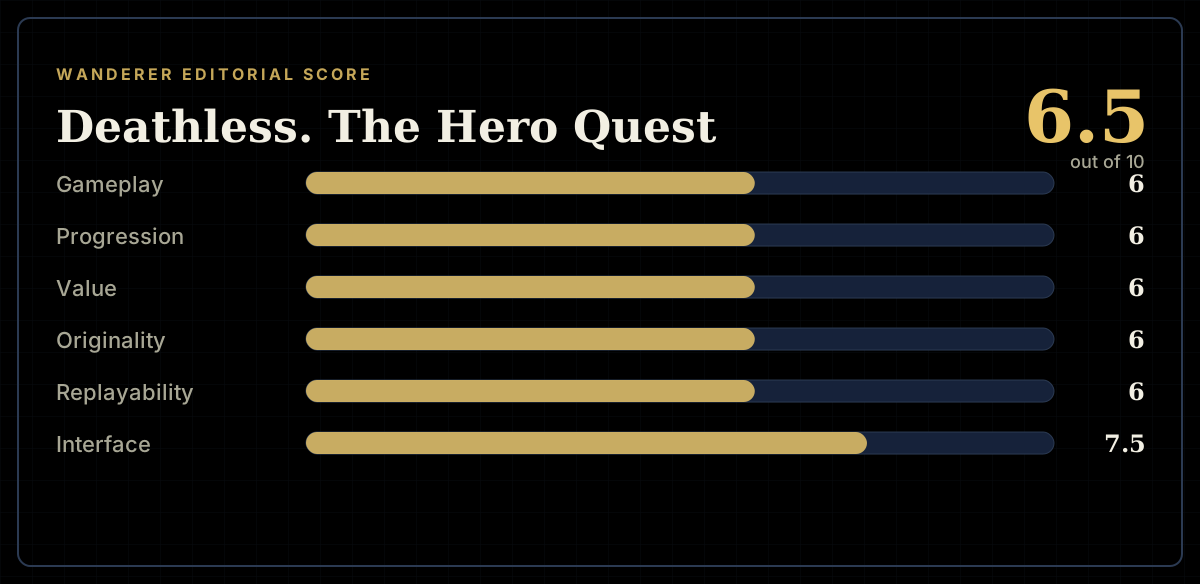
6.5 / 10
- Developer
- FOR-GAMES CR LTD
- Publisher
- FOR-GAMES CR LTD
- Released
- 12 December 2024
- Platforms
- Windows, Steam Deck Verified
- Genre
- Roguelike deckbuilder
- Monetisation
- One-time purchase, no in-game store or additional currency purchases
- Players
- Single-player only
The short version
Deathless. The Hero Quest sends four distinct heroes drawn from Old Rus folklore through a Slay the Spire-shaped roguelike deckbuilder structure, building decks and relic combinations to fight through waves of Slavic monsters toward escalating boss encounters. This review's sample shows genre veterans holding the game in real regard, with several ranking it among the stronger entries in a genre now thick with imitators. What tempers that praise, repeated across a large and specific portion of the negative sample, is a recurring balance complaint: card and relic power levels are described as uneven enough that higher difficulties become a fight against unfavorable RNG rather than a rewarding test of deckbuilding skill, and reviewers with hundreds or thousands of hours invested still describe runs falling apart before a workable strategy comes together.
Biggest strengths
- The art direction, character designs, and combat animations draw near-universal, specific praise, with multiple reviewers calling the visual presentation genuinely top-tier for the genre
- Experienced deckbuilder veterans rank the game highly against established genre peers, with several naming it alongside Slay the Spire, Monster Train, and Roguebook as a worthy entry rather than a lesser imitator
- The four playable heroes are credited with real, distinguishable playstyles that meaningfully change how a run unfolds, giving the game genuine build variety at its foundation
Biggest weaknesses
- A widely repeated complaint concerns card and relic balance, with multiple reviewers independently describing runs that fail to produce a workable strategy due to uneven power levels, making higher difficulties feel unfairly punishing rather than appropriately challenging
- Several reviewers, including some with thousands of hours invested, describe a slow overall game pace that compounds frustration when runs end early due to balance issues rather than clear player mistakes
- Multiple reviewers directly compare the game to Slay the Spire in less favorable terms, describing it as derivative enough that they couldn't identify a compelling reason to choose it over the genre's foundational title
Who it's for: Fans of Slay the Spire-style roguelike deckbuilders drawn to distinctive folklore theming and strong visual presentation, with patience for real, documented balance rough edges especially at higher difficulty tiers.
Our recommendation: A visually stunning, well-regarded entry in a crowded genre, worth it for deckbuilder fans who can tolerate genuine balance friction at higher difficulties — the developer's active, multi-year patch history suggests continued improvement is a realistic expectation, not a hope.
6.5 / 10
Deathless. The Hero Quest wears its influences openly: build a deck, fight escalating waves of monsters, collect relics, face down a boss. It's the Slay the Spire formula, reskinned with genuinely distinctive Old Rus folklore theming and some of the more striking visual presentation this review series has covered in the genre. This review's sample confirms that presentation lands powerfully — and identifies, with real specificity, exactly where the underlying systems don't always match that polish.
Genre veterans taking it seriously
The praise here often comes from reviewers who've clearly played dozens of similar games and are comparing this one against real, established benchmarks. "It clearly draws inspiration from and heavily clones Slay the Spire, but unlike 90% of the other clones, this game does it brilliantly. You get 4 different characters right from th[e start, each meaningfully distinct]," one reviewer writes. Another, with over 11,000 minutes logged, offers a detailed technical assessment: "Already excellent potentially top-tier Slay-the-Spire like, with some very compelling and notable improvements over the classic Slay template, such as far more generous opportunities to build your deck and tableau. Visually beautiful and super slick" in its presentation. A third situates it among genuinely respected genre company: "Great animations and good hero variety. Another great roguelike deckbuilder alongside the likes of STS, Monster Train, Across the Obelisk, Vault of the Void, and Roguebook."
The balance complaint that recurs across huge playtime investments
What makes this review's negative sample worth taking seriously is how much time its authors had already invested before landing on their criticism. "Wildly unbalanced cards make building decks kinda boring, game pace is also pretty slow which pairs poorly with boring runs. Difficulty is also very uneven, requiring VERY strong deckbuilding, which due to unbalanced cards requires VERY particular decks to win, which brings us back to tedious r[uns]," one reviewer with nearly 2,900 minutes logged writes. Another, with an even larger investment, describes the same underlying pattern: "Not worth the money. Game is very frustratingly hard and is extremely slow. Most characters are very underpowered and there's no sense of accomplishment in progression - after 8 hours of playtime, I find myself despising each playable character." A third reviewer sums up a widely echoed frustration precisely: "Higher difficulties suck - require balance patch IMO to be worthwhile pursuing. RNG often gets in the way of setting up broken combos - the pieces of exodia rarely come together, leaving junk in your deck." These aren't complaints from players bouncing off the genre — they're detailed, invested critiques from people who clearly wanted the deeper difficulty tiers to work.
An honest comparison that cuts both ways
Several reviewers make the Slay the Spire comparison directly, and not all land as favorably as the praise above. "It's a Slay the Spire clone that barely stands out and has a worse gameplay loop that feels very unrewarding," one reviewer writes bluntly. Another asks the direct, fair question: "It's an okay game, but unfortunately, I haven't really found a reason why I would play this instead of Slay the Spire." That's a legitimate critique worth weighing seriously against the more effusive praise elsewhere in this sample — this is a genuinely crowded genre, and the folklore theming and visual polish, while real strengths, don't automatically answer the question of whether the underlying mechanics justify a purchase over the genre's most established title.
Story doesn't match the visual ambition
A smaller but consistent thread notes a gap between the game's presentation and its narrative content. "The art is nice, but the animations are crap, and when the game zooms in on your character every turn to give you an action cam of him lethargically bonking his shield on the ground 4 times in a row, you can't NOT notice it," one reviewer writes, flagging a specific animation-pacing annoyance distinct from the broader visual praise elsewhere. Another notes plainly: "Beautiful graphics and setting, although the story might as well not exist," a fair observation that the folklore theming provides atmosphere without necessarily delivering substantial narrative payoff.
What the achievement data confirms about the difficulty complaints
Steam's own completion figures back up the reviewer-described difficulty pattern precisely. An early boss milestone sits at a reasonable 77.4%, with several mid-tier boss-defeat achievements comfortably above 60%, suggesting most players do make solid early progress. But challenge-run achievements — winning without relics, without upgrades, defeating all bosses in a row — collapse to between 2.4% and 3.2%, an extreme drop that directly corroborates reviewer reports that the hardest difficulty tiers and challenge conditions are considerably harder to clear fairly than the base game's early content suggests.
An exceptional, ongoing commitment to improvement
Whatever balance concerns exist, this review found overwhelming evidence the developer has been actively working the problem rather than letting it sit. Deathless's partner-events feed documents an extraordinary cadence of updates: dozens of dated rebalance patches through its Early Access beta period and continuing after full release, live developer streams discussing changes directly with the community, a console launch, Steam Deck verification, and continued sales and content support running through 2027. Reviewers frustrated by balance today are engaging with a developer that has a demonstrated, multi-year track record of iterating specifically on that feedback.
Final verdict
Deathless. The Hero Quest earns real respect from experienced genre players for its visual polish, hero variety, and distinctive folklore setting, tempered by a widely and specifically documented balance problem that makes its higher difficulty tiers feel like a fight against unfavorable odds rather than a fair test of skill. Given the developer's exceptionally active, multi-year patch history, this is a game worth watching closely even if current balance concerns give you pause today.
Pros and cons
Pros
- The art direction, character designs, and combat animations draw near-universal, specific praise, with multiple reviewers calling the visual presentation genuinely top-tier for the genre
- Experienced deckbuilder veterans rank the game highly against established genre peers, with several naming it alongside Slay the Spire, Monster Train, and Roguebook as a worthy entry rather than a lesser imitator
- The four playable heroes are credited with real, distinguishable playstyles that meaningfully change how a run unfolds, giving the game genuine build variety at its foundation
- Steam's own partner-events feed documents an exceptionally sustained, active development history, with dozens of balance patches through both its Early Access period and full release, a console launch, and continued support well past initial launch
- The Old Rus folklore setting earns specific credit as a distinctive, well-realized theme that sets the game apart visually and thematically from its many genre competitors
Cons
- A widely repeated complaint concerns card and relic balance, with multiple reviewers independently describing runs that fail to produce a workable strategy due to uneven power levels, making higher difficulties feel unfairly punishing rather than appropriately challenging
- Several reviewers, including some with thousands of hours invested, describe a slow overall game pace that compounds frustration when runs end early due to balance issues rather than clear player mistakes
- Multiple reviewers directly compare the game to Slay the Spire in less favorable terms, describing it as derivative enough that they couldn't identify a compelling reason to choose it over the genre's foundational title
- The story and writing are consistently described as weak or generic relative to the strength of the visual presentation, with several reviewers noting the folklore setting isn't matched by comparably strong narrative content
- Achievement data shows an extremely steep falloff toward challenge-run achievements, with several sitting under 3%, corroborating reviewer reports that the hardest difficulty tiers and challenge-run conditions are genuinely difficult to clear given the reported balance issues
Screenshots
-

Deathless. The Hero QuestImage: FOR-GAMES CR LTD via Steam -

Deathless. The Hero QuestImage: FOR-GAMES CR LTD via Steam -

Deathless. The Hero QuestImage: FOR-GAMES CR LTD via Steam -
How the review scores each part of the gameWanderer Editorial -
The short versionWanderer Editorial