
Game review
1001st Hyper Tower
6 / 10
- Developer
- Toster12D3
- Publisher
- A Game From Low Polystan
- Released
- 7 November 2019
- Platforms
- Windows
- Genre
- Action
- Monetisation
- Paid, no in-app purchases found
- Players
- false
The short version
1001st Hyper Tower asks a simple, well-executed question: what if a rogue-lite FPS were built entirely around climbing, with rocket boots turning every procedurally generated floor of a destructible tower into a vertical playground? For players who click with its movement and gunplay, several describe it as a genuine 'just one more go' compulsion loop. But steep, poorly explained difficulty walls and a small studio that split its attention across two newer projects after 2019 leave it feeling like a genuinely good idea that never quite finished cohering.
Biggest strengths
- A distinctive core hook — rocket-boot verticality through a fully destructible, procedurally generated tower — that multiple reviewers say delivers a genuinely compulsive "just one more go" loop
- A strong, stylish low-poly aesthetic and "infectious soundtrack" that reviewers consistently praise alongside the game's dark comic tone
- A high skill ceiling that rewards mastering movement and gunfights together, appealing specifically to fans of the broader movement-shooter genre
Biggest weaknesses
- A steep difficulty curve compounded by thin documentation: reviewers report confusion over what various on-screen resource bars represent, and describe boss encounters (including a puzzle-like first-area boss) as opaque rather than clearly telegraphed
- Achievement data shows only 25.3% of owners have completed the game's own tutorial, and just 1.5% have reached the ending — a steep drop-off consistent with an onboarding problem rather than simple high difficulty
- Real, if partial, development abandonment: after an active 2019 launch-year patch cadence, the studio went quiet for roughly two years, returned briefly with one update in 2022 alongside a discount, then moved fully onto newer projects with no further Hyper Tower updates since
Who it's for: Movement-shooter and rogue-lite fans who want something built specifically around verticality, and who are prepared to learn its systems mostly through repeated failure.
Our recommendation: Worth trying for the core movement and shooting alone, with realistic expectations about a steep difficulty curve and light, sometimes confusing documentation.
6 / 10
What it is
1001st Hyper Tower sends players climbing a procedurally generated tower set in an Arabian cyberpunk world, fighting through "cunning enemies" and boss encounters on the way to the top. Its defining mechanical idea is verticality: rocket boots let the player traverse each floor with real speed and freedom, and every structure in the tower is fully destructible, meaning cover and level geometry can be reshaped mid-fight rather than staying fixed. One reviewer with over 3,300 minutes logged describes it as "a really compelling rogue-lite shooter" specifically because of "the emphasis it places on the verticality of the massive tower levels," with "a real sense of style as you jet around the levels on rocket boots."
It released on 7 November 2019 at NZD 15.49, developed by Toster12D3 under the small studio banner Low Polystan. Its review corpus is modest at 31 total reviews but leans clearly Positive (26 to 5), and reading through it in full surfaces both real enthusiasm for the core concept and specific, recurring frustration with how the game teaches — or fails to teach — its own systems.
The movement-shooter case for it
Fans of the genre describe the core loop in strongly positive terms. One reviewer with nearly 80 hours logged calls it their "default compulsive 'just one more go' game" for several months running, specifically praising the tower's verticality and the feel of the rocket-boot traversal. Another, watching from an early alpha build onward, reports that common complaints levelled at rogue-lite FPS games generally — poor enemy AI chief among them — "don't seem to apply here," crediting a "sufficiently high skill cap" for keeping the format fresh over repeated runs. A third reviewer frames it in genre terms directly: "If you like movement shooters, this is the game for you. If you like rogue-lites, this is the game for you," while still noting real frustration with specific level design choices layered on top of that praise. The aesthetic package draws consistent, specific compliments too — "an infectious soundtrack," a distinctive low-poly art style, and dark comic tone that one reviewer says gets "the endless comedy of a bad situation getting worse and worse" right.
Where the difficulty tips into confusion
The most consistent complaint isn't that the game is hard — several reviewers explicitly enjoy the challenge — it's that the game does a poor job explaining what its systems mean before demanding mastery of them. One reviewer reports being unable to progress past the first level after several hours, citing "not enough ammo," unclear healing options, and "very little documentation" for the various status bars on screen. Another describes the first boss specifically as containing "a sort of puzzle element" requiring precise jump sequences that isn't clearly signposted, on top of general complaints about enemy volume and fall damage resulting in instant game-overs. The achievement data backs this up with a concrete number: only 25.3% of owners have completed the in-game tutorial itself — not a mid-game boss, not a late-game achievement, the tutorial — which points toward an onboarding problem specifically, distinct from the game simply being difficult once its systems are understood. From there, completion rates fall further still, down to just 1.5% for the achievement tied to finishing the game.
A studio that moved on, then briefly came back
Steam's own news feed tells a clear story about ongoing support. A real, active patch cadence runs through 2019, matching the game's launch year — multiple named updates from March through December. Then the trail goes quiet for roughly two years. In February 2022, the studio (posting as "Low Polystan") announced an entirely new game, Saffron Fields, and shortly after, in May 2022, shipped one further Hyper Tower update alongside a 50% discount — a brief, real return rather than total silence, but not a sustained one. By March 2023 the studio's news feed shifts to promoting yet another new project, DUST DEVIL, and nothing further about Hyper Tower has followed since. That timeline explains the split sentiment in the review corpus directly: one reviewer flatly states "the game is finished... dunno what the reviews are all about," while another, likely writing after a longer gap without updates, calls it "abandoned" and laments that it's "SOOO close to being finished" with just some polish standing between it and completion. Both readings can be accurate depending on exactly when each reviewer checked in.
A specific late-game roadblock
Beyond the general difficulty curve, at least one detailed review identifies a specific structural choke point rather than a vague complaint about hardness. Around the second or third boss, that reviewer reports being unable to progress further without first defeating a specific "warp gate caravan boss" — a fight structured around a deceptive early phase before the real battle begins underneath the only accessible area, in a way the reviewer found unclear on a first attempt. That kind of single, mandatory gate blocking further progress is a meaningfully different design problem from difficulty spread evenly across a run — it concentrates frustration at one specific point rather than testing sustained skill, and it lines up with the broader pattern of the game asking a lot of trial-and-error investment before its systems become legible.
Weighing the destructible-tower hook against the execution
It's worth being clear about what 1001st Hyper Tower gets right even amid the criticism, because the destructible-environment verticality is genuinely uncommon execution for a rogue-lite FPS at this budget level. Several reviewers who otherwise raise real complaints about difficulty or documentation still return to praising the core traversal feel specifically — "one robotic foot is worth" the price of admission, as one puts it, alongside praise for the "cool immersive atmosphere" of the setting. That's a meaningful signal: the complaints in this corpus are almost entirely about onboarding, balance and follow-through rather than about the fundamental design idea being weak. A studio with more sustained resources to polish tutorialisation and boss telegraphing around an already-solid core movement-and-shooting loop could plausibly have turned this into a genre standout; what shipped, and mostly stayed as, is a rougher version of that same good idea.
Verdict
1001st Hyper Tower has a genuinely distinctive, well-liked core idea in its rocket-boot verticality and destructible tower structure, and the players who click with its movement and gunplay describe real, sustained compulsion to keep climbing. But thin onboarding, confirmed directly by a striking 25.3% tutorial-completion rate, and a small studio's divided attention across newer projects since 2019 leave it feeling unfinished at the edges even to reviewers who otherwise recommend it. Worth trying for movement-shooter fans specifically, with patience built in for a rough first few hours.
Pros and cons
Pros
- A distinctive core hook — rocket-boot verticality through a fully destructible, procedurally generated tower — that multiple reviewers say delivers a genuinely compulsive "just one more go" loop
- A strong, stylish low-poly aesthetic and "infectious soundtrack" that reviewers consistently praise alongside the game's dark comic tone
- A high skill ceiling that rewards mastering movement and gunfights together, appealing specifically to fans of the broader movement-shooter genre
- At least one detailed account of the developer actively responding to and implementing player feedback during its more active development period
Cons
- A steep difficulty curve compounded by thin documentation: reviewers report confusion over what various on-screen resource bars represent, and describe boss encounters (including a puzzle-like first-area boss) as opaque rather than clearly telegraphed
- Achievement data shows only 25.3% of owners have completed the game's own tutorial, and just 1.5% have reached the ending — a steep drop-off consistent with an onboarding problem rather than simple high difficulty
- Real, if partial, development abandonment: after an active 2019 launch-year patch cadence, the studio went quiet for roughly two years, returned briefly with one update in 2022 alongside a discount, then moved fully onto newer projects with no further Hyper Tower updates since
- At least one reviewer reports poor performance and choppy frame pacing even on a very high refresh-rate monitor, with limited graphics or display options to diagnose or fix it
- Reviewers disagree sharply on whether the game is actually finished, with some calling it complete and polished and others describing it as close but clearly missing final passes
Screenshots
-

1001st Hyper TowerImage: A Game From Low Polystan via Steam -

1001st Hyper TowerImage: A Game From Low Polystan via Steam -

1001st Hyper TowerImage: A Game From Low Polystan via Steam -
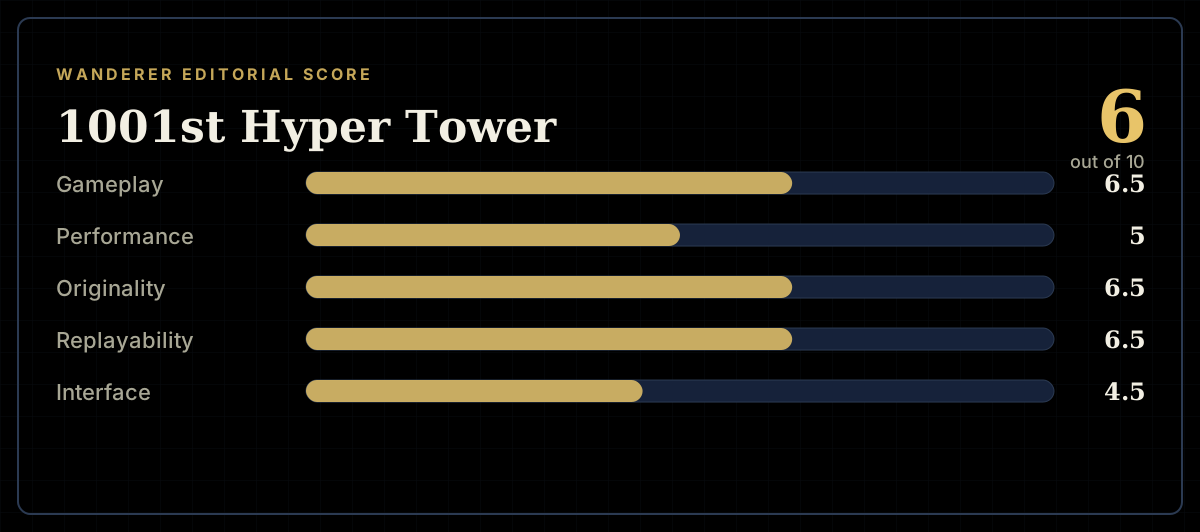
How the review scores each part of the gameWanderer Editorial -
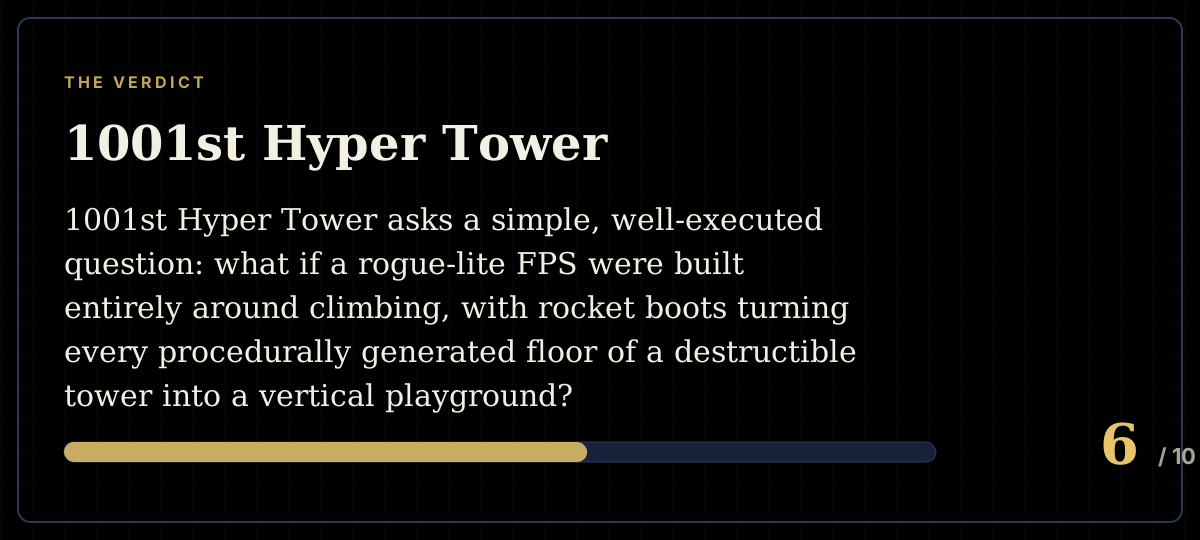
The short versionWanderer Editorial