
Game review
Void Bastards
6.5 / 10
- Developer
- Blue Manchu
- Publisher
- Blue Manchu
- Released
- 28 May 2019
- Platforms
- Windows
- Genre
- Action
- Monetisation
- Paid, no in-app purchases found
- Players
- false
The short version
Void Bastards sends convict crew members drifting through a nebula, boarding derelict ships to scavenge parts and repair a prison transport, wrapped in a distinctive hand-drawn comic art style and a dry, memorable narration voiced by The Stanley Parable's Kevan Brighting. Its core loop draws consistent, near-unanimous praise for style and consistent, near-unanimous criticism for shallow repetition after the first several hours — but a striking, detailed counter-finding from within its own review corpus suggests much of that criticism traces back to the game's default difficulty undercutting its own tension, rather than a flaw in the underlying design itself.
Biggest strengths
- A genuinely distinctive comic-book art style and dry, memorable narration (voiced by Kevan Brighting, familiar from The Stanley Parable) that draws consistent, near-universal praise
- A satisfying core scavenging loop of boarding procedurally varied derelict ships, managing limited resources, and deciding which risks are worth taking
- Runs well even on modest hardware thanks to its deliberately simple, stylised visual approach
Biggest weaknesses
- A dominant, independently repeated complaint across many reviewers: despite excellent presentation, the core gameplay becomes shallow and repetitive after roughly 7 to 10 hours
- Multiple reviewers argue the asking price doesn't match the amount of content on offer, consistently recommending buyers wait for a sale
- On the default Normal difficulty, one detailed account reports dying only twice across an entire playthrough — a level of safety that undermines the tension a roguelike-structured game depends on to feel meaningful
Who it's for: Fans of System Shock-adjacent scavenger loops and FTL-style resource management who specifically play on higher difficulty settings, or who want a strong art style and writing over long-term depth.
Our recommendation: Worth it on sale, and worth starting on Hard rather than Normal difficulty regardless of price paid — reviewer evidence suggests the easier setting undersells what the game is actually going for.
6.5 / 10
What it is
Void Bastards casts the player as a rotating cast of expendable convicts — "WCG Clients," in the game's own dry corporate-dystopian framing — drifting through the Sargasso Nebula aboard a damaged prison ship, the Void Ark. To repair it and escape, players board a procession of derelict vessels, scavenging parts, fuel, food and ammunition while avoiding or fighting mutated "Citizens," security robots, and space pirates. Developer Blue Manchu draws on real pedigree in this space — several team members previously worked on the System Shock and BioShock series — and that lineage shows in the scavenger-horror-adjacent structure layered underneath a much lighter, more comic tone. The game's hand-drawn, cel-shaded art style and dry, deadpan narration (voiced by Kevan Brighting, whose work as the narrator of The Stanley Parable draws direct comparisons from multiple reviewers) give Void Bastards a genuinely distinctive identity that sets it apart visually from almost anything else in its genre.
It released on 28 May 2019 at NZD 36.99. Its 2,740-review English corpus sits at a strong Very Positive (2,387 to 353), and reading through it in depth reveals an unusually consistent pattern: reviewers on both sides of the recommendation line largely agree on what the game does well and what it doesn't, disagreeing mainly on how much the shortcomings outweigh the strengths.
Where the praise is close to unanimous
Presentation draws essentially no disagreement across the corpus. "The art direction is exceptional," writes one otherwise conflicted reviewer, and that sentiment repeats constantly: "visuals, sound, and music are simply incredible," a "very distinct and sardonic personality," an art style "evocative of" classic sci-fi illustration. The scavenging loop itself — deciding which derelict ships are worth the risk of boarding, managing a limited crew who can each die permanently, and gradually unlocking better weapons and upgrades — also draws real, specific praise from reviewers who enjoyed it: "extremely satisfying gameplay and progression," writes one, favourably comparing the overall package to "System Shock, but crossed with Rogue Legacy and Borderlands."
The recurring complaint, and where it might actually come from
Set against that praise is an equally consistent critical thread: the gameplay, several reviewers argue, simply doesn't sustain the presentation's ambition. "Great art style, great theme, really shallow and repetitive gameplay," reads one blunt summary; another states plainly that "the weird and unknown became all too familiar way too quickly." Multiple reviewers independently report the game growing stale somewhere between 7 and 10 hours in, well before most campaigns conclude, and several separately argue the asking price doesn't match what's ultimately a fairly short, thin experience once its novelty wears off.
What makes this corpus worth reading past the surface-level score, though, is one unusually detailed review that offers a specific, actionable explanation for exactly this complaint. Its author admits they were "this close" to writing a negative review after finishing the campaign on Normal difficulty, having died only twice in the entire playthrough — a survival rate the reviewer attributes not to skill but to the difficulty setting itself failing to generate real threat. Restarting on "Hard Bastard" difficulty with Iron Man mode enabled (permadeath with no save-scumming) produced, in their words, "a completely different game" — closer to "a non-horror, comedic take on the combat, stealth and survival systems of System Shock 1 or 2," where specific enemy types like Pirates and Security Bots become genuinely dangerous rather than incidental obstacles. That's a striking, specific piece of evidence suggesting the "shallow and repetitive" complaint many reviewers raise independently may correlate strongly with playing on the game's default difficulty rather than reflecting a ceiling on the design itself.
What the achievement data adds to the difficulty question
Void Bastards tracks 24 achievements, and their completion spread offers a useful, if indirect, corroboration of the difficulty-dependent-satisfaction theory above. Early, low-commitment achievements sit extremely high — 95.6% for the first tracked milestone, 89.6% for a basic weapon-upgrade achievement — confirming most buyers do at least start engaging with the core loop seriously. But the achievements tied to the game's hardest optional challenge runs — completing a playthrough using only a single tool, only a primary weapon, only a secondary weapon, with no upgrades at all, or with no weapons whatsoever — all cluster tightly around 1.1% to 1.3%. That's an unusually narrow band for a game's very hardest achievements to sit in, and it suggests those challenge-run conditions are attempted by, and rewarding to, only a small, dedicated slice of the playerbase — precisely the subset most likely to have also pushed into Hard or Hard Bastard difficulty to make those runs meaningfully harder in the first place. The broader playerbase, by this reading, largely experiences the campaign once on default settings and moves on, which lines up closely with both the "shallow after 7-10 hours" complaint and the specific difficulty-setting explanation offered above.
Weighing presentation against price
It's worth being direct about the value calculation several reviewers make explicitly: a NZD 36.99 asking price for what a meaningful share of the corpus describes as a 9-to-15-hour experience that grows repetitive partway through is a harder sell than the same content at a lower price point would be. Reviewers aren't disputing that the hours they spent were reasonably enjoyable — the complaint is almost always about the ratio of price to content rather than outright dissatisfaction with what's there. That distinction matters for how to weigh the "wait for a sale" advice repeated so often in this corpus: it's less "this game isn't good" and more "this game is good enough to enjoy once, at a price point that should reflect that single-playthrough-shaped reality" — a genre where indie alternatives routinely offer greater replayable depth at similar or lower prices.
Verdict
Void Bastards pairs one of 2019's most distinctive visual and narrative packages with a scavenging loop that a large share of its own audience found didn't hold up over a full campaign — but the review corpus itself contains a compelling, detailed counter-argument that the default difficulty is partly to blame for that impression, with a meaningfully tenser and more rewarding experience available on harder settings. Worth playing for the art and writing alone, and worth starting on Hard from the outset rather than discovering the difference the hard way after finishing an easier run.
Pros and cons
Pros
- A genuinely distinctive comic-book art style and dry, memorable narration (voiced by Kevan Brighting, familiar from The Stanley Parable) that draws consistent, near-universal praise
- A satisfying core scavenging loop of boarding procedurally varied derelict ships, managing limited resources, and deciding which risks are worth taking
- Runs well even on modest hardware thanks to its deliberately simple, stylised visual approach
- A detailed reviewer account suggests the harder difficulty settings (Hard and "Hard Bastard," especially with Iron Man mode) deliver a meaningfully tenser, more System Shock-like experience than the default setting
Cons
- A dominant, independently repeated complaint across many reviewers: despite excellent presentation, the core gameplay becomes shallow and repetitive after roughly 7 to 10 hours
- Multiple reviewers argue the asking price doesn't match the amount of content on offer, consistently recommending buyers wait for a sale
- On the default Normal difficulty, one detailed account reports dying only twice across an entire playthrough — a level of safety that undermines the tension a roguelike-structured game depends on to feel meaningful
- A relatively short main campaign (roughly 9-15 hours) that several reviewers say offers little reason to replay once finished on a single difficulty setting
- Achievement data shows a steep drop after early milestones (95.6% for the first tracked achievement down to roughly 1.1-1.3% for hard challenge-run achievements), reflecting how few players engage with the game's harder optional modes where several reviewers say it shines most
Screenshots
-

Void BastardsImage: Blue Manchu via Steam -

Void BastardsImage: Blue Manchu via Steam -

Void BastardsImage: Blue Manchu via Steam -
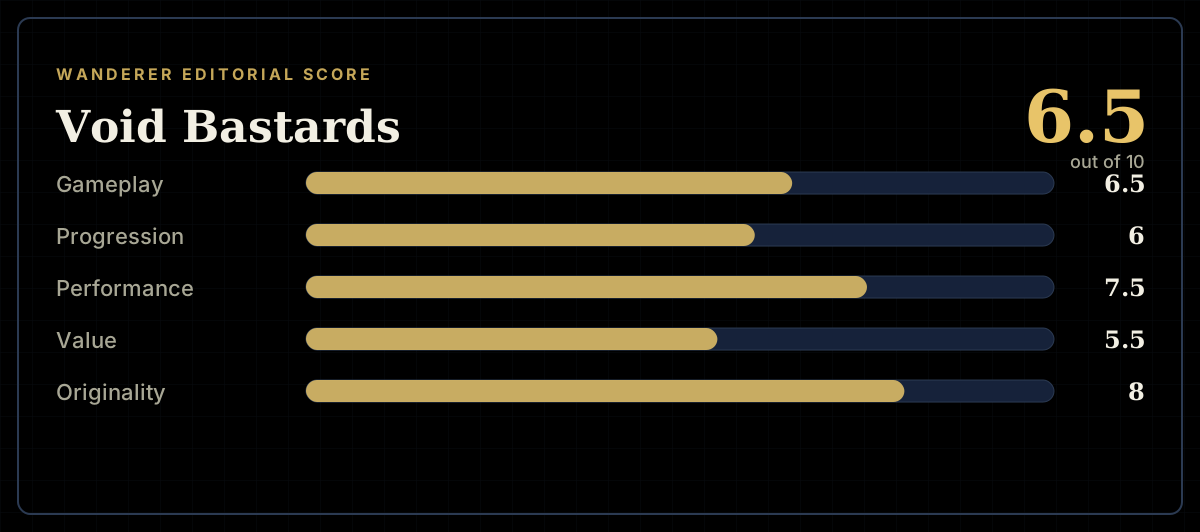
How the review scores each part of the gameWanderer Editorial -
The short versionWanderer Editorial