
Game review
Deadzone: Rogue
6.5 / 10
- Developer
- Prophecy Games
- Publisher
- Prophecy Games
- Released
- 29 April 2025
- Platforms
- Windows
- Genre
- Action
- Players
- Co-op
The short version
Biggest strengths
- Sharp, well-regarded gunplay and movement that reviewers consistently rate among the best currently available in the roguelite-FPS genre
- A deep, genuinely varied build-crafting system layering augments and elemental effects across a substantial weapon roster
- Tight, roughly hour-long runs that work equally well solo or in easy-to-join co-op, with meaningful carry-over progression between attempts
Biggest weaknesses
- The developer's decision to announce a sequel shortly after this game exited Early Access, while it was still reportedly missing promised content, is the single most upvoted and most discussed complaint in the entire review sample
- Prophecy Games has a documented history, cited directly and repeatedly by reviewers, of previous titles being abandoned, renamed, or under-supported after initial sales
- Multiple reviewers report extensive use of AI-generated dialogue and imagery throughout the game, a specific and recurring transparency complaint
6.5 / 10
A genuinely well-made roguelite FPS, reviewed alongside its own developer's reputation
Deadzone: Rogue asks players to blast through swarms of hostile machines in space, forging a build across each run by combining weapons, augments, and elemental effects, solo or with friends in co-op. Based purely on the mechanics, the reception is close to unambiguous: "This game slaps," one reviewer states simply, listing off a run-down of specific strengths — "Roguelike FPS, runs last about an hour, solo and co-op both own, easy to jump into open co-op games, carry-over progress between runs feels significant, still getting content." A separate reviewer goes further, calling it "one of the best shooter games I've ever played. Lots of guns and build options, a lot of content... The gunplay and the movement feels so good and sharp, it's just 10/10."
Based on the available English-language review sample of 8,680 reviews — 7,504 positive, 1,176 negative, landing at an overall Very Positive rating — that mechanical quality is real and widely agreed upon. But this is one of the more unusual review samples this lane has covered, in that the single most upvoted review in the entire dataset isn't primarily about the gameplay at all — it's about the developer's conduct, and that thread runs consistently through a large share of the sample regardless of star rating.
A sequel announcement that landed very badly
The most heavily upvoted review in the sample — 726 votes, negative — opens with the specific incident driving much of the current discourse: "Announcing Deadzone: Rogue 2 while the original game is still relatively fresh out of Early Access, missing content, and plagued by a number of issues is certainly a choice. The game itself is good and has a lot of potential, but seeing the developers already shift their focus to a sequel makes it feel less like long-term support and more like a quick cash grab." That's a specific, dateable grievance rather than a vague complaint about developer trust, and it's echoed by the second-most-upvoted review in the sample (373 votes), which states plainly: "The game is decent, 100% can't lie to you there. But I wouldn't recommend people buy the game because of the (not so recent anymore) news regarding its sequel."
What makes this complaint land as hard as it clearly has is that it connects to a broader, independently-corroborated pattern reviewers describe about the developer's history. "The devs have a history of pumping out a game, making money off of it, and never updating said game. Keep this in mind before buying," one reviewer writes, while a separate reviewer adds a specific detail about this game's own pre-launch history: "The company is KNOWN for leaving games that aren't doing well. I believe that this game had 4 name changes? Once this one got wishlisted/downloaded during early access, they kept the name." One especially detailed reviewer connects the dots to a specific, named prior project: "Wow. This game was an extraction shooter at one time. It was called Starseige Deadzone. It was actually great but it never made it off the ground. Then years later I see a notification in my library that a game called Deadzone Rogue is in my library and ready to download. I never bought this game but I did buy the founders pack of Starseige Deadzone." That's a specific, verifiable-sounding claim about game history worth reporting plainly as this reviewer's account, illustrating exactly why the developer's track record is weighing so heavily on this game's reception independent of its mechanical quality.
AI content, reported specifically and repeatedly
A separate, more specific complaint concerns the use of AI-generated content within the game itself. "Tons of AI stuff. Holy crap the amount of in game dialog and pictures that use AI is just nuts," one reviewer writes, a complaint about undisclosed generative content distinct from, but related to, the broader trust concerns about the developer's conduct. This review sample doesn't offer independent confirmation beyond reviewer testimony, but the specificity and repetition of the claim across multiple reviews suggests it reflects a real, noticeable pattern in the shipped game's dialogue and art assets rather than an isolated complaint.
A worthwhile game underneath the controversy, by wide agreement
Despite all of that, it's genuinely notable how many reviewers explicitly separate their trust concerns about the developer from their assessment of the game itself, and land on a positive recommendation anyway. "I'm gonna be honest. I gave up on this game at first. I saw the negative reviews and read about the company's history, including how they abandoned previous games or misled players about mechanics that were later changed. Even so, I wanted to give it a fair shot because I really enjoy roguelikes, and FPS roguelikes are no exception," one reviewer writes, going on to recommend the game despite those reservations. A separate, more skeptical reviewer frames a similarly qualified endorsement: "it is... fine. I dont regret buying it on sale for $14, but I feel like if I paid the 'full price' of $25 I would have. Its a good little simple roguelike FPS, the story is acceptable and the gameplay is serviceable, but feels barebones at times."
The achievement data offers strong, independent confirmation that whatever the controversy, there's real structural depth here: across 58 total achievements, early milestones sit near universal completion (98.6%), while the hardest late-game and Nightmare-difficulty goals fall to well under 1%. That's an unusually wide spread even among the roguelites this lane has covered, and it argues for a genuinely deep, well-supported difficulty and content ladder — directly at odds with the "missing content" framing in the sequel-announcement complaints, and worth weighing as a real, positive counterpoint. One especially charmed reviewer sums up the emotional core some players have found in the game's smaller touches: "The gameplay loop is really well made and I enjoy using most of the guns within each run. But I mostly play this game to talk to planty. I just really love that plant. It is my best friend."
Where this leaves it
Deadzone: Rogue is, by broad mechanical consensus, a genuinely excellent roguelite FPS with sharp gunplay, deep build-crafting, and substantial, achievement-verified content depth — and it's also a game whose review base is unusually preoccupied, for good reason, with its developer's specific, documented history of abandoning or rebranding earlier projects and a sequel announcement that landed as a serious breach of goodwill shortly after this game's own 1.0 launch. Both things are true at once, and reviewers overwhelmingly agree on both. Recommended for roguelite-FPS fans on the strength of the gameplay itself, with the clear caveat that Prophecy Games' track record and the still-fresh sequel controversy are legitimate, specific reasons for caution about long-term support that this review can't responsibly wave away.
Pros and cons
Pros
- Sharp, well-regarded gunplay and movement that reviewers consistently rate among the best currently available in the roguelite-FPS genre
- A deep, genuinely varied build-crafting system layering augments and elemental effects across a substantial weapon roster
- Tight, roughly hour-long runs that work equally well solo or in easy-to-join co-op, with meaningful carry-over progression between attempts
- A large, wide-spread 58-achievement structure (98.6% down to 0.4%) confirming real, substantial long-term content and difficulty tiers
Cons
- The developer's decision to announce a sequel shortly after this game exited Early Access, while it was still reportedly missing promised content, is the single most upvoted and most discussed complaint in the entire review sample
- Prophecy Games has a documented history, cited directly and repeatedly by reviewers, of previous titles being abandoned, renamed, or under-supported after initial sales
- Multiple reviewers report extensive use of AI-generated dialogue and imagery throughout the game, a specific and recurring transparency complaint
- Some reviewers connect this release to Starseige Deadzone, an earlier extraction shooter from a related team that never fully launched, and treat that history as a specific reason for caution
- A minority of reviewers find the moment-to-moment combat merely serviceable rather than exceptional once the build-crafting novelty wears off, and want clearer in-game stat visibility (crit chance and damage specifically)
Screenshots
-

Deadzone: RogueImage: Prophecy Games via Steam -

Deadzone: RogueImage: Prophecy Games via Steam -

Deadzone: RogueImage: Prophecy Games via Steam -
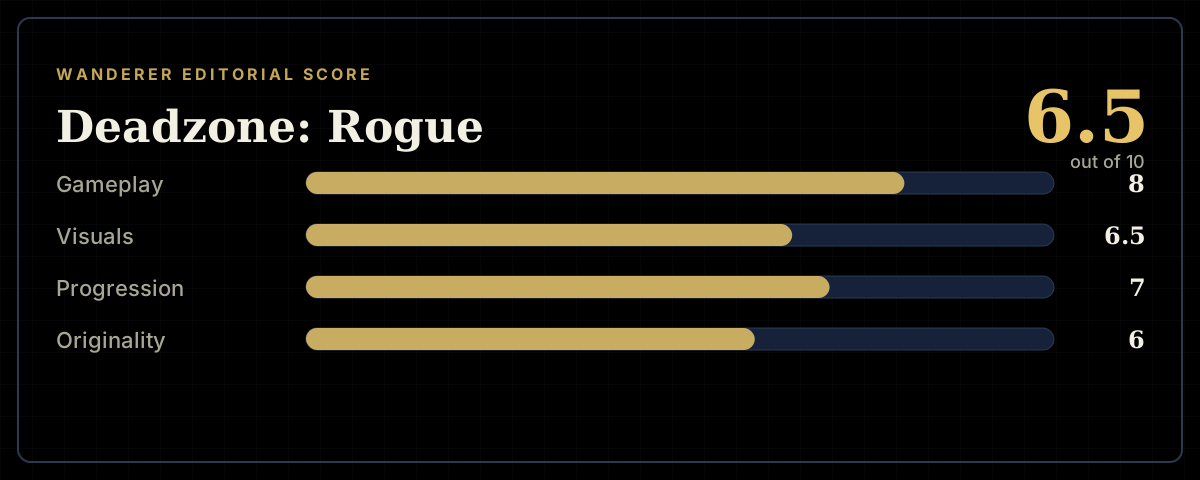
How the review scores each part of the gameWanderer Editorial -
The short versionWanderer Editorial