
Game review
Yawnoc
8 / 10
- Developer
- DaFluffyPotato
- Publisher
- DaFluffyPotato
- Released
- 13 November 2024
- Platforms
- Windows
- Genre
- Bullet-hell roguelite with cellular-automaton enemy AI
- Monetisation
- One-time purchase, no in-game store or additional currency purchases
- Players
- Single-player only
The short version
Yawnoc's central hook is genuinely rare in the bullet-hell roguelite genre: the mechanical enemies invading its forest actually follow the rules of Conway's Game of Life, Brian's Brain, and other real cellular automata, meaning a careless kill can trigger a chain reaction that spawns or removes further enemies depending on the surrounding pattern. Reviewers describe this as genuinely unlike anything else they've played, and back it with real enthusiasm for the persistent, run-spanning weapon enchantment system layered on top. At a price most reviewers call an outright bargain, the response has been close to unanimous. What holds this back from a clean recommendation for everyone is a specific, physically real complaint about camera jitter that at least one reviewer says made the game unplayable regardless of settings, plus a detailed critique of how chest and upgrade timing can waste the very power-ups the run design depends on.
Biggest strengths
- The core premise of enemies genuinely following cellular automaton rulesets is repeatedly described as unique and intellectually engaging, rewarding players who think about which enemies to kill and in what order rather than simply spraying bullets at everything on screen
- A persistent, between-run weapon enchantment system gives real long-term build variety, with reviewers describing thousands of possible enchant combinations and genuine excitement at discovering unusual ones
- The price draws close to unanimous praise as excellent value, with reviewers repeatedly calling it "cheap as dirt" and "an absolute bargain" for the amount of polish and content on offer
Biggest weaknesses
- Camera jitter and shake are reported by at least one player as causing genuine motion sickness severe enough to make the game unplayable, with no combination of available settings fully resolving it, a real accessibility concern rather than a stylistic quibble
- A detailed reviewer identifies a specific design flaw in chest and upgrade timing: temporary power-ups activate immediately on pickup, so a chest positioned away from the current fight can expire before it's useful, and there's no way to save an upgrade for a more opportune moment
- The same reviewer notes there's sometimes not enough time to collect all the currency a wave drops before it disappears, adding avoidable frustration to runs that are already meant to be difficult
Who it's for: Bullet-hell and roguelite fans who want a genuinely novel mechanical premise to think through rather than just react to, especially anyone with a soft spot for mathematical curiosities like cellular automata, and who can tolerate real, sustained difficulty.
Our recommendation: A near-automatic purchase at its price for genre fans, and one of the more intellectually distinctive small releases covered in this lane this year. Test the camera settings early if you're prone to motion sickness in games, since this is a specific, reported issue that doesn't fully resolve for everyone even with available options adjusted.
8 / 10
There's a specific kind of reviewer reaction that shows up repeatedly in Yawnoc's Steam page, and it's worth quoting directly because it captures something most bullet-hell roguelites never attempt: "Someone used Conway's Game of Life cellular simulation as a premise to make a game? Ok, you got my attention, I know about it, I follow Numberphile channel for decades." Yawnoc's mechanical enemies don't just look like they're following a pattern — they genuinely are, running on the actual rules of Conway's Game of Life, Brian's Brain, and a ruleset called LowDeath, meaning a careless kill can trigger a cascading update cycle that spawns more enemies or wipes out a cluster entirely depending on what surrounds it. That's a rare thing for the genre to attempt, and the review sample overwhelmingly says it works.
Combat that rewards thinking, not just reflexes
The core loop is recognisably a bullet-hell roguelite — waves of enemies, a shop between rounds, escalating difficulty — but the automaton rulesets change what "playing well" actually means. One reviewer captures the resulting texture memorably: "killed an enemy, it helped him live. I saw an enemy kill itself by obeying its rules. The game oscillates between 'damn, I could do this with my eyes closed' and 'OK I AM SOO DEAD!' in split seconds." Another draws a direct line to the genre's current giants while noting what sets this apart: "reminds me of Vampire Survivors and Brotato... I like the risk/reward system of getting in close to get more money before it disappears or shoot from far away to stay safe," but adds that understanding the underlying cellular automata rules "really benefits you" in a way those comparisons don't require. Layered on top is a persistent enchantment system carrying between runs, with reviewers describing genuine excitement discovering odd combinations — a shotgun that "raises up an army of centipedes," as the store page itself puts it, only slightly tongue-in-cheek.
A price nobody seems to argue with
Value comes up constantly, and almost nobody in the sample pushes back on it. "Great range of difficulty and its cheap as dirt. I don't see why you would buy it honestly," reads one deliberately backwards-sounding but clearly enthusiastic review. Another calls it "an absolute bargain game that deserves way more attention." A third notes the added novelty that the game is built commercially in Python using the Pygame library — a detail that draws its own specific appreciation from reviewers with a development background, on top of the base price-to-content assessment nearly everyone lands on independently.
A camera issue that's more than a preference
Set against that enthusiasm is one specific, serious complaint that deserves to be reported plainly rather than folded into general polish concerns. One reviewer states directly: "the game jitters and shakes in a way that makes me motion sick, and I'm unable to play it. No combination of settings that I could find made this right. And I'm not one who typically gets motion sickness from games." A separate positive reviewer independently confirms camera jitter as a real issue, offering a partial workaround — turning off camera slack and mouse-controlled movement — while noting "it doesn't 100% fix it, but it makes it playable for me anyways." Two independent reports of the same specific technical issue, one severe enough to prevent play entirely, is worth treating as a genuine accessibility concern rather than an isolated sensitivity.
A detailed critique of how upgrades actually get used
The most substantive critical review in the sample raises a specific structural problem rather than a vague balance complaint. Chests and their temporary power-ups activate immediately on pickup, but chest placement doesn't account for where the current fight is happening — meaning a player who spots a chest in one corner of the map while fighting in another effectively wastes it, since the buff can expire before it's useful. The same reviewer proposes a specific, reasonable fix: letting players bank at least one upgrade to use when it actually matters, rather than being forced to activate it the moment it's collected. A related complaint concerns wave-end currency: chests detonate with barely enough time to see what dropped, let alone collect all of it, adding friction that reads as a pacing oversight rather than intended difficulty. Notably, this same reviewer struck through an earlier complaint about "bullet sponge" automata after realising the frustration was partly a skill issue solvable by prioritising kills more carefully — a useful reminder that this genre's steepest learning curves can look like design flaws before they look like technique gaps.
Difficulty that the numbers confirm is real
Steam's own achievement data backs up the review sample's repeated claims that this is a genuinely hard game. Even the most-cleared achievement sits at only 38% completion, and full-victory achievements at the hardest difficulty settings drop to 0.3% and 0.4%. That's a steep curve by any genre's standard, consistent with reviewers who describe the game as "challenging even on the lowest difficulty" and openly admit to dying repeatedly on early waves well into dozens of hours of play.
Final verdict
Yawnoc does something genuinely uncommon for its genre: it builds a real intellectual hook — actual cellular automata rules governing enemy behaviour — into a bullet-hell roguelite loop that's already been executed with real care, backed by a persistent enchantment system and a price the review sample treats as close to a non-issue. The camera jitter complaint is a real, physically-reported problem worth taking seriously before buying, and the detailed critique of chest and upgrade timing points to genuine, fixable friction in how the run economy is paced. Neither undoes what's already a distinctive, well-loved small release; they're the specific, honest caveats attached to a game that's otherwise earned its Very Positive standing the hard way.
Pros and cons
Pros
- The core premise of enemies genuinely following cellular automaton rulesets is repeatedly described as unique and intellectually engaging, rewarding players who think about which enemies to kill and in what order rather than simply spraying bullets at everything on screen
- A persistent, between-run weapon enchantment system gives real long-term build variety, with reviewers describing thousands of possible enchant combinations and genuine excitement at discovering unusual ones
- The price draws close to unanimous praise as excellent value, with reviewers repeatedly calling it "cheap as dirt" and "an absolute bargain" for the amount of polish and content on offer
- The developer responded quickly to specific reported issues, fixing a damage-after-level-completion bug tied to the game's "Miasma" mechanic in a December 2024 update that one reviewer explicitly confirms was resolved
- Steam Deck and macOS support were confirmed shortly after launch, and the game continued receiving patches as recently as April 2026, showing sustained if measured attention well past its initial release window
Cons
- Camera jitter and shake are reported by at least one player as causing genuine motion sickness severe enough to make the game unplayable, with no combination of available settings fully resolving it, a real accessibility concern rather than a stylistic quibble
- A detailed reviewer identifies a specific design flaw in chest and upgrade timing: temporary power-ups activate immediately on pickup, so a chest positioned away from the current fight can expire before it's useful, and there's no way to save an upgrade for a more opportune moment
- The same reviewer notes there's sometimes not enough time to collect all the currency a wave drops before it disappears, adding avoidable frustration to runs that are already meant to be difficult
- Enemy bullets are described by at least one reviewer as not standing out clearly enough against the background art, a visibility issue in a genre where reading incoming projectiles quickly is central to survival
- The early game, roughly the first seven waves of the first area, is described by one reviewer as a comparative "slog" of minor upgrades before the game's more interesting systems and difficulty kick in around wave eight
Screenshots
-

YawnocImage: DaFluffyPotato via Steam -

YawnocImage: DaFluffyPotato via Steam -

YawnocImage: DaFluffyPotato via Steam -
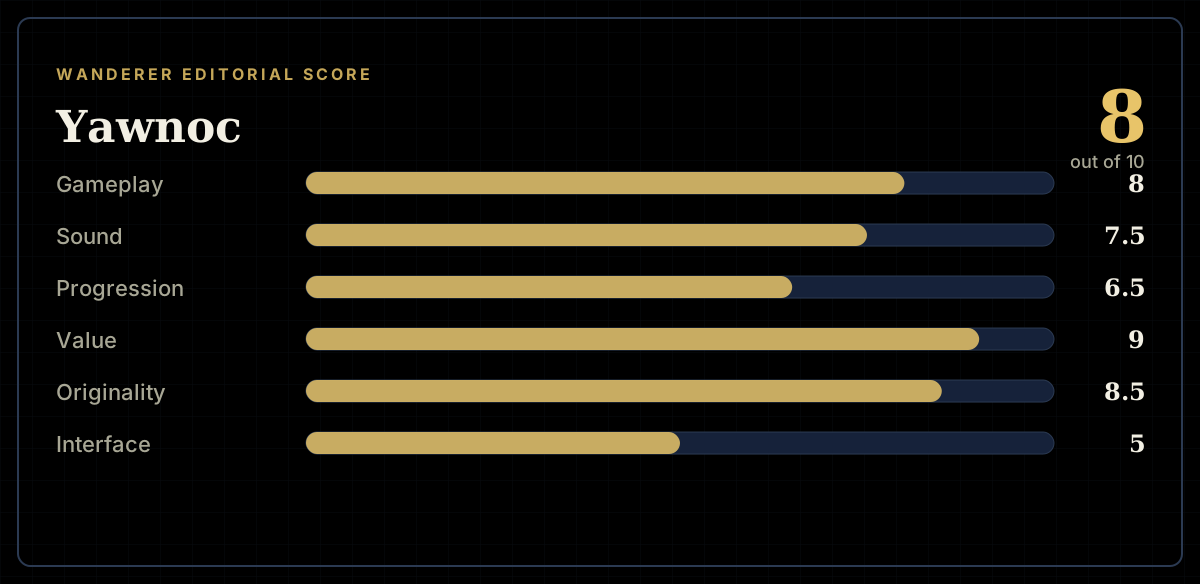
How the review scores each part of the gameWanderer Editorial -
The short versionWanderer Editorial