
Game review
Wizard Shrimp
8 / 10
- Developer
- Wizard Shrimp Games
- Publisher
- Wizard Shrimp Games
- Released
- 13 December 2024
- Platforms
- Windows
- Genre
- Bullet-hell roguelite with player-built level paths
- Monetisation
- One-time purchase, no in-game store or additional currency purchases
- Players
- Single-player only
The short version
Wizard Shrimp asks you to accept, without further explanation, that its protagonist is a shrimp who is also a wizard, and then gets on with the business of being a genuinely well-made bullet-hell roguelite underneath the joke. Players choose their own sequence of tiles between encounters — deciding whether to grab a safe campfire or gamble on stacking fights for bigger rewards — while collecting stacking upgrades on the way to a Mushroom Wizard's tower. At roughly five dollars, the response has been close to unanimous: 98% of a review sample well past a hundred entries recommends it, repeatedly citing the game's charm, its inventive path-building twist, and its now-famous credits song. Backing that reception up is an unusually committed fourteen-month patch cycle from its solo developer, adding entire new progression systems long after most games this cheap would have been considered finished.
Biggest strengths
- The player-built path system — choosing your own sequence of encounter, treasure, and rest tiles between fights — draws consistent praise as a genuinely distinctive twist on the roguelite formula, giving players direct control over their own risk-reward balance run to run
- The game's value proposition is repeatedly described in close to unanimous terms, with reviewers calling it "worth every penny," "shrimply the best," and comparable in spirit to the freeware Flash and browser games of the 2000s that first popularised the genre
- The credits sequence and its accompanying song are singled out by name across a striking number of reviews as a genuine highlight, with several reviewers admitting to listening to it on repeat outside the game itself
Biggest weaknesses
- Character movement is described by multiple reviewers as occasionally difficult to control precisely, a real concern in a genre where dodging bullet patterns depends on tight positioning
- At least one specific overpowered build is called out directly — a health-regeneration-on-critical-hit skill in the game's Krill Tree meta-progression — that several reviewers say lets players largely ignore the bullet-hell mechanics the genre is built around once unlocked
- A reported softlock bug can occur when selecting certain path options after an encounter, leaving at least one player unable to continue a run partway through the Tower and forced to close the game entirely
Who it's for: Fans of quick, replayable bullet-hell roguelites who want genuine build variety and don't need a large content library to be satisfied, especially anyone drawn to a game that doesn't take itself remotely seriously.
Our recommendation: An easy, low-risk purchase at its price, and one of the strongest value propositions covered in this lane this year. Go in expecting a small but growing amount of content and some real rough edges around movement precision and a reported softlock bug, rather than a large or perfectly polished package.
8 / 10
Wizard Shrimp does not explain why its protagonist is a crustacean who also casts spells, and the review sample agrees this is exactly the right call. The premise is a joke the whole game is built around, but the bullet-hell roguelite underneath that joke is executed with enough genuine care that a review sample past a hundred entries lands at 98% positive — a ratio few games in this lane, at any price, come close to matching.
A path you design yourself
The game's clearest mechanical hook is its approach to level structure: rather than a fixed sequence of rooms, players choose their own path between encounters from a randomly generated set of tiles, deciding whether to bank a safe campfire after a fight or chain straight into more enemies for bigger rewards at higher risk. The store page frames this choice bluntly — "leverage your tiles to your tactical advantage... or say '[expletive] it' and put down only enemy tiles up until the boss" — and reviewers describe exactly that tension as one of the game's most satisfying systems. One reviewer, comparing it to a genre classic, calls it "like if you took Slay the Spire, replace the cards with 2D combat, and you get to make the path you journey on." It's a small structural idea, but it gives players direct, legible control over their own risk-reward curve in a genre that usually leaves that decision entirely to random generation.
Cheap enough that value barely needs debating
If there's one thing the review sample agrees on almost without exception, it's that Wizard Shrimp is a lot of game for very little money. At roughly five dollars, reviewers reach for comparisons to the free browser and Flash games that first popularised bullet-hell roguelites, meant as a genuine compliment about accessible, distraction-free fun rather than a knock on production values. "Best 1 dollar and 59 cents I spent," writes one reviewer who caught it on sale; another simply calls it "worth every penny" before recommending it "even more so if it is on sale." This isn't damning with faint praise — it's a review sample repeatedly concluding that the price is almost beside the point given what's delivered.
A credits sequence people won't stop talking about
An unusually specific and recurring detail in the positive reviews is the game's ending credits, and specifically its accompanying song. Multiple reviewers single this out by name as one of the best parts of the entire experience — "the credits are so fun and definitely one of the best parts of the game, I do recommend listening," reads one; another admits to "listening to the credits song on loop" well after finishing a run. For a five-dollar solo-developer game, having its ending sequence become a specific, recurring talking point across dozens of independent reviews is a genuinely unusual and telling signal of the care put into details most players would forgive a small studio for treating as an afterthought.
Real, if minor, rough edges
The negative feedback in the sample is notably specific rather than sweeping. Character movement is flagged by more than one reviewer as occasionally imprecise, a real concern for a genre built around tight bullet-pattern dodging. A specific overpowered build draws direct criticism: a health-regeneration-on-critical-hit skill in the game's Krill Tree meta-progression is described by multiple reviewers as strong enough to let a player largely ignore the core bullet-hell dodging mechanics once unlocked. And at least one reviewer reports a genuine softlock — getting stuck partway through the Tower after selecting a specific path option, unable to continue without closing the game entirely and losing the run. None of these read as dealbreakers in context — they're raised by reviewers who otherwise clearly enjoyed the game — but they're specific, real issues rather than vague grumbling.
A developer who kept adding, long after launch would have been a reasonable stopping point
What elevates Wizard Shrimp above a merely charming, cheap indie is how much its solo developer has kept building on it since release. The events feed shows a "Cauldron" difficulty-tier update arriving in January 2025, followed within weeks by an entirely new "Krill Tree" meta-progression system — the same system whose overpowered build draws criticism above, itself evidence of a developer actively adding and then needing to balance new systems rather than shipping once and stopping. Controller support followed in March 2025. Even after announcing a second game, "Mushroom Clicker," in November 2025, the developer continued shipping Wizard Shrimp-specific bugfix patches as recently as February 2026 — a genuinely rare commitment to keep a five-dollar game supported well past the point most buyers would have stopped expecting it.
Where full completion actually leads
Steam's own achievement data gives a useful, objective picture of how the difficulty curve actually plays out for a wide audience. Early progression milestones clear comfortably — nearly 75% of players reach the game's first meaningful Krill Point reward — and the game's individual boss-kill achievements sit in a moderate 33% to 44% range, suggesting most players who commit to a run see real content rather than bouncing off immediately. The curve steepens sharply, however, once the post-launch "Cauldron" difficulty tiers enter the picture: the hardest tier clears sit at only 5.6% to 7.2% completion. That's a wide gap between "beat the base game" and "master the endgame," and it lines up with how the review sample itself talks about difficulty — approachable and forgiving at the surface, genuinely demanding for anyone chasing full mastery of the harder tiers the developer added after launch.
Final verdict
Wizard Shrimp is a small, funny, unpretentious bullet-hell roguelite that earns its near-unanimous praise honestly: a distinctive path-building twist, real ongoing content investment from a clearly passionate solo developer, and a price that makes the whole conversation about value feel almost unnecessary. The rough edges that exist — some movement imprecision, one overpowered build, a reported softlock bug — are specific and real, but minor set against everything the game gets right for the money being asked. Few releases in this lane this year combine this much charm, this much sustained developer support, and this little financial risk in one package.
Pros and cons
Pros
- The player-built path system — choosing your own sequence of encounter, treasure, and rest tiles between fights — draws consistent praise as a genuinely distinctive twist on the roguelite formula, giving players direct control over their own risk-reward balance run to run
- The game's value proposition is repeatedly described in close to unanimous terms, with reviewers calling it "worth every penny," "shrimply the best," and comparable in spirit to the freeware Flash and browser games of the 2000s that first popularised the genre
- The credits sequence and its accompanying song are singled out by name across a striking number of reviews as a genuine highlight, with several reviewers admitting to listening to it on repeat outside the game itself
- The developer's own events feed shows sustained, substantial post-launch support: a full "Cauldron" difficulty-tier update in January 2025, an entirely new "Krill Tree" meta-progression system later that same month, and controller support added in March 2025, all well beyond what a five-dollar release typically receives
- Patches continued into February 2026, more than a year after launch and even after the developer publicly announced a second game, showing a rare commitment to keep supporting an already-released, fully-priced-out title rather than moving on entirely
Cons
- Character movement is described by multiple reviewers as occasionally difficult to control precisely, a real concern in a genre where dodging bullet patterns depends on tight positioning
- At least one specific overpowered build is called out directly — a health-regeneration-on-critical-hit skill in the game's Krill Tree meta-progression — that several reviewers say lets players largely ignore the bullet-hell mechanics the genre is built around once unlocked
- A reported softlock bug can occur when selecting certain path options after an encounter, leaving at least one player unable to continue a run partway through the Tower and forced to close the game entirely
- Content is described by several reviewers as fairly limited at launch, with one calling the item and upgrade pool "bare bones" and asking for more maps, though the developer's subsequent major updates have since added real content on top of the base release
- The tile-placement sequence between encounters produces an audio effect some reviewers find genuinely overwhelming, with one describing the sound of tiles being placed simultaneously as an "unskippable sensory nightmare," a minor but real complaint about a mechanic otherwise widely praised
Screenshots
-

Wizard ShrimpImage: Wizard Shrimp Games via Steam -

Wizard ShrimpImage: Wizard Shrimp Games via Steam -

Wizard ShrimpImage: Wizard Shrimp Games via Steam -
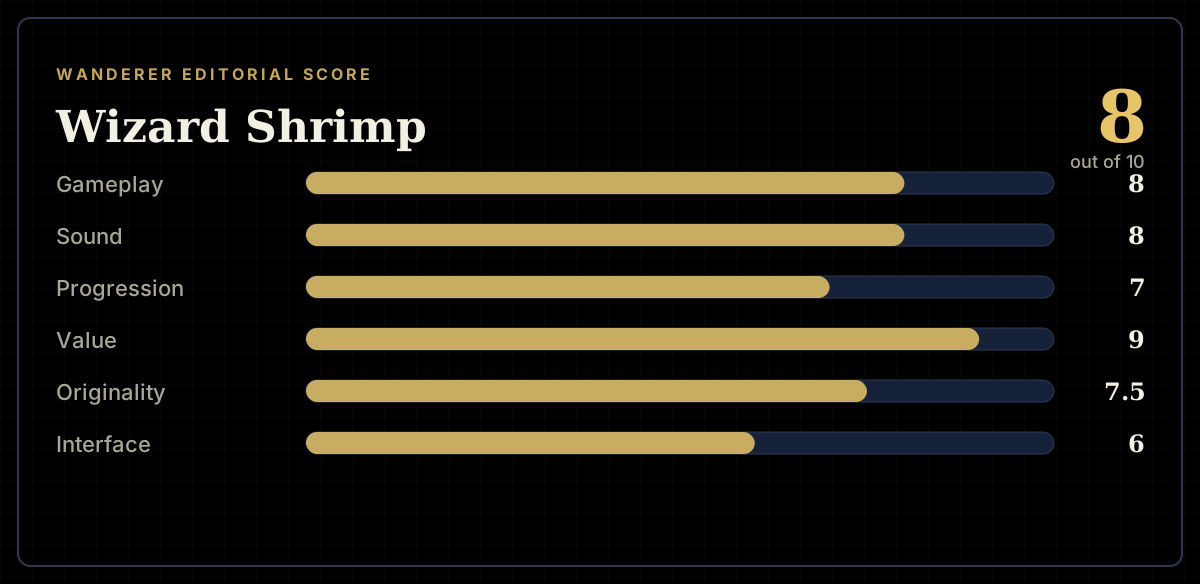
How the review scores each part of the gameWanderer Editorial -
The short versionWanderer Editorial