
Game review
Dwarf Looter
6.5 / 10
- Developer
- Orbi Universo Team
- Publisher
- Orbi Universo Team
- Released
- 22 February 2024
- Platforms
- Windows
- Genre
- Humor-infused fantasy roguelike dungeon crawler
- Monetisation
- One-time purchase, no in-game store or additional currency purchases
- Players
- Single-player only
The short version
Dwarf Looter, which began life as a Ludum Dare 54 game jam entry before its Steam release, sends a greedy dwarf into procedurally generated ruins for gold, weapons and "bizarre hats," with a simple but effective twist: the more treasure you're carrying, the more a growing Greed curse makes escaping back to the surface. Reviewers, largely discovering the game through a French content creator's video, describe it with consistent, genuine affection, several comparing its polish and charm favourably to much older, more established casual titles. Every one of the game's 32 lifetime reviews recommends it. The near-universal caveat attached to that recommendation is length: reviewers repeatedly describe the game as short, light, and lacking basic quality-of-life conveniences like item storage between runs, treating it as a perfect lunch-break diversion rather than a game built for long-term investment.
Biggest strengths
- The core loot-and-escape loop, where a growing hoard of treasure makes retreating to the surface progressively riskier through a "Greed" curse, is repeatedly praised as a simple, effective hook that keeps runs tense right up to the exit
- The game is described as impressively well-optimized, with one reviewer confirming it runs smoothly on a "4GB laptop" despite the store page recommending 6-8GB, and no reviewer in the sample reports encountering bugs
- Humour and presentation are called out specifically and often, with reviewers comparing the polish and charm favourably to well-established, much older casual game studios despite the low price
Biggest weaknesses
- The single most repeated complaint across the review sample concerns overall length, with multiple reviewers independently describing the game's "durée de vie" (lifespan) as limited and expressing hope for additional content that, as of this review, has not arrived
- There is no way to store items between runs, a specific and repeatedly requested feature reviewers say would meaningfully ease the grind toward higher-value equipment without requiring everything to be found and used in a single expedition
- Inventory management is described by at least one reviewer as unclear, and the same reviewer separately wishes dropped items remained visible in the world rather than disappearing entirely once discarded
Who it's for: Fans of short, humorous roguelikes who want a light, well-polished dungeon-diving loop for quick sessions, and who don't need dozens of hours of content to feel satisfied with a purchase.
Our recommendation: A safe, low-risk buy at its price for a handful of genuinely charming short sessions. Manage expectations around content volume and missing conveniences like a storage chest, and consider waiting for a sale if a shorter play window makes the difference for you.
6.5 / 10
Dwarf Looter started life as an entry in Ludum Dare 54, the recurring 72-hour game jam, before its developer expanded it into a full Steam release. That origin shows in the best way: the core idea is small, sharp, and immediately legible — descend into procedurally generated ruins as a dwarf hunting treasure, and the more of it you're carrying, the harder a rising "Greed" curse makes it to actually escape with your haul. It's a simple twist on the loot-and-retreat roguelike formula, and reviewers, almost entirely discovering the game through a French content creator's video, describe it with a consistency that's rare for even much bigger releases: every single one of the game's 32 lifetime reviews recommends it.
A tight hook, well executed
The greed mechanic is the game's clearest good idea, and reviewers describe its tension specifically rather than in general terms. One writes that the game "makes you want to go deeper and deeper and be greedier and greedier," capturing the exact push-and-pull the design is built around. Combat, described as turn-based and built around a simplified D&D-style stat system, draws praise for being approachable enough that one reviewer recommends it specifically as a way to introduce younger or newer players to RPG mechanics without overwhelming them. Underpinning all of it is presentation reviewers keep comparing to far more established studios — one writes they assumed, based on the price and art style, that the game "must have been more than ten years old," comparing it directly to the polish of a well-known legacy casual-game publisher.
Impressively light on technical problems
A specific, practical point in the game's favour: it appears to run well on genuinely modest hardware. One reviewer reports it performing perfectly on "my ancient 4GB laptop," despite the store page recommending 6 to 8GB of memory — a notable gap between stated requirements and real-world performance, in the generous direction. No reviewer in the full sample reports encountering a bug, a genuinely unusual thing to be able to say about any indie release, let alone one that began as a rushed jam project.
Short, and reviewers know it
Set against that goodwill is a consistent, repeated qualifier: this is not a long game, and reviewers are candid about it even while still recommending the purchase. Several French-language reviewers use the phrase "durée de vie limitée" — limited lifespan — independently, and one English-language reviewer bluntly predicts "I doubt it will receive more updates," framing the game specifically as something "you use to pass time in a boring lecture or a slow day at work" rather than a game meant to be returned to indefinitely. This isn't presented as a dealbreaker by the reviewers raising it — several explicitly still recommend the game on the strength of what's there — but it's the clearest, most repeated boundary on how much value a buyer should expect to extract from the purchase.
Missing conveniences reviewers keep asking for
A specific, recurring quality-of-life request concerns item storage. Multiple reviewers independently ask for a bank or chest system to hold valuable equipment between runs, framing it as an obvious and low-cost addition that would meaningfully ease the grind toward better gear without requiring every valuable find to be used or lost within a single expedition. A separate, smaller complaint concerns inventory clarity itself, with one reviewer wishing the item-management screen were easier to parse and that discarded items remained visible in the dungeon rather than vanishing outright. A third reviewer raises a more basic display request: the game currently has no windowed mode, a simple technical omission for a game this size.
A developer who has, in fact, kept coming back
The reviewer prediction that Dwarf Looter "won't receive more updates" turns out to be only partly right. This review can confirm the developer's public patch history shows real, if sparse, continued attention: a launch-week hotfix in February 2024, a further patch in October 2025, and — notably — a "Maintenance and New Languages" update as recently as August 2026, over two and a half years after the original release. That's not the sustained, frequent support cadence some other small games in this lane have shown, but it directly contradicts the idea that the developer walked away entirely, and it suggests the specific requests reviewers keep raising — a storage system, more content — could plausibly still see attention in future updates rather than being permanently closed off.
What the achievement data confirms about pacing
Steam's own achievement percentages back up how quickly most players work through the game's core content. An early milestone sits at 95.6% completion, and even a mid-tier achievement tied to defeating a specific boss creature sits at 27.3%, with full quest-line completion at 24.0% — a relatively gentle overall curve compared to some of the steeper cliffs seen elsewhere in this lane. That's consistent with reviewer reports of a short, accessible game most buyers can substantially finish in a handful of sessions, rather than one with a long, punishing tail reserved for a tiny fraction of dedicated players. For a game already candid about its own limited scope, that's the right shape for its achievement curve to take.
Final verdict
Dwarf Looter is exactly what its game-jam origins suggest: a small, sharp, genuinely charming idea, executed with more polish and fewer bugs than its low price and short development window would predict. The universal recommendation rate across its review sample is earned honestly, through a tight core loop and presentation reviewers keep comparing favourably to much bigger studios. What it isn't, by its own reviewers' consistent account, is a long game — treat it as a well-made short diversion rather than a long-term project, and the missing conveniences like item storage as reasonable, specific wishes for a developer who, on the evidence of a recent 2026 update, hasn't entirely moved on.
Pros and cons
Pros
- The core loot-and-escape loop, where a growing hoard of treasure makes retreating to the surface progressively riskier through a "Greed" curse, is repeatedly praised as a simple, effective hook that keeps runs tense right up to the exit
- The game is described as impressively well-optimized, with one reviewer confirming it runs smoothly on a "4GB laptop" despite the store page recommending 6-8GB, and no reviewer in the sample reports encountering bugs
- Humour and presentation are called out specifically and often, with reviewers comparing the polish and charm favourably to well-established, much older casual game studios despite the low price
- Multiple difficulty tiers and a wizard's quest line give committed players real reasons to keep exploring beyond a single successful run, including hunting for a specific hidden ring several reviewers mention pursuing
- The developer has continued supporting the game well beyond launch, with the events feed showing a maintenance and new-language update as recently as August 2026, over two years after the original release
Cons
- The single most repeated complaint across the review sample concerns overall length, with multiple reviewers independently describing the game's "durée de vie" (lifespan) as limited and expressing hope for additional content that, as of this review, has not arrived
- There is no way to store items between runs, a specific and repeatedly requested feature reviewers say would meaningfully ease the grind toward higher-value equipment without requiring everything to be found and used in a single expedition
- Inventory management is described by at least one reviewer as unclear, and the same reviewer separately wishes dropped items remained visible in the world rather than disappearing entirely once discarded
- The game lacks a windowed display mode, a specific and direct request from at least one reviewer who otherwise enjoyed the experience
- One reviewer explicitly frames the value proposition as only justified at a discounted price rather than full retail, suggesting the content-to-price ratio, while broadly accepted, isn't universally seen as generous
Screenshots
-

Dwarf LooterImage: Orbi Universo Team via Steam -

Dwarf LooterImage: Orbi Universo Team via Steam -

Dwarf LooterImage: Orbi Universo Team via Steam -
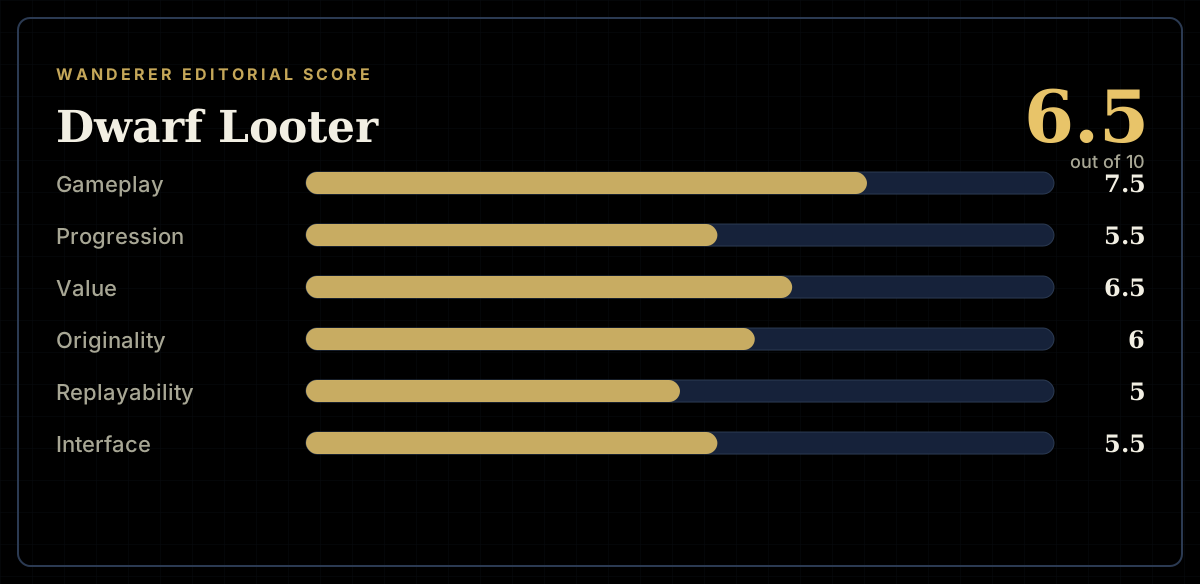
How the review scores each part of the gameWanderer Editorial -
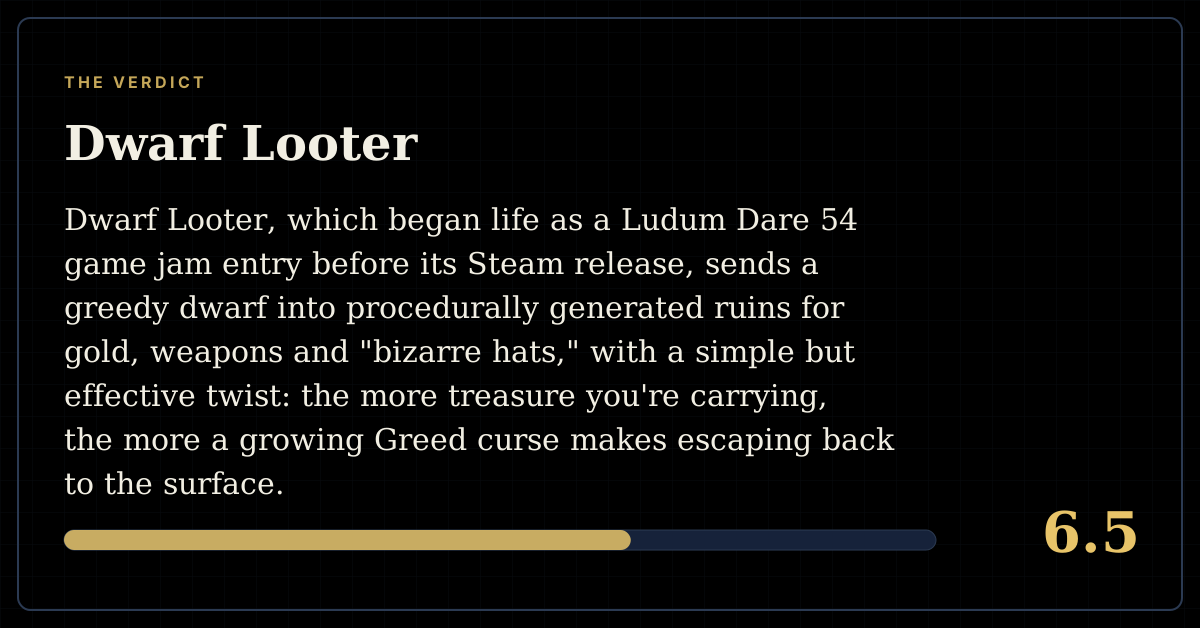
The short versionWanderer Editorial