
Game review
Dice & Fold
6 / 10
- Developer
- Tinymice Entertainment
- Publisher
- Rogue Duck Interactive, Gamersky Games
- Released
- 24 June 2024
- Platforms
- Windows, macOS, Linux
- Genre
- Dice-combat roguelite dungeon crawler
- Monetisation
- One-time purchase, no in-game store or additional currency purchases
- Players
- Single-player only
The short version
Dice & Fold takes a simple, appealing idea — face down a row of monster cards by rolling dice and folding your rolls into attacks — and wraps it in roguelite trappings: 35-plus heroes, a generative dungeon, meta-currency that carries over between failed runs, and escalating difficulty modes. The hook works well enough in short sessions that it earns real, sometimes enormous playtimes from its fans. But a large and detailed share of the review sample makes the same specific argument from different angles: that the strategic decisions on offer are thinner than the character count and item pool suggest, that dice-based randomness isn't consistently mitigated by meaningful player choice, and that balance between the 35-plus heroes swings hard between "trivially strong" and "close to unplayable." The developer has kept updating the game for over two years, adding heroes, difficulty modes, and controller support along the way, but reviewers who've played the most describe those updates as tinkering at the edges of a design problem rather than solving it.
Biggest strengths
- The central dice-and-fold combat hook is repeatedly described as immediately appealing and easy to pick up, with several reviewers specifically praising how quickly a session goes by
- A genuinely large roster of 35-plus playable heroes, each with a distinct skill, gives real build variety on paper and has kept multiple reviewers engaged for well over 100 hours
- Meta-progression carries forward after a run ends in defeat, softening the sting of a loss in a way several reviewers specifically appreciate compared to harsher roguelites
Biggest weaknesses
- The single most repeated criticism across the negative review sample is that strategic depth is thinner than the character and item count implies, with multiple reviewers independently describing runs as "playing themselves" once the initial novelty wears off
- Difficulty balance between heroes is described as extreme in both directions, with some reviewers calling specific classes "op" and trivializing even the hardest difficulty tier while others report the same tier as frustratingly punishing depending on which hero they drew
- Several reviewers report unresolved UI and controller bugs, including one describing the controller interface as needing to be rebuilt "from scratch" and another citing bugs that make it impossible to land a hit, alongside item-text wording that's inconsistent between cards
Who it's for: Fans of light roguelite deckbuilders who want a low-commitment, session-sized dice game to dip into casually, and who don't need Slay the Spire-level strategic depth to stay entertained. Less suited to players seeking a rigorous, high-skill-ceiling roguelite.
Our recommendation: A reasonable purchase at a discount for short, casual sessions with a likeable hook and a genuinely large character roster. Go in expecting a game about managing chaos rather than mastering strategy, and expect balance to feel uneven between heroes and difficulty tiers.
6 / 10
Dice & Fold's pitch is unusually easy to explain in one sentence: you roll dice, and you fold the results into attacks against a row of monster cards, trying to beat their numbers before they beat yours. It's Solitaire crossed with a tabletop RPG combat encounter, wrapped in roguelite scaffolding — a generative dungeon, meta-currency that persists after a loss, and a genuinely enormous roster of 35-plus playable heroes, each with a distinct skill. That simplicity is a real strength in short bursts, and it's clearly earned the game a loyal following, including reviewers who've logged hundreds of hours across its two years of updates. It's also, according to a large and unusually detailed share of the negative review sample, the source of the game's central problem: a combat system that reads as strategic on the surface but plays out closer to managing randomness than making meaningful decisions.
The hook, and why it works at first
The dice-rolling combat loop is immediately legible in a way a lot of roguelite deckbuilders aren't. You see the enemy row, you roll, you decide where each die goes, and the risk-reward tension of pushing for more damage against the threat of a counterattack is easy to read at a glance. Reviewers consistently describe the opening hours as genuinely compelling: one calls the loop "highly addictive if a little frustrating," and multiple others specifically praise how quickly a session passes, several noting six hours evaporating without them noticing. The comparison several reviewers reach for independently — Dicey Dungeons, One Deck Dungeon, Circadian Dice — places it fairly within a real, established niche of dice-based combat games, and on that specific axis, Dice & Fold delivers exactly what the comparison promises.
Where the strategic case against it gets specific
What separates this review sample from ordinary "it's fine but not for me" negativity is how precisely reviewers describe the same underlying complaint. "There are very few meaningful decisions to make in this game," one writes. "It SEEMS like there is a lot of customization and strategy, but after you play for a while you realize that the game almost plays itself." A more detailed account frames it as a structural issue rather than a difficulty issue: "D&F doesn't understand what makes a good roguelite... you pick a character that has one skill... and that's it," arguing the item pool doesn't create the build-crafting depth the genre trains players to expect. Another reviewer, invoking the well-worn "wide as an ocean, deep as a puddle" comparison, makes essentially the same case about the 35-plus-hero roster: an enormous amount of surface variety sitting on top of a shallower mechanical core than the character count implies.
Balance that swings hard in both directions
A second, closely related complaint concerns difficulty tuning. Multiple reviewers report the game's hardest official difficulty as trivially easy with the right hero — "every strategy seems to work... it's just too easy," one writes of Extreme mode — while others report the opposite experience on the same tier with a different class, describing runs as "RNG hell" where losses feel entirely out of their control. One reviewer states plainly that item balance "defeats the roguelike idea," since a small number of strong items dominate every run's decision-making rather than encouraging the experimentation the genre is built around. This isn't a contradiction so much as a consistent signal: hero-to-hero balance is wide enough that two players' accounts of the same difficulty tier can read like entirely different games, which is a real design gap rather than simple player skill variance.
What the achievement data actually shows
Steam's own completion data offers a useful independent check on these balance complaints. Early class-clear achievements sit at a healthy 65-72% — most players who commit to a hero do eventually beat a run with them — but the curve falls off a cliff for the game's Endless and Extreme modes, several of which sit below 1% completion across the entire player base. That's consistent with a game whose base difficulty is broadly approachable but whose highest tiers are either genuinely brutal or so RNG-dependent that consistent mastery is rare even among dedicated players, giving some independent weight to reviewers on both sides of the "too easy" versus "too random" divide.
A long support record, without a clear fix for the core complaint
To the developer's credit, this isn't a game that shipped and was abandoned. The partner-events feed documents a dense, sustained cadence of more than three dozen updates from the March 2024 demo through May 2026, including an Endless Mode addition, an Extreme difficulty tier, full controller support, Steam Deck verification, and repeated waves of new heroes and items. That's a genuinely strong post-launch record for a game at this price point. What it hasn't done, according to reviewers who've stuck with the game across several of those updates, is resolve the underlying strategic-depth complaint — new heroes and items add more surface variety without necessarily deepening the decision space, and at least one long-session reviewer explicitly frames the ongoing balance patches as adjusting numbers around a structural issue rather than addressing it directly. Separately, a specific and easy-to-fix complaint about in-game advertising for the publisher's other titles appearing inside a paid, single-player game is worth flagging on its own, since it's the kind of thing a patch could plausibly remove without touching the core design at all.
Final verdict
Dice & Fold is a likeable, easy-to-parse dice-combat roguelite that clearly delivers real, sustained fun for a meaningful share of its audience — the playtimes and the sheer size of its hero roster back that up. But a specific and repeated criticism running through its review sample deserves to be taken seriously: that the strategic depth beneath its dice-rolling hook doesn't hold up to close scrutiny, that balance between its 35-plus heroes swings unusually wide, and that two years of otherwise solid post-launch support haven't resolved either problem. Worth a look at a discount for short, casual sessions where you're not looking for a rigorous strategic workout — go in expecting a game about managing chaos, not mastering it.
Pros and cons
Pros
- The central dice-and-fold combat hook is repeatedly described as immediately appealing and easy to pick up, with several reviewers specifically praising how quickly a session goes by
- A genuinely large roster of 35-plus playable heroes, each with a distinct skill, gives real build variety on paper and has kept multiple reviewers engaged for well over 100 hours
- Meta-progression carries forward after a run ends in defeat, softening the sting of a loss in a way several reviewers specifically appreciate compared to harsher roguelites
- The developer has sustained an unusually long and active post-launch support record, with more than three dozen documented patches and content updates running from the June 2024 launch through May 2026, including full controller support, Steam Deck verification, and multiple new-hero content waves
- Steam achievement data shows a wide spread of completion rates, from over 70% for early class-clear milestones down to under 1% for the hardest Endless-mode challenges, indicating the game does offer real long-term challenge for its most dedicated players even if the base difficulty draws complaints
Cons
- The single most repeated criticism across the negative review sample is that strategic depth is thinner than the character and item count implies, with multiple reviewers independently describing runs as "playing themselves" once the initial novelty wears off
- Difficulty balance between heroes is described as extreme in both directions, with some reviewers calling specific classes "op" and trivializing even the hardest difficulty tier while others report the same tier as frustratingly punishing depending on which hero they drew
- Several reviewers report unresolved UI and controller bugs, including one describing the controller interface as needing to be rebuilt "from scratch" and another citing bugs that make it impossible to land a hit, alongside item-text wording that's inconsistent between cards
- At least one reviewer specifically flags in-game advertising for the publisher's other titles as an unwelcome intrusion into a paid, single-player game
- The generative dungeon layout and item pool are described by more than one reviewer as producing repetitive, low-variety runs once a player has seen most of the roster, undermining the replayability the roguelite structure is meant to provide
Screenshots
-

Dice & FoldImage: Rogue Duck Interactive via Steam -

Dice & FoldImage: Rogue Duck Interactive via Steam -

Dice & FoldImage: Rogue Duck Interactive via Steam -
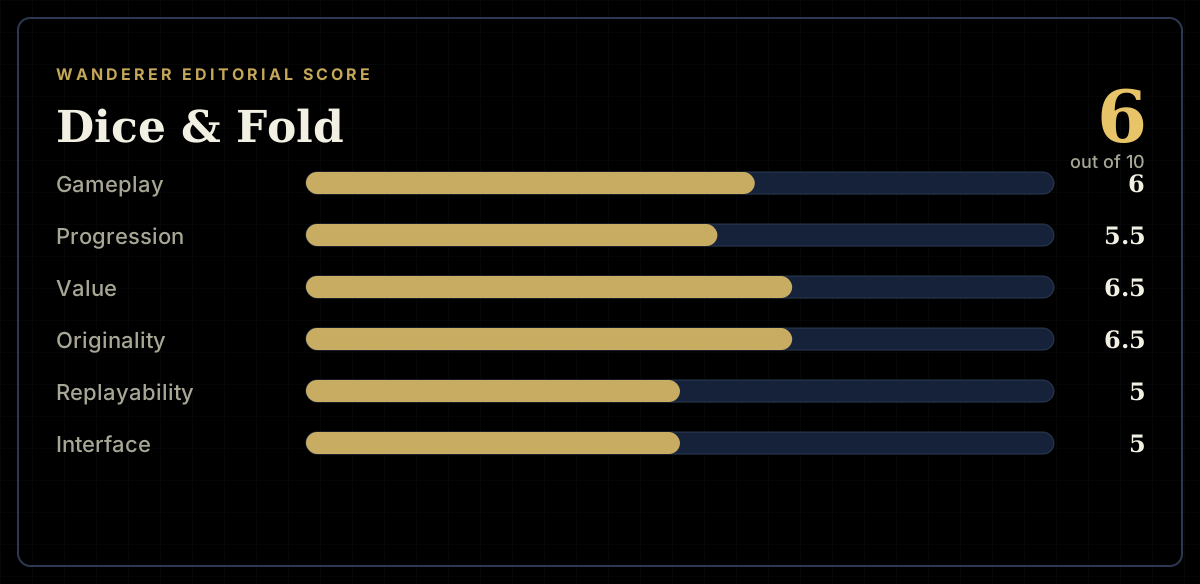
How the review scores each part of the gameWanderer Editorial -
The short versionWanderer Editorial