Game review
Rookspell
7 / 10
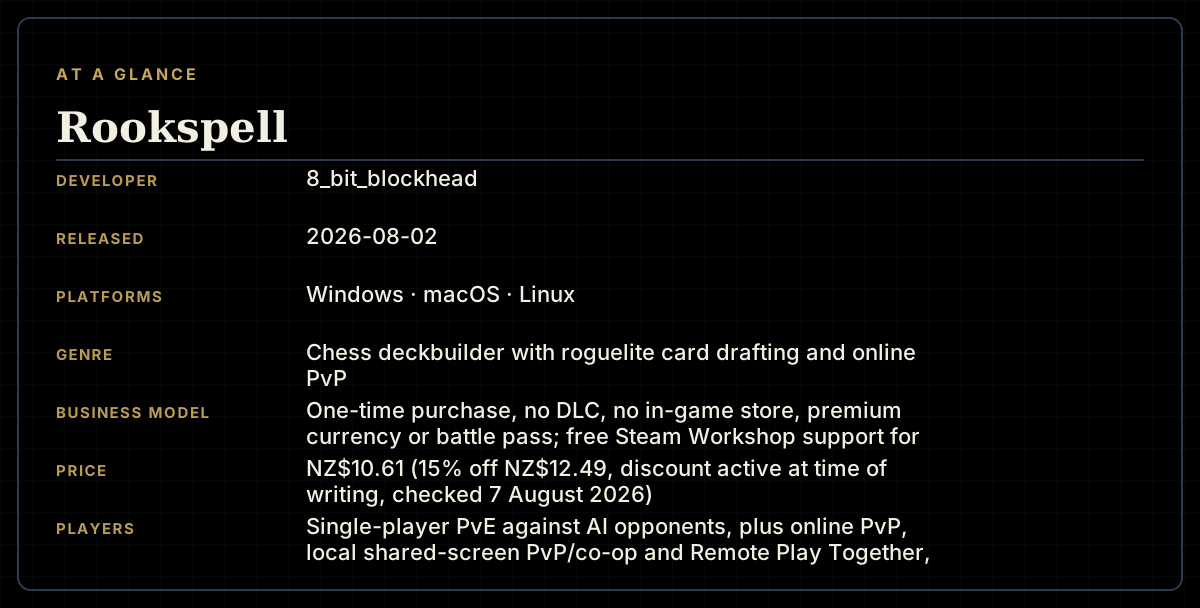
- Developer
- 8_bit_blockhead
- Publisher
- 8_bit_blockhead
- Released
- 2 August 2026
- Platforms
- Windows, macOS, Linux
- Genre
- Chess deckbuilder with roguelite card drafting and online PvP
- Monetisation
- One-time purchase, no DLC, no in-game store, premium currency or battle pass; free Steam Workshop support for custom cards and rulesets
- Players
- Single-player PvE against AI opponents, plus online PvP, local shared-screen PvP/co-op and Remote Play Together, all via Steam
The short version
Rookspell isn't a card game wearing a chess skin. Pieces move by the real rules, captures happen the way they always have, and the twist is that every capture also hands you a spell card — Freeze a bishop mid-advance, rotate a 2x2 corner of the board, or mark a rook as a decoy king that has to answer check on your opponent's behalf. Draw odds are tiered (50% Common down to 2.5% Legendary), a pity system guarantees a new card after four repeats, and a Collection screen tracks all 41 spells across a Standard and a rarity-inverted Arcane mode. It's a genuinely inventive hybrid built with real care — a rebuilt onboarding flow, scalable UI, adaptive controller support, and a QA pass the developer says cleared 776 automated checks. What it doesn't have, five days after its 1.0 launch, is a single Steam review or more than a handful of people who've opened it at all.
Biggest strengths
- Real chess movement underneath the spell layer, with captures directly feeding the card economy instead of the two systems running in parallel
- Tiered draw odds (50% Common, 30% Uncommon, 12.5% Rare, 5% Epic, 2.5% Legendary) plus a guaranteed-new-card pity system after four repeat rewards give the 41-card Collection a clear shape to chase
- Specific, rules-literate spell design — Mistaken Identity forces a marked piece to answer check as a false king, Clockwork Square rotates a king-free 2x2 area — rather than generic damage-style effects bolted onto a chessboard
Biggest weaknesses
- Zero Steam user reviews and a recorded concurrent-player count of zero at time of writing mean the online PvP, matchmaking and AI difficulty curve have no outside confirmation yet
- Global achievement percentages sit in exact multiples of 12.5%, consistent with roughly eight total contributing players — an unusually quiet reading even for a launch week
- A 41-card pool is workable but modest for a game whose whole pitch rests on card variety, and Epic and Legendary draws are rare enough (5% and 2.5%) that most matches will lean on the same common tools
Who it's for: Chess players curious about a genuine tactical twist, and deckbuilder fans who want their card pool to sit on top of a ruleset they already understand rather than a new one to learn from scratch.
Our recommendation: At NZ$10.61 for a one-time purchase with a real Workshop and no DLC, the asking price is modest even before the discount. The open question isn't the price, it's whether there's anyone on the other side of the online queue yet.
7 / 10
Rookspell is not a card game with chess pieces drawn on the box. Every match is played on a real board, with pieces that move by the rules you already know — a knight still jumps in an L, a bishop still can't leave its colour, castling still needs a clear, unmoved path. The invention sits entirely in what happens when you take something. Capture an enemy piece in Rookspell and the game hands you a spell card, drawn from a tiered pool that ranges from common battlefield tricks to the kind of Legendary effect that can turn a losing position inside out. It's a chess variant built by someone who clearly respects the base game enough not to touch its rules, and then built an entire economy on top of the one moment chess already treats as a reward: the capture.
What actually happens when you take a piece
The mechanical hook is specific enough to describe precisely, because the developer's own July patch notes lay out the maths: standard draw odds run 50% Common, 30% Uncommon, 12.5% Rare, 5% Epic and 2.5% Legendary, pulled from a 41-card pool at the time of writing. Rather than leaving that curve to punish players with bad luck, a pity system kicks in after four capture rewards in a row without a new card — the next eligible reward is guaranteed to be something the player hasn't seen yet. That's a small design decision, but it's the kind that separates a deckbuilder that respects a player's time from one that just gates content behind randomness.
The card pool itself reads as considered rather than filler. Sidewind, a Common, lets a chosen pawn step diagonally into an empty square without being able to promote off that move — a small, rules-literate tweak rather than a generic buff. Runic Mine marks an empty square so the first enemy piece to land there is petrified through its following turn. Clockwork Square, an Epic, rotates everything inside a king-free 2x2 area clockwise, including empty squares, which can reposition three or four pieces in a single card without ever touching the king directly. The Legendary showpiece, Mistaken Identity, marks a non-king piece as a false king for one round — a checked false king has to try to escape, and if that escape would expose the real king, the real king has to move immediately instead. None of that reads like "deal 3 damage" reskinned onto a chessboard. It reads like someone who sat with the actual rulebook and asked what a spell would need to do to matter inside it.
The smoke, the clock, and what the screenshots confirm
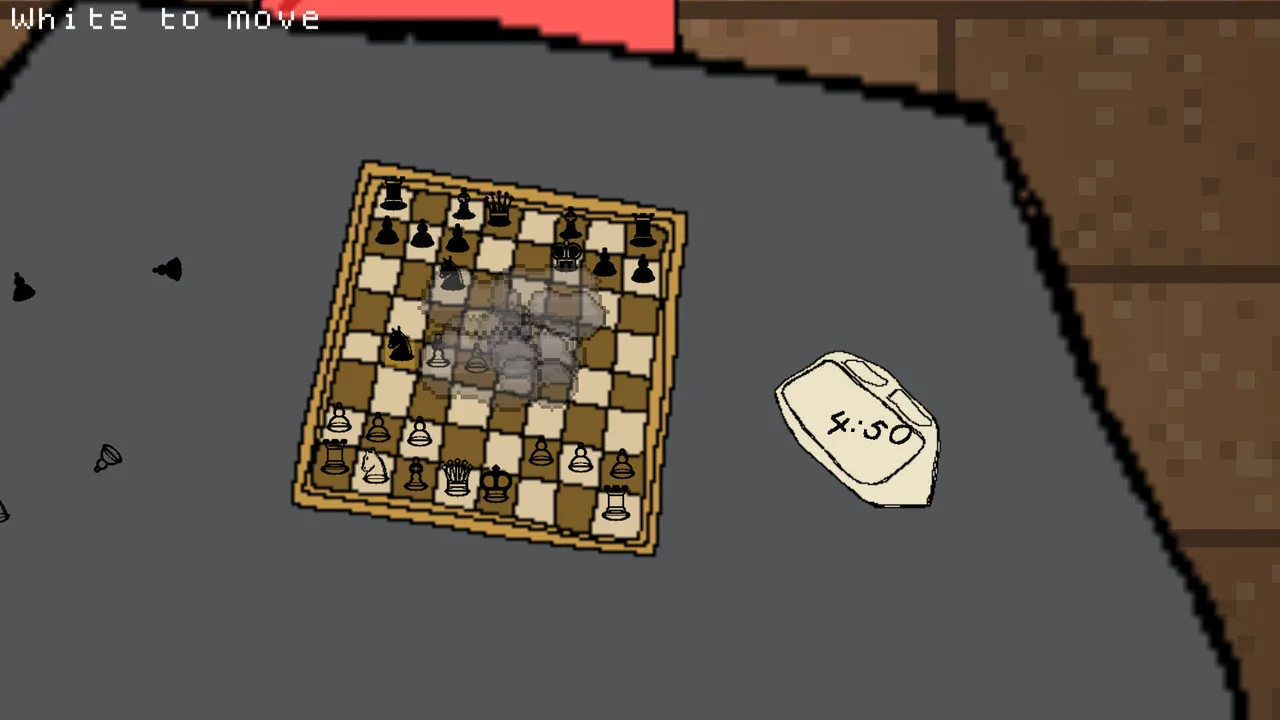
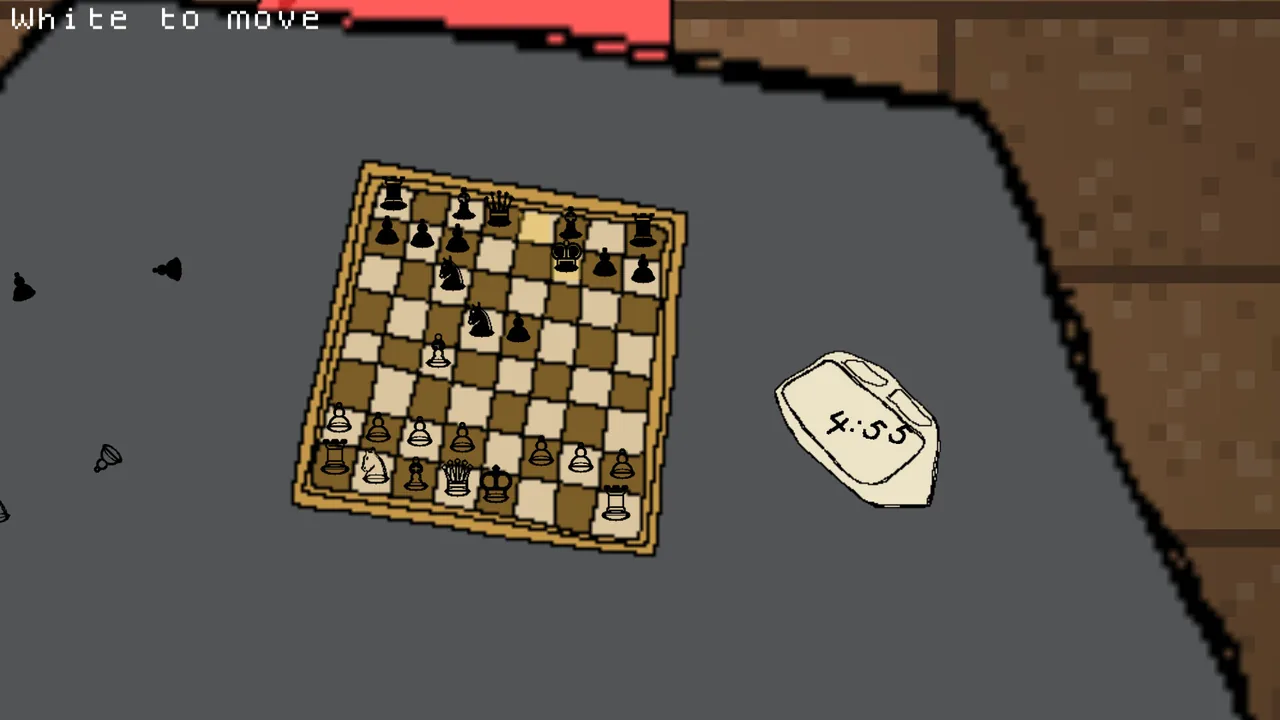
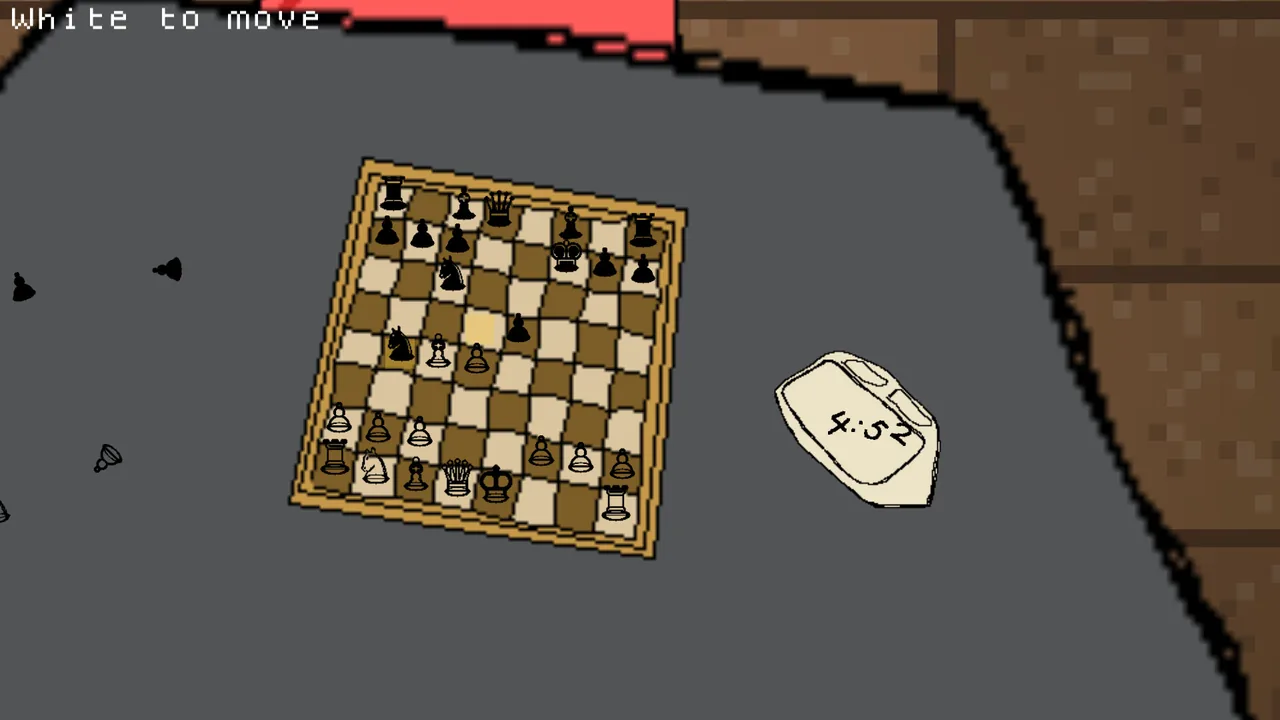
Two systems are visible directly in the developer's own promotional screenshots rather than only in patch-note text. The first is time pressure: every capture shown carries an on-screen chess clock counting down from roughly five minutes, confirming Rookspell runs as a blitz-format game by default, with cards like Time Bank and Tempo built specifically to scale with whatever clock a match starts on rather than producing an oversized swing in a very short or very long game. The second is Smoke, an effect that hides every piece inside a 3x3 area from anyone who didn't cast it — visible directly in two of the five official screenshots as a pale, ghost-like haze sitting over the center of the board, with the pieces beneath it rendered as faint outlines rather than solid shapes. The patch notes confirm the caster still sees through their own smoke and that the AI has been specifically tuned to plan only from the information it's actually allowed to see under it — a detail worth noting, because "the AI cheats through my hidden-information effect" is exactly the kind of complaint that sinks a game like this once real opponents start testing it.
The card hand itself is presented as a row of retro, cassette-styled tiles, each carrying a coloured rarity diamond and a full tooltip — the "Recastle" card shown in the marketing material, an Uncommon that restores castling rights even after the king has moved, describes itself in plain, unambiguous language rather than icon soup. It's a small presentational choice, but it means a new player can read what a card does without needing a wiki open in a second window.
A collection to chase, not just a run to win
Where Rookspell edges toward "roguelite" rather than a pure one-off match is in its Collection layer. The Spellbook system lets players construct an 8-to-12-card capture-reward pool for offline matches, and the game tracks discovery, card-usage totals and rarity-completion goals across every session — the achievement list includes separate milestones for collecting every Common, Uncommon, Rare, Epic and Legendary card, alongside a "Full Deck" goal for the complete set. A Standard mode uses the tiered odds above; an Arcane mode flattens that curve, making Epic and Legendary pulls considerably more common for players who'd rather build toward a wild late-game than grind toward one. The store page's separate claim — that surviving a run means facing "increasingly dangerous opponents with their own powerful decks" — describes what sounds like a proper PvE ladder sitting alongside the standalone matches, but neither the store page nor the patch notes go far enough to confirm how many rungs that ladder has or how steeply it escalates, so treat that specific claim as the developer's framing rather than a verified structure.
Forty-one cards is a real number, but it's not a large one next to genre benchmarks, and the rarity math means a typical match will lean heavily on the 80% of the pool sitting in Common and Uncommon. That's not necessarily a flaw this early — a tight pool is easier to balance than a bloated one, and Rookspell clearly prioritised making each card mechanically distinct over stacking up filler — but it does mean the ceiling on "how long before I've seen everything" is lower here than in card games that measure their pool in the hundreds.
An unusually careful accessibility pass
For a solo developer's debut, the settings menu is doing more work than the genre typically bothers with. UI and text scale from 85% to 150%. Animation can be set to Full, Reduced or Off. Controller support includes Auto, On and Off modes, with Auto following whichever input device the player last touched intentionally, adaptive on-screen prompts that switch accordingly, and stick-drift filtering. Mouse-only and touch-only play are both explicitly supported categories on the store page, not just implied by "works with a controller too." New players are asked up front whether they already understand chess, and those who don't are walked through movement, captures, promotion, castling, check and checkmate before the spell layer is introduced at all, defaulting to an easier AI and an untimed clock until they're ready. Experienced players can skip straight past all of it into the Rookspell-specific tutorial. It's a rebuilt-from-scratch onboarding flow rather than a single skippable pop-up, and it shows a level of care that a lot of much larger releases don't bother with.
The AI disclosure, and what it isn't
Rookspell carries a Steam AI Generated Content Disclosure, and its scope is worth being precise about because it's narrower than what's become common on this kind of release: "Some generative ai was used for general bug fixes." That's a disclosure about code assistance, not about the card art, the pixel chess pieces or the audio — a materially different claim than a game whose entire visual and audio package was AI-generated and then curated after the fact. It's a smaller, more defensible use of the technology, and it's stated plainly rather than buried.
A launch with almost nobody watching
This is normally the section built from what players are saying, and for Rookspell there is close to nothing to draw on. The Steam review API returns a completely empty query summary — not a low score, not a handful of mixed opinions, zero reviews of any kind, five days after a 1.0 launch that had already been publicly playable in a separate Playtest listing since late June. The concurrent-player count read zero at the time of checking. The achievement data tells a consistent story in a different shape: every one of the fifteen percentages lands on an exact multiple of 12.5%, which is the signature of a denominator around eight total players who've opened the game and triggered any tracked event at all. First Victory and Hard Lesson (winning or losing a first match) sit at 25%; wins against a friend, wins on the clock and a first win generally all sit at 12.5%; every rarity-collection goal, plus the achievements for triggering Smoke and Slime effects, sit at a flat 0%. That's not a verdict on the design — it's a genuinely tiny sample, and the systems described above are specific and considered enough that they read like the product of real design thought rather than a rushed asset flip. But it does mean every claim here about how the online queue behaves, how the AI ladder escalates, or how the card balance holds up past a first few matches is a reading of what's been built, not a report on how it's holding up under real pressure from a real player base — because right now, there mostly isn't one.
Final verdict
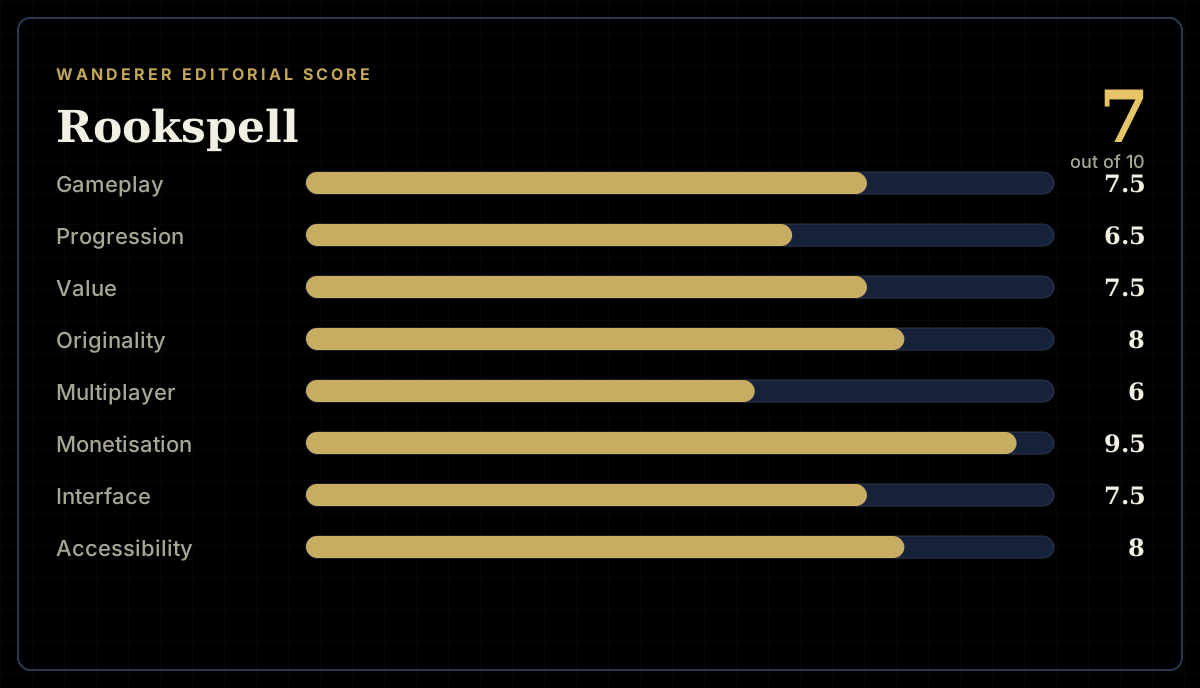
Rookspell earns a 7.0 for genuinely marrying two systems that usually stay separate: real chess rules underneath a capture-triggered spell economy that's specific enough to reward reading each card's actual text, backed by a tiered rarity curve, a pity system, and an accessibility and onboarding pass that goes further than most solo debuts bother going. It doesn't score higher because the multiplayer half of its pitch currently has no visible players to test it against, the 41-card pool is real but modest for a game selling itself on variety, and the PvE ladder the store page describes can't yet be verified beyond the developer's own framing. For NZ$10.61, with no DLC and a working Workshop behind it, the price makes this an easy gamble for anyone who already knows how a rook moves and wants to see what happens when captures start paying spell cards instead of nothing at all. Anyone hoping to queue into a populated online lobby on day five should wait for the player count to catch up with what's been built.
Pros and cons
Pros
- Real chess movement underneath the spell layer, with captures directly feeding the card economy instead of the two systems running in parallel
- Tiered draw odds (50% Common, 30% Uncommon, 12.5% Rare, 5% Epic, 2.5% Legendary) plus a guaranteed-new-card pity system after four repeat rewards give the 41-card Collection a clear shape to chase
- Specific, rules-literate spell design — Mistaken Identity forces a marked piece to answer check as a false king, Clockwork Square rotates a king-free 2x2 area — rather than generic damage-style effects bolted onto a chessboard
- Accessibility options exceed the genre norm for a solo debut: UI/text scaling from 85% to 150%, full/reduced/off animation settings, mouse-only and touch-only modes, and an untimed, easier-AI onboarding track for newcomers
- A one-time NZ$10.61 purchase with no DLC, no premium currency and Steam Workshop support for free custom cards, rulesets and board variants
Cons
- Zero Steam user reviews and a recorded concurrent-player count of zero at time of writing mean the online PvP, matchmaking and AI difficulty curve have no outside confirmation yet
- Global achievement percentages sit in exact multiples of 12.5%, consistent with roughly eight total contributing players — an unusually quiet reading even for a launch week
- A 41-card pool is workable but modest for a game whose whole pitch rests on card variety, and Epic and Legendary draws are rare enough (5% and 2.5%) that most matches will lean on the same common tools
- The store page's "increasingly dangerous opponents" PvE ladder is described in the marketing copy but not detailed anywhere Wanderer could verify independently, so its length and difficulty curve are unknowns
- Online PvP, local co-op and Remote Play Together are all built, but with nobody visibly playing right now the multiplayer half of the pitch is currently untested by a real audience
Screenshots
-
RookspellImage: 8_bit_blockhead via Steam -
RookspellImage: 8_bit_blockhead via Steam -
RookspellImage: 8_bit_blockhead via Steam -
How the review scores each part of the gameWanderer Editorial -
The game at a glanceWanderer Editorial -
The short versionWanderer Editorial