
Game review
Summoner's Gambit
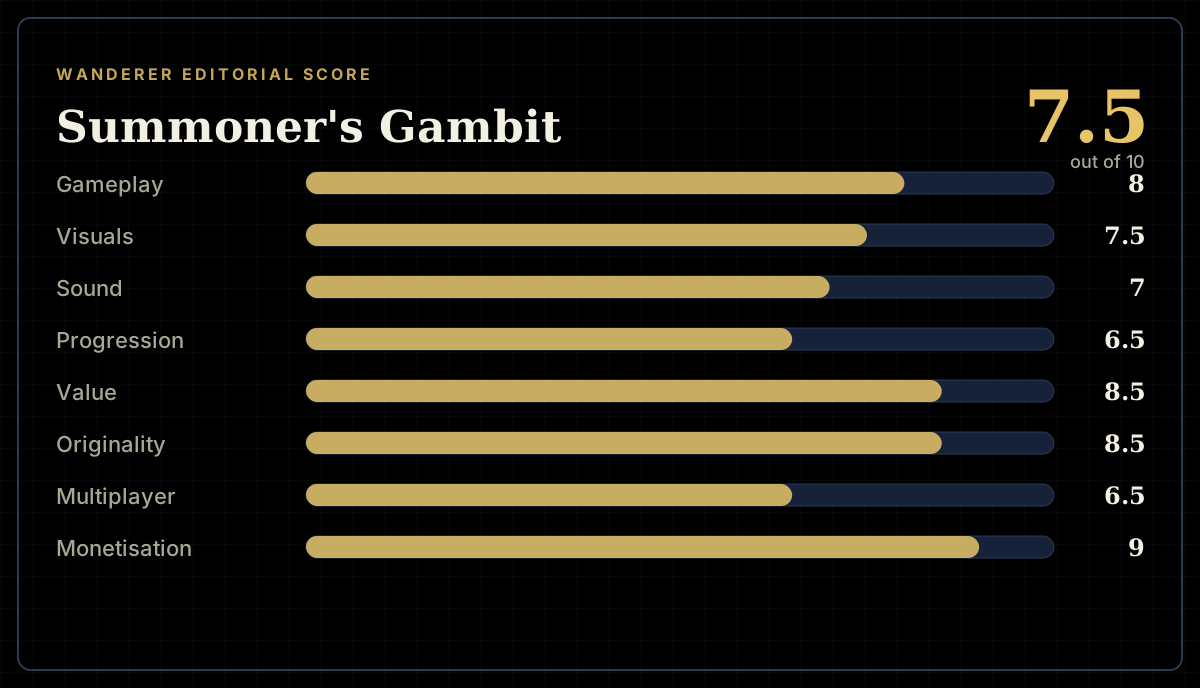
7.5 / 10
- Developer
- Billion Studio
- Publisher
- Billion Studio
- Released
- 6 August 2026
- Platforms
- Windows
- Genre
- Roguelike deckbuilder and auto-battler RPG with online PvP
- Monetisation
- One-time purchase, no DLC listed on Steam, 21 achievements, no in-game store or premium currency of any kind
- Players
- Single-player campaign plus online PvP, including an asynchronous duel mode and a separate ranked mode; no local co-op or split-screen options
The short version
Summoner's Gambit is a deckbuilding duel game with a genuinely sharp central idea: every creature you summon draws against a shared energy cap, and pushing past it doesn't just fail — it triggers backlash against you. That single rule turns positioning, card fusion and hand management into one continuous risk calculation instead of three separate systems bolted together, and it's the reason the game's most dedicated players — the ones logging hundreds of hours since its long public demo — are also its most enthusiastic. The rough edge is the flip side of the same coin: at higher difficulty, several of the game's own reviewers report the AI's energy cap simply running ahead of the player's, turning a calculated risk into a stacked deck. It's a young, small, almost entirely Chinese-and-Japanese-speaking review base for a genuinely inventive game, and an English-speaking audience is about to find out for itself whether the late-game tuning holds up.
Biggest strengths
- The energy-cap "overflow triggers backlash against you" rule gives every summon genuine risk, tying deckbuilding, positioning and hand management into one continuous decision instead of three separate systems
- Positioning directly changes attack priority and skill range, so the auto-battler layer is a real tactical lever rather than cosmetic formation-setting
- Card fusion inherits traits from both parent creatures, and the game's highest-playtime reviewers — several past 600 hours — specifically credit long-term fusion experimentation for keeping runs interesting
Biggest weaknesses
- Four of the game's five negative reviews independently describe the same problem: the opponent's energy cap consistently running higher than the player's own from around the second and third act onward, turning a calculated risk into a fight the AI simply wins on numbers
- Steam's own achievement data backs that pattern up — a tutorial-tier achievement sits at 69.8% completion, but the run-completion achievements (Adventurer, Honorable Defeat, Battle Royale Victory) all sit between 4.0% and 4.4%, and the toughest single-player achievement clears just 0.4% of the playerbase
- Several long-time players say the build that shipped on 6 August looks and plays close to identical to the free demo that's been public since September 2025, a thin jump for what's billed as the 1.0 release
Who it's for: Deckbuilder and auto-battler fans who want a game built around one clean, punishing rule rather than a sprawling menu of systems, and who don't mind being an early adopter in a review base that barely exists yet in English.
Our recommendation: At NZ$11.24 for a single-player campaign, 200-plus cards, a fusion system and asynchronous online duels, the price matches the scope honestly and the monetisation is as clean as Steam allows — one purchase, nothing else to buy. The energy-cap imbalance reported at higher difficulty is worth knowing before you commit a full run to it, but it hasn't stopped the game's longest-playing fans from calling it addictive.
7.5 / 10
The best deckbuilders usually earn their tension from scarcity — not enough mana, not enough cards, not enough turns. Summoner's Gambit gets its tension from the opposite direction: you can absolutely summon too much. Every creature you field draws against a shared energy cap, and if your formation pushes past it, the overflow doesn't just fizzle — it triggers backlash against the side that caused it. That's the whole game in one sentence, and it's a sharper idea than the store page's fairly generic pitch about "strategy roguelike" and "auto-battler positioning" lets on.
The cap is the game
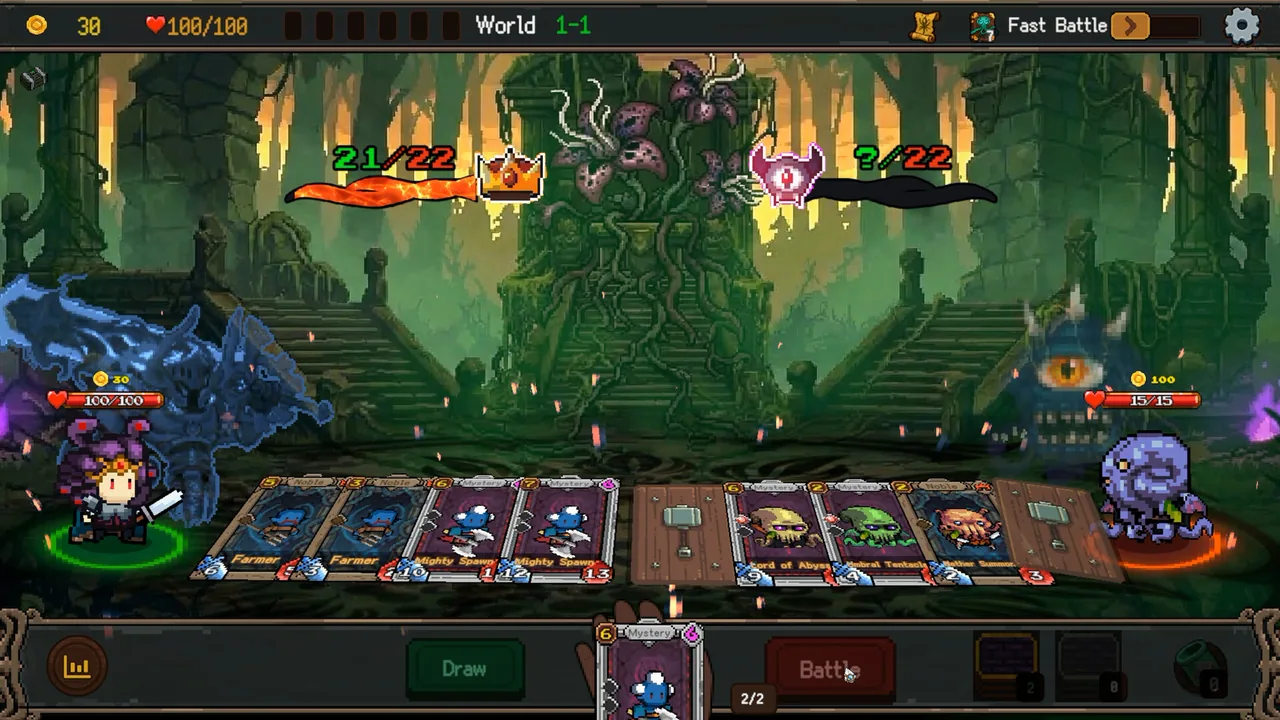
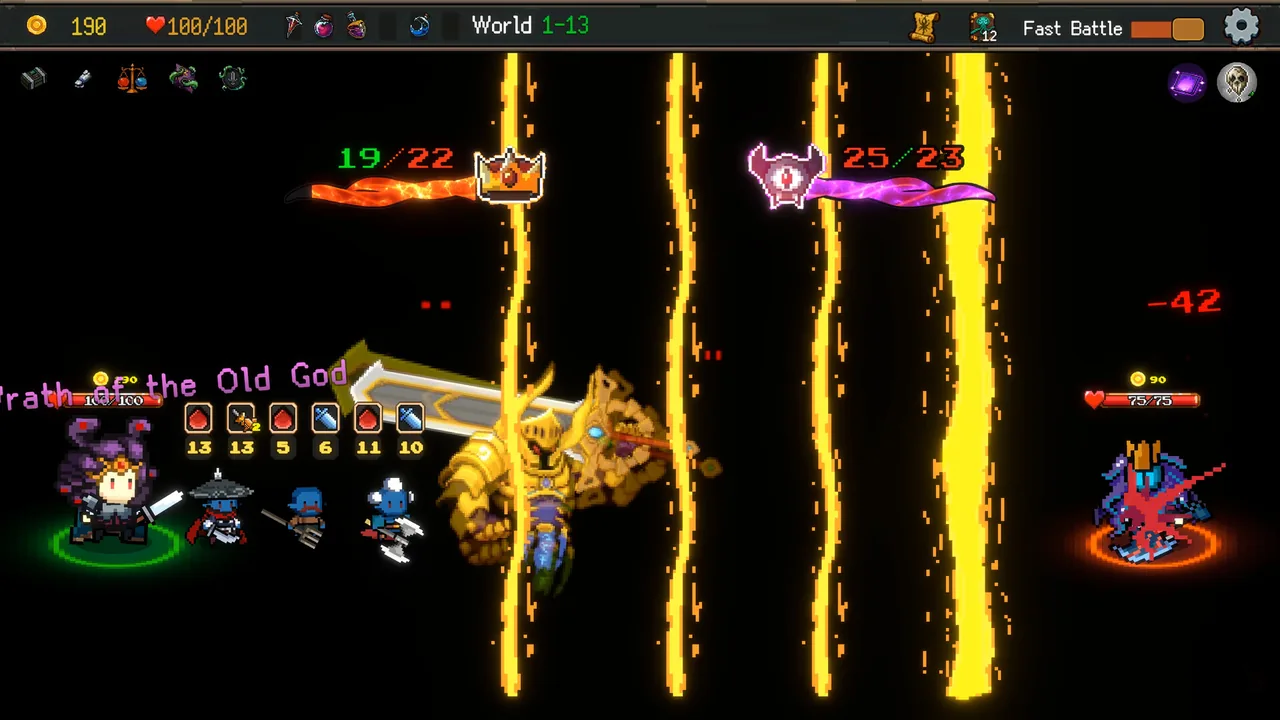
Everything else in Summoner's Gambit is built to make that one rule matter more. As the Apostle of an Old God summoning ancient creatures sealed inside cards, you build a formation across a grid where position determines both who a unit attacks first and how far its skills reach — so the same card can be a frontline tank or a backline threat depending on where you drop it, and every placement decision also nudges you closer to or further from your own energy ceiling. Reviewers who've logged real time with the fusion system describe pushing right up against that limit deliberately, because greater risk is explicitly rewarded, and then having to build the rest of the turn around not tipping over. It's the kind of system that's easy to describe and hard to execute cleanly, and by the accounts of the game's most invested players, Billion Studio mostly landed it.
Card fusion is where that risk-reward loop compounds. Nearly every creature card you acquire can be fused with another, and the result inherits traits from both parents rather than simply averaging their stats — meaning a fusion late in a run can carry the fingerprints of choices made turns earlier. Several reviewers specifically single this out as the game's "joy point," the moment a run stops being about individual good cards and starts being about a specific lineage of fusions nobody else built the same way. With four classes, reportedly over 200 character cards and around 100 runes feeding into that system, there's a real amount of raw material to fuse through — and the achievements track distinct faction-flavoured builds by name, from forest-aligned creatures to barbarian and "possessed" lines, suggesting the build variety on offer isn't just cosmetic.
Where the numbers stop adding up
The trouble starts exactly where you'd expect a numbers-driven system to break: when the numbers themselves stop feeling fair. Of the twenty-five reviews Summoner's Gambit had accumulated at the time of writing, five are negative, and four of those five independently describe the same complaint in different words — that the opponent's energy cap simply runs ahead of the player's own once the run reaches its second or third stage. One reviewer with 106 hours logged put concrete numbers on it: a 30-point cap for the player against a 33-point cap for the AI, with the opponent consistently landing at 32 while the player's own hand couldn't keep pace. Another, with 225 hours behind them, described the imbalance turning severe by the third world and specific creature types feeling structurally underpowered regardless of how well they were played.
That's not a huge sample, and Steam's own achievement data is the more useful corroborating evidence. A tutorial-tier achievement clears 69.8% of players — a healthy, expected number for a game's easiest milestone — but the achievements tied to actually finishing a run sit in a tight, low cluster: Adventurer at 4.0%, Honorable Defeat at 4.2%, Battle Royale Victory at 4.4%. The hardest single-player achievement on the list, Unbroken Champion, sits at 0.4%. Difficulty spikes are a legitimate design choice in a roguelike, and a demanding endgame isn't automatically a flaw — but a cluster of independent reviewers naming the same specific mechanism, backed by a completion curve that falls off a cliff after the tutorial, reads as a tuning problem rather than intended difficulty.
Worth weighing against that: the game's positive reviews carry more weight in hours than its negative ones. Across the full sample, positive reviewers have a median playtime of roughly 195 hours against 67 hours for the negative reviewers, and several of the most enthusiastic accounts are sitting on 600, 700 or, in one case, over 1,400 hours. Those numbers only make sense because Summoner's Gambit isn't actually a one-day-old game in practice — it ran as a public demo from September 2025 and went through a closed playtest that July, so a chunk of that playtime was banked long before the 6 August full release, and Steam counts it as the same app. That cuts both ways editorially: it means the people calling this addictive have had a genuinely long runway to get tired of it and haven't, but it also means several reviewers explicitly note that the shipped 1.0 build doesn't feel meaningfully different from the demo they'd already spent months in — a fair complaint to raise against a release billed as the finished game.
Presentation and the online layer
Visually, Summoner's Gambit leans into a Lovecraftian, gothic pixel-art style that matches its "sealed ancient creatures" premise, backed by an 8-bit soundtrack that reviewers describe warmly without dwelling on it much — a competent, atmospheric backdrop rather than a headline feature. One critical review calls the art "low-quality," but that's an outlier against a sample where most players single out the aesthetic as one of the game's stronger draws, alongside its willingness to lean fully into its Old Gods framing rather than playing it for laughs.
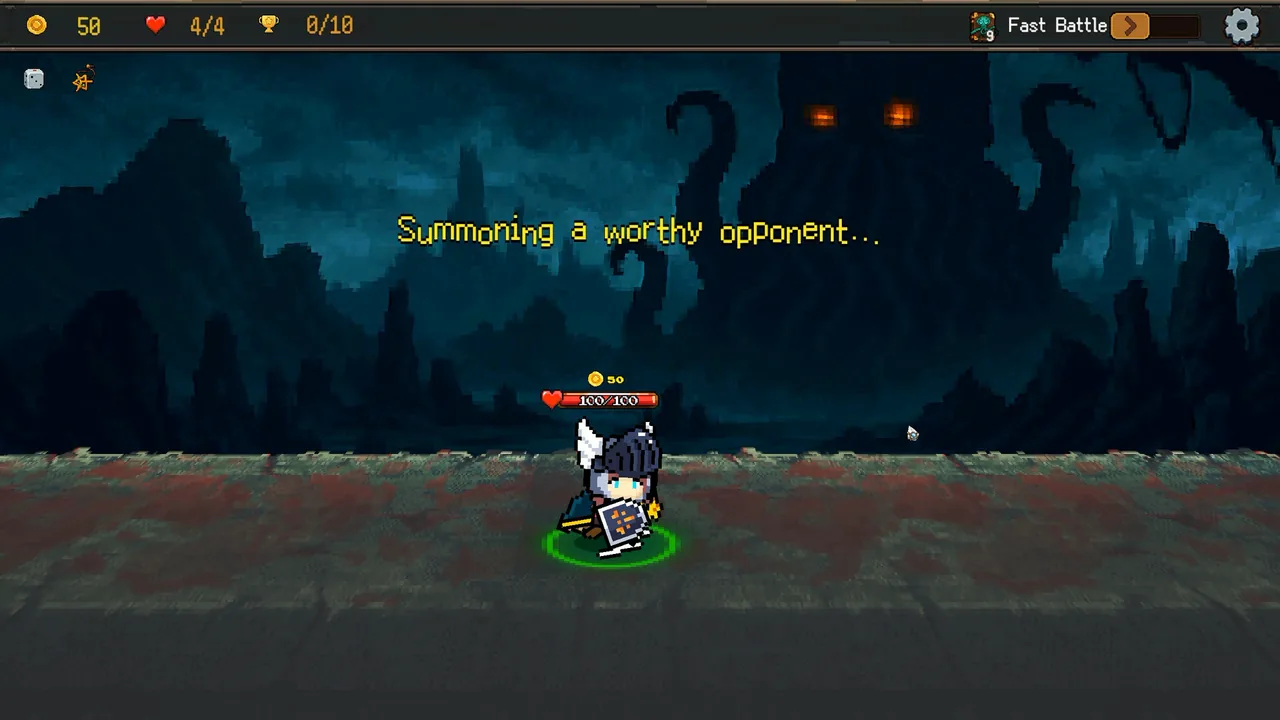
The online side splits more clearly. Asynchronous PvP duels — battling against another player's saved formation rather than needing them online at the same time — draw genuine praise as a way to keep playing after the campaign ends, fitting neatly with a genre where a finished single-player run can otherwise just stop dead. Ranked mode fares worse: at least one veteran reviewer dismisses it as "tasteless," under-detailed next to the asynchronous mode and light on the kind of structure that makes a ranked ladder worth climbing. It reads like the newer, less-tested half of the multiplayer offering, which tracks with an online layer built for a game that spent most of its life as a single-player-focused demo.
The store page also carries an AI Generated Content Disclosure, stating plainly that "some background visuals and textual elements were created using AI-generated technology." It's a factual disclosure rather than a specific player complaint — nobody in the current review sample raises it as an issue — but it's worth knowing going in, particularly for a genre where hand-crafted card art is often part of the appeal.
The audience gap
One more thing is worth being upfront about: every single review on Summoner's Gambit's Steam page right now is written in Simplified Chinese or Japanese. There isn't yet a single English-language review to check your own impressions against, despite English being one of the four supported languages. That's not unusual for a small studio whose closed playtest and demo built up a following in a specific region before the wider Steam audience arrived, but it does mean an English-speaking buyer is genuinely an early adopter for this particular corner of the game's community, arriving after a small but very engaged non-English-speaking playerbase already has a year's head start.
Final verdict
Summoner's Gambit earns a 7.5 for building an entire card-fusion, positioning and risk-management loop around one clean, punishing rule, and for having the kind of dedicated, high-hour player base that usually only shows up around games doing something genuinely right. It doesn't score higher because the game's own review sample — small as it is — converges on a specific, credible complaint about the computer opponent's energy cap outrunning the player's at higher difficulty, and Steam's achievement data backs that pattern rather than contradicting it. If you want a deckbuilder whose core mechanic isn't a reskin of something you've already played a dozen times, and you're willing to be one of its first English-speaking reviewers rather than relying on an established consensus, the asking price makes that an easy risk to take. If you'd rather wait for the tuning to settle and for more voices to weigh in, that's a reasonable call too — this is still, for all practical purposes, a very new game.
Pros and cons
Pros
- The energy-cap "overflow triggers backlash against you" rule gives every summon genuine risk, tying deckbuilding, positioning and hand management into one continuous decision instead of three separate systems
- Positioning directly changes attack priority and skill range, so the auto-battler layer is a real tactical lever rather than cosmetic formation-setting
- Card fusion inherits traits from both parent creatures, and the game's highest-playtime reviewers — several past 600 hours — specifically credit long-term fusion experimentation for keeping runs interesting
- A one-time NZ$11.24 purchase with no DLC, no premium currency and no in-game store is about as clean a monetisation model as this genre offers
- The players who have logged the most time with the game are overwhelmingly its positive reviewers — a 194-hour median playtime among positive reviews against 67 hours among the negative ones — suggesting the loop holds up for people who commit to it
Cons
- Four of the game's five negative reviews independently describe the same problem: the opponent's energy cap consistently running higher than the player's own from around the second and third act onward, turning a calculated risk into a fight the AI simply wins on numbers
- Steam's own achievement data backs that pattern up — a tutorial-tier achievement sits at 69.8% completion, but the run-completion achievements (Adventurer, Honorable Defeat, Battle Royale Victory) all sit between 4.0% and 4.4%, and the toughest single-player achievement clears just 0.4% of the playerbase
- Several long-time players say the build that shipped on 6 August looks and plays close to identical to the free demo that's been public since September 2025, a thin jump for what's billed as the 1.0 release
- Ranked mode draws a "tasteless" complaint from at least one veteran player, an underexplained corner of the online offering next to the well-regarded asynchronous duel mode
- Every review on the store page right now is written in Simplified Chinese or Japanese, there isn't a single English-language review yet, and the game is Windows-only with no Mac or Linux support
Screenshots
-
Summoner's GambitImage: Billion Studio via Steam -
Summoner's GambitImage: Billion Studio via Steam -
Summoner's GambitImage: Billion Studio via Steam -
How the review scores each part of the gameWanderer Editorial -
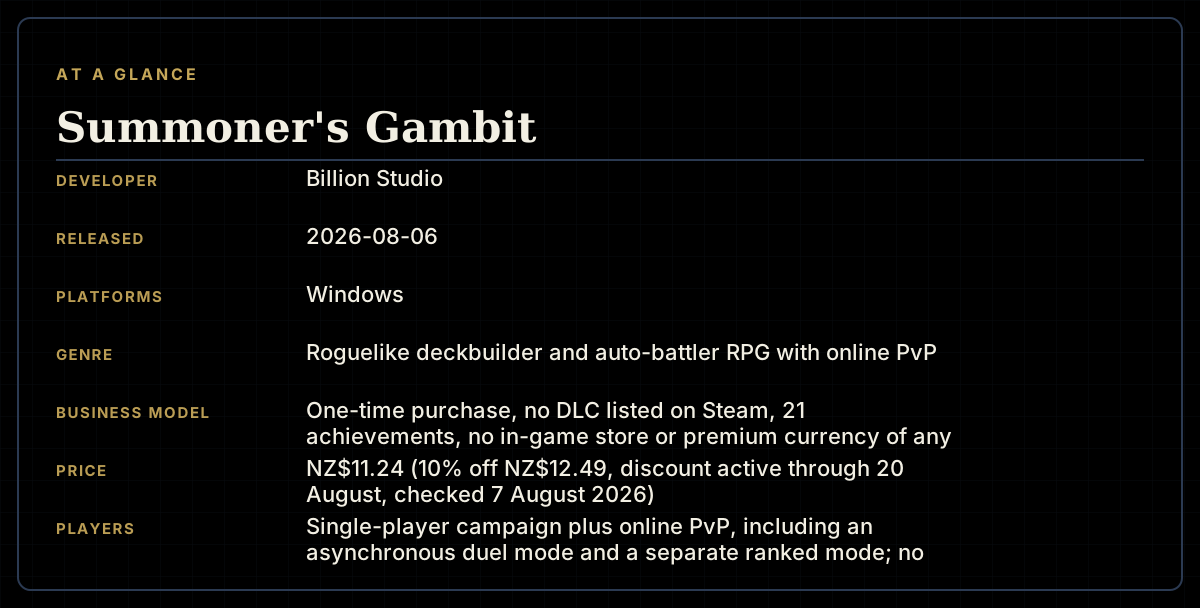
The game at a glanceWanderer Editorial -
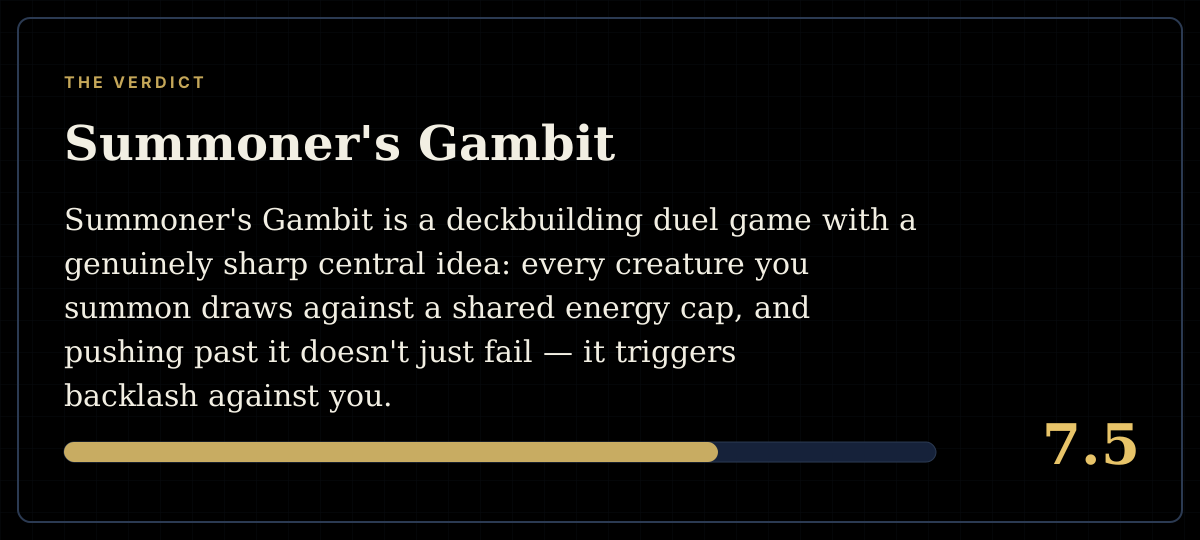
The short versionWanderer Editorial