Game review
Guild's Requiem
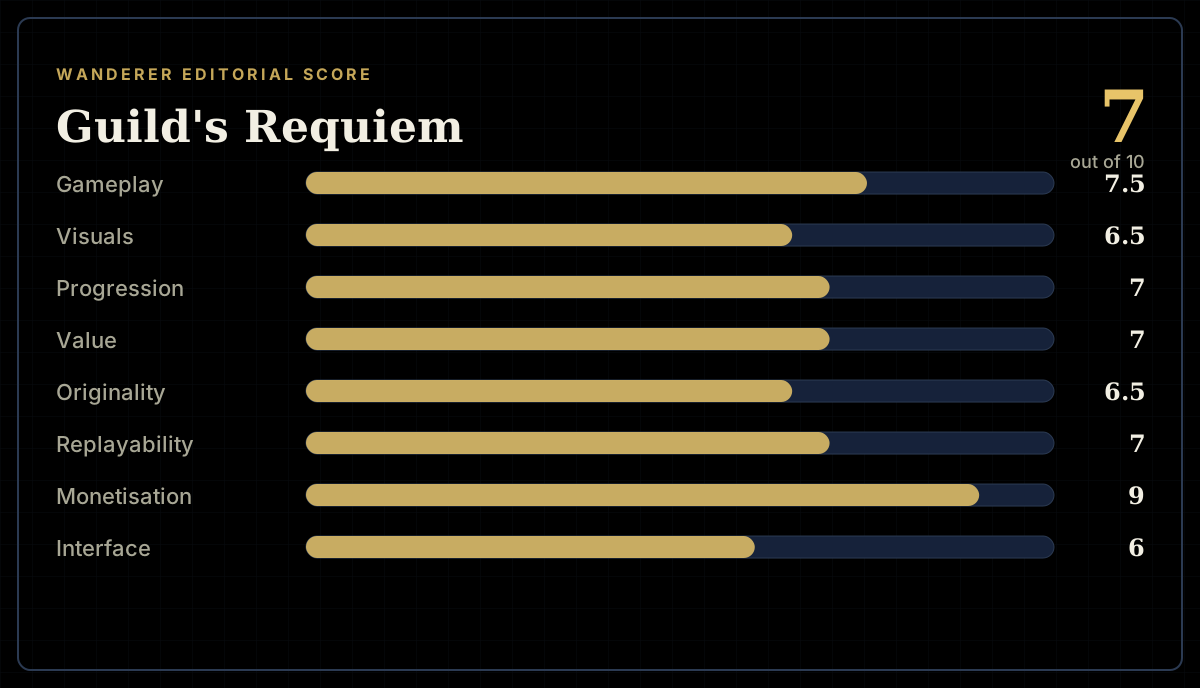
7 / 10
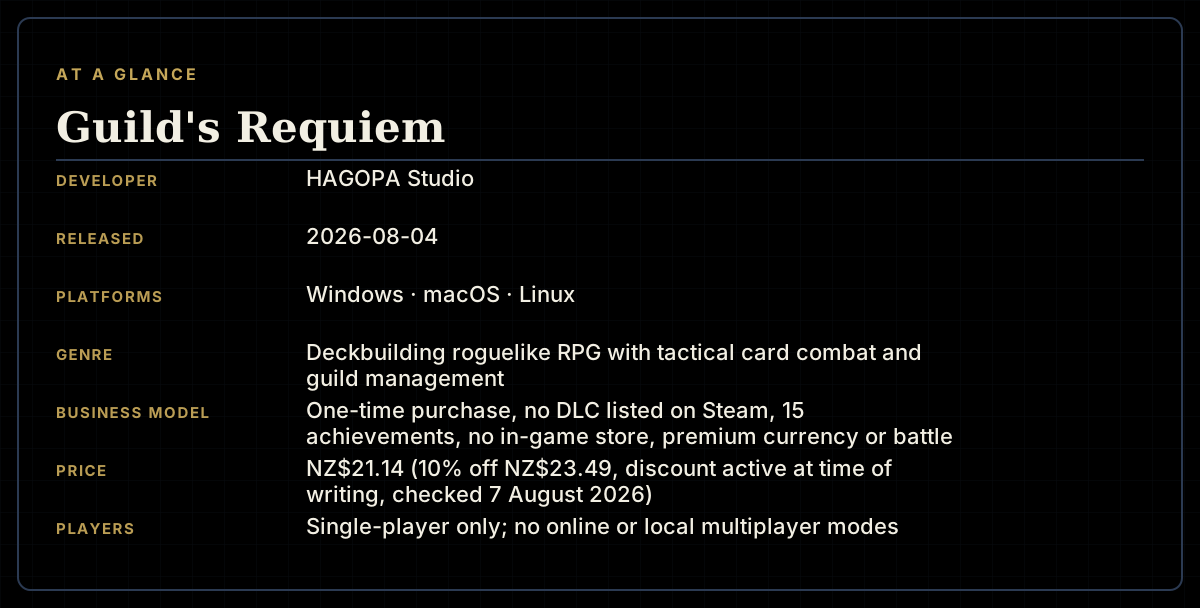
- Developer
- HAGOPA Studio
- Publisher
- BUKSAETONG
- Released
- 4 August 2026
- Platforms
- Windows, macOS, Linux
- Genre
- Deckbuilding roguelike RPG with tactical card combat and guild management
- Monetisation
- One-time purchase, no DLC listed on Steam, 15 achievements, no in-game store, premium currency or battle pass
- Players
- Single-player only; no online or local multiplayer modes
The short version
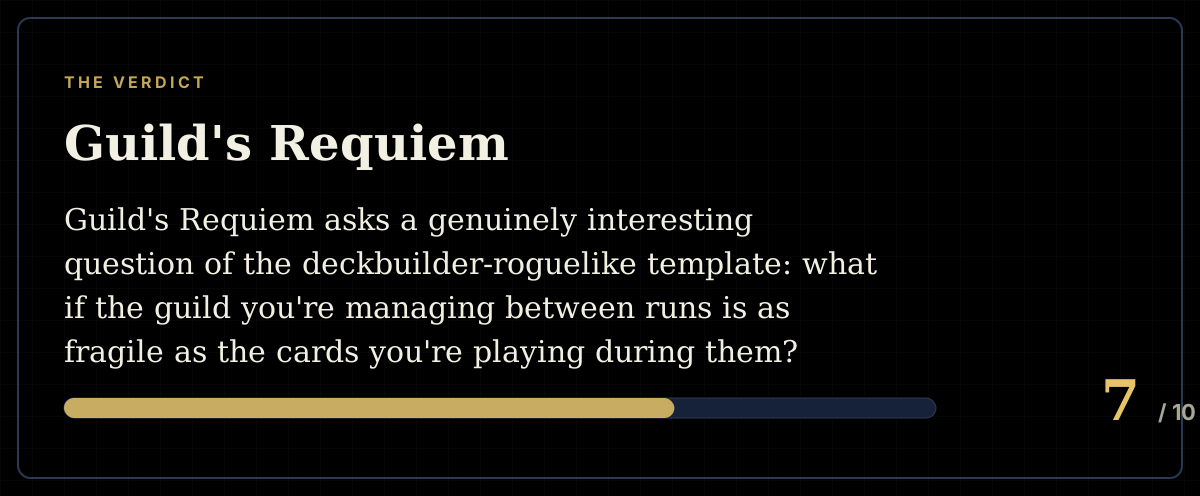
Guild's Requiem asks a genuinely interesting question of the deckbuilder-roguelike template: what if the guild you're managing between runs is as fragile as the cards you're playing during them? A shared Focus gauge that builds toward a team finisher, four independently-growing resource pools so no single hero can jam up the whole turn, and a Chain system that rewards stacking hits on one target all sit underneath a hub where wages, injuries and permadeath make every recruit a real investment. It's a well-constructed set of ideas from a first-time studio, built entirely on a one-time NZ$21.14 purchase with nothing else to buy. What it doesn't have, three days after launch, is a single Steam user review or a meaningfully populated achievement curve to confirm any of it holds up under real pressure — buyers right now are the playtest.
Biggest strengths
- The shared Focus gauge that builds toward a team-wide finisher, sitting alongside four independently-growing per-hero resource pools, gives the turn structure a real tactical question beyond "which card does the most damage"
- The Chain system — stacking hits on one target for a stacking damage bonus, up to +50% at Chain x3 — is visible working exactly as advertised in the developer's own combat screenshots
- A one-time NZ$21.14 purchase with no DLC, no premium currency and no in-game store is about as clean as this genre's monetisation gets
Biggest weaknesses
- The store page's own AI Generated Content Disclosure states that card art, character portraits, backgrounds, enemy art, UI icons, music and sound effects were all produced with generative tools and then curated by the developer — a fact worth knowing before spending NZ$21 on it
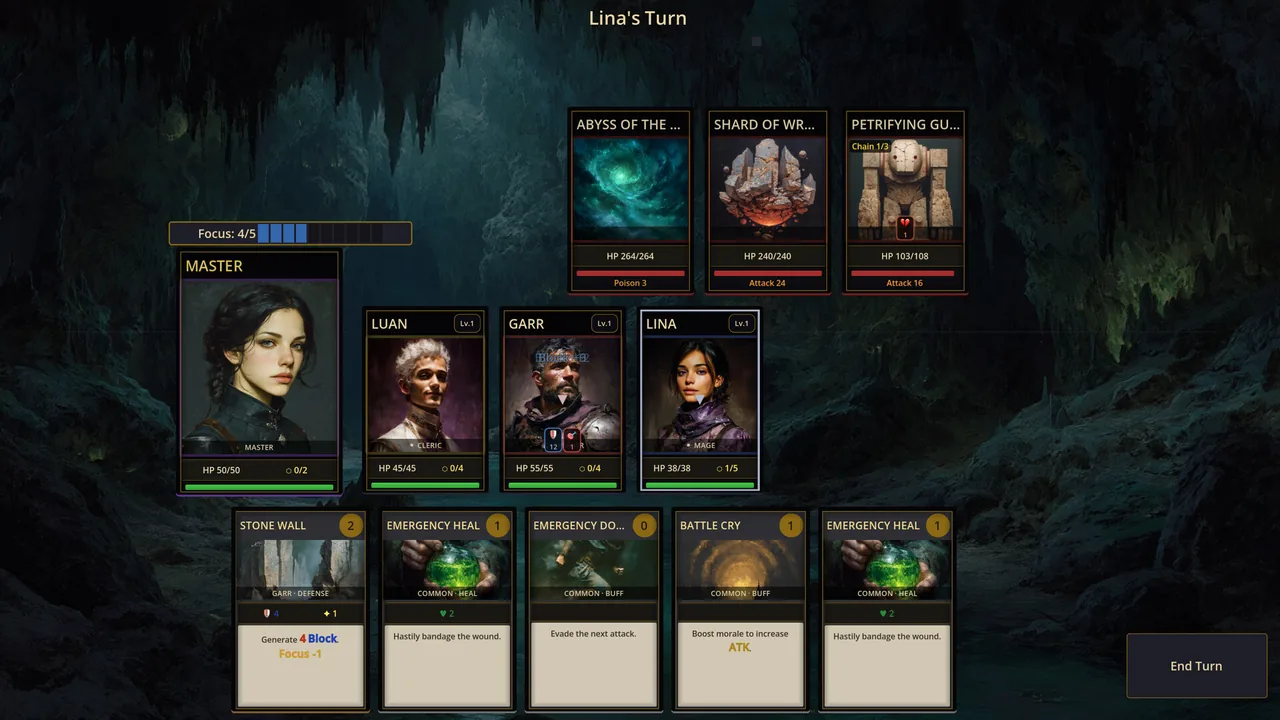
- The developer's own promotional screenshots show enemy and card names routinely clipping mid-word in the combat UI — "MUTANT FLOR...", "HYDRO ELEME...", "PETRIFYING GU..." — a text-overflow issue visible before a single outside player has weighed in
- Zero Steam user reviews and a recorded concurrent-player count of zero three days after release mean there is no independent confirmation yet of the difficulty curve, card balance or how the run length holds up over repeated attempts
Who it's for: Deckbuilder and roguelike fans who like a permadeath management layer bolted onto their card combat, and who are comfortable being among the very first people to actually judge whether the difficulty curve and card pool hold up.
Our recommendation: At NZ$21.14 for a one-time purchase with no DLC and no in-game store, the price is fair for the amount of system on offer — ten heroes, 215 cards, 42 enemies, 18 relics, a chapter campaign plus Endless Dungeon and Daily Challenge modes for replay value. The catch isn't the price, it's the total absence of anyone else's experience to check your own against yet.
7 / 10
There were twelve lights in the world, and Guild's Requiem opens with the first one going out. That's a good pitch for a dark fantasy card game, and the studio behind it, first-time developer HAGOPA Studio working with publisher BUKSAETONG, has built a genuinely interesting structure to hang it on: a deckbuilding roguelike where the thing you're actually managing between runs isn't a deck at all. It's a guild, and the people in it can die for good.
A guild built to lose people
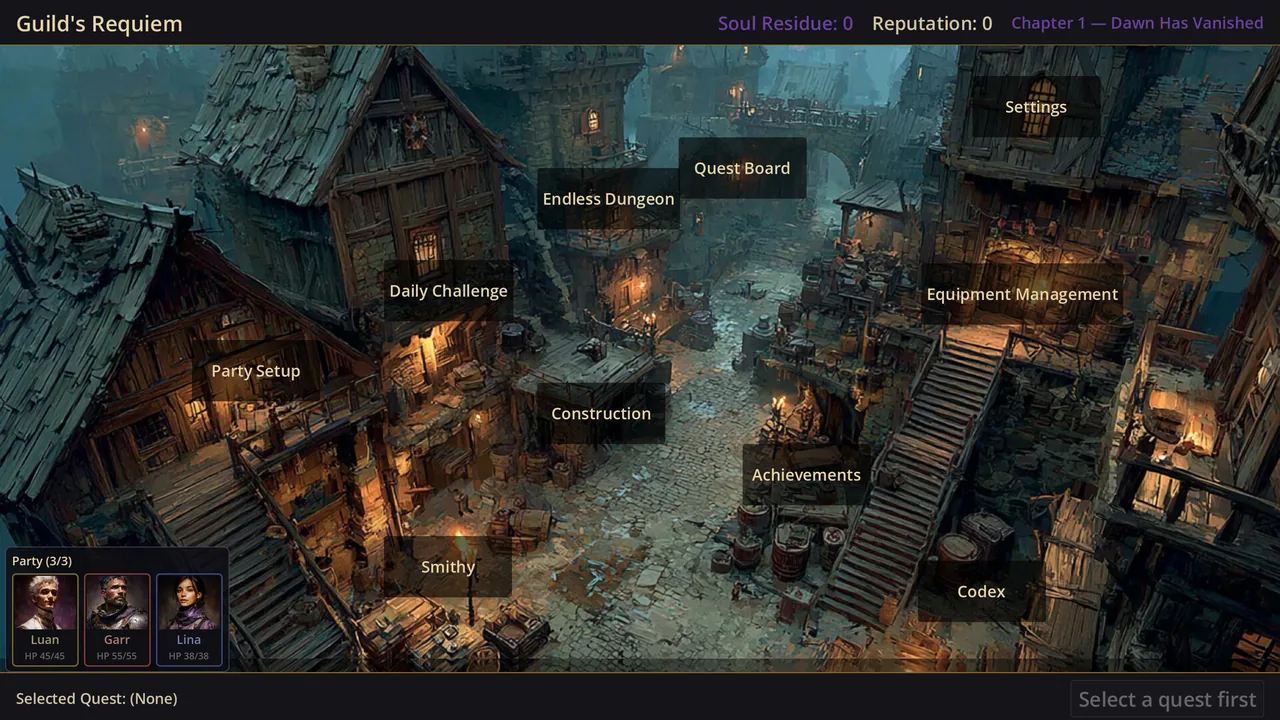
The hub is where Guild's Requiem earns its "management" half. Between expeditions you're back at the guild hall, choosing quests from a board, assigning a three-hero party alongside your guild master, and spending whatever the last run brought home on four facilities — a Training Hall, a Smithy, an Infirmary and a Dormitory — that carry forward into every future attempt. None of that spending is free of consequence. The store page is explicit that heroes draw wages, can be injured, and that a hero left wounded too long is gone for good — permadeath applied not to a single unlucky run, but to the roster you've been building for hours. That's a heavier bet than most deckbuilders ask a player to make, and it reframes the between-run economy: gold and materials aren't just power-ups, they're the difference between losing a fight and losing a person.
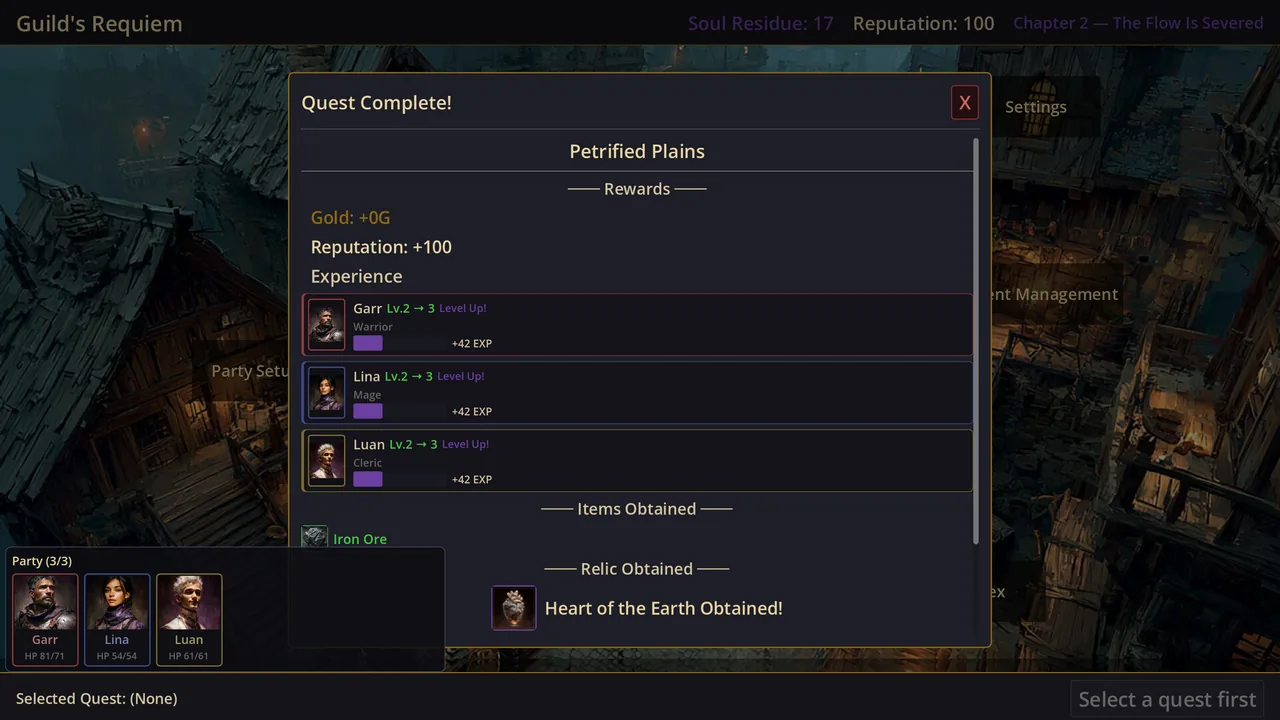
The guild master gets their own smaller arc inside that structure, levelling from 1 to 5 within a single expedition and picking up new cards along the way — a short-term progression loop layered on top of the long-term one, so a single bad run still produces a character who feels different by its end even before the meta-progression from facilities kicks in.
Where the fighting actually happens
Combat is standard turn-based card-battler territory on the surface — a party of up to three heroes plus the master, each fielding a hand built from their own signature card pool, facing down enemies with visible attack and status telegraphs — but two systems underneath it do real work. The whole party shares a single Focus gauge that fills as you spend cards, and rather than being just another resource to manage, it's built around a deliberate choice: keep spending it turn by turn for smaller effects, or hold it and unleash a finisher that burns the entire bar at once. Layered against that, every individual hero grows their own separate resource pool each round — the store page calls it "four independent cost pools, no shared economy, no single point of failure," and the developer's own combat screenshots back that up, showing each party member tracking a distinct counter (0/4, 1/5, 2/4) independently of the shared Focus bar above them.
The other system worth calling out is Chain: stack hits from different party members onto the same target and the game tracks it, escalating to a stated +50% damage bonus at Chain x3. It's visible doing exactly that in the developer's own screenshots — a "Chain x3! +50%" banner firing mid-combat against a target that's already been softened by two other attackers — which is a rarer thing to be able to confirm from marketing material than it sounds. Between the shared finisher meter, the per-hero resource pools and a combo system that rewards coordinated targeting over spreading damage around, the combat has more going on than "play the biggest number" — the question each turn is really about sequencing across four different characters' resources at once, not just one hand of cards.
What's actually behind the premise
The parts that matter most for a guild-management pitch are roster size and run length, and both are present without being enormous. Ten heroes are recruitable, each with a signature card pool and a stated backstory, though only three plus the master can be fielded on any given expedition — so roster management is as much about bench decisions and who's healing in the Infirmary as it is about deck construction. Above that sits 215 cards across every hero and a shared common pool, 42 enemies and bosses, and 18 divine relics described as reshaping strategy outright. For a permadeath run structure those numbers are real but not vast — a comparable Steam deckbuilder-roguelike will often clear well past 300 cards — though the campaign is built to be attempted more than once by design: a chaptered story campaign (the two opening chapters are titled "Dawn Has Vanished" and "The Flow Is Severed," in keeping with the world-ending framing) sits alongside an Endless Dungeon mode, a rotating Daily Challenge, and stackable Challenge Modifiers for players who want to push difficulty past what the campaign asks for. That's a reasonable spread of ways to keep playing after the story missions are done, even if nobody has logged enough hours yet to say whether the card pool holds up to repeated runs without feeling like the same handful of builds each time.
Steam's own accessibility tagging is worth a mention here too — Mouse Only Option, Playable without Timed Input, and Custom Volume Controls are all listed categories on the store page, which is a concrete, specific set of options for a small studio's debut rather than the usual vague accessibility promise.
The AI question
Guild's Requiem carries a store-page AI Generated Content Disclosure, and it's worth quoting rather than summarising: "Visual assets — including card illustrations, character portraits, backgrounds, enemy artwork, and UI icons — were produced with AI image tools (Midjourney, Leonardo, Stable Diffusion, and DALL·E) and then reviewed, edited, and curated by the developer. Music and some sound effects were generated with AI audio tools (Udio and ElevenLabs)." That covers nearly the entire audiovisual package for a paid release. The disclosure itself is honest and specific rather than evasive, and the developer's own screenshots show a consistent painterly dark-fantasy look that reads as curated rather than dumped in raw — but for a genre where hand-painted card art has traditionally been part of the appeal, and at a NZ$21 asking price from a studio with no track record, that's a fact worth knowing before buying rather than after.
Those same screenshots also surface a smaller, more ordinary problem: card and enemy name labels routinely clip mid-word in the combat interface — "MUTANT FLOR...", "HYDRO ELEME...", "ABYSS OF THE...", "PETRIFYING GU...", "SHARD OF WR..." — across multiple official captures. It's a text-box sizing issue rather than anything structural, but it's the kind of polish pass a launch build should have caught, and it's visible in the developer's own marketing material rather than something a review had to dig for.
A launch nobody has weighed in on yet
This is the part of the review that's usually built from what players are saying, and for Guild's Requiem there is currently nothing to draw on. Steam's review API returns zero reviews of any kind — not a low score, not a mixed one, an empty query summary — three days after a full 1.0 launch with no prior demo or playtest under this listing to have built up goodwill or complaints in advance. The concurrent-player count sat at zero at the time of writing. The global achievement data tells the same story in a different shape: First Blood, presumably an early-run milestone, has unlocked for 44.4% of whoever has opened the game, but almost every later achievement — including straightforward run-completion goals like Slayer, Boss Hunter and Centurion — sits at a flat 0%, with only Perfect Run showing any life at 11.1%. That's not evidence of a bad game; it's evidence of a genuinely tiny sample, consistent with a small studio's release that hasn't found its audience yet. But it does mean every claim in this review about how the systems are designed to work is exactly that — a reading of the design, not a report on how it plays out once real players start pushing against Chapter 3 and beyond.
Final verdict
Guild's Requiem earns a 7.0 for a genuinely thoughtful set of systems: a shared Focus meter that turns "spend now or save for the finisher" into a real decision, four resource pools that keep any one hero from bottlenecking the turn, a Chain combo system doing visibly what it promises, and a guild hub where permadeath and wages make every recruit matter beyond their card pool. It doesn't score higher because none of that comes with any outside confirmation yet — no reviews, no meaningful player base, an achievement curve that's barely been touched, and an interface bug sitting in the developer's own screenshots. Add an unusually heavy reliance on AI-generated art and audio across the entire package, disclosed honestly but extensive all the same, and this reads as a well-constructed debut that simply hasn't been tested by anyone but its own developer yet. If a permadeath guild sim wrapped around solid card mechanics sounds worth NZ$21 on its systems alone, this delivers that. If you'd rather wait for a second wave of buyers to confirm the difficulty curve holds together past the opening chapters, that's the more cautious and entirely reasonable call.
Pros and cons
Pros
- The shared Focus gauge that builds toward a team-wide finisher, sitting alongside four independently-growing per-hero resource pools, gives the turn structure a real tactical question beyond "which card does the most damage"
- The Chain system — stacking hits on one target for a stacking damage bonus, up to +50% at Chain x3 — is visible working exactly as advertised in the developer's own combat screenshots
- A one-time NZ$21.14 purchase with no DLC, no premium currency and no in-game store is about as clean as this genre's monetisation gets
- Fully playable, not just menu-translated, in seven languages for a first-time studio's debut release is a genuine investment in reach
- Endless Dungeon, Daily Challenge and stackable Challenge Modifiers give the chapter campaign real replay structure once the main story missions are cleared
Cons
- The store page's own AI Generated Content Disclosure states that card art, character portraits, backgrounds, enemy art, UI icons, music and sound effects were all produced with generative tools and then curated by the developer — a fact worth knowing before spending NZ$21 on it
- The developer's own promotional screenshots show enemy and card names routinely clipping mid-word in the combat UI — "MUTANT FLOR...", "HYDRO ELEME...", "PETRIFYING GU..." — a text-overflow issue visible before a single outside player has weighed in
- Zero Steam user reviews and a recorded concurrent-player count of zero three days after release mean there is no independent confirmation yet of the difficulty curve, card balance or how the run length holds up over repeated attempts
- Global achievement data backs up how quiet the launch has been: only the earliest milestone has meaningfully unlocked, and every later achievement — including basic run-completion goals — sits at 0%
- At 215 cards, 42 enemies and 18 relics spread across ten heroes, the content pool is real but modest, and with no player base yet there's no way to know how quickly the strategic combinations start repeating
Screenshots
-
Guild's RequiemImage: BUKSAETONG via Steam -
Guild's RequiemImage: BUKSAETONG via Steam -
Guild's RequiemImage: BUKSAETONG via Steam -
How the review scores each part of the gameWanderer Editorial -
The game at a glanceWanderer Editorial -
The short versionWanderer Editorial