
Game review
Card-en-Ciel
6.5 / 10
- Developer
- INTI CREATES CO., LTD.
- Publisher
- INTI CREATES CO., LTD.
- Released
- 23 October 2024
- Platforms
- Windows
- Genre
- Roguelite deckbuilder
- Monetisation
- One-time purchase, with an optional paid Expansion Pass adding DLC content
- Players
- Single-player only
The short version
Card-en-Ciel drops you into a 3x3 battle grid that looks, at first glance, like a clear homage to Mega Man Battle Network — and then plays almost nothing like it, unfolding instead as a fully turn-based, Slay the Spire-style deckbuilding roguelite dressed in maximalist anime presentation and an extensive celebration of INTI CREATES's own back catalog. This review's sample is dominated by one recurring story: a great many reviewers arrived expecting a real-time action game, felt real initial disappointment discovering it wasn't one, and then found something they genuinely respected once they adjusted their expectations. A smaller but consistent minority never gets past either that mismatch or the game's intensely cringe-forward dialogue and voice work, which this review treats as a legitimate, recurring taste divide rather than a fringe complaint.
Biggest strengths
- The core deckbuilding systems earn genuine, specific praise for inventiveness within the genre, with multiple experienced deckbuilder fans describing real depth and satisfying combo-building once the learning curve is cleared
- The game's celebration of INTI CREATES's own history and broader otaku culture references draws real affection from longtime fans of the studio's other work, including Gunvolt and Blaster Master Zero
- The 50-plus song soundtrack and the "Muse" system that ties musical numbers to specific in-battle achievements draws consistent, enthusiastic praise as a genuinely novel presentation hook
Biggest weaknesses
- The single most repeated pattern across this review's sample is reviewers arriving expecting a Mega Man Battle Network-style real-time action game and discovering a fully turn-based deckbuilder instead, a mismatch multiple reviewers describe as genuinely disappointing regardless of the actual game's quality
- A meaningful minority of reviewers describe the dialogue, characters, and voice acting as actively "cringe," with several specifically citing this as the reason they couldn't recommend an otherwise mechanically sound game
- Multiple reviewers report combat becoming repetitive over extended play, citing limited enemy and dungeon-layout variety across runs
Who it's for: Deckbuilding roguelite fans open to a maximalist anime presentation, and INTI CREATES fans curious to see their catalog celebrated in a new genre — but not players specifically hoping for a real-time Mega Man Battle Network successor, since this explicitly is not one.
Our recommendation: A genuinely inventive, well-supported deckbuilder worth trying via its extensive public demo first, given how consistently reviewers report an initial mismatch between marketing expectations and the actual turn-based gameplay — go in informed and it's a strong recommendation; go in expecting Battle Network and you may be disappointed regardless of the game's real quality.
6.5 / 10
Card-en-Ciel's marketing leans hard on visual language that instantly recalls Mega Man Battle Network: a 3x3 battle grid, chip-like cards, an anime protagonist paired with a digital companion. The catch, repeated across nearly every review in this sample regardless of final verdict, is that the game underneath that presentation isn't Battle Network at all — it's a fully turn-based Slay the Spire-style deckbuilder, and how a given player reacts to that discovery shapes almost everything else about their experience with it.
The expectation mismatch that defines the sample
This is, by a wide margin, the single most repeated observation across this review's negative and positive samples alike. "If any MMBN fans are interested in this like I was, know that its a turn based game. Plays very differently than MMBN," one reviewer writes plainly. Another, ultimately positive, frames the adjustment honestly: "I honestly played this game under the impression it was going to be Mega Man Battle Network. At the end of the day, it is not; it is its own game. To my surprise, it is not necessarily a bad thing." A third distills the whole dynamic in one line: "It tastes kinda like Megaman battle network, looks kinda like megaman battle network and ultimately it will be compared to it. If you came in expecting MBN" you should reset those expectations before buying. Crucially, this isn't a case where reviewers disagree about what the game is — everyone agrees on the mechanics. The disagreement is entirely about whether that turns out to matter once the initial disappointment passes.
What wins reviewers over once they adjust
For the substantial majority who do get past that mismatch, the praise becomes specific and genuinely enthusiastic. "It's like Megaman Battle Network x Library of Ruina, but with cute anime girls singing for you instead of horrifying abnormalities/SCPs. If you love Library of Ruina, you will love this game," one reviewer writes, offering a considered genre comparison from someone clearly well-versed in deckbuilders. Another, with over 12,000 minutes logged, gives a detailed, experienced-player's assessment: "A breath of fresh air in the deckbuilding genre... You can chip away at enemies turn after turn, without the need to pull off synergistic plays... and the game kinda works.. but not amazingly well. It's much more" rewarding, they go on to explain, once you engage with its deeper combo systems rather than playing passively. A third reviewer sums up the celebratory, self-referential tone directly: "This game is a celebration of past INTI games, videogames and otaku culture in general."
A separate, genuine dialogue and tone complaint
Distinct from the Battle Network mismatch, a real minority of reviewers raise a legitimate, separate concern about the writing and voice direction. "A overly complex but uninteresting card battler, with CONSTANT cringe voicework," one reviewer writes. Another, more conflicted: "I really really wanted to like it....its just SO CRINGEY!" A third reviewer, notably one of the game's more enthusiastic supporters, is honest about this specific weakness even while recommending the game overall: "Solid 3/10 story. It was dumb, didn't make much sense, and the foundational motivations were all bizarre." That last example is worth highlighting specifically — it shows this isn't purely a taste-driven negative-review pattern, since even reviewers who ultimately loved the gameplay openly acknowledge the writing's weaknesses.
Repetition and a deliberate, divisive design choice
Beyond tone, a smaller thread of mechanical criticism concerns long-term variety. "The game is very repetitive, with little enemy variety, dungeon layouts, special rules, and bosses," one reviewer with eight hours invested writes. A separate, more structural critique comes from a reviewer flagging a genre-atypical design decision: the game deliberately omits deck-thinning, a staple mechanic in most card-based roguelites. "You can really dive into if you're willing to forget some things you know (like thinning your deck by removing cards, not really a thing here) and accept some anime flavor," one reviewer notes, treating it as an adjustment rather than a flaw — but it's a real departure from convention worth flagging directly for deckbuilder veterans expecting standard genre mechanics.
What the achievement data confirms about depth
Steam's own completion figures back up the picture of a game with real, demanding long-term depth beneath its accessible surface. An early milestone sits at 90.4%, with several mid-tier achievements comfortably in the 50-70% range, confirming most buyers meaningfully engage with the core systems. The steepest late-game achievements, by contrast, fall to just 1.1-1.5%, evidence of a genuinely challenging roguelite structure that rewards sustained mastery — directly supporting the experienced reviewer's description of a game that "kinda works" on the surface but rewards much deeper engagement with its combo systems.
An exceptional, ongoing support record
Whatever this review's criticisms of tone or expectation-setting, none reflect a neglected release. Card-en-Ciel's partner-events feed documents an extraordinarily active post-launch history: dozens of version updates through 2025, a paid Expansion Pass adding new DLC content, a Blaster Master Zero crossover, and repeated demo updates continuing well into 2027. Few games in this review series have received this level of sustained developer attention.
Final verdict
Card-en-Ciel is a genuinely inventive turn-based deckbuilder wearing a Mega Man Battle Network costume it deliberately doesn't live up to mechanically, and this review's sample shows that mismatch causing real, repeated frustration for a meaningful share of buyers even as most who push past it find something they genuinely respect. Play the extensive public demo first to set your expectations correctly, and judge the maximalist anime tone for yourself before committing — this is a strong deckbuilder on its own terms, but only for players who go in knowing exactly what those terms are.
Pros and cons
Pros
- The core deckbuilding systems earn genuine, specific praise for inventiveness within the genre, with multiple experienced deckbuilder fans describing real depth and satisfying combo-building once the learning curve is cleared
- The game's celebration of INTI CREATES's own history and broader otaku culture references draws real affection from longtime fans of the studio's other work, including Gunvolt and Blaster Master Zero
- The 50-plus song soundtrack and the "Muse" system that ties musical numbers to specific in-battle achievements draws consistent, enthusiastic praise as a genuinely novel presentation hook
- Steam's own partner-events feed documents an exceptionally sustained, active support record, with dozens of version updates, a paid Expansion Pass, and a Blaster Master Zero crossover DLC extending well past initial launch
- The extensive, frequently updated public demo gives prospective buyers a genuinely accurate preview of the actual turn-based gameplay before purchase, directly addressing the expectation-mismatch problem this review's sample repeatedly describes
Cons
- The single most repeated pattern across this review's sample is reviewers arriving expecting a Mega Man Battle Network-style real-time action game and discovering a fully turn-based deckbuilder instead, a mismatch multiple reviewers describe as genuinely disappointing regardless of the actual game's quality
- A meaningful minority of reviewers describe the dialogue, characters, and voice acting as actively "cringe," with several specifically citing this as the reason they couldn't recommend an otherwise mechanically sound game
- Multiple reviewers report combat becoming repetitive over extended play, citing limited enemy and dungeon-layout variety across runs
- The absence of a deck-thinning mechanic, unusual for the genre, is flagged by at least one reviewer as a deliberate but polarizing design choice that runs against established deckbuilder conventions
- Several reviewers report specific, reproducible crashes and freezes mid-dungeon that forced restarting entire runs, alongside at least one report of persistent poor translation quality making the story genuinely hard to follow
Screenshots
-

Card-en-CielImage: INTI CREATES CO., LTD. via Steam -

Card-en-CielImage: INTI CREATES CO., LTD. via Steam -

Card-en-CielImage: INTI CREATES CO., LTD. via Steam -
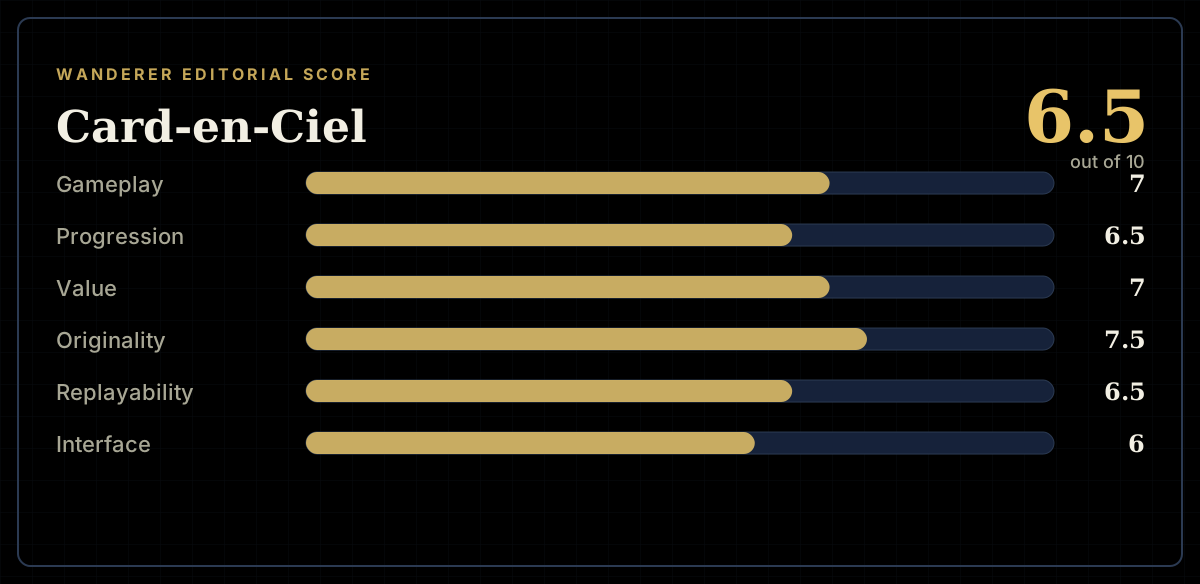
How the review scores each part of the gameWanderer Editorial -
The short versionWanderer Editorial