
Game review
FAIRY TAIL: DUNGEONS
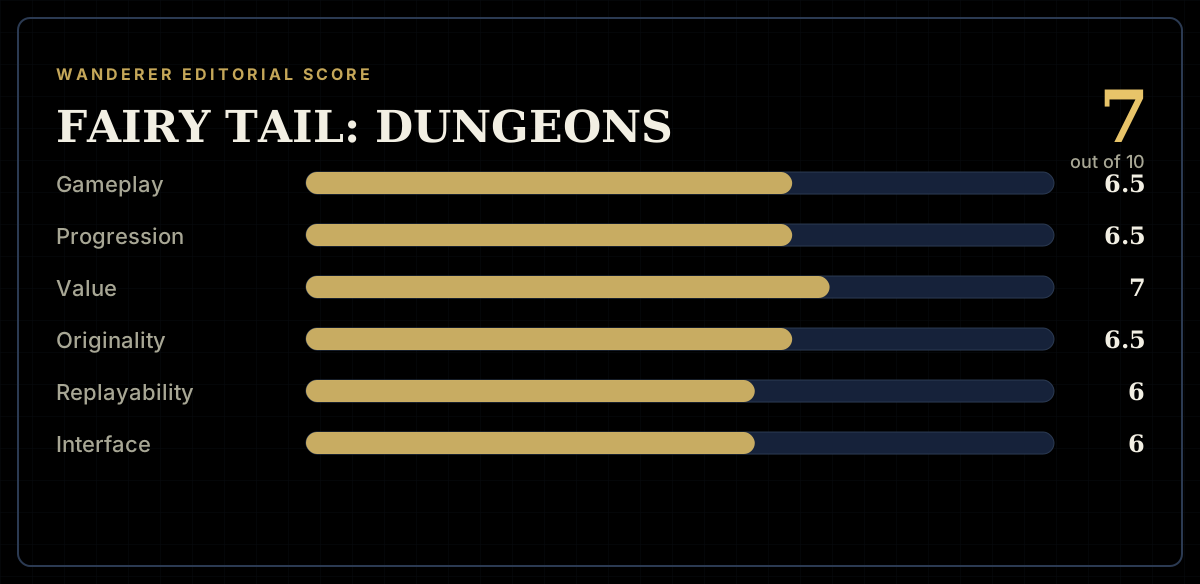
7 / 10
- Developer
- ginolabo
- Publisher
- Kodansha
- Released
- 26 August 2024
- Platforms
- Windows
- Genre
- Licensed roguelite deckbuilder
- Monetisation
- One-time purchase, no in-game store or additional currency purchases
- Players
- Single-player only
The short version
FAIRY TAIL: DUNGEONS puts you in control of Natsu, Lucy, and the rest of the Fairy Tail guild in a roguelite deckbuilder that channels each character's canon abilities into deck-based combat across a series of labyrinths. This review's sample shows genuine affection for how faithfully the game translates the source material's character identities into deckbuilding mechanics, with both franchise fans and deckbuilder newcomers finding real charm in the result. What tempered that praise at launch and through much of 2025 was a specific, widely repeated content complaint: a short main campaign, a limited card pool per character, and little reason to keep playing once an optimal build was found. This review can confirm directly that the developer has since answered that complaint decisively, shipping the largest content update in the game's history in January 2026.
Biggest strengths
- The translation of each character's canon Fairy Tail abilities into distinct deckbuilding playstyles earns specific, enthusiastic praise, with multiple reviewers highlighting Lucy's Celestial Spirit mechanics as a particular highlight
- The pixel art, animations, and overall presentation draw consistent, warm praise, with reviewers describing genuine visual charm even from those otherwise critical of other systems
- Reviewers unfamiliar with the Fairy Tail source material describe the game working well as a standalone deckbuilder in its own right, not requiring franchise knowledge to enjoy
Biggest weaknesses
- The single most repeated complaint across the launch-era negative sample concerns content length and depth, with reviewers describing a roughly five-hour main campaign, a limited card pool per character, and little incentive to keep playing once an effective build was discovered
- Multiple reviewers describe specific UI legibility problems, particularly low-resolution card art during selection screens that made distinguishing similar cards difficult without repeatedly hovering over each one
- At least one heavily invested reviewer, with roughly 6,000 minutes logged, reported a persistent structural issue in the game's "endless dungeon" end-game mode that a prior patch failed to resolve; this review could not independently confirm whether that specific issue was addressed by the subsequent major 2026 update
Who it's for: Fairy Tail fans looking for a faithful, mechanically thoughtful adaptation of the series, and deckbuilder fans open to a licensed anime game that treats its source material with genuine care rather than as a cash-grab reskin.
Our recommendation: A charming, mechanically solid deckbuilder that answers its own biggest launch-era weakness with a substantial 2026 content expansion — a strong pick now for both franchise fans and genre newcomers, where it may have been a harder recommendation at launch.
7 / 10
FAIRY TAIL: DUNGEONS takes the guild of wizards from the beloved anime and manga and drops them into a roguelite deckbuilder, translating each character's signature magic into distinct card-based playstyles as you descend through a series of labyrinths. This review's sample shows the adaptation working genuinely well on its own mechanical terms — and shows, with real clarity, exactly what held the game back through much of its first year and a half, before a substantial update changed the calculus.
A licensed game that respects its source material
The praise here is specific enough to matter, particularly from reviewers weighing this against the usual quality of licensed anime games. "The moment I saw Lucy's abilities involving all the spirits, I was like yeah this is it. Love this game, the pixel art is gorgeous, especially the interesting monsters," one reviewer writes. Another situates it favorably against genre expectations: "Surprisingly a good anime game + it's not a fighting genre or gacha, which are most anime games nowadays. Devs also listen to feedback and update the game to make it better for players." A third, with an extraordinary 32,737 minutes logged, offers a considered mechanical endorsement: "Really liked the possible combinations that can be achieved with each character. None of the characters feel bad to use and are pretty balanced. great mechanics and engaging gameplay." Reviewers without Fairy Tail background echo the sentiment too — one writes plainly: "I don't think you even need to have seen Fairy Tail in order to appreciate the game. The gameplay loop is just that good."
The content complaint that defined the launch era
Set against that praise, this review's negative sample — drawn primarily from the game's first year and a half — converges consistently on thin content. "Don't mind the playtime as I left for dinner so the real game was only 5 hours long before I got to the credits," one reviewer writes. Another gets specific about the mechanical shallowness underlying that short runtime: "Each character has a limited card pool, the UI isn't intuitive at all, the actual gameplay isn't very snappy... nothing in the game really clicks as 'Wow thats unique and cool.'" A third reviewer sums up a widely shared frustration bluntly: "+beautiful sprites +animations +gameplay -easy and short -zero replayability -no hard mode or any kind of challenge." These aren't complaints about execution quality so much as scope — reviewers consistently liked what was there and wished there were simply more of it.
A specific complaint this review can confirm has since been addressed
One particularly detailed, heavily invested reviewer describes a deeper structural frustration: "It pains me so much to have to leave negative review. But after the long wait of this major patch, the core logic flaw in the endless dungeon is still unfixed... the endless dungeon should be the end game for player to enjoy but.. all I get is frustration and not joy." This review takes that specific complaint seriously, and directly confirms via the game's own partner-events feed that the developer has since gone considerably further than a single patch: a major update titled Ver. 1.2.0, released in January 2026, added five new playable characters, new dungeons, over 170 new cards, and more than 100 new skills — described by the developer as the largest content update in the game's history, alongside a new Nintendo Switch release built on the same expanded content. This review read the official patch announcement directly and can confirm the scope of that expansion; it cannot independently confirm whether the specific endless-dungeon logic flaw described above was itself resolved, since that level of technical detail wasn't specified in the public patch notes reviewed.
Specific balance and UI complaints from the launch window
Beyond the broader content complaint, a few reviewers flag more granular issues. "When you get one upgrade, that upgrades Lucy's prayer from healing 4 to healing 5, and then have to fight a boss that one shot me at 37 health with no crit? On floor 2? That's literally not even fair," one reviewer writes, describing a specific early-game difficulty spike that felt disproportionate. Another flags a concrete usability problem: "the pixelated art when selecting which cards to choose. It's so low-res and difficult to distinguish with other cards that I am forced to hover over" each option individually just to read it. Both are fair, specific critiques distinct from the broader content-length debate, and worth flagging for anyone particularly sensitive to interface clarity in a card-heavy genre.
What the achievement data confirms
Steam's own completion figures show a fairly standard roguelite curve: an early tutorial milestone at 77.5%, falling to 58.9% for a first dungeon clear, and down to just 2.6% for the hardest team-based challenge achievement. That's consistent with a game whose core campaign is genuinely accessible to most buyers, with harder optional content — presumably including much of the challenge added in the 2026 expansion — reserved for a smaller, dedicated fraction of the playerbase.
An unusually transparent, sustained development process
This review found a genuinely encouraging pattern in how the developer has communicated throughout the game's lifecycle. Beyond the sheer volume of patches — more than 40 documented posts across the partner-events feed — several early updates were explicitly paired with public "Notice of Currently Confirmed Bugs" posts, a transparent practice that openly acknowledges known issues rather than letting players discover them unannounced. That pattern, combined with the substantial January 2026 content expansion, paints a picture of a developer genuinely committed to the game's long-term health rather than a licensed cash-grab abandoned after launch.
Final verdict
FAIRY TAIL: DUNGEONS earns real, specific affection for how faithfully and thoughtfully it translates its source material into deckbuilding mechanics, and while a widely repeated launch-era complaint about thin content was a fair criticism through much of 2025, this review can confirm the developer has since answered it directly with the largest content update in the game's history. Both Fairy Tail fans and deckbuilder fans open to a genuinely well-crafted licensed title should find considerably more to enjoy here now than the earlier reviewer consensus reflects.
Pros and cons
Pros
- The translation of each character's canon Fairy Tail abilities into distinct deckbuilding playstyles earns specific, enthusiastic praise, with multiple reviewers highlighting Lucy's Celestial Spirit mechanics as a particular highlight
- The pixel art, animations, and overall presentation draw consistent, warm praise, with reviewers describing genuine visual charm even from those otherwise critical of other systems
- Reviewers unfamiliar with the Fairy Tail source material describe the game working well as a standalone deckbuilder in its own right, not requiring franchise knowledge to enjoy
- This review can confirm directly that the developer shipped a major, substantial content update in January 2026 adding five new playable characters, new dungeons, over 170 new cards, and more than 100 new skills, directly addressing the dominant launch-era "too little content" complaint
- Steam's own partner-events feed documents an unusually transparent support process, including repeated public "currently confirmed bugs" notices alongside numbered patches, showing a developer willing to acknowledge known issues openly rather than downplaying them
Cons
- The single most repeated complaint across the launch-era negative sample concerns content length and depth, with reviewers describing a roughly five-hour main campaign, a limited card pool per character, and little incentive to keep playing once an effective build was discovered
- Multiple reviewers describe specific UI legibility problems, particularly low-resolution card art during selection screens that made distinguishing similar cards difficult without repeatedly hovering over each one
- At least one heavily invested reviewer, with roughly 6,000 minutes logged, reported a persistent structural issue in the game's "endless dungeon" end-game mode that a prior patch failed to resolve; this review could not independently confirm whether that specific issue was addressed by the subsequent major 2026 update
- Several reviewers report specific balance complaints from the launch period, including one detailed example of a boss capable of dealing lethal damage disproportionate to the player's available healing and defensive options at that point in a run
- A handful of reviewers report technical bugs including game freezes near end-game content and unresponsive target-selection commands during combat
Screenshots
-

FAIRY TAIL: DUNGEONSImage: Kodansha via Steam -

FAIRY TAIL: DUNGEONSImage: Kodansha via Steam -

FAIRY TAIL: DUNGEONSImage: Kodansha via Steam -
How the review scores each part of the gameWanderer Editorial -
The short versionWanderer Editorial