
Game review
Technotopia
5.5 / 10
- Developer
- Yustas
- Publisher
- Alawar
- Released
- 23 October 2024
- Platforms
- Windows
- Genre
- Narrative-driven tile-placement roguelite
- Monetisation
- One-time purchase, no in-game store or additional currency purchases
- Players
- Single-player only
The short version
Technotopia casts you as Iris, an artificial intelligence tasked with building the perfect city by placing buildings in Tetris-like formations while balancing the competing demands of capitalists, aristocrats, politicians, and ordinary citizens. Its art-deco visual style and tightly written, decision-driven narrative earn genuine, specific praise, and multiple reviewers describe a short but satisfying few hours of play. What tempers that praise across nearly the entire review sample is agreement that the game's content ends almost exactly where the story does — once the roughly two-to-five-hour campaign concludes, reviewers consistently report nothing left to meaningfully return for. This review can confirm directly that development support essentially stopped about a week after launch, corroborating widespread reviewer claims that the game was left in an unfinished state rather than expanded into the fuller experience its systems seem built to support.
Biggest strengths
- The art-deco visual style and overall presentation draw near-universal, specific praise, with reviewers repeatedly describing the aesthetic as genuinely beautiful and distinctive even among more expensive competitors
- The story and decision-driven narrative earn real, specific credit, with reviewers comparing the format favourably to Reigns and praising how faction-balancing choices integrate meaningfully into the plot rather than feeling like separate systems
- Quality-of-life basics are handled well from the very first launch, with reviewers specifically praising the absence of long loading screens or excessive publisher branding and a thoughtfully calibrated default audio volume
Biggest weaknesses
- The single most repeated complaint across the entire review sample is that meaningful content ends when the story does, typically within two to five hours, with reviewers consistently describing no reason to continue playing once the main campaign concludes
- This review confirms directly that development support effectively ceased about a week after the 23 October 2024 launch, corroborating widespread reviewer descriptions of the game as abandoned in an unfinished state rather than expanded toward its evident potential
- The faction-balancing systems are described by multiple reviewers as too shallow to support real strategic decision-making, with events failing to meaningfully affect the board and vice versa according to at least one detailed account
Who it's for: Fans of short, narrative-focused puzzle games with a strong visual identity who don't mind limited replay value, and who are buying primarily for a single, well-told playthrough rather than an ongoing roguelite with escalating depth.
Our recommendation: Worth its very low price for a single, visually striking playthrough with a genuinely well-written decision-driven story. Don't expect meaningful content beyond that one story campaign, and know going in that further development is very unlikely given the confirmed lack of post-launch support.
5.5 / 10
Technotopia's premise carries a specific, appealing weight: you play Iris, an artificial intelligence built to design a perfect city for a world torn apart by economic and social conflict, arranging buildings into Tetris-like formations on a board while four factions — capitalists, aristocrats, politicians, and ordinary citizens — pull in different, often incompatible directions. It's a striking art-deco cyberpunk package, and this review's sample is unusually unanimous about what it gets right and, separately, about exactly where it runs out.
A striking, well-written short experience
The presentation earns consistent, specific praise. "Most of the artwork has the right retro art deco futurism" feel, one reviewer writes, a sentiment echoed by nearly every review in the sample regardless of overall recommendation. The narrative draws its own genuine credit: one reviewer frames the format precisely as "a mix between citybuilders like Dorfromantik and decision-driven RPGs like Reigns," praising how weekly city-event dilemmas integrate meaningfully into both the story and the board rather than feeling bolted on. Quality-of-life polish earns specific mention too — "no endless loading times, no endless publisher/developer screens... the volume out of the box was set to roughly 1/3 of max volume, which was the appropriate level," one reviewer notes, small details that speak to real care taken in the initial player experience.
The wall almost everyone hits at the same point
What makes this review sample distinctive is how precisely reviewers agree on where the game's real content ends. "Once you finish the story, there is literally no reason to go back to 'building' the city. There is no WIN condition, you just play until you lose," one reviewer writes. Another, more blunt: "I beat this game in five hours while barely understanding it's economic and influence systems... in the end I beat the game by stringing random buildings together in straight lines." A third sums up the shared verdict succinctly: "the main game is gone in like 2 hours." This isn't a scattered handful of impatient players — it's close to a consensus among reviewers who otherwise clearly appreciated the game's craft.
A confirmed, not merely suspected, lack of ongoing support
Multiple reviewers go further than describing thin content, stating directly that development stopped. "The game is dead. It looks pretty and has tremendous potential, but the devs stopped working on it long before it was really a full game," one reviewer writes, and another separately states: "Despite the devs not working on this, this game is still just the bare bones of a game that doesn't exist." This review can confirm that claim directly rather than relay it as unverified suspicion: the game's own partner-events feed shows exactly two update posts in the week following the 23 October 2024 launch, and nothing further specific to this title since — while the same developer's channel went on to announce entirely separate, unrelated projects. The reviewer consensus about abandonment is not speculation; it matches the documented record.
Systems that don't fully deliver on their own premise
Beyond the content-length complaint, at least one detailed reviewer describes a more specific structural problem: "the events do not impact the board and the board does not appear to impact the events," arguing the faction-balancing systems central to the game's premise don't actually interact with the tile-placement puzzle in the way the marketing implies. That's a meaningful critique distinct from "there's not enough of it" — it suggests the two core systems the game is built around were never fully integrated even within the content that does exist.
What the achievement data confirms
Steam's own completion figures back up the "short, then nothing" pattern directly. An early milestone sits at 82%, and turn-based survival achievements at the 25 and 50-turn marks sit at a healthy 82% and 70.2% respectively — consistent with most buyers comfortably reaching and finishing the story. But achievements tied to specific faction-dominance outcomes sit much lower, around 7-20%, suggesting the deeper systemic variety the game gestures toward is thin enough that most players don't feel pulled back to explore it after their first successful run.
A specific, sympathetic recommendation worth including
Not every review frames the short length as a dealbreaker. "For its price, it's a nice little card game with number balancing. It can give you a few hours of entertainment," one reviewer writes, treating the brevity as proportionate to the very low cost rather than a broken promise. That's a fair, honest framing for a game this cheap, even if it doesn't resolve the deeper concern that the game was seemingly left unfinished relative to what its own systems suggested it was building toward.
What "not a city builder" means for expectations
At least one reviewer makes a specific, useful clarification worth passing on directly: "This is not a city-building game. I repeat, this is not a city-building game. It's neither a deck-builder game. It's more like a rogue-lite puzzle game." That's a fair correction to how the store page and marketing frame the experience, and it matters for setting expectations correctly — buyers specifically hoping for a genuine city-management sim with deep economic simulation, in the vein of something like Cities: Skylines scaled down, will find Technotopia's actual systems considerably more abstract and puzzle-focused than that framing implies. Understood as a short, decision-driven puzzle narrative instead, the game's actual scope and pacing make considerably more sense.
Final verdict
Technotopia is a genuinely beautiful, well-written short experience that delivers real satisfaction for the few hours its story lasts, and this review can confirm directly that its development was effectively wrapped up within about a week of launch, leaving a game reviewers consistently describe as reaching only a fraction of its evident potential. Worth its very low price for a single, polished playthrough; don't buy it expecting an evolving roguelite with real long-term depth, since the record shows that expansion was never coming.
Pros and cons
Pros
- The art-deco visual style and overall presentation draw near-universal, specific praise, with reviewers repeatedly describing the aesthetic as genuinely beautiful and distinctive even among more expensive competitors
- The story and decision-driven narrative earn real, specific credit, with reviewers comparing the format favourably to Reigns and praising how faction-balancing choices integrate meaningfully into the plot rather than feeling like separate systems
- Quality-of-life basics are handled well from the very first launch, with reviewers specifically praising the absence of long loading screens or excessive publisher branding and a thoughtfully calibrated default audio volume
- The core tile-placement mechanic draws praise for its puzzle satisfaction in short sessions, even from reviewers who ultimately found the broader game thin
- At its very low price, several reviewers explicitly frame the purchase as a fair trade for a few hours of polished, visually striking entertainment regardless of its other limitations
Cons
- The single most repeated complaint across the entire review sample is that meaningful content ends when the story does, typically within two to five hours, with reviewers consistently describing no reason to continue playing once the main campaign concludes
- This review confirms directly that development support effectively ceased about a week after the 23 October 2024 launch, corroborating widespread reviewer descriptions of the game as abandoned in an unfinished state rather than expanded toward its evident potential
- The faction-balancing systems are described by multiple reviewers as too shallow to support real strategic decision-making, with events failing to meaningfully affect the board and vice versa according to at least one detailed account
- Several reviewers describe beating the game through repetitive or unintended strategies, such as placing buildings in simple straight lines, rather than through the deeper faction-management systems the game's premise foregrounds
- At least one reviewer reports the game freezing on a black screen during the tutorial, and another reports significant performance lag on their hardware, both concrete technical complaints beyond the broader content-depth criticism
Screenshots
-

TechnotopiaImage: Alawar via Steam -

TechnotopiaImage: Alawar via Steam -

TechnotopiaImage: Alawar via Steam -
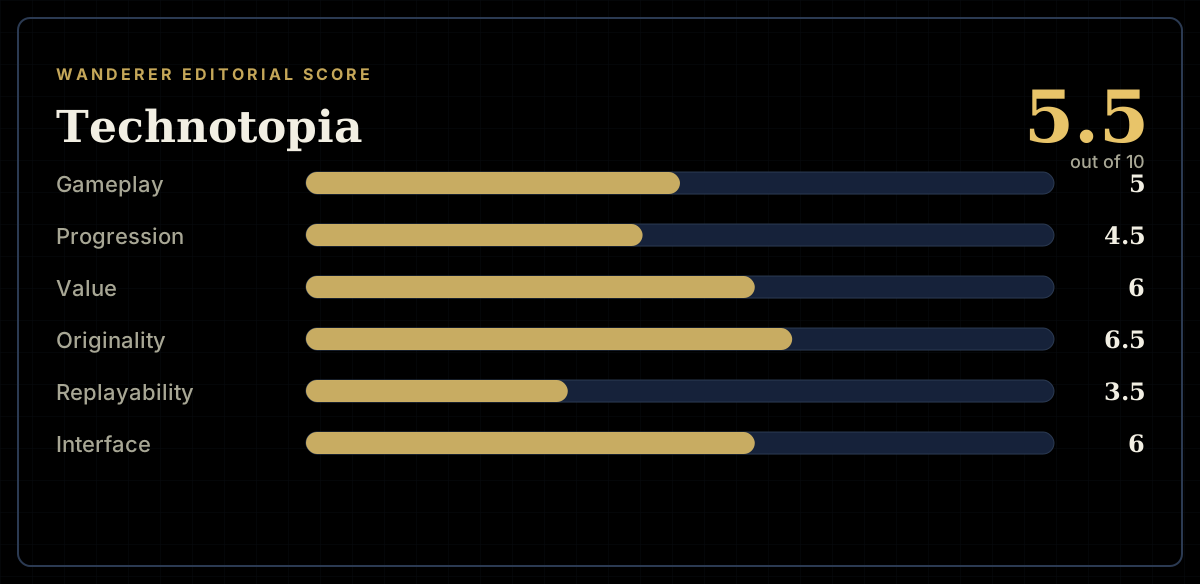
How the review scores each part of the gameWanderer Editorial -
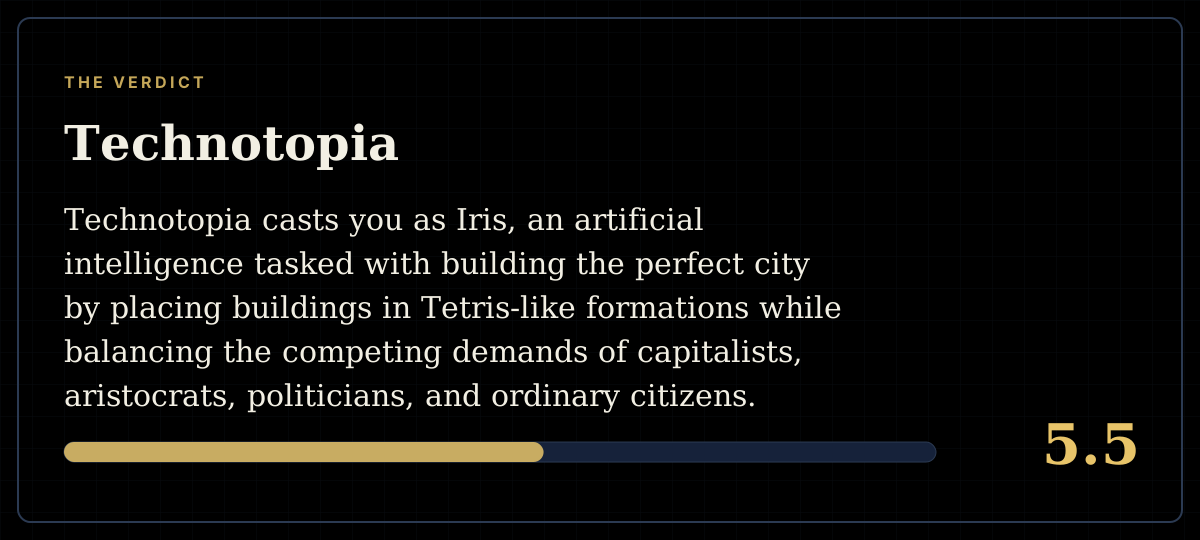
The short versionWanderer Editorial