
Game review
Lucky Hunter
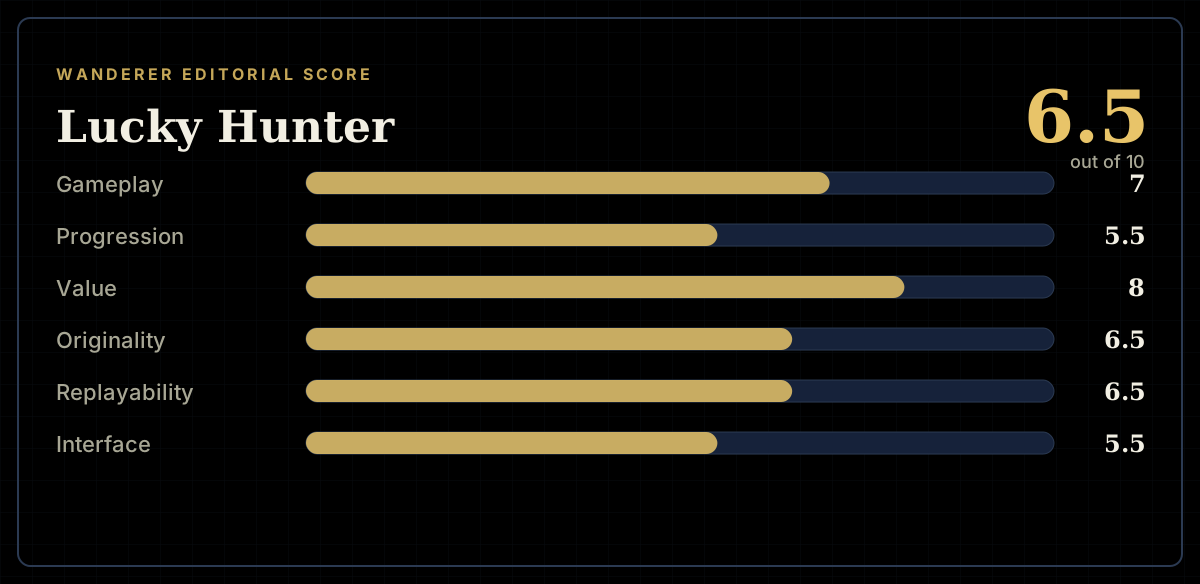
6.5 / 10
- Developer
- 159 Studio
- Publisher
- indienova
- Released
- 5 November 2024
- Platforms
- Windows
- Genre
- Grid-based auto-battler deckbuilding roguelite
- Monetisation
- One-time purchase, no in-game store or additional currency purchases
- Players
- Single-player only
The short version
Lucky Hunter sends a chess-piece-wielding hunter along procedurally generated routes through forests, swamps, and volcanic regions, building a deck of automatically-placed pieces on a grid where matching three of the same level triggers a combination into something stronger. It's a genuinely inventive fusion of auto-battler mechanics, Slay the Spire-style route planning, and slot-machine synergy design, and reviewers consistently praise both the depth on offer and the very low price it comes at. What tempers that enthusiasm for a real share of long-session players is a specific complaint about the game's Endless mode: enemy stats scaling directly with the player's own damage and armor output, which several detailed reviewers argue actively punishes exactly the kind of deck optimisation the rest of the game is built to reward. The developer shipped an unusually dense cluster of daily patches in the weeks immediately following launch and has continued adding content well into 2025, though the endless-mode scaling complaint persists in reviews posted throughout that support window.
Biggest strengths
- The core grid-based merging mechanic, where matching three same-level pieces combines them into something stronger, is repeatedly praised as a genuinely fresh twist on the deckbuilding roguelite formula
- Value draws overwhelming, specific praise, with reviewers consistently framing the depth and content on offer as remarkable for a price under ten dollars, several stating they'd have paid significantly more
- The variety of pieces, artifacts, and synergy combinations gives real, substantial build diversity, with reviewers specifically comparing favourable elements of Luck Be a Landlord, Slay the Spire, and Balatro all blended into one cohesive package
Biggest weaknesses
- A specific, well-documented complaint concerns Endless mode's difficulty scaling, where enemy health and damage output rise directly in proportion to the player's own deck strength, which multiple detailed reviewers argue actively discourages upgrading pieces rather than rewarding it
- Meta-progression is described by several reviewers as unlocking core content too slowly, with the initial roster of playable pieces felt by some to be restrictively small until a meaningful grind unlocks more variety
- English localisation draws a specific, repeated complaint, with reviewers describing the translation quality as noticeably rough in places, though generally still comprehensible
Who it's for: Fans of Slay the Spire, Luck Be a Landlord, and similar roguelite deckbuilders who want a cheap, genuinely deep new entry in that space, and who are primarily interested in the game's standard campaign rather than its endless mode specifically. Less suited to players seeking a long-term endless-mode grind without balance friction.
Our recommendation: An easy recommendation at its very low price for deckbuilder and auto-battler fans. The core campaign is genuinely excellent value; go in aware that Endless mode's scaling has drawn specific, detailed criticism from experienced players before committing serious time to it.
6.5 / 10
Lucky Hunter's central mechanic is easy to describe and clearly took real design work to get right: your chess-piece hunters place themselves automatically onto a battlefield grid, and whenever three pieces of the same level end up adjacent, they merge into a single stronger unit. Layer that onto a Slay the Spire-style branching route map — battles, shops, enchantments, events — and you get a genuinely distinctive fusion of auto-battler positioning and roguelite deckbuilding. This review's sample, though thin in raw English review count, is detailed and consistent enough to draw real conclusions from, and the overwhelming theme is enthusiasm tempered by one specific, recurring technical complaint.
A genuinely fresh mechanical hook
Reviewers with real familiarity across the genre's landmark titles describe Lucky Hunter as a successful, distinctive synthesis rather than a derivative clone. "Something from Lucky to be a landlord, something from Slay the Spire, something from Balatro (but only good stuff), something from that roguelike with dices... And it's really good mixed!" one reviewer writes, capturing the specific pleasure of recognising familiar genre DNA recombined into something that still feels new. Another describes the core appeal precisely: "as you fill your deck — and thus, the board — what you're doing in battle increases... empty spaces provide no benefit," highlighting a genuinely interesting spatial puzzle layered on top of the usual deckbuilding decisions.
Value that draws some of the strongest praise in this lane
Few complaints in this review's sample concern the price, and many reviewers go out of their way to praise it specifically. "There's a good amount of game here packed at a reasonable price," one writes, while another calls it "fantastic game when you consider the price (~$8 CAD)." At under nine New Zealand dollars, reviewers consistently frame the content-to-cost ratio as remarkable even before factoring in the game's actual quality, a genuinely strong value proposition even by the standards of an already value-conscious genre.
A specific, well-argued balance complaint about Endless mode
Set against that praise, a detailed and recurring complaint concerns what happens once a player pushes into the game's Endless mode. "Enemy HP scales with your damage done? Enemy damage done scales with your armor? What's the bloody point of upgrading your deck then?" one reviewer with nearly 3,900 minutes logged asks, describing a scaling system that seems to actively work against the deck-building mastery the rest of the game rewards. Another, independently, makes almost exactly the same point: "regardless how 'lucky' you are, you will never out-level the mobs to farm some more gold, they ALWAYS scale with each of your deck upgrade." This is a specific, mechanically grounded critique repeated by multiple long-session players rather than a vague difficulty complaint, and it points at a genuine design tension between the campaign's escalating-power fantasy and the endless mode's apparent attempt to keep pace with it indefinitely.
Real friction in translation and early unlocks
Beyond the Endless mode complaint, a smaller cluster of reviewers flag rougher edges: English localisation quality draws specific, if mild, criticism, and at least one reviewer describes the initial roster of unlockable pieces as restrictively small, requiring a real grind before the game's full variety opens up. "The initial content is awfully restrictive, you basically get 3 pieces to play with so you have to grind to get more content before it becomes fun," one reviewer writes — a fair onboarding concern for a game whose eventual depth depends heavily on that expanded roster.
A developer that responded fast, and kept building
To its credit, this review can confirm the developer supported the November 2024 launch with an exceptionally dense cluster of near-daily patches through the following two weeks, directly addressing early feedback. Development didn't stop there — a Chinese New Year-themed content update followed in January 2025, and further pieces and content continued arriving through at least mid-2025. That's real, sustained investment for a budget-priced release, even if the specific Endless mode scaling complaint appears to persist in reviews posted throughout that same support window.
What the achievement data suggests about the Endless mode complaint
Steam's own completion figures offer a useful independent look at how the scaling complaint plays out in practice. Early achievements sit above 90%, confirming the base campaign is broadly approachable, but the curve drops sharply toward late-game and Endless-specific challenges, several of which sit below 5%. That steep falloff is consistent with reviewers' accounts of a scaling system that becomes genuinely punishing at the extremes — not necessarily broken for a typical playthrough, but demonstrably harder to push meaningfully deep into than the standard campaign's own achievement curve would suggest, exactly the pattern experienced players describe running into once they try to keep optimising indefinitely.
A reasonable defense of the design worth including
At least one reviewer offers a more forgiving read of the same mechanic, framing their own decision to keep recommending the game despite frustration: "I certainly played it enough that me giving it a thumbs down is a bit disingenuous, but it's always the things you like that disappoint you the most." That's a useful, honest data point distinct from the harsher critical reviews — it suggests the Endless mode scaling issue frustrates precisely the players who are most invested in the game rather than turning away newcomers, which is a real design problem worth fixing, but a different one than a complaint that would drive people off the game entirely before they'd gotten their money's worth from the core campaign.
Final verdict
Lucky Hunter is a genuinely inventive, well-executed deckbuilding roguelite that earns real, specific praise for both its mechanical fusion of grid-based merging and route-based progression, and for offering an unusual amount of depth at a genuinely low price. Its Endless mode carries a real, well-documented balance problem that several experienced players describe as working against the game's own core reward loop, and its localisation and early-unlock pacing have their own smaller rough edges. Worth an easy purchase for deckbuilder fans focused on the standard campaign; approach Endless mode with tempered expectations about how rewarding continued deck investment will actually feel.
Pros and cons
Pros
- The core grid-based merging mechanic, where matching three same-level pieces combines them into something stronger, is repeatedly praised as a genuinely fresh twist on the deckbuilding roguelite formula
- Value draws overwhelming, specific praise, with reviewers consistently framing the depth and content on offer as remarkable for a price under ten dollars, several stating they'd have paid significantly more
- The variety of pieces, artifacts, and synergy combinations gives real, substantial build diversity, with reviewers specifically comparing favourable elements of Luck Be a Landlord, Slay the Spire, and Balatro all blended into one cohesive package
- The developer shipped an unusually dense cluster of near-daily patches in the weeks immediately following the 5 November 2024 launch, directly responding to early balance and clarity feedback
- The developer continued adding meaningful content well past launch, including new pieces and a Chinese New Year-themed update, running through at least mid-2025
Cons
- A specific, well-documented complaint concerns Endless mode's difficulty scaling, where enemy health and damage output rise directly in proportion to the player's own deck strength, which multiple detailed reviewers argue actively discourages upgrading pieces rather than rewarding it
- Meta-progression is described by several reviewers as unlocking core content too slowly, with the initial roster of playable pieces felt by some to be restrictively small until a meaningful grind unlocks more variety
- English localisation draws a specific, repeated complaint, with reviewers describing the translation quality as noticeably rough in places, though generally still comprehensible
- At least one reviewer identifies a specific completionist achievement as unusually obnoxious to obtain, a notable outlier in an otherwise reasonably paced unlock structure
- This review's own English-language sample is thin relative to the game's likely broader reach, with only 106 lifetime English reviews recorded at time of writing
Screenshots
-

Lucky HunterImage: indienova via Steam -

Lucky HunterImage: indienova via Steam -

Lucky HunterImage: indienova via Steam -
How the review scores each part of the gameWanderer Editorial -
The short versionWanderer Editorial