
Game review
Necroking
5.5 / 10
- Developer
- KORO.GAMES
- Publisher
- Alawar
- Released
- 4 September 2024
- Platforms
- Windows
- Genre
- Necromancer deckbuilding roguelite
- Monetisation
- One-time purchase, no in-game store or additional currency purchases
- Players
- Single-player only
The short version
Necroking casts you as a death monarch raising an army of skeletons and other undead minions to conquer settlements across a procedurally generated world map, wrapped in genuinely striking hand-crafted pixel art and animation. Reviewers consistently praise the presentation and the core evil-necromancer fantasy, but a large and specific share of the same sample describes a wildly uneven difficulty curve between the game's four available tiers, a deck that resets to near-nothing at the start of each new chapter in a way several find undermines any sense of building progression, and a strategic layer several reviewers describe as shallower than its variety of units initially suggests. The developer has backed the release with a genuinely sustained year-plus support record, including console ports and several balance-focused updates, though a specific, reproducible combat soft-lock bug is still reported well after launch.
Biggest strengths
- The hand-crafted pixel art, animation, and overall atmosphere draw near-universal, specific praise, with reviewers consistently calling it the game's strongest asset regardless of their overall recommendation
- The core necromancer fantasy of commanding a growing undead army against desecrated settlements is repeatedly described as genuinely satisfying and well-realised in its opening hours
- A surprising number of distinct unit types and Skull-based deckbuilding options give real build variety on paper, with several reviewers praising specific, functional unit synergies they discovered
Biggest weaknesses
- Difficulty balance between the game's four tiers is the single most repeated and detailed complaint, with reviewers describing the lower difficulties as nearly unloseable and the highest as demanding near-encyclopedic game knowledge, with little comfortable middle ground between them
- Several reviewers describe the deck and stat reset at the start of each new chapter as undermining any real sense of building progression, directly comparing it unfavourably to genre leaders like Slay the Spire that don't strip earned power between acts
- A meaningful share of reviewers report the strategic depth thinning out quickly once a small number of dominant unit combinations are discovered, with one describing a simple, repeatable formula capable of winning every encounter regardless of the enemy composition
Who it's for: Fans of pixel-art deckbuilding roguelites who want a strong necromancer fantasy and don't mind picking through difficulty tiers to find one that's actually well-calibrated for their skill level. Less suited to players seeking the escalating strategic depth of genre leaders like Slay the Spire.
Our recommendation: Worth its very low price for the art and the central fantasy alone. Read up on difficulty settings before committing to one, since reviewers report an unusually wide gap between "too easy" and "punishingly hard" with little comfortable middle ground.
5.5 / 10
Necroking's fantasy is a satisfying, well-worn one delivered with real visual polish: crown yourself the Necroking, raise an army from over 30 types of undead minions, and march across a procedurally generated map crushing settlements that dared to desecrate the natural order. The hand-crafted pixel art carries a huge amount of the game's early goodwill, and this review's sample confirms it — but a specific, detailed, and remarkably consistent set of complaints about difficulty calibration and strategic depth runs right alongside that visual praise.
Art that everyone agrees on
Whatever else divides this review's sample, the presentation doesn't. "While I really enjoyed the art, animations, (and sound, to an extent), of Necroking," begins even one of the harshest negative reviews, a pattern repeated across nearly every review regardless of overall recommendation. Reviewers describe the central fantasy — building an undead horde and watching it grow — as genuinely satisfying in its opening hours, with the pixel-art presentation frequently singled out as punching well above the game's very low asking price.
A difficulty curve reviewers call genuinely broken
The most detailed, specific complaint in this review's sample concerns difficulty balance, and it's worth quoting at length because of how precisely one reviewer documents it: having chosen the higher of two initially unlocked difficulties, they report beating "the entire story campaign, all 5 versions of the final boss, every mini boss... while taking HP damage but once during my whole first run," while separately confirming the highest of the four total tiers demands "eidetic memory and encyclopedic knowledge of the game" to even approach. That's an extraordinarily wide gap for a single game to contain, and it's echoed by other reviewers independently: "I haven't lost a single fight since I started playing," one writes, while another reports the opposite experience on a harder setting entirely. At least one reviewer pushes back directly against the "too easy" framing, arguing selecting a harder tier resolves the complaint — a fair point, but one that doesn't erase the fact that the game's own default recommended difficulty appears to be miscalibrated for a meaningful share of its audience.
A progression system some find hollow
A second, specific complaint concerns what happens to a player's built-up deck between chapters. "Way too easy, and the fact that your deck and stats reset at the start of each chapter removes any sense of progression," one reviewer writes, drawing a direct comparison: "imagine if at the beginning of a new act in Slay the Spire, the game took away all your relics and swapped out the deck you'd been crafting for a slightly better base deck." That's a specific, structural critique rather than a vague complaint about difficulty, and it points at a real tension in the design — a roguelite genre built around escalating, earned power, paired with a reset mechanic that several players feel undercuts exactly that escalation.
Depth that several reviewers say doesn't hold up under scrutiny
Beyond balance, a related complaint concerns how much genuine strategic thinking the game actually rewards once its systems are understood. "It seems like its a lot deeper than it really is... just add 3 of each kind of unit, remove lower tiers of them when you unlock them. Win every time," one reviewer writes, describing a simple, repeatable formula capable of trivialising most encounters. Another, more experienced with the broader genre, writes plainly: "the strategy is shallow, the units are unbalanced, the usual problem of diluting your unit pool with trash via unlocks is there." These are specific, mechanically grounded critiques from reviewers who clearly engaged seriously with the game's systems rather than bouncing off quickly.
A real bug, and real rough edges in onboarding
Beyond design disagreements, at least one reviewer reports a specific, reproducible soft-lock bug occurring during combat, describing the game as promising but currently undermined by the issue. Separately, onboarding draws specific criticism: one reviewer describes confusing menu flow when starting a new run, needing to discover through trial and error that a "Load Save" option had to be selected before a "Continue" button would function as expected — a small but real point of friction for a game that otherwise doesn't over-explain its systems.
A genuinely sustained support record
To its credit, this review can confirm KORO.GAMES backed the September 2024 launch with real, continued investment: a major balance update arrived within a week, controller support and Steam Deck verification followed within a month, and a Nintendo Switch port shipped roughly seven months after launch. That's a solid, verifiable support record for a budget-priced indie release, even if it hasn't resolved the specific difficulty-calibration and progression complaints raised throughout this review.
A shovelware comparison worth taking seriously, and pushing back on
At least one reviewer describes the overall experience as feeling "like a shovelware mobile game" despite acknowledging real effort clearly went into the art and animation. That's a harsh framing worth examining rather than simply repeating: shovelware typically implies minimal underlying systems dressed up with polish, and the sheer number of distinct unit types, the Skull-based deckbuilding customisation, and the real (if inconsistently balanced) difficulty tiers all argue against that label being fully accurate. A fairer read, based on the weight of this review's sample, is a game with genuinely more mechanical ambition than "shovelware" implies, let down specifically by calibration and pacing rather than a fundamental lack of underlying systems.
Value that holds up regardless of the design complaints
Whatever the balance and progression issues, value is one area where this review's sample shows little disagreement. At its very low asking price, multiple reviewers frame even a single, several-hour playthrough as a fair trade regardless of the game's other shortcomings — one specifically calling seven and a half hours of playtime "a good trade" for the price paid. That's a meaningfully different calculus than a full-price release facing the same design criticisms would face, and it's worth weighing directly: the specific complaints in this review are real, but they land differently against a budget price tag than they would against a premium one.
Final verdict
Necroking delivers a genuinely satisfying necromancer fantasy wrapped in some of the strongest pixel art this lane has seen at this price point, and reviewers across the spectrum agree on that much. Its difficulty tiers are inconsistently calibrated enough that finding the right one takes real trial and error, its chapter-reset progression system draws fair, specific criticism from genre-literate players, and its strategic depth thins out for some once a few dominant tactics are discovered. Worth its very low price for the art and the fantasy alone — just go in ready to experiment with difficulty settings rather than trusting the game's own default recommendation.
Pros and cons
Pros
- The hand-crafted pixel art, animation, and overall atmosphere draw near-universal, specific praise, with reviewers consistently calling it the game's strongest asset regardless of their overall recommendation
- The core necromancer fantasy of commanding a growing undead army against desecrated settlements is repeatedly described as genuinely satisfying and well-realised in its opening hours
- A surprising number of distinct unit types and Skull-based deckbuilding options give real build variety on paper, with several reviewers praising specific, functional unit synergies they discovered
- The developer has maintained a genuinely sustained, year-plus post-launch support record, including a major balance update within a week of launch, controller support, Steam Deck verification, and a Nintendo Switch port roughly seven months after release
- At least one reviewer with over 9,000 minutes logged describes the game as consistently enjoyable across a very long engagement, suggesting real staying power for players who find the right difficulty and strategic approach for their taste
Cons
- Difficulty balance between the game's four tiers is the single most repeated and detailed complaint, with reviewers describing the lower difficulties as nearly unloseable and the highest as demanding near-encyclopedic game knowledge, with little comfortable middle ground between them
- Several reviewers describe the deck and stat reset at the start of each new chapter as undermining any real sense of building progression, directly comparing it unfavourably to genre leaders like Slay the Spire that don't strip earned power between acts
- A meaningful share of reviewers report the strategic depth thinning out quickly once a small number of dominant unit combinations are discovered, with one describing a simple, repeatable formula capable of winning every encounter regardless of the enemy composition
- A specific, reproducible soft-lock bug occurring during combat is reported by at least one reviewer well after launch, describing the game as otherwise promising but currently undermined by this technical issue
- Onboarding and interface clarity draw specific complaints, including confusing menu flow when starting a new run and a general lack of in-game explanation for some systems, requiring trial and error to understand basic mechanics
Screenshots
-

NecrokingImage: Alawar via Steam -

NecrokingImage: Alawar via Steam -

NecrokingImage: Alawar via Steam -
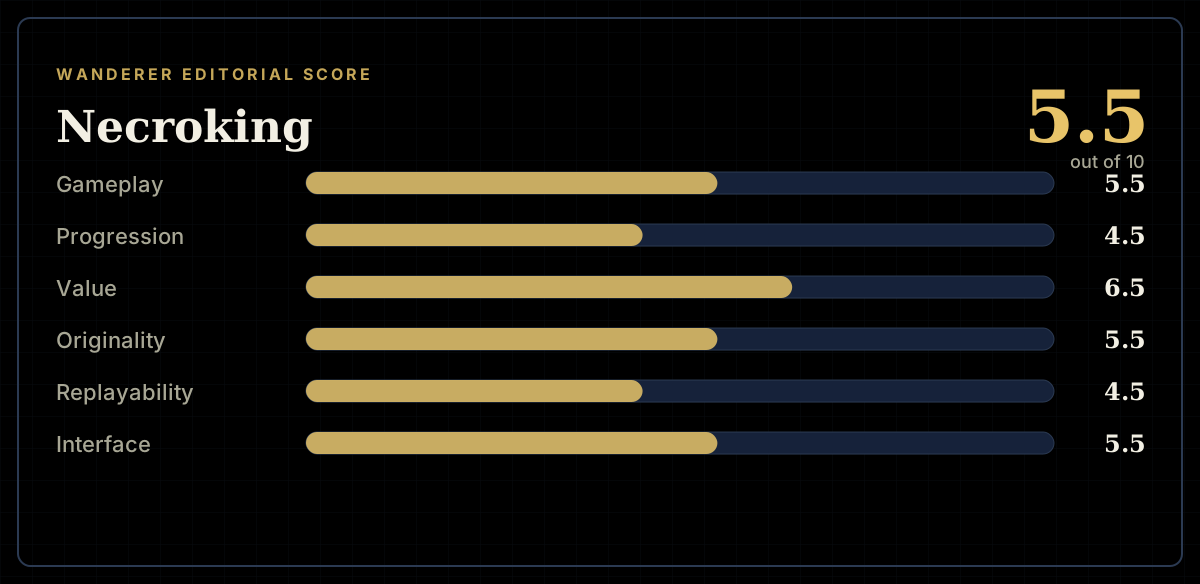
How the review scores each part of the gameWanderer Editorial -
The short versionWanderer Editorial