
Game review
Fatermyth
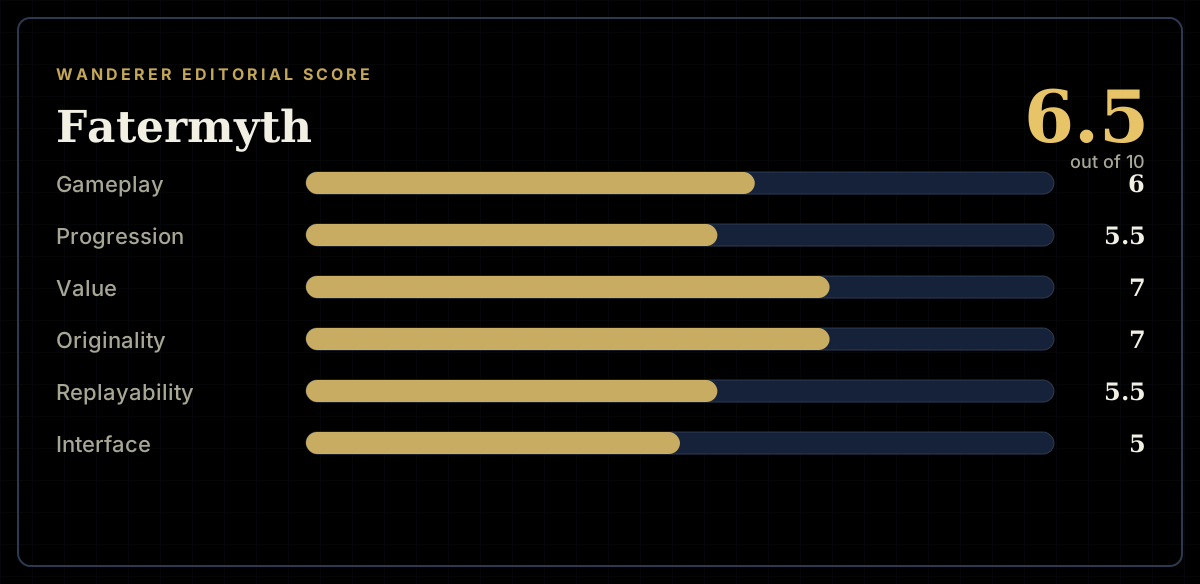
6.5 / 10
- Developer
- KDream
- Publisher
- Merlion Games, ETime Studio
- Released
- 23 April 2024
- Platforms
- Windows
- Genre
- Dice-based narrative roguelite RPG
- Monetisation
- One-time purchase, no in-game store or additional currency purchases
- Players
- Single-player only
The short version
Fatermyth sends its player, guided by a mysterious angler from beyond death, through a retelling of Chinese mythology spanning thousands of years and seven playable protagonists, using dice rolls in place of the card-cost mana most Slay the Spire-style roguelites use. This review's English-language sample is unusually small, but unusually consistent and detailed: reviewers who found the game describe it with real, specific enthusiasm, several explicitly calling it an underrated hidden gem and comparing its dice-based combat favourably to Hand of Fate and its narrative ambition to acclaimed RPGs. Set against that praise is a genuine, unresolved dispute about localisation completeness — one reviewer directly and pointedly contradicts another's claim that the English translation is good, describing entire menus and tutorial screens left untranslated — and a separate, fair criticism that the game's central "chosen one" narrative structure locks players into a single male protagonist framing some found limiting regardless of the story's broader ambition.
Biggest strengths
- The dice-based combat system, used in place of typical mana or energy costs, is repeatedly praised as a genuinely fresh mechanic within the Slay the Spire-adjacent genre, with reviewers specifically comparing it favourably to Hand of Fate
- The narrative ambition draws unusually strong, specific praise, with multiple reviewers describing a genuinely emotional, story-driven experience spanning seven distinct protagonists across a reimagined Chinese mythological history
- Several reviewers with very large playtimes, including one reporting over 11,600 minutes, describe the game as unexpectedly moving and "criminally underrated," suggesting real substance beneath its modest profile
Biggest weaknesses
- This review's own English-language sample is extremely small, with only 20 lifetime English reviews found against a much larger all-language total of 540, meaning any conclusions here should be weighed as drawn from a genuinely limited slice of the game's total audience
- Localisation completeness is a matter of direct, unresolved dispute between reviewers, with one stating bluntly that a positive review's claim of good translation quality is "a LIE" and describing buttons and tutorial screens left entirely untranslated, while several other reviewers report the translation as merely rough rather than broken
- At least one reviewer raises a specific, fair criticism that the game's central "chosen one" framing locks players into a single male protagonist perspective they found limiting and eventually disengaging from, despite appreciating the game's art and broader ambition
Who it's for: Fans of dice-based or narrative-heavy roguelite deckbuilders, and players specifically interested in Chinese mythology retellings with real emotional and narrative ambition. Given the very small English review sample, players relying entirely on English text should weigh the disputed translation-quality claims carefully before buying.
Our recommendation: Worth trying for players drawn to its dice-combat hook and mythological narrative ambition, especially given the small but consistently enthusiastic English-speaking following it has built. Research the localisation-quality dispute specifically before buying if you don't read Chinese, since reviewers directly disagree about how complete the English version actually is.
6.5 / 10
Fatermyth's premise is genuinely ambitious for a modestly priced indie release: a mysterious angler rescues you from death and invites you into a game spanning thousands of years of reimagined Chinese mythology, playable across seven distinct protagonists, with combat driven by dice rolls rather than the mana or energy systems most Slay the Spire-style roguelites default to. This review's English-language sample is unusually small — small enough that this review states that limitation directly rather than letting it pass unmentioned — but the reviews that do exist are detailed, substantive, and worth taking seriously on their own terms.
An unusually devoted small following
Reviewers who found this game describe it with a specific intensity that stands out even in a small sample. "Absolute cinema. Completely exceeded my expectations. I initially went in just to scratch my Slay the Spire itch, but instead I found a deeply emotional, story-driven gem. It feels criminally underrated," one reviewer with over 11,600 minutes logged writes. Another compares the dice-combat hook directly: "Cool gameplay, never seen using dice as stamina before. The story is pretty good so far. It feels a bit like Hand of Fate." A third goes further still, comparing its narrative structure favourably against a well-regarded RPG: "I'll die on the hill that it's superior to the likes of Octopath Traveler in every way" — strong, specific praise from someone clearly willing to make bold comparative claims rather than vague enthusiasm.
A genuine, unresolved dispute about the translation
What makes this review sample particularly useful is a direct disagreement between two reviewers, visible in the same list, about the exact same subject. One positive review opens: "First of all the big question: Is the translation good? Yes it is." A separate, negative review responds directly to that exact claim: "This is a LIE. A horrible, blatant lie. The game is filled with buttons, tutorial screens, and more that aren't even translated at all. Literally unplayable for an English-only speaker." This review cannot resolve that direct contradiction with certainty from outside gameplay — but it's worth reporting exactly as it appears, since a prospective English-only buyer deserves to know reviewers genuinely disagree, sharply, about something as basic as whether the game is playable in their language. Other reviewers land in between, describing the translation as merely rough rather than broken, which suggests the truth may depend on which specific menus or story segments a given player encounters.
A fair criticism about narrative framing
Beyond the translation dispute, at least one reviewer raises a specific, reasonable objection to the game's structure: "you locked in the story as a 'chosen one' male character that is 'playing' fates and that is banal and nauseatingly boring... I was losing interest in the story fast," they write, while still acknowledging the art and broader ambition. That's a fair critique of a specific structural choice — however varied the seven protagonists' individual stories are, the overarching frame around them is fixed, and not every player will find that frame as compelling as the specific character stories layered inside it.
Real narrative ambition, backed by detail
The praise for Fatermyth's story isn't vague. One reviewer describes the setup precisely: "you are technically in the afterlife with i believed to be a handsome Grim Reaper, while sailing into the endless stream of sea you are invited by him for a 'game'... it feels like mixture of Dungeons & Dragon setup but with colourful and memorable characters." Another specifically praises how failure integrates into the storytelling rather than simply ending a run: the game "plays out as a visual novel with choices, deaths and failure states," treating a loss as narrative content rather than a dead end. That's a genuinely thoughtful design choice for a roguelite, where death is usually treated purely as a mechanical reset rather than meaningful story material.
What the achievement data adds
Steam's own completion figures show a real, if not extreme, drop-off consistent with a substantial game rather than a shallow one — an early milestone sits at 79.8%, but the curve falls steadily toward the rarest late-game unlocks, several sitting below 3%. That's consistent with a game offering genuine, multi-character depth for players willing to invest the time, even as a meaningful share of buyers likely don't push through every one of the seven protagonists' full stories.
A note on individual character balance
Beyond the broader story and translation discussions, at least one detailed reviewer raises a specific mechanical point worth including: certain characters have what they describe as reliable "cheese strats," repeatable strategies that consistently trivialise most encounters once discovered, with few fights genuinely challenging or circumventing them. That's a fair, specific balance observation rather than a vague difficulty complaint, and it's worth flagging for players specifically drawn to the game for a demanding strategic challenge rather than its narrative — Fatermyth's combat, on this account, may reward finding a strong build more than it tests ongoing tactical adaptation.
Why the thin sample size matters here specifically
It's worth spelling out exactly why this review treats its own evidence base as limited rather than simply noting the review count in passing. With only 20 English reviews total, this review has effectively read and weighed the entire available English-language sample rather than a representative excerpt of a much larger pool, the way most other reviews in this lane do. That means there's a real chance the specific voices quoted here — both the passionate defenders and the translation critic — represent a wider range of opinion than their raw numbers alone would suggest, but it also means there simply isn't enough English-language data to be fully confident this sample reflects the broader, overwhelmingly non-English-speaking audience's actual experience with the game.
Final verdict
Fatermyth is a genuinely ambitious, narratively rich dice-combat roguelite that has built a small but unusually devoted following among the English-speaking players who've found it, several of whom describe it in terms typically reserved for far more prominent releases. Its most serious open question — how complete and reliable its English localisation actually is — remains a real, reviewer-disputed uncertainty this review can't fully resolve from the outside, and a legitimate structural criticism about its "chosen one" framing deserves to be weighed alongside its genuine strengths. Worth trying for players drawn to its specific hook, with the clear caveat that this review's own evidence base here is thinner than most, and readers should research the translation question directly before committing.
Pros and cons
Pros
- The dice-based combat system, used in place of typical mana or energy costs, is repeatedly praised as a genuinely fresh mechanic within the Slay the Spire-adjacent genre, with reviewers specifically comparing it favourably to Hand of Fate
- The narrative ambition draws unusually strong, specific praise, with multiple reviewers describing a genuinely emotional, story-driven experience spanning seven distinct protagonists across a reimagined Chinese mythological history
- Several reviewers with very large playtimes, including one reporting over 11,600 minutes, describe the game as unexpectedly moving and "criminally underrated," suggesting real substance beneath its modest profile
- The game explicitly frames failure and death as part of its narrative structure rather than a pure fail state, with at least one reviewer specifically praising how choices, deaths, and consequences integrate into the storytelling
- At its price, value draws consistent praise, with one reviewer reporting a full 35-hour completion time and describing it as well worth the cost
Cons
- This review's own English-language sample is extremely small, with only 20 lifetime English reviews found against a much larger all-language total of 540, meaning any conclusions here should be weighed as drawn from a genuinely limited slice of the game's total audience
- Localisation completeness is a matter of direct, unresolved dispute between reviewers, with one stating bluntly that a positive review's claim of good translation quality is "a LIE" and describing buttons and tutorial screens left entirely untranslated, while several other reviewers report the translation as merely rough rather than broken
- At least one reviewer raises a specific, fair criticism that the game's central "chosen one" framing locks players into a single male protagonist perspective they found limiting and eventually disengaging from, despite appreciating the game's art and broader ambition
- Several reviewers describe individual character strategies as insufficiently challenging once discovered, with one describing "cheese strats" that trivialise most encounters for a given character
- Hardware compatibility draws a specific complaint from at least one reviewer using a tablet-style device, who notes the game does not support touchscreen or stylus input despite otherwise recommending the content
Screenshots
-

FatermythImage: Merlion Games via Steam -

FatermythImage: Merlion Games via Steam -

FatermythImage: Merlion Games via Steam -
How the review scores each part of the gameWanderer Editorial -
The short versionWanderer Editorial