
Game review
Pyrene
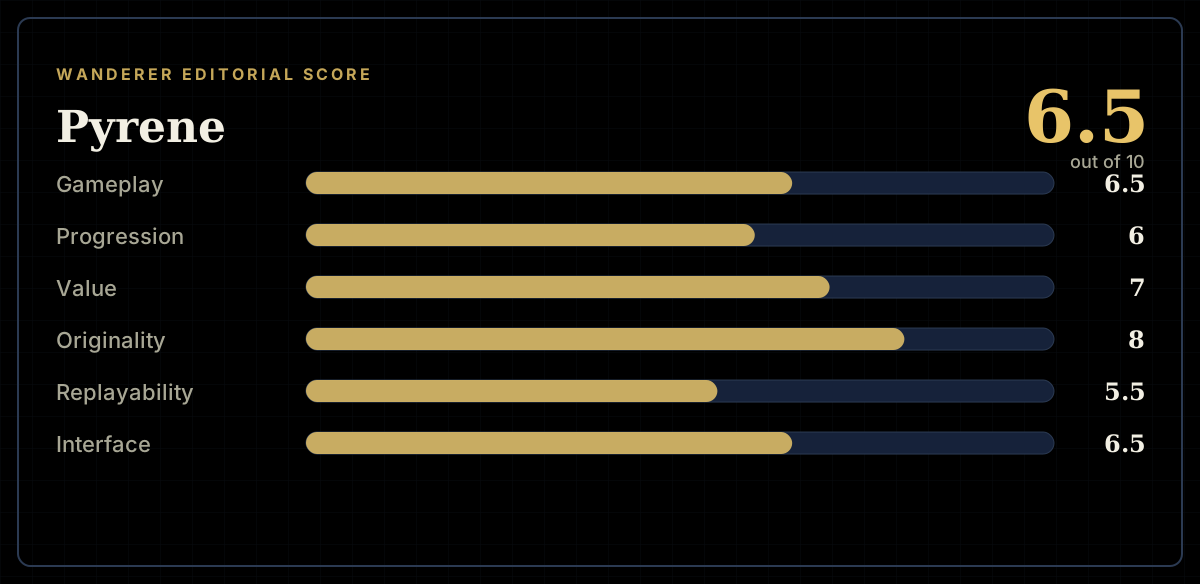
6.5 / 10
- Developer
- Two Tiny Dice
- Publisher
- Indie Asylum
- Released
- 13 September 2024
- Platforms
- Windows, Steam Deck
- Genre
- Roguelike card-on-a-board dungeon crawler
- Monetisation
- One-time purchase, no in-game store or additional currency purchases
- Players
- Single-player only
The short version
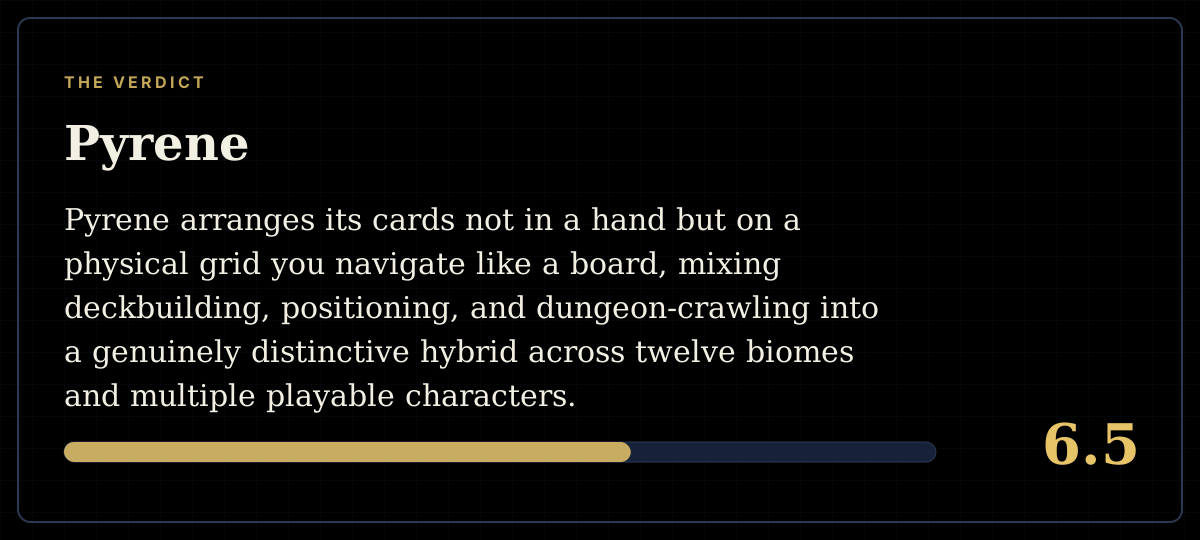
Pyrene arranges its cards not in a hand but on a physical grid you navigate like a board, mixing deckbuilding, positioning, and dungeon-crawling into a genuinely distinctive hybrid across twelve biomes and multiple playable characters. This review's sample shows genre veterans holding the game in real, specific regard, with more than one experienced reviewer calling it the best deckbuilder since Slay the Spire. Set against that praise is an equally substantial, specific complaint from reviewers with comparably deep time investment: card and encounter balance is described as uneven enough that a run's fate is frequently decided in its opening minutes, with little the player can do to recover from an unlucky start regardless of skill.
Biggest strengths
- The card-on-a-board structure, where you physically navigate a grid rather than play cards from a hand, earns wide, specific praise as a genuinely original mechanical hybrid rarely seen in the genre
- Experienced deckbuilder veterans rank the game highly against established genre benchmarks, with multiple reviewers explicitly comparing it favorably to Slay the Spire, Hades, and Inscryption in different specific respects
- The variety of playable characters and twelve distinct biomes draw consistent credit for genuine content depth, with reviewers describing dozens of hours of engagement before content repeats
Biggest weaknesses
- A specific, widely repeated complaint concerns run-defining snowball effects, with multiple reviewers describing how the outcome of the first few fights in a run — sometimes the first five percent of playtime — determines whether the rest of the run is winnable at all
- Several reviewers, including some with over a thousand hours invested, describe specific balance breakdowns, from certain overpowered ability combinations that trivialize encounters to runs left unwinnable by RNG regardless of player skill
- A meaningful portion of reviewers describe the game losing depth and becoming repetitive after roughly ten hours, once an optimal strategy is discovered and there's little incentive to experiment further
Who it's for: Fans of roguelike deckbuilders looking for something mechanically distinct from Slay the Spire's hand-of-cards format, who enjoy dungeon-crawler positioning and don't mind real, documented balance rough edges at higher difficulty.
Our recommendation: A genuinely inventive, well-supported entry in a crowded genre that rewards patient players who can absorb some real balance friction — worth it for deckbuilder fans specifically seeking mechanical novelty over another Slay the Spire clone.
6.5 / 10
Pyrene takes the deckbuilding roguelite formula and does something genuinely uncommon with it: instead of playing cards from a hand, you navigate a physical grid where cards, monsters, and loot all occupy actual positions you move between. It's a village-under-siege story wrapped around a genuinely distinct mechanical hook, and this review's sample shows experienced genre players taking that hook seriously — even as an equally experienced portion of the same audience identifies real, specific cracks in how the underlying systems are balanced.
Earning comparisons most clones never reach
The praise here comes from reviewers with real, comparative genre knowledge, and it's specific rather than vague. "Best deckbuilder since Slay the Spire. This is a very satisfying fusion of mechanics from other card-builders and roguelikes: A Hades-esque main hub that's upgradable between runs, Slay the Spire-esque enemies, statuses, cards, and relics, Inscryption-esque boards and" positioning, one reviewer writes, breaking down precisely what the game borrows and what it does with those borrowed pieces. Another, with over 13,600 minutes logged, offers a simpler but no less confident endorsement: "Pyrene is a game very much worth its price. Fun gameplay loop, story is a bit simple but fine for what the game tries to achieve." A third situates it favorably within the developer's own track record: "Their previous game, Forward Escape the Fold was just excellent... It's exactly my type of game and I'm happy to report that it plays very well and seems to have tons of conte[nt]."
The complaint that surfaces across huge time investments
What makes this review's negative sample worth real weight is how much time its authors had already committed before landing on their criticism. "Game balance is awful; you will get hard stuck on the second quest because the RNG is horrible and the game gives you too little to work with until it ramps up the difficulty. You often get 2-3 cards to work with on a whole run, making synergies nearly impossible," one reviewer with over 800 minutes logged writes. Another, with nearly 1,832 minutes invested and having completed the story and unlocked every character, still lands on a critical verdict: "This was a cute game, original mechanics, interesting characters and play styles but ultimately very poorly balanced. Dodge is incredibly overpowered, as it avoids all combat damage" — a specific mechanical imbalance rather than a vague "it's too hard" complaint. A third reviewer, with over 620 minutes, describes the same underlying pattern from a different angle: "There's some great potential here, but the game is hilariously unbalanced. There are some combinations (of only 2-3 perks) that completely break the game, whilst others make progress all but impossible."
The specific snowball effect several reviewers name directly
A more precise version of the balance complaint appears across multiple independent reviews: the outcome of a run is disproportionately determined by its opening minutes. "I dislike how snowball heavy it is. The first three fights matter more than anything else in the game, which is the first 5% of a run. If you can leave the first zone with what I'd c[onsider a strong build, the rest of the run is comfortable; if not, it's often unwinnable]," one reviewer writes. That's a genuinely specific, structural critique distinct from general difficulty complaints — it suggests the game's early-game randomness carries outsized weight relative to mid-run decision-making, a real design tension for a genre that usually prizes ongoing strategic adaptation over an early lucky draw.
Diminishing depth after the honeymoon period
A separate, smaller thread concerns long-term staying power specifically. "After playing for just over 10 hours and completing the [main content, I found] the game's biggest problem is that it's too easy, and progression is too quick," one reviewer writes, describing quick mastery rather than sustained challenge. Another echoes the same arc: "as soon as I found an overpowered strategy, which was around hour 3, the game doesn't give me any incentive to mix it up, so I find myself optimizing the fun out of the game." That's a fair, distinct critique from the balance-instability complaints above — here the issue isn't randomness working against the player, but rather the opposite: once a strong strategy is found, nothing pushes players away from repeating it.
Documented Steam Deck friction
Beyond the deeper balance debate, multiple reviewers flag concrete technical issues specific to handheld play. "I really like this game, but it runs terribly on the Steam Deck. It is slow and fails to load card images sometimes. Does not support full pad controls, have to use the touch pad most of the time. Really struggles with sleep mode, has frozen my deck on a black screen on occasions," one reviewer writes in detail — a specific, actionable set of complaints worth flagging directly for anyone planning to play primarily on Deck.
What the achievement data confirms about difficulty
Steam's own completion figures line up with the reviewer-described tension between an accessible core and a genuinely demanding tail. An early story milestone sits at 80.7%, but the hardest tracked achievements fall to under 1%, a dramatic drop consistent with reviewer reports that mastering the game's optional, harder content — including its added Hard Mode — remains a genuine challenge even for dedicated players who found the base campaign approachable.
A confirmed, ongoing commitment to the game
This review found real evidence the developer has continued investing in Pyrene well past launch. The partner-events feed documents several balance-focused patches in the months following release, a substantial free major content update roughly nine months post-launch, a dedicated Hard Mode addition directly responsive to players wanting more challenge, an official soundtrack, and a celebrated first anniversary — a genuinely healthy, ongoing commitment from a small studio.
Final verdict
Pyrene earns real, specific respect from experienced deckbuilder fans for a genuinely original mechanical hybrid rarely attempted in this crowded genre, tempered by an equally credible, specific chorus describing balance problems serious enough to make a run's fate feel decided before real strategy comes into play. Genre fans specifically seeking mechanical novelty over another straightforward Slay the Spire clone should find plenty to love here, provided they're prepared for genuine balance friction along the way.
Pros and cons
Pros
- The card-on-a-board structure, where you physically navigate a grid rather than play cards from a hand, earns wide, specific praise as a genuinely original mechanical hybrid rarely seen in the genre
- Experienced deckbuilder veterans rank the game highly against established genre benchmarks, with multiple reviewers explicitly comparing it favorably to Slay the Spire, Hades, and Inscryption in different specific respects
- The variety of playable characters and twelve distinct biomes draw consistent credit for genuine content depth, with reviewers describing dozens of hours of engagement before content repeats
- Steam's own partner-events feed documents sustained, active post-launch support, including a free major content update, a dedicated Hard Mode addition, and continued celebration of the game's first anniversary
- The developer's prior game, Forward, is referenced approvingly by multiple returning fans as evidence of a studio with a track record of thoughtful, mechanically distinct design
Cons
- A specific, widely repeated complaint concerns run-defining snowball effects, with multiple reviewers describing how the outcome of the first few fights in a run — sometimes the first five percent of playtime — determines whether the rest of the run is winnable at all
- Several reviewers, including some with over a thousand hours invested, describe specific balance breakdowns, from certain overpowered ability combinations that trivialize encounters to runs left unwinnable by RNG regardless of player skill
- A meaningful portion of reviewers describe the game losing depth and becoming repetitive after roughly ten hours, once an optimal strategy is discovered and there's little incentive to experiment further
- Multiple Steam Deck users report specific technical problems, including slow performance, missing full controller support requiring touchpad use, and the game occasionally freezing on a black screen during sleep mode
- At least one reviewer reports the absence of an undo button as a specific usability gap, particularly frustrating for players using keyboard input who may misclick
Screenshots
-

PyreneImage: Indie Asylum via Steam -

PyreneImage: Indie Asylum via Steam -

PyreneImage: Indie Asylum via Steam -
How the review scores each part of the gameWanderer Editorial -
The short versionWanderer Editorial