
Game review
Dungeons of Blood and Dream
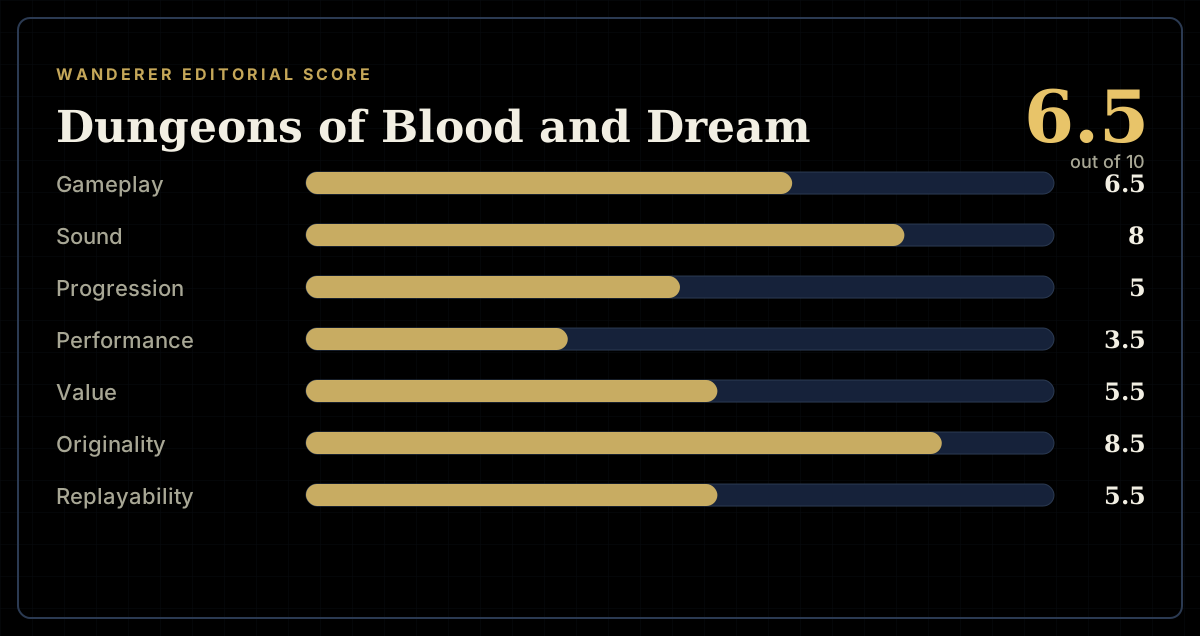
6.5 / 10
- Developer
- Lori Vornoy
- Publisher
- Lori Vornoy
- Released
- 27 May 2024
- Platforms
- Windows
- Genre
- Roguelike dungeon crawler with mystery-driven item identification
- Monetisation
- One-time purchase, no in-game store or additional currency purchases
- Players
- Single-player only
The short version
Dungeons of Blood and Dream casts you as a wizard trapped in a psychedelic dream-dungeon, fighting through procedurally generated levels with cursed rings whose effects depend on which finger you wear them on, unmarked potions you have to figure out through trial and clue-reading, and a body-horror sense of humour that involves drinking your own blood and, memorably, worse. Solo developer Lori Vornoy built something genuinely unlike anything else in the genre, and 94% of nearly 1,220 reviewers agree. What keeps this from an easy recommendation is a severe, extremely well-documented pattern of crashes, save-file corruption and boss-fight frame-rate collapse that the game's own patch history shows went almost entirely unaddressed for roughly eighteen months after its November 2024 1.0 release, before a single fix arrived in May 2026.
Biggest strengths
- The ring-and-finger system — where a cursed ring's effect changes depending on which finger it's worn on — is repeatedly singled out as one of the most original mechanics reviewers have seen in the genre, and draws direct comparisons to Hades and Cruelty Squad from reviewers not given to hyperbole
- A genuinely distinctive PS1-horror aesthetic and a soundtrack multiple reviewers say "sticks" long after a session ends give the game an identity no reference-chasing clone could replicate
- The unmarked-potion and cursed-item identification system, which pushes players toward experimentation, note-taking and community-shared identification tables rather than clear tooltips, is praised specifically for respecting player curiosity over convenience
Biggest weaknesses
- Startup crashes, mid-run crashes, blue-screen reports, and boss-fight frame-rate collapse into single digits are the single most repeated complaint across the negative review sample, described by multiple reviewers as making specific late-game bosses effectively unplayable on their hardware
- Several reviewers report Steam Cloud save corruption or complete save-file loss, with no confirmed recovery path, a serious risk for a game whose meta-progression is meant to reward long-term investment
- The game's own patch history shows a roughly eighteen-month gap between the last substantive fix after its November 2024 1.0 release and a single further patch in May 2026, matching multiple reviewers' direct claims that the game was abandoned before that patch appeared
Who it's for: Players who want something genuinely strange rather than another Hades-alike — fans of PS1-era horror aesthetics, mystery-box item identification systems, and a dark sense of humour who can tolerate real technical risk in exchange for a vision this distinctive.
Our recommendation: Worth experiencing for the ring system and atmosphere alone if crashes and frame drops don't bother you enough to abandon a run over them. Check very recent reviews before buying, since whether the technical issues have actually improved since the developer's May 2026 patch is something this review could not fully confirm.
6.5 / 10
It's rare for a review sample to reach for Hades, Cruelty Squad, and King's Field as reference points for the same game, and rarer still for a solo-developer roguelike priced under thirty dollars to earn all three comparisons from reviewers who clearly aren't exaggerating for effect. Dungeons of Blood and Dream, developer Lori Vornoy's procedurally generated dungeon crawler about a wizard trapped in a psychedelic dream-prison, has built a genuinely devoted following on the strength of ideas most roguelikes don't attempt. What it hasn't built, according to a large and specific slice of its own reviewers, is the technical stability to match — and the game's public patch history backs up exactly how long that gap has gone unaddressed.
A ring system nobody else is doing
The single most-praised mechanic in the entire review sample is disarmingly simple to describe and clearly difficult to execute: cursed rings in this game change their effect depending on which of your character's fingers you put them on. One reviewer, deep enough into the game to have "actually use[d] all your fingers for rings," calls it out with genuine enthusiasm; another, more measured, describes "a great sense of discovery/experimentation with the spell/ring system" as the thing that hooked them immediately. Layered on top of this is an item-identification system built around ambiguity rather than clarity — unmarked potions and rings whose effects you have to work out through trial, clue-reading, and an in-game notebook, with reviewers explicitly recommending new players go in without external guides to preserve the discovery. One reviewer sums up the appeal of this design philosophy bluntly: it's "the most original/challe[nging]" system they've encountered in the genre recently, and it's the throughline connecting almost every enthusiastic review in the sample, however else that reviewer felt about the rest of the game.
An aesthetic that earns its comparisons
Reviewers reach for very specific, unusual touchstones to describe the game's look and feel — PS1-era horror, "Old School Runescape on 3 whole grams of Benadryl," a bootleg game store find rediscovered years later. Underneath the jokes is a consistent, genuine point: the grimy, low-fidelity visual style and a soundtrack multiple reviewers say "sticks" long after a session ends are doing real atmospheric work, not just leaning on nostalgia for its own sake. The game's sense of humour, meanwhile, is inseparable from its identity — drinking blood and worse for buffs, chopping off your own finger to fit another ring, a journal system players are encouraged to fill in their own words — and reviewers who love the game tend to quote it directly rather than describe it, which is its own kind of endorsement.
The technical problems are not a minor asterisk
Set against all of that is a genuinely severe, widely and specifically reported set of technical issues. Crashes on startup, crashes mid-run, and — in more than one account — actual blue-screen crashes appear repeatedly across the negative sample, not as a rare edge case but as a defining, run-ending frustration. Frame rate is a separate, equally specific complaint: multiple reviewers describe boss fights collapsing into single-digit frame rates regardless of hardware, with one joking bitterly that a specific boss "should be renamed 'The Frame Rate Killer.'" A smaller but more serious subset reports actual save-data loss, including through Steam Cloud specifically, with no recovery path confirmed. None of this reads as isolated bad luck — it's the same handful of specific failure modes reported independently, across different systems, spanning the entire post-launch period.
An eighteen-month silence, then one patch
This review can settle, with the developer's own public record, exactly how long those problems went unaddressed. The game's Steam events feed shows an extraordinarily active Early Access period — the game actually launched on 27 May 2024, not the 11 November 2024 date Steam's own appdetails listing shows, which marks only the later 1.0 exit rather than the original release. Between May and November 2024, Vornoy shipped patches at a near-daily pace, including major content additions roughly every two to four weeks. After the 1.0 release in November 2024, that cadence stops almost entirely: the next post on the feed is a single patch in May 2026, roughly eighteen months later. One reviewer's account matches this timeline precisely, noting bugs including deleted save data and startup crashes that the developer "seems to have ignored, as the game was abandoned in 2024" — then adding an edit dated 21 May 2026 noting the developer had "apparently... fixed these bugs," inviting readers to "maybe give it a try" again. This review cannot independently confirm how much that single patch actually resolved, since the negative review sample includes accounts both before and clustered right around that date, and it's genuinely unclear how many of the crash reports predate the fix versus persist after it. What's verifiable is the gap itself: roughly a year and a half of near-silence on a game whose own reviewers were actively, repeatedly asking for exactly this kind of fix.
Combat that fights the player as much as the enemies
Beyond the headline stability issues, several reviewers raise a more specific design complaint about combat feel: hit detection that doesn't appear to respect a weapon's stated reach, requiring the player to more or less overlap with an enemy model to land a hit regardless of the weapon equipped. "You literally need to bump into enemy while swinging a weapon to make the game register a hit," one reviewer writes; another separately confirms "it doesn't feel good... you can't tell how far an enemy can attack, and it's even harder to get a feel for how far your own attacks reach." This is a different category of problem from the crashes — it's a moment-to-moment feel issue rather than a stability one — but it shows up often enough, described in near-identical terms by different reviewers, to be a real rather than idiosyncratic complaint.
Full completion asks a lot, and some of it isn't up to the player
For reviewers chasing full completion, two separate criticisms compound each other. Several describe meta-progression as slower and more grindy than the moment-to-moment gameplay deserves, with runs feeling repetitive well before the unlock list is exhausted. Layered on top of that, reaching every ending is reported to require specific, RNG-gated portal sequences appearing in the right order across a run — a design choice one heavily invested reviewer flags as their only real complaint after 1,145 minutes of play. Steam's own achievement data backs up how steep this curve actually is: while an early boss-kill achievement sits at 55.8% completion, several of the game's rarer unlocks — including one tied to reaching a specific ending — sit below 5%, a gap consistent with a lot of runs stopping well short of full completion, whether from difficulty, repetition fatigue, or simple bad luck with generation.
Final verdict
Dungeons of Blood and Dream is a genuinely rare thing: a solo-developer roguelike with an idea — its finger-based ring system — that nothing else in the genre is doing, wrapped in an aesthetic distinctive enough to earn comparisons to Hades and Cruelty Squad from reviewers who clearly mean it. That's not a small achievement, and it's the reason 94% of a review sample well past a thousand entries still recommends it. But the same sample documents, specifically and repeatedly, a technical foundation that doesn't match the creative one: crashes, save corruption, and frame-rate collapse that the developer's own patch history shows went almost entirely unaddressed for roughly eighteen months after its 1.0 release. If the May 2026 patch genuinely fixed what reviewers were reporting, this is a considerably better game today than its review-sample average suggests; this review found real reasons to hope so and no way to confirm it definitively. Go in for the ring system and the atmosphere, and go in aware that stability, not difficulty, is the thing most likely to end your run early.
Pros and cons
Pros
- The ring-and-finger system — where a cursed ring's effect changes depending on which finger it's worn on — is repeatedly singled out as one of the most original mechanics reviewers have seen in the genre, and draws direct comparisons to Hades and Cruelty Squad from reviewers not given to hyperbole
- A genuinely distinctive PS1-horror aesthetic and a soundtrack multiple reviewers say "sticks" long after a session ends give the game an identity no reference-chasing clone could replicate
- The unmarked-potion and cursed-item identification system, which pushes players toward experimentation, note-taking and community-shared identification tables rather than clear tooltips, is praised specifically for respecting player curiosity over convenience
- A single-developer project with a visibly enormous content list for its price — procedurally generated dungeons, multiple endings, secret areas, and dozens of unique weapons and rings — reflects real scope for a solo release
- The developer maintained an extremely active, near-daily patch cadence through the entire Early Access period from May to November 2024, shipping major content updates roughly every two to four weeks
Cons
- Startup crashes, mid-run crashes, blue-screen reports, and boss-fight frame-rate collapse into single digits are the single most repeated complaint across the negative review sample, described by multiple reviewers as making specific late-game bosses effectively unplayable on their hardware
- Several reviewers report Steam Cloud save corruption or complete save-file loss, with no confirmed recovery path, a serious risk for a game whose meta-progression is meant to reward long-term investment
- The game's own patch history shows a roughly eighteen-month gap between the last substantive fix after its November 2024 1.0 release and a single further patch in May 2026, matching multiple reviewers' direct claims that the game was abandoned before that patch appeared
- Combat hit detection draws specific, technical criticism — several reviewers describe needing to physically overlap with an enemy's model to register a hit regardless of a weapon's stated reach, making engagements feel arbitrary rather than skill-based
- Full completion is gated behind a meaningful amount of chance rather than skill, with one dedicated 1,145-minute reviewer noting that reaching every ending requires specific portal sequences to appear in a run, something Steam's own achievement data supports — several late-game achievements sit below 5% completion against 55.8% for an early boss kill
Screenshots
-

Dungeons of Blood and DreamImage: Lori Vornoy via Steam -

Dungeons of Blood and DreamImage: Lori Vornoy via Steam -

Dungeons of Blood and DreamImage: Lori Vornoy via Steam -
How the review scores each part of the gameWanderer Editorial -
The short versionWanderer Editorial