
Game review
Dark Hunting Ground
6.5 / 10
- Developer
- BingX
- Publisher
- The Bueno Interactive
- Released
- 6 September 2025
- Platforms
- Windows
- Genre
- Action RPG, Loot, Idle
- Monetisation
- One-time purchase, no DLC or in-game currency
- Players
- Single-player
The short version
Dark Hunting Ground strips loot-driven action RPGs down to their build-crafting core: hunt monsters in short, bite-sized runs, gather relics and Slates, socket and re-socket skills across six archetypes, and push into an endlessly scaling Void as your build gets stronger. Reviewers reach for big comparisons and mean them as genuine praise — "Path of Exile at home," in one memorable framing, or "if PoE is like eating a cake, DHG is like eating the frosting straight out of the mixing bowl" — crediting a small development team with capturing genuine build-crafting depth in a compact, minimalist package. Set against that praise is an equally consistent, equally detailed complaint: several reviewers who loved their first few hours report the game slowing to a grinding standstill once diminishing returns, a hard level cap, and an unforgiving crafting system with no pity mechanic take over.
Biggest strengths
- The build-crafting systems draw genuinely enthusiastic, specific praise from reviewers who know the genre well, with repeated comparisons to Path of Exile's depth condensed into a much smaller, more approachable package
- Six distinct archetypes, 18 core skills with unique variants, and a socketing system spanning 80 relics, 60 Slates and 35 Abyssal Eyes give dedicated players a large combinatorial space to theorycraft within, and reviewers confirm meaningfully different playstyles are achievable rather than one dominant build
- Quality-of-life features draw specific credit, including free respeccing and a loot system that reviewers say evolves from hands-on farming toward automated collection as your build matures
Biggest weaknesses
- A specific, widely-repeated pattern describes a genuinely strong opening giving way to "an absolute standstill crawl of just endless grinding with seemingly no purpose," with several reviewers independently reporting the exact same shape: engaging discovery in the first hours, diminishing returns soon after
- A hard level cap (reported at 50) combined with a limited pool of skill points frustrates players expecting continuous character growth, with one reviewer comparing the structure unfavourably to how Borderlands handles skill-point scarcity
- Item crafting and stat rerolling are described as extremely tedious by design, explicitly lacking the kind of pity system found in genre comparison points like Slormancer, meaning bad luck can compound without any safety net
Who it's for: Action RPG and loot-genre fans who want Path of Exile-style build theorycrafting condensed into short, digestible runs, and who don't mind a minimalist story and presentation in exchange for systemic depth. Less of a fit for anyone who wants a long, escalating endgame, since several detailed reviewers report the same final boss serving as both the mid-game and end-game encounter.
Our recommendation: A strong buy for loot-and-build enthusiasts specifically drawn to the Path of Exile comparison, provided you treat the first several hours as the core experience rather than expecting the late game to keep escalating at the same pace — reviewers are unusually consistent that it doesn't.
6.5 / 10
Path of Exile, condensed
Dark Hunting Ground's own marketing promises "no bloated story, no filler" — just streamlined combat and build-focused progression, and the review corpus largely agrees the game delivers exactly that. You hunt monsters across six archetypes — Warrior, Assassin, Scholar, Ranger, Summoner, Guardian — mixing and matching 18 core skills, each modifiable through a socketing system spanning 80 relics, 60 Slates and 35 Abyssal Eyes. The comparisons reviewers reach for are telling: one calls it "Path of Exile at home," another describes it more vividly still as eating "the frosting straight out of the mixing bowl" rather than the whole cake that PoE represents. For a genre built around deep, often-intimidating systems, distilling that appeal into short, approachable runs is a genuine achievement, and reviewers who know the genre well are the ones making these comparisons — this isn't casual praise from players unfamiliar with what it's being measured against.
When the frosting runs out
Set against that enthusiasm is an unusually specific and consistent complaint about what happens once the initial systems have been explored. One detailed review captures the shape precisely: "Very strong start... but then it slogs down to an absolute standstill crawl of just endless grinding with seemingly no purpose or reason other than to waste time." That's not an isolated reaction — multiple reviewers independently describe the same arc, engaging discovery in the early hours followed by noticeably diminishing returns, and the pattern shows up often enough across otherwise very positive reviews to be treated as a real structural issue rather than one player's fatigue with the genre.
Two specific mechanical decisions get named as the likely cause. First, a hard level cap — reported at 50 — limits how far character growth can continue, with one reviewer comparing it unfavourably to Borderlands-style skill-point scarcity that artificially constrains build completion rather than letting it grow naturally. Second, item crafting and stat rerolling are described as deliberately, extremely tedious, explicitly lacking a pity system of the kind found in genre comparison points like Slormancer — meaning a run of bad luck compounds with no built-in safety net to guarantee eventual progress. One reviewer summarises the practical effect starkly: the game's climactic "main boss" serves as both an early milestone and the final encounter needed to complete the game, meaning the back half offers no new stakes to escalate toward.
A promising small-team project with real edges
It's worth stating plainly that much of this criticism comes wrapped in genuine respect for what a small team accomplished. One reviewer specifically frames the game as "remarkably deep" given its apparent simplicity and single-developer scope, and expresses a wish that more players would discover and support the work. That combination — real admiration for the craft, alongside specific, detailed frustration with pacing decisions — is a more useful signal than either uncomplicated praise or dismissal would be on its own. A separate, more practical complaint concerns platform support: Steam Deck's controller input reportedly doesn't register key bindings at all, forcing players to fall back on mouse-and-keyboard control on a device this kind of top-down action game would otherwise suit well.
From hands-on hunting to hands-off automation
One of the more interesting long-term accounts in the corpus comes from a reviewer who updated their own review after 60 hours to describe the game evolving into something closer to an idle auto-battler with strong ARPG-style build-making layered on top, rather than the actively-piloted hunt the opening hours suggest. That's consistent with the store page's own stated design goal — moving players "from hands-on farming to fully automated looting" as systems mature — and for reviewers who enjoy that kind of transition, it's framed as a genuine strength: build your character well enough, and the game increasingly plays a supporting role to your own optimisation work rather than demanding constant active attention. For reviewers who came in wanting sustained hands-on action throughout, that same shift reads as the game quietly becoming a different genre partway through, which may partly explain why the "endless grinding, no purpose" complaints and the "idle/auto-battler" framing come from what might otherwise seem like contradictory readings of the same design decision.
The custom Hunting Ground feature — letting players design their own hunt layouts from 13 different cores — is mentioned only briefly in the corpus relative to the build-crafting systems, suggesting it's a less central draw than the marketing positions it as. That's not a criticism so much as a useful calibration: buyers specifically excited about the level-design or custom-content angle should weigh that against a review corpus that talks about it far less than the character-building side of the game.
The verdict
Dark Hunting Ground earns its Very Positive reception by delivering something genuinely rare: real, substantive build-crafting depth condensed into short, digestible runs, praised by reviewers who clearly know and love the genre it's drawing from. Where it falls short for a meaningful share of that same audience is sustaining that momentum — a hard level cap, punishing pity-free crafting, and a late game several reviewers describe as repetitive grinding rather than escalating challenge. At NZ$18.99, that's a fair trade for players who go in treating the first several hours as the main event, but temper expectations for a satisfying, ever-deepening endgame to match, and be ready for the game's own transition from active hunting to passive automation to reshape what you're doing with your time somewhere along the way.
Pros and cons
Pros
- The build-crafting systems draw genuinely enthusiastic, specific praise from reviewers who know the genre well, with repeated comparisons to Path of Exile's depth condensed into a much smaller, more approachable package
- Six distinct archetypes, 18 core skills with unique variants, and a socketing system spanning 80 relics, 60 Slates and 35 Abyssal Eyes give dedicated players a large combinatorial space to theorycraft within, and reviewers confirm meaningfully different playstyles are achievable rather than one dominant build
- Quality-of-life features draw specific credit, including free respeccing and a loot system that reviewers say evolves from hands-on farming toward automated collection as your build matures
- As a small-team or solo-developer project, reviewers repeatedly express surprise and admiration at how much systemic depth and polish has been packed into the release, with one specifically wishing more players would discover and support the developer's work
- Runs are short enough to fit into brief sessions, with one reviewer specifically praising it as a good "lazy afternoon" game — destarkly different from the multi-hour commitment bigger loot RPGs typically demand
Cons
- A specific, widely-repeated pattern describes a genuinely strong opening giving way to "an absolute standstill crawl of just endless grinding with seemingly no purpose," with several reviewers independently reporting the exact same shape: engaging discovery in the first hours, diminishing returns soon after
- A hard level cap (reported at 50) combined with a limited pool of skill points frustrates players expecting continuous character growth, with one reviewer comparing the structure unfavourably to how Borderlands handles skill-point scarcity
- Item crafting and stat rerolling are described as extremely tedious by design, explicitly lacking the kind of pity system found in genre comparison points like Slormancer, meaning bad luck can compound without any safety net
- One detailed reviewer reports the same "main boss" serves as both an early milestone and the final encounter needed to complete the game, undercutting any sense of escalating stakes across a full playthrough
- The game is reported unplayable via Steam Deck's native controls, with one reviewer specifically noting keybinds don't register at all, forcing an awkward mouse-and-keyboard workaround on a device otherwise well-suited to a top-down action game like this
Screenshots
-

Dark Hunting GroundImage: The Bueno Interactive via Steam -

Dark Hunting GroundImage: The Bueno Interactive via Steam -

Dark Hunting GroundImage: The Bueno Interactive via Steam -
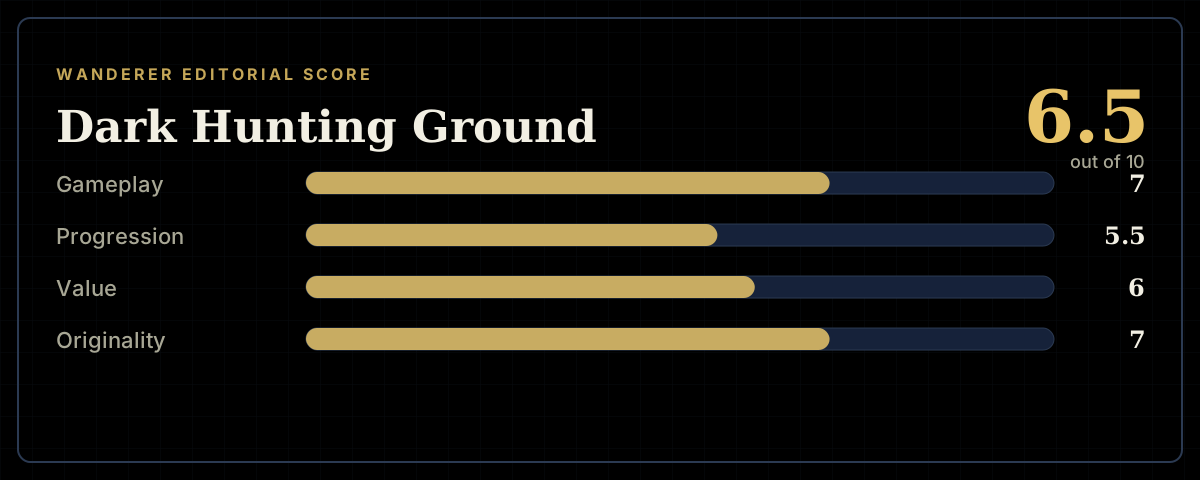
How the review scores each part of the gameWanderer Editorial -
The short versionWanderer Editorial