
Game review
SlimeHold
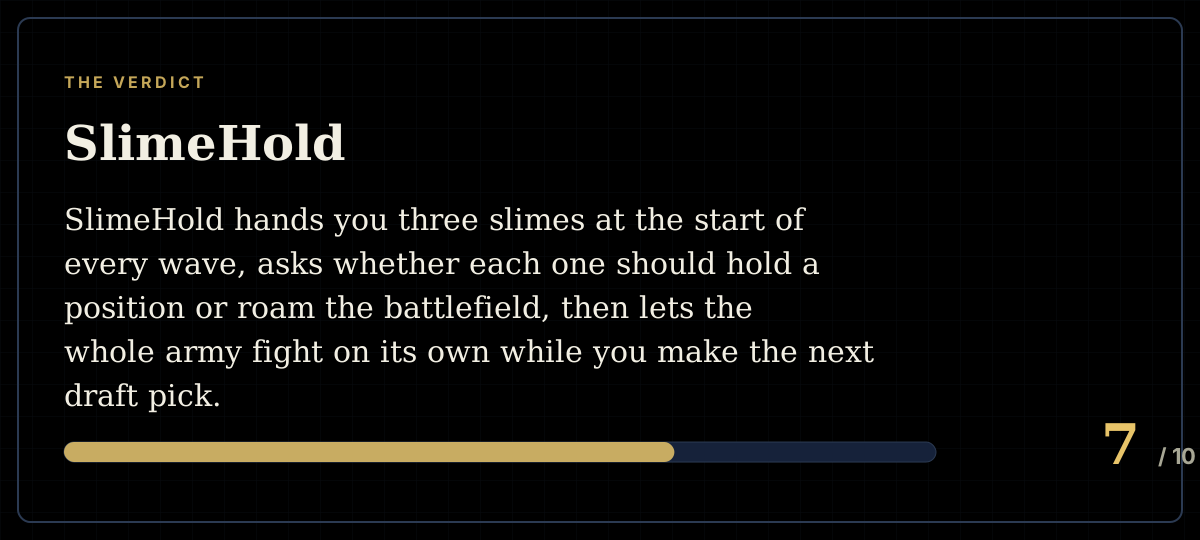
7 / 10
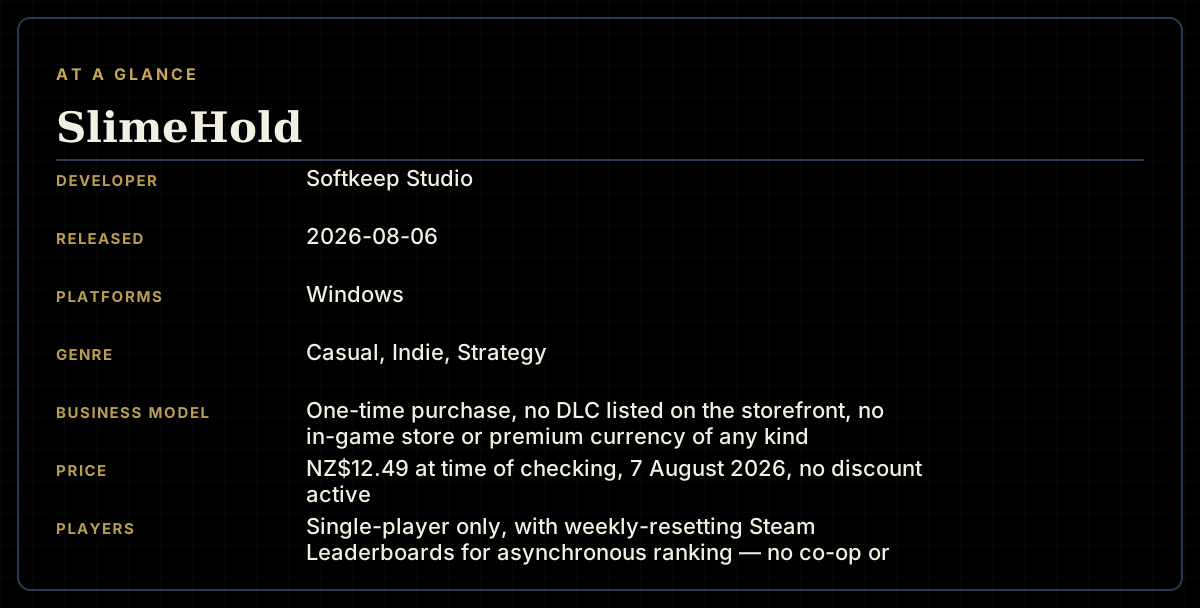
- Developer
- Softkeep Studio
- Publisher
- Softkeep Studio
- Released
- 6 August 2026
- Platforms
- Windows
- Genre
- Casual, Indie, Strategy
- Monetisation
- One-time purchase, no DLC listed on the storefront, no in-game store or premium currency of any kind
- Players
- Single-player only, with weekly-resetting Steam Leaderboards for asynchronous ranking — no co-op or competitive modes
The short version
SlimeHold hands you three slimes at the start of every wave, asks whether each one should hold a position or roam the battlefield, then lets the whole army fight on its own while you make the next draft pick. It's a genuinely workable fusion of roguelite drafting, auto-battler positioning and permanent collection-based unlocks, wrapped around a King who stands in the open with enemies closing in from every direction rather than a lane he can retreat down. The pricing is as clean as Steam gets — one purchase, no DLC, no store — and a weekly leaderboard reset gives a single-player game an actual reason to come back on a schedule. What it can't offer yet, one day after launch, is any evidence about how the loop holds up over dozens of runs, and the mid-wave screen already gets crowded enough that a newcomer will need a few losses just to read it.
Biggest strengths
- The wave-by-wave draft of three slimes, each with a genuinely different attack pattern, forces a real Stationed-versus-Roaming call rather than just recruiting whatever rolls highest damage
- The Collection screen locks specific slimes and items behind named challenges — reach past Wave 15 across five runs, land 400 attacks, immobilise 150 monsters — so a run that ends badly still banks progress toward something concrete
- Weekly-resetting leaderboards for Highest Wave and for Three Crowns, the combined best of three different Kings, give a one-time-purchase single-player game a structured reason to return on a schedule
Biggest weaknesses
- Windows only, with no macOS or Linux build and no controller support listed, an odd gap for a game built around fast wave-to-wave decisions
- By the later waves the arena is packed with dozens of overlapping slimes, floating damage numbers and status icons at once, and nothing in the storefront material suggests a way to thin that view out
- The store page frames this as a "tower defense auto-battler," but the promotional screenshots show the King standing in an open arena surrounded on all sides rather than behind any lane or chokepoint, and the community's own tag votes rank Bullet Hell and Auto Battler above Tower Defense — a shopper expecting classic lane-based placement will find something different
Who it's for: Roguelite and auto-battler fans who like a drafting decision every wave, and anyone who wants a tightly-priced single-player game with a genuine reason to return each week rather than each day.
Our recommendation: At NZ$12.49 for a one-time purchase with no DLC and no in-game store, SlimeHold is a fair, low-risk buy for the genre's regulars. It's Windows-only with no controller support, so check that before buying, and go in aware that this is a day-one release with no player feedback on record yet.
7 / 10
There's no lane to fall back to in SlimeHold. The King stands in the middle of an open field and the waves close in from all 360 degrees at once, which is a small structural choice that changes what the whole game is about: not choke-point placement, but building an army that can survive being surrounded. That's a more interesting starting premise than the store page's own "tower defense" label suggests, and a solo developer's day-one release leaning into it is the most promising thing about SlimeHold.
Three slimes, two roles, one decision every wave
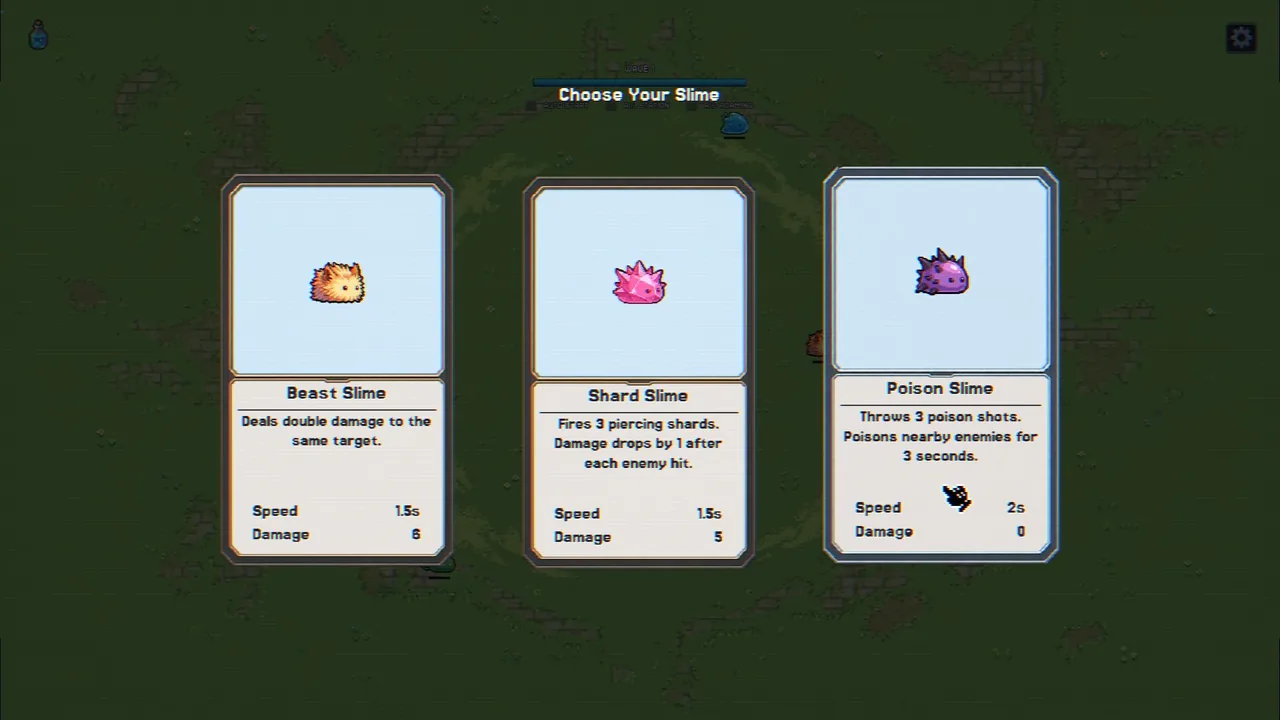
The loop repeats every wave: pick one of three offered slimes, each with a genuinely different attack pattern rather than a reskinned stat block. A Beast Slime deals double damage to whatever it last hit; a Shard Slime fires three piercing shots that lose a point of damage per enemy pierced; a Poison Slime throws three shots that do no direct damage at all but poison anything nearby for three seconds. Recruit one and it joins the roster; assign it Stationed to hold a fixed position in the ring around the King, or Roaming to move freely and chase down stragglers. Neither role is obviously correct — a Stationed line covers a fixed arc reliably, a Roaming slime can plug a gap the line can't reach — and the choice compounds as the roster grows, because a Roaming Poison Slime and a Stationed wall of Beast Slimes create a completely different defensive shape from the reverse.
Combat resolves on its own once a wave starts. The player's job is entirely upstream of that: which slime to draft, which role to assign it, which items to pick up along the way. It's a clean division of labour that auto-battlers depend on, and SlimeHold earns it by making the pre-fight decisions matter rather than treating the draft as a formality before the real game — the automatic fighting — begins.
A Collection that turns failed runs into progress
What keeps a permadeath structure from feeling like starting from zero every time is SlimeHold's Collection screen, split into a Slimes tab and an Items tab, both showing locked cards as silhouetted "???" entries with the specific unlock condition printed underneath: immobilise 150 monsters, reach past Wave 15 across five separate runs, finish five runs outright, land 400 attacks. None of those require winning — they're built from things a losing run still does along the way — so a King who falls at Wave 20 has still moved a counter forward somewhere. The items already unlocked read like a real modifier pool rather than filler: Hero's Testament adds flat base damage, Amber Prison gives Stationed slimes fifty percent more attack range, Chalice Wine lets enemy deaths raise the King's own max health. Multiple playable Kings sit on top of that — the review's own sample end-of-run screen names "Forest King" as one option among however many the full roster holds, each presumably changing the starting lineup the way the store page's "Choose Your King" pitch promises.
A weekly leaderboard for a single-player game
The most distinctive system on the storefront's screenshots is the Weekly Leaderboards screen, tracking Highest Wave reached with any King and a separate "Three Crowns" ranking for a player's combined best score across three different Kings, both resetting every Monday at 00:00 UTC with a visible countdown to the next reset. That's an unusual thing to build into a one-time-purchase, single-player roguelite — most games in this price bracket either skip leaderboards entirely or treat them as a vanity screen nobody checks. Worth being precise about what the screenshot actually shows, though: the leaderboard pictured is populated with more than a dozen ranked entries, which reads more like a developer's demonstration of the feature than an organic snapshot from launch day itself. A live current-player check at the time of writing found exactly one person in the game, so whatever competitive picture that board settles into is still entirely unwritten.
Readable at wave ten, busy at wave fifty
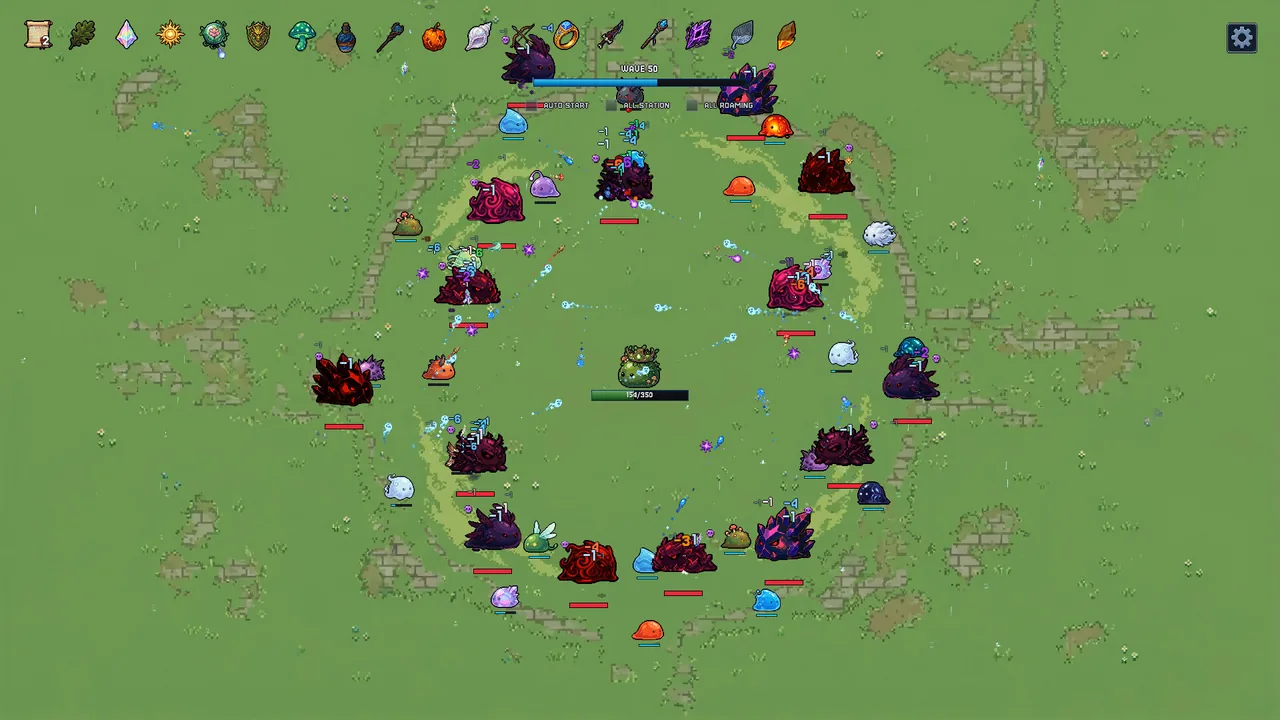
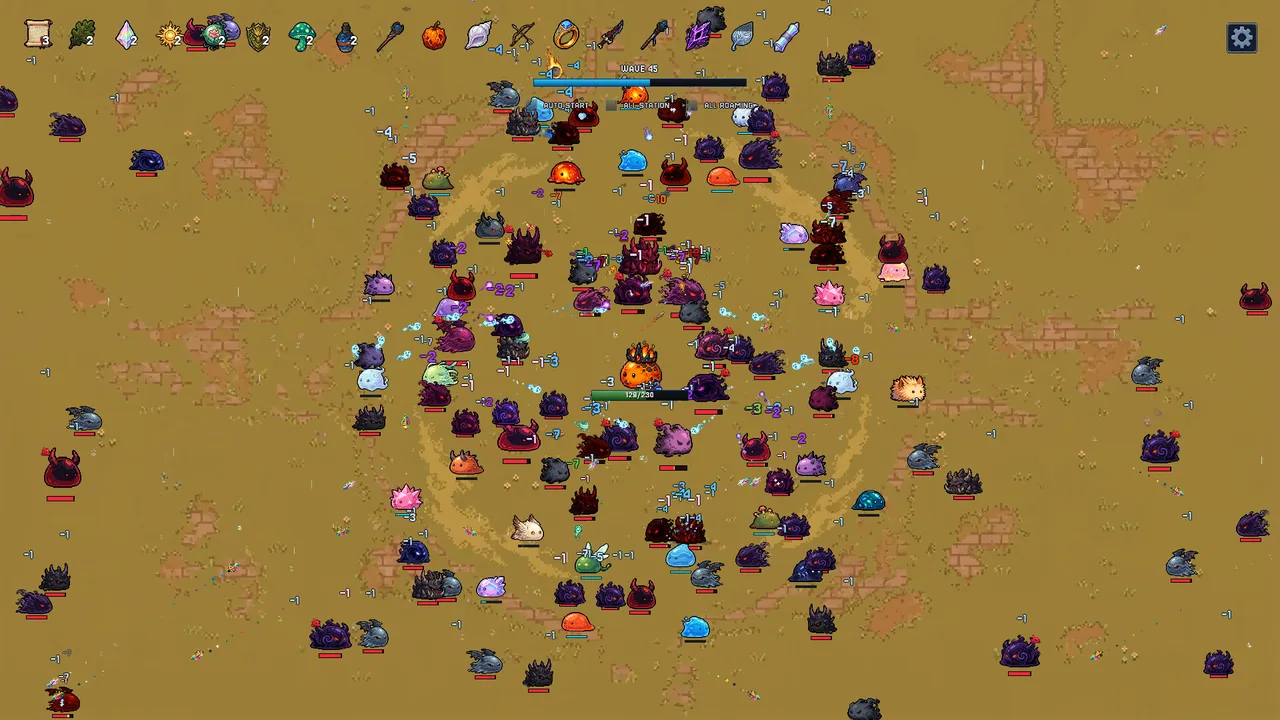
The presentation is straightforward cute-pixel fantasy — round, expressive slime sprites in bright colours against grassy or desert arenas — and it holds up fine early on, when a wave might have half a dozen enemies onscreen. It stops holding up quite so well by the later waves shown in the promotional screenshots: at Wave 45 and Wave 50 the arena is packed with dozens of overlapping slimes and enemies, floating damage numbers, poison and burn stacks, and status icons all firing at once, to the point where picking out the King's own health bar takes a genuine search. None of that is unusual for the genre — Vampire Survivors-style swarm games lean into visual chaos as a feature — but SlimeHold's official description sells the pitch as tactical positioning ("which ones hold their ground, which ones roam"), and a screen that dense makes it hard to tell whether a specific positioning call actually mattered or whether the swarm simply overwhelmed the read. The community's own tag votes back up that tension: Bullet Hell sits ahead of both Auto Battler and Tower Defense on the vote-count list pulled from the store page, ahead even of Strategy, which suggests players who've actually looked closely already categorise this closer to a swarm-survival game than a placement puzzle.
Clean pricing, real if modest accessibility
There's very little to untangle about the money side. One purchase at NZ$12.49, no discount active at the time of checking, nothing else on the storefront to buy — no DLC listed, no in-game store, no premium currency, no battle pass. That's about as uncomplicated as Steam pricing gets, and it's worth saying plainly rather than assuming a reader already knows a $12 indie game has no hidden costs. Steam's own category tags back it with a modest but genuine accessibility set: custom volume controls, a mouse-only input option, play at your own pace, and no mechanic anywhere that demands timed input. It isn't the deep accessibility sheet a larger studio might ship, but for a solo debut it's more than a formality.
One day old, and it shows
SlimeHold launched on 6 August 2026, and this review was checked the following day — which means almost everything about its long-term shape is still unknown. There isn't a single user review of any kind, positive or negative, on either of two checks taken minutes apart. A concurrent-player check found exactly one person in the game at that moment. The achievement data tells the same story from a different angle: six of the twenty achievements already sit at 100 percent completion, which sounds impressive until you realise it means every single person who's played so far has cleared them — a population of a handful, not a curve. None of that reflects badly on the game itself; a day-one debut is supposed to look exactly like this. But it does mean nobody has yet logged the dozens of runs it would take to say whether the Collection's unlock pacing feels fair, whether the later waves are tuned honestly or just crowded, or whether the weekly leaderboard actually develops into the competitive hook its structure promises. A search for other Steam titles under Softkeep Studio's name turns up nothing else, so this reads as a first release finding its early footing rather than a known quantity with a track record to check against.
Final verdict
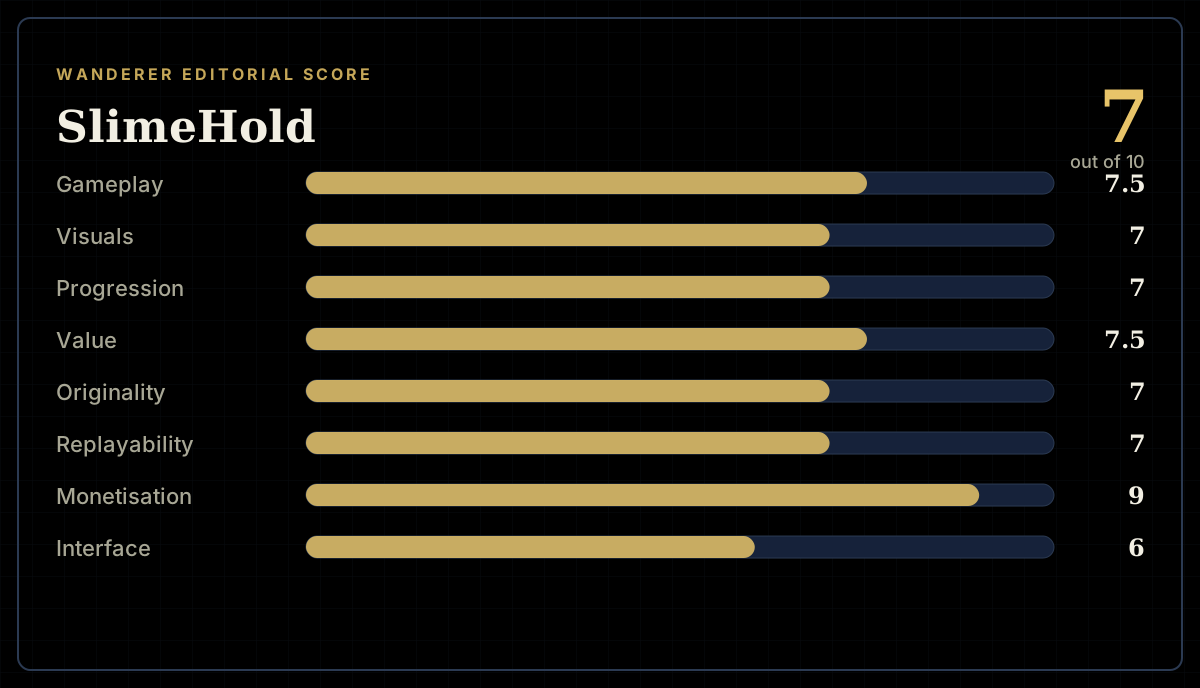
SlimeHold earns a 7 for a drafting-and-positioning loop that's more thoughtful than its "tower defense" label suggests, a Collection system that gives failed runs somewhere to go, and pricing that asks for exactly one payment and nothing more. It doesn't score higher because the interface gets genuinely crowded once a run runs long, there's no controller support or non-Windows build, and — the one thing no amount of good design can fix by itself — there simply isn't a single day of player feedback yet to confirm any of this holds up over the dozens of runs its own systems are clearly built for. At NZ$12.49 for a clean one-time purchase, it's a reasonable bet for roguelite and auto-battler regulars willing to be early, and a game worth checking back on once it has an actual review corpus behind it.
Pros and cons
Pros
- The wave-by-wave draft of three slimes, each with a genuinely different attack pattern, forces a real Stationed-versus-Roaming call rather than just recruiting whatever rolls highest damage
- The Collection screen locks specific slimes and items behind named challenges — reach past Wave 15 across five runs, land 400 attacks, immobilise 150 monsters — so a run that ends badly still banks progress toward something concrete
- Weekly-resetting leaderboards for Highest Wave and for Three Crowns, the combined best of three different Kings, give a one-time-purchase single-player game a structured reason to return on a schedule
- Pricing is as clean as Steam gets: one NZ$12.49 purchase, no DLC on the storefront, no in-game store and nothing resembling a premium currency
- Twenty Steam Achievements, Steam Cloud and Steam Leaderboards ship on day one, alongside real accessibility options — custom volume controls, a mouse-only input mode and no mechanic that demands timed input
Cons
- Windows only, with no macOS or Linux build and no controller support listed, an odd gap for a game built around fast wave-to-wave decisions
- By the later waves the arena is packed with dozens of overlapping slimes, floating damage numbers and status icons at once, and nothing in the storefront material suggests a way to thin that view out
- The store page frames this as a "tower defense auto-battler," but the promotional screenshots show the King standing in an open arena surrounded on all sides rather than behind any lane or chokepoint, and the community's own tag votes rank Bullet Hell and Auto Battler above Tower Defense — a shopper expecting classic lane-based placement will find something different
- One day after launch there isn't a single user review of any kind, a live concurrent-player check found exactly one person in the game, and six of the twenty achievements already sit at 100 percent completion against a population this small, which makes the curve meaningless rather than informative
- There's no idle, offline or away-from-keyboard progression anywhere in the design — the "auto" in auto-battler only covers combat resolution during an active session, not time spent with the game closed
Screenshots
-
SlimeHoldImage: Softkeep Studio via Steam -
SlimeHoldImage: Softkeep Studio via Steam -
SlimeHoldImage: Softkeep Studio via Steam -
How the review scores each part of the gameWanderer Editorial -
The game at a glanceWanderer Editorial -
The short versionWanderer Editorial