
Game review
Loopstructor
7.5 / 10
- Developer
- Pone Games
- Publisher
- Pone Games
- Released
- 8 August 2024
- Platforms
- Windows
- Genre
- Roguelite tower defense with train-based towers
- Monetisation
- One-time purchase, no in-game store or additional currency purchases
- Players
- Single-player only
The short version
Loopstructor replaces the static towers of a normal tower defense game with trains, riding tracks the player designs and rebuilds around their base each run. It's a genuinely uncommon idea executed well enough that reviewers, including several who run strategy-game curator pages, call it one of the more innovative takes on the genre in years — and at roughly NZD 11, almost every review treats the price as close to a steal. Solo developer Pone Games has backed that reception with an unusually sustained eighteen-month patch cycle addressing the game's biggest launch-week complaint, poor translation quality, directly by name. What keeps this from a higher score is that some of those fixes only partially landed — translation quality is still described as hit-and-miss well into 2025 — and a detailed, specific critique argues the core loop layout matters less strategically than the marketing suggests, once a specific synergy combination is found.
Biggest strengths
- The core hook — building loop-shaped tracks around your base and running trains along them as mobile, synergy-combining towers — draws consistent, specific praise as genuinely novel, with multiple reviewers unable to name a close comparison elsewhere in the tower defense genre
- Reviewers overwhelmingly treat the price as excellent value, with phrases like "a steal," "bang for buck," and "the price of a sandwich" appearing independently across the sample
- The developer's own Steam events feed shows an exceptionally sustained support cycle: numbered patches within days of the August 2024 launch, a major "Ultimate Update" with endgame content in October 2024, Steam Workshop support added in November 2024, and continued monthly community challenges running into 2025, with a sequel already announced by April 2025
Biggest weaknesses
- Translation quality is the single most repeated complaint in the review sample: the game launches in Chinese by default with no initial prompt, requiring players to navigate an unfamiliar menu to find the language setting, and even after switching, several reviewers describe English (and other language) translations as "horribly bad" or too unclear to follow the more intricate mechanics
- A detailed, specific critical review argues the loop-and-track design that's central to the game's marketing ends up mattering less than expected in practice, once a specific vampiric-then-freeze/haste synergy combination is found, which the reviewer says clears most content "mindlessly" regardless of track layout
- The same reviewer describes the game's twenty difficulty tiers as feeling largely undifferentiated in practice, following a repeating pattern of excitement at a new tier followed by the realisation that it plays out the same as the last one
Who it's for: Tower-defense and roguelite fans looking for a genuinely new mechanical hook rather than another reskin, especially budget-conscious players who want real content for a low asking price and don't mind a rough English localisation in exchange for it.
Our recommendation: An easy recommendation at its price for genre fans, backed by a developer track record strong enough to trust with future updates. Go in expecting some translation friction in the game's more intricate systems, and don't be surprised if one train-and-synergy combination trivialises much of the difficulty curve before you've explored the full roster.
7.5 / 10
Tower defense is a genre built on a fixed idea: towers stay put, enemies move past them. Loopstructor's one significant, well-executed change is to break that assumption entirely — the towers here are trains, riding tracks the player designs as closed loops around a central base, and figuring out how to route those loops effectively is as much the game as choosing what to build. Reviewers, several of whom run dedicated strategy-game curator pages on Steam, consistently single this out as a genuinely uncommon idea for the genre, and at a price most describe as barely more than pocket change, it's easy to see why the reception has been so positive. What keeps this review from an unqualified rave is that the game's other major talking point — its launch translation quality — took real time to improve, and a detailed critical account raises a specific, harder-to-dismiss question about how much the signature loop-design mechanic actually matters once players find the right combination.
A genuinely new spin on an old genre
The core loop asks players to lay track in closed shapes around their base, then assign different train cars — each with distinct attack types — onto those loops, aiming for synergies between vehicles that share categories or traits. One reviewer captures the appeal directly: "it's kind of like a Vampire Survivors, tower defense and deckbuilder mix that is just fun to explore and play around with... it has its own unique twist to it." Another, more technically focused, calls it "an inventive indie strategy title... that rethinks traditional tower defense by replacing static placements with dynamic, player-constructed loops." The praise isn't vague enthusiasm — reviewers repeatedly point to the specific combination-building layer, stacking traits across trains sharing a loop, as where the game finds real depth beyond its central gimmick, with one describing categorising vehicles onto different trains "to get different buffs from their synergies" as the system that kept them engaged well past their first few runs.
Priced to be an easy yes
Value comes up constantly and consistently, almost as a refrain running through the entire review sample. "At $4.99 this is pretty good bang for buck," reads one typical review; "worth a look for the price of a sandwich," reads another. A reviewer with over 11,900 minutes — close to 200 hours — logged calls it simply "a 5 bucks treasure." This isn't damning with faint praise about a cheap, thin game; it's reviewers who clearly got substantial playtime treating the price as almost beside the point given what the game delivers, which is a stronger value signal than a single low number on its own would be.
The translation problem, and a developer who kept working on it
Set against that enthusiasm is the sample's most consistently repeated complaint: launch-week localisation. Several reviewers describe the game opening in Chinese with no initial language prompt, requiring players to "fumble through the options in Chinese" just to switch to their preferred language — not a difficult step once found, but an unwelcoming first impression for an international audience. Once switched, translation quality for English and other languages draws real, specific criticism: one reviewer states plainly that "people are really underselling how bad it is," and a reviewer testing the Italian localisation calls the result "even more confusing" than the initial Chinese-language default. This review can add useful context here: the developer's own patch history shows a December 2024 update explicitly titled with "Translation Optimization" as one of its two headline features, alongside a substantial content remake — a direct, named response to exactly this complaint, roughly four months after launch. Reviews from 2025 suggest the improvement was real but incomplete, with translations still described as "hit and miss" for the game's more intricate mechanics even after that update, rather than the problem being fully solved.
A dominant strategy undercutting the headline mechanic
The most detailed critical account in the sample, written in Traditional Chinese by a reviewer with over 1,770 minutes logged, raises a more specific structural concern worth taking seriously rather than dismissing as one player's frustration. Translated, the core argument is that regardless of which starting train a player chooses, gathering a "vampiric barrier" synergy followed by a "freeze/slow barrier" synergy clears most content without much further thought, and that track design — the game's headline, most-marketed mechanic — ends up mattering far less than expected as a result: a short loop tucked close to the main base, with two trains on it, handles almost every non-boss encounter. The same reviewer describes the game's twenty difficulty tiers as feeling repetitive rather than meaningfully distinct, following a pattern of "new difficulty → unlock new starting train → excitement → realizing there's no real difference → next difficulty." Steam's own achievement data lends some support to the shape of this complaint: while several achievements sit comfortably above 60%, a cluster of vehicle-specific "atk" achievements — likely tied to actually using each of the game's varied train types in a completed run — fall to between 1.1% and 3.1%, consistent with a playerbase gravitating toward one effective combination rather than exploring the full roster the synergy system is built around.
Rougher technical edges
A smaller cluster of reviews raises straightforward performance complaints: frame rates dropping below 30 with only a modest number of enemies active, and track-editing controls that feel sluggish enough that one reviewer says they avoided rearranging loops mid-run "as much as possible" despite the game encouraging exactly that kind of real-time adaptation. A separate reviewer reports a specific boss-encounter bug where already-defeated enemy spawns reactivate unexpectedly near a boss fight, describing it as something that "needs some bug fixing to be great" rather than a dealbreaker on its own.
A support record worth noting on its own terms
Whatever specific complaints remain, it's worth stating plainly that Pone Games has backed this release with an unusually sustained commitment. The events feed shows patches arriving within days of the 8 August 2024 launch, a substantial "Ultimate Update" adding endgame content and optimisation passes in October 2024, Steam Workshop support the following month, ongoing monthly community challenges running well into 2025, and a sequel already confirmed to be in development by April 2025 — a track record that stands in real contrast to several other small 2024 releases in this same price range that received a handful of launch-week fixes and then went quiet.
Final verdict
Loopstructor earns its reputation as one of the more genuinely inventive tower defense releases of 2024: trains-as-towers on player-designed loops is a real, well-executed idea, backed by a synergy system with enough depth to hold dedicated players for hundreds of hours, all at a price that makes the decision to try it an easy one. The rough launch-week translation and a detailed, specific argument that the loop-design mechanic matters less than advertised once a dominant strategy is found are real, documented costs — but a developer that's kept patching, translating, and adding content for a year and a half since launch, right up through an already-announced sequel, has earned real benefit of the doubt that these are still being worked on rather than left behind.
Pros and cons
Pros
- The core hook — building loop-shaped tracks around your base and running trains along them as mobile, synergy-combining towers — draws consistent, specific praise as genuinely novel, with multiple reviewers unable to name a close comparison elsewhere in the tower defense genre
- Reviewers overwhelmingly treat the price as excellent value, with phrases like "a steal," "bang for buck," and "the price of a sandwich" appearing independently across the sample
- The developer's own Steam events feed shows an exceptionally sustained support cycle: numbered patches within days of the August 2024 launch, a major "Ultimate Update" with endgame content in October 2024, Steam Workshop support added in November 2024, and continued monthly community challenges running into 2025, with a sequel already announced by April 2025
- A December 2024 update explicitly titled with "Translation Optimization" shows the developer directly targeting the game's most common launch-week complaint rather than letting it sit unaddressed
- Long-session reviewers report genuine depth in combining vehicle types, categories, and "Super Modules" into synergy builds, with one reviewer logging over 11,900 minutes and still recommending it as a "5 bucks treasure"
Cons
- Translation quality is the single most repeated complaint in the review sample: the game launches in Chinese by default with no initial prompt, requiring players to navigate an unfamiliar menu to find the language setting, and even after switching, several reviewers describe English (and other language) translations as "horribly bad" or too unclear to follow the more intricate mechanics
- A detailed, specific critical review argues the loop-and-track design that's central to the game's marketing ends up mattering less than expected in practice, once a specific vampiric-then-freeze/haste synergy combination is found, which the reviewer says clears most content "mindlessly" regardless of track layout
- The same reviewer describes the game's twenty difficulty tiers as feeling largely undifferentiated in practice, following a repeating pattern of excitement at a new tier followed by the realisation that it plays out the same as the last one
- Multiple reviewers report performance problems, including frame rates dropping below 30 with only a modest number of enemies on screen, and sluggish mouse response specifically when editing track layouts mid-run
- At least one reviewer reports a specific boss-encounter bug where previously defeated enemy spawns reactivate near a boss fight, alongside general requests for further bug fixing before the game reaches its full potential
Screenshots
-

LoopstructorImage: Pone Games via Steam -

LoopstructorImage: Pone Games via Steam -

LoopstructorImage: Pone Games via Steam -
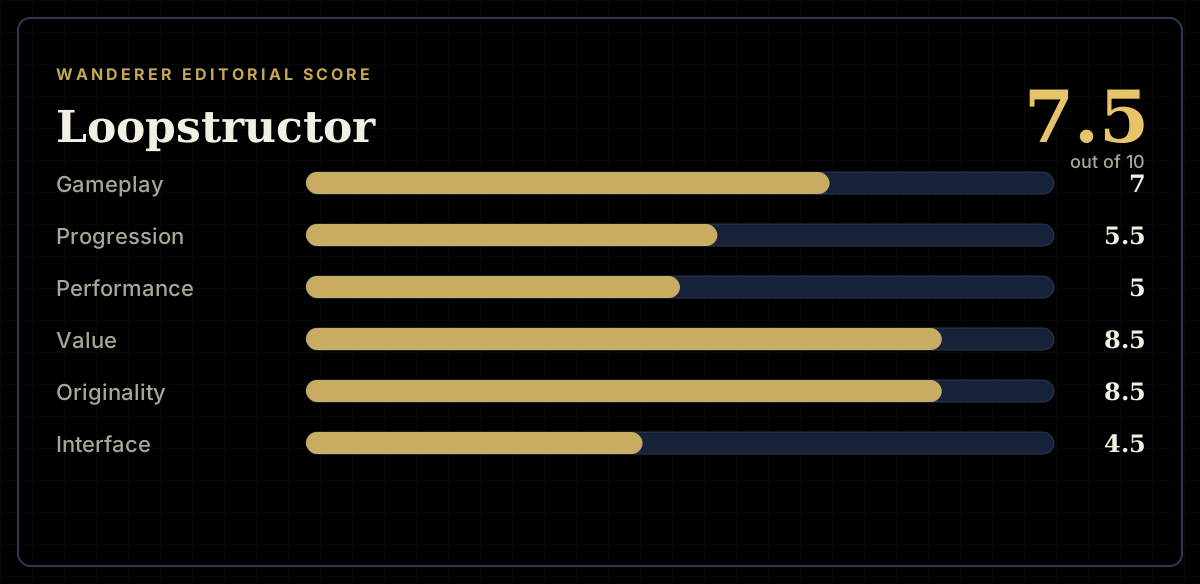
How the review scores each part of the gameWanderer Editorial -
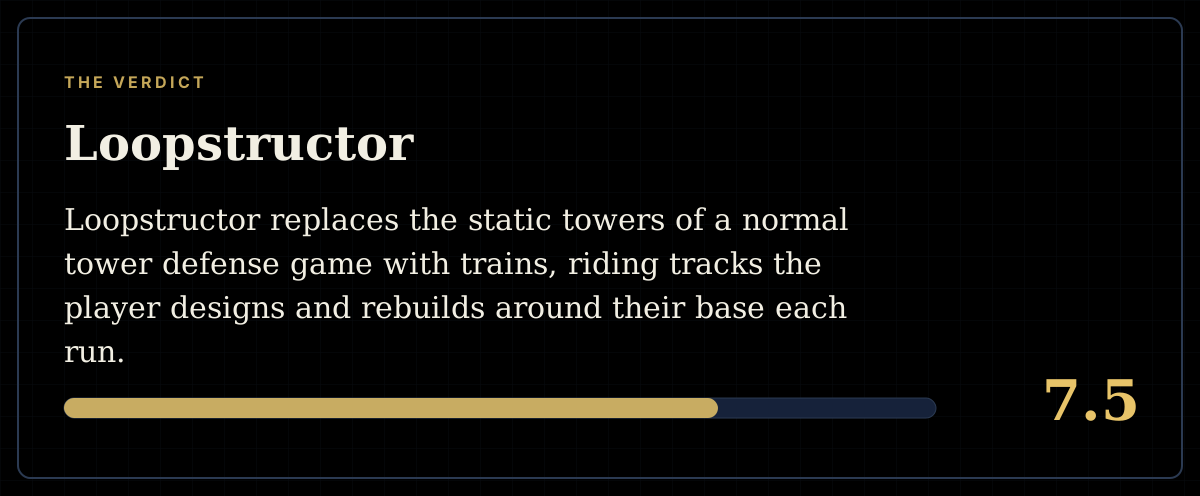
The short versionWanderer Editorial