
Game review
Outhold
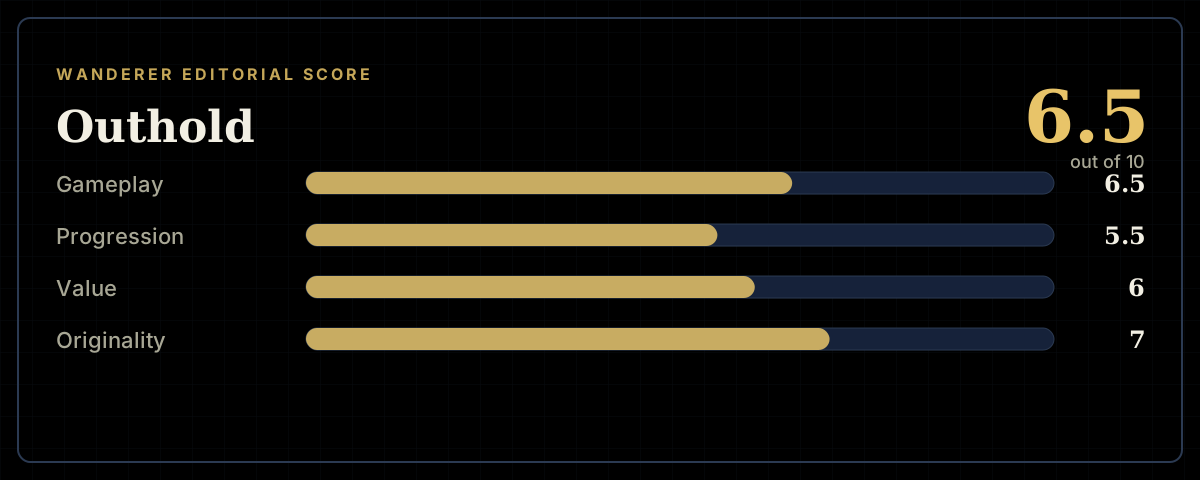
6.5 / 10
- Developer
- Tellus Games
- Publisher
- Tellus Games
- Released
- 12 December 2025
- Platforms
- Windows
- Genre
- Tower Defense, Incremental
- Monetisation
- One-time purchase, no DLC or in-game currency
- Players
- Single-player
The short version
Outhold blends tower defense with incremental-style meta-progression: start a run, see how far your towers get against waves of enemies, spend what you've earned on a deep upgrade tree, and try again with a stronger build. It's explicitly designed as a short, compact experience — the developer states 4-to-5 hours across ten levels plus endgame min-max content — and its 1,804-review corpus is Very Positive, with reviewers repeatedly praising the minimalist aesthetic and the addictive "one more run" pull of the core loop. What that same large corpus is just as consistent about, independently and in remarkably similar language, is that the upgrade tree's advertised freedom is something of an illusion: progressing through most levels means puzzling out the one specific build combination each stage actually demands, rather than freely experimenting your way to victory with whatever playstyle you prefer.
Biggest strengths
- The core "one more run" loop is repeatedly described as genuinely addictive, with a minimalist but polished aesthetic that lets quick, focused sessions feel satisfying rather than sparse
- Free respeccing of all upgrades removes the anxiety of committing to a build path, and reviewers who embraced the puzzle-like structure describe real satisfaction in eventually cracking a level's intended solution
- The price-to-content ratio is judged fair by a meaningful share of reviewers even among the critical ones — one bluntly summarises it as "a $7 game that will give you about $7-$10 worth of entertainment value," neither overselling nor underdelivering on that specific measure
Biggest weaknesses
- The single most repeated complaint across the corpus, phrased independently by dozens of reviewers in similar terms, is that the upgrade tree amounts to "an illusion of choice" — most levels have effectively one intended solution to find rather than genuinely open build diversity, turning the game into what several reviewers directly call a min/max puzzle rather than a true incremental
- Ten levels is judged too few by a wide margin of reviewers, including many otherwise positive ones, with the game commonly finished in around four hours and the free demo alone reportedly covering roughly a third of the full release's content
- At least one detailed reviewer reports needing community-written guides to reach 100% completion, and frames relying on outside guides for full clearance as a real design shortcoming rather than a minor inconvenience
Who it's for: Players who enjoy tower-defense games with a genuine puzzle-solving core, and who are comfortable replaying the same handful of levels repeatedly while hunting for the exact synergy that unlocks progress. Less of a fit for anyone expecting the free-form build experimentation the marketing emphasises, or anyone who wants a longer campaign rather than a tight, short one.
Our recommendation: A solid buy at its discounted price for tower-defense and incremental fans specifically drawn to puzzle-like optimisation, but go in understanding "deep upgrade tree" means "many possible builds to discover the one correct answer among," not "many equally viable playstyles" — and that even fans of the core loop consistently wish there were more than ten levels to apply it to.
6.5 / 10
Ten levels, one intended answer
Outhold's pitch is straightforward: defend Outhold's dwindling fires across ten levels, spending resources earned from each run on a deep, freely-respeccable upgrade tree, experimenting with tower combinations to find synergies powerful enough to clear the next challenge. The developer is upfront that this is meant to be short and compact — 4 to 5 hours across the main campaign, with additional endgame content for min-maxers — and reviewers largely agree the core loop delivers on that promise in its early hours. The minimalist aesthetic draws consistent praise for staying polished rather than sparse, and the "one more run" pull that defines good incremental design is present and effective for most of the corpus.
When "deep upgrade tree" means "one correct answer"
Where the reception splits is over what that upgrade tree actually asks of you. An unusually large number of reviewers, writing independently and arriving at strikingly similar phrasing, describe the tree as "an illusion of choice" — a wide array of options on paper that narrows, level by level, to essentially one specific build combination each stage actually requires. Several reviewers go further and argue the game is more honestly described as a min/max puzzle than a true incremental: you're not gradually growing more powerful through accumulated choices so much as searching for the correct solution to each level's specific challenge, with grinding and free respecs as the tools for finding it rather than genuine build diversity carrying you through. One reviewer's blunt summary — "You're meant to pretty frequently change up your build based on what enemies/challenges the game wants you to do instead of just making numbers go up" — captures a real tension between the marketing's "deep upgrade tree" framing and what many players report actually experiencing.
That's not a universal complaint; several reviewers who embraced the puzzle framing describe genuine satisfaction in eventually discovering a level's intended solution, and the tower-combination variety is specifically praised for making early levels feel meaningfully different from each other. But the sheer number of independent reviewers converging on the same "illusion of choice" language is strong evidence this isn't one player's misreading of the design — it's a real, if debatable, gap between how Outhold markets its systems and how a large share of players experience them.
Short, and everyone agrees
The second major and equally consistent complaint is length. Ten levels is judged too few by a wide margin of the corpus, including reviewers who otherwise rate the game highly — one specifically notes the free demo alone covers roughly a third of the full release, and multiple reviewers report clearing the entire campaign in around four hours. Steam's own achievement data adds useful texture here: 97.5% of players clear the very first level, but only 5.2% complete every available challenge, a genuinely steep drop-off that lines up with reviewer accounts of a short, accessible main campaign giving way to a much more demanding, guide-dependent endgame. One detailed reviewer reports needing community guides to reach full completion, framing reliance on outside resources for 100% as a real design shortcoming rather than a badge of the game's depth.
A designer's-eye view of the same tension
One of the more unusual reviews in the corpus makes the split explicit rather than picking a side. Titled "This is a weird review," it describes the reviewer's inner game designer loving Outhold's systems, resource economy and minimalist-but-polished presentation, while the player in them struggles with exactly the grind-versus-puzzle tension described above. That kind of self-aware, two-minds account is worth taking seriously as a synthesis of the corpus's broader split: Outhold is a well-constructed set of systems that a meaningful number of players nonetheless don't enjoy engaging with in practice, and the review doesn't read as a contradiction so much as an honest account of liking a game's craftsmanship more than its moment-to-moment feel.
That tension extends to genre labelling itself. More than one reviewer explicitly argues Outhold "mislabels itself as an incremental," pointing out that genuine incremental games typically let you lean into whatever build you enjoy and watch numbers climb, whereas Outhold frequently demands you abandon a comfortable build and reconfigure specifically to answer what a given level or challenge is asking for. Whether that's a flaw or simply a different, more tactical subgenre depends on what a buyer is looking for — but it's a meaningfully different pitch than "incremental" alone implies on a storefront page, and worth knowing before buying based on genre tags alone.
What the challenge modes actually add
Beyond the ten main levels, Outhold offers per-level challenge variants and a post-campaign hard mode, and reviewers who engage with them describe more of the same fundamental tension rather than a change of pace. One reviewer notes each stage carries multiple challenges on top of its base clearance condition, giving completionists "quite a bit of content" to chase if they're willing to keep replaying familiar maps under stricter constraints. Others are less charitable, describing the endgame specifically as extremely grindy busywork once the main ten levels are exhausted, rather than new mechanical wrinkles worth discovering. Both readings can be true at once: there's genuinely more to do here than a bare ten-level campaign would suggest, but "more to do" mostly means doing the same kind of puzzle-solving again under tighter constraints, not encountering meaningfully new systems.
The verdict
Outhold earns its Very Positive reception by delivering a genuinely satisfying, well-polished core loop for the several hours its main campaign lasts — but its own review corpus is unusually clear-eyed about the gap between what the game promises and what it delivers underneath. "Deep upgrade tree" turns out to mean, for most levels, a specific combination to discover rather than open-ended experimentation, and ten levels leaves even fans of the concept wanting considerably more. At its current discounted price, that's still a fair trade for tower-defense and puzzle-incremental fans specifically — just don't expect the freedom the marketing implies, or a campaign that outlasts a single afternoon. Go in treating it as a tight tactical puzzle box rather than an open-ended number-go-up incremental, and the frustration several reviewers describe becomes much easier to sidestep entirely.
Pros and cons
Pros
- The core "one more run" loop is repeatedly described as genuinely addictive, with a minimalist but polished aesthetic that lets quick, focused sessions feel satisfying rather than sparse
- Free respeccing of all upgrades removes the anxiety of committing to a build path, and reviewers who embraced the puzzle-like structure describe real satisfaction in eventually cracking a level's intended solution
- The price-to-content ratio is judged fair by a meaningful share of reviewers even among the critical ones — one bluntly summarises it as "a $7 game that will give you about $7-$10 worth of entertainment value," neither overselling nor underdelivering on that specific measure
- Multiple challenge modes and a post-campaign hard mode give completionist players real additional structure beyond the core ten levels, even if several reviewers find that endgame content considerably less fun than the main campaign, describing it as a harder version of the same puzzle-solving rather than meaningfully new content
- The variety of towers and their combination possibilities draws specific praise for meaningfully changing how a run plays out, at least in the earlier levels before the game's puzzle-like structure tightens around fewer viable solutions
Cons
- The single most repeated complaint across the corpus, phrased independently by dozens of reviewers in similar terms, is that the upgrade tree amounts to "an illusion of choice" — most levels have effectively one intended solution to find rather than genuinely open build diversity, turning the game into what several reviewers directly call a min/max puzzle rather than a true incremental
- Ten levels is judged too few by a wide margin of reviewers, including many otherwise positive ones, with the game commonly finished in around four hours and the free demo alone reportedly covering roughly a third of the full release's content
- At least one detailed reviewer reports needing community-written guides to reach 100% completion, and frames relying on outside guides for full clearance as a real design shortcoming rather than a minor inconvenience
- A colourblind reviewer specifically flags the tech tree's colour-coded availability indicators as difficult to read, a concrete accessibility gap in a genre where parsing an upgrade tree quickly matters
- Steam's own achievement data shows an unusually steep completion cliff even by incremental-genre standards: 97.5% of players clear the first level, but only 5.2% complete every challenge, corroborating widespread reviewer reports that the back half demands guide-level optimisation rather than natural progression
Screenshots
-

OutholdImage: Tellus Games via Steam -

OutholdImage: Tellus Games via Steam -

OutholdImage: Tellus Games via Steam -
How the review scores each part of the gameWanderer Editorial -
The short versionWanderer Editorial