
Game review
Void Wizard
7.5 / 10
- Developer
- Antique Gear Games
- Publisher
- Antique Gear Games
- Released
- 12 April 2024
- Platforms
- Windows
- Genre
- Voxel first-person shooter roguelike
- Monetisation
- One-time purchase, no in-game store or additional currency purchases
- Players
- Single-player only
The short version
Void Wizard puts a wand in each hand — levitation, time manipulation, explosive blasts, and eventually a wand that's really just a gun — and sends you looping through procedurally generated voxel dungeons to face the wizard responsible for it all. It's a small, cheap, fast-paced roguelike shooter that draws direct, favourable comparisons to Ultrakill and the Heretic lineage of fantasy FPS games, and its review sample is unusually one-sided: every single one of its 58 lifetime reviews recommends it. That near-unanimous enthusiasm comes with an honest caveat repeated by many of the same fans — the upgrade pool is thin, the main loop is short, and the game essentially became a four-month passion project before its solo developer moved on to smaller games of their own.
Biggest strengths
- Combat and movement draw sustained, specific praise for feeling genuinely satisfying, with reviewers directly comparing the pace and feel to Ultrakill and to classic Heretic-lineage fantasy shooters
- The dual-wand system gives real moment-to-moment variety, with different wand combinations meaningfully changing how a run plays, even as reviewers note some combinations are clearly stronger than others
- At roughly two to three dollars, the price draws close to unanimous praise, with reviewers repeatedly calling it an easy purchase regardless of how much content is on offer
Biggest weaknesses
- The upgrade pool is described by multiple reviewers as thin, limited largely to fire rate and mana increases, with at least one reviewer directly asking for more build variety to support longer play
- The main content loop is short by design, structured as looping floors rather than a fixed set of levels, and at least two reviewers explicitly say they would have preferred discrete levels over an endless structure
- Early difficulty is reported by more than one reviewer as relying on enemy-spam in small rooms and damage that's hard to avoid when moving through doorways, though later reviews note this has been adjusted since launch
Who it's for: Fans of fast, boomer-shooter-style movement and combat who want a cheap, bite-sized fantasy FPS roguelike for short sessions, rather than a deep, long-tail build-crafting game.
Our recommendation: An easy, near-risk-free purchase at its price, and one of the most consistently well-reviewed small games in this lane. Go in expecting a short, replayable arcade loop rather than a deep roguelike with dozens of hours of build variety.
7.5 / 10
Void Wizard's entire review history, all 58 entries of it, recommends the game. That's a rare thing to find at any price, let alone one sitting around two to three dollars, and it's worth taking seriously as a signal rather than dismissing as too small a sample to matter — the reasons reviewers give for that recommendation are specific and consistent, not vague goodwill toward a cheap indie.
Fast, chunky, and genuinely satisfying to control
The core appeal is movement and combat feel, and reviewers reach for exacting comparisons rather than generic praise. One calls it "Ultrakill if you were a wizard"; another places it "directly in that lineage" of fantasy FPS games "going all the way back to games like Catacomb and Heretic," while noting the roguelike structure layered on top is its own addition to that history. A third simply says "the movement is up there with the best boomer shooters, it's fast and frantic and a lot of fun to master." The dual-wand system — levitation, time manipulation, explosive blasts, and a wand that functions essentially as a gun — gives moment-to-moment variety real teeth, with reviewers noting that different combinations meaningfully change how a run plays, even as more than one jokes about the irony of the "best build" in a wizard game being two guns rather than two spells.
A voxel style that earns its charm
Distinctive presentation shows up as a recurring, specific compliment rather than an afterthought. Reviewers repeatedly single out the "crisp voxel graphics," and one writes that despite not usually favouring voxel or pixel art, "Void Wizard pulls it off well." Combined with a soundtrack multiple reviewers call fitting and well-composed, the game has a visual and audio identity that punches above what its price tag would typically buy, giving it a personality distinct from the many small roguelike shooters competing for the same audience.
The honest limitation even fans admit
Where the review sample turns from pure enthusiasm to constructive caveat is content depth. Multiple reviewers describe the upgrade pool as thin — one states directly it "would definitely benefit from more upgrades than just fire rate and mana increases." Others note the core structure is an endless loop of floors rather than a fixed set of discrete levels, and at least two reviewers say they'd have preferred traditional level structure instead. None of this reads as disappointment so much as reviewers being honest about scope while still recommending the game — a genuinely rare tone to strike, and one that speaks to how much goodwill the core mechanics have banked with this specific audience.
Difficulty that's rough at the edges, by design or otherwise
A smaller cluster of complaints concerns specific difficulty spikes: enemy density in small rooms, and damage that's difficult to avoid when moving through doorways into a fight already in progress. One reviewer flags this directly as "a little rough, kind of just enemy spam in the same small rooms," while a later review notes "some frustrations when it introduces difficult to avoid damage with full rooms... but this has been worked on" — a useful signal that at least some of this friction was addressed during the game's active support window rather than left untouched. The in-run economy compounds this for some players: healing is available only by purchasing potions from an in-level shopkeeper, an intentional resource-tension design that at least one reviewer wishes were slightly more forgiving heading into boss fights.
A short support window, in line with the game's own scale
This review can add useful context about what to expect going forward. The developer's own events feed shows a real, if brief, post-launch support period: a Coliseum arcade mode added in May 2024, directly responding to requests for more to do beyond the core loop, and cloud save support that August. After that, the developer moved on to other small solo projects — "Comet Rogue" in 2025 and "Idle Gumball Machine" in 2025 and 2026 — rather than continuing to expand Void Wizard specifically. For a two-to-three-dollar game from what reads as a very small or solo studio, that's a reasonable and unremarkable lifecycle rather than a broken promise; it does mean the specific requests reviewers make — more upgrade variety, Steam Workshop support, structured levels — are unlikely to arrive in a future update.
What the achievement data confirms about the endgame
Steam's own achievement tracking backs up the shape of the content complaint with hard numbers. Early milestones clear comfortably — nearly 80% of players unlock an early progression achievement, and the mid-tier "wizard rank" achievements sit in a moderate 54% to 67% range, meaning most buyers who start the game do see a meaningful chunk of it. But the curve then falls off a cliff for anything resembling mastery: achievements tied to high score-attack thresholds and specialised builds sit between 1.5% and 2.8% completion. That's consistent with a game whose main loop is short and approachable, but whose replayable Coliseum and score-attack modes — the exact systems added post-launch to extend playtime — are where the real, much harder long tail actually lives. For a buyer deciding whether the "short main loop" complaint above matters to them, this is a useful distinction: the core game is brief, but chasing genuine mastery of its harder modes is a different, considerably longer proposition.
Final verdict
Void Wizard delivers exactly what a two-to-three-dollar fantasy FPS roguelike should: fast, satisfying combat, a distinctive voxel art style, and a price that makes the purchase decision almost automatic. Its content ceiling is real and openly acknowledged even by its most enthusiastic reviewers — a thin upgrade pool and a short, loop-based structure rather than a deep, long-tail roguelike. But a review sample with zero negative entries out of 58 is not something to wave away, and the reasons behind that unanimity — genuinely good movement, charm, and an honest price-to-content match — hold up under scrutiny. This is a small, complete, well-made arcade shooter worth its asking price several times over, not a deep game pretending to be one.
Pros and cons
Pros
- Combat and movement draw sustained, specific praise for feeling genuinely satisfying, with reviewers directly comparing the pace and feel to Ultrakill and to classic Heretic-lineage fantasy shooters
- The dual-wand system gives real moment-to-moment variety, with different wand combinations meaningfully changing how a run plays, even as reviewers note some combinations are clearly stronger than others
- At roughly two to three dollars, the price draws close to unanimous praise, with reviewers repeatedly calling it an easy purchase regardless of how much content is on offer
- A distinctive voxel art style is repeatedly singled out as charming and well-executed, giving the game visual identity well beyond what its price point typically buys
- The developer added a Coliseum arcade mode and score-attack replayability in a May 2024 update specifically responding to requests for more to do beyond the core loop, showing real responsiveness during the game's active support window
Cons
- The upgrade pool is described by multiple reviewers as thin, limited largely to fire rate and mana increases, with at least one reviewer directly asking for more build variety to support longer play
- The main content loop is short by design, structured as looping floors rather than a fixed set of levels, and at least two reviewers explicitly say they would have preferred discrete levels over an endless structure
- Early difficulty is reported by more than one reviewer as relying on enemy-spam in small rooms and damage that's hard to avoid when moving through doorways, though later reviews note this has been adjusted since launch
- There is no way to heal outside of purchasing potions from an in-run shopkeeper, an intentional economy tension some reviewers flag as a real source of frustration in tighter runs
- The developer's own events feed shows active support lasting roughly four months after launch before moving on to other small projects, meaning the specific requests reviewers make — more upgrades, Steam Workshop support, structured levels — are unlikely to be addressed going forward
Screenshots
-

Void WizardImage: Antique Gear Games via Steam -

Void WizardImage: Antique Gear Games via Steam -

Void WizardImage: Antique Gear Games via Steam -
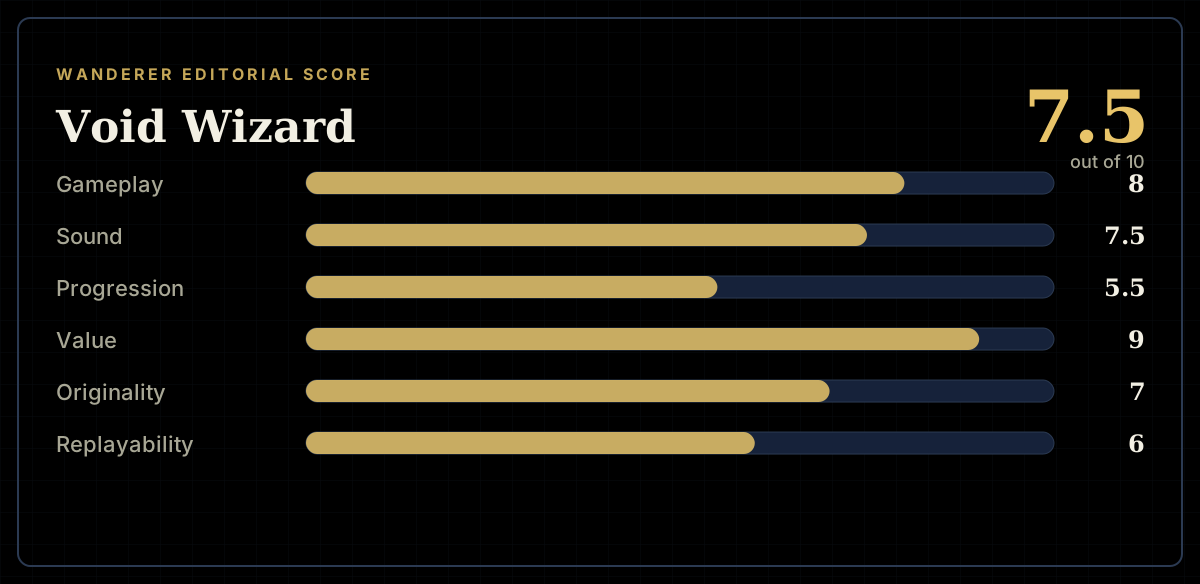
How the review scores each part of the gameWanderer Editorial -
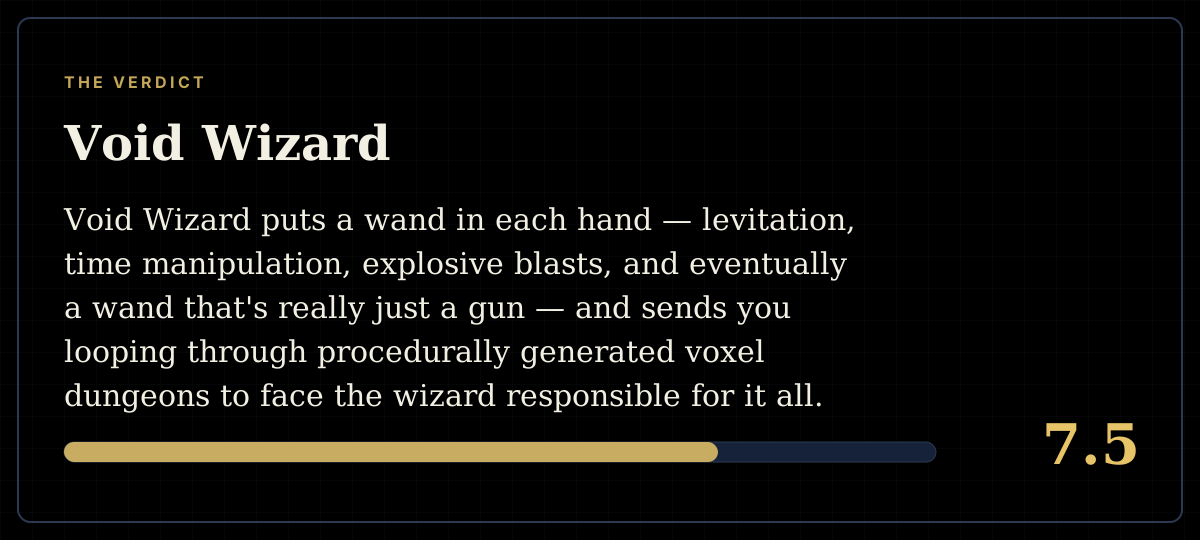
The short versionWanderer Editorial