
Game review
Claymores of the Lost Kingdom
5.5 / 10
- Developer
- Ultaan Games
- Publisher
- Ultaan Games
- Released
- 25 November 2024
- Platforms
- Windows
- Genre
- RPG-infused roguelike deckbuilder
- Monetisation
- One-time purchase, no in-game store or additional currency purchases
- Players
- Single-player only
The short version
Claymores of the Lost Kingdom builds its deck around your character's five core attributes, meaning the cards you find and the playstyle you end up with emerge directly from how you choose to level up rather than from a fixed class. Reviewers consistently single this system out as the game's most genuinely inventive idea, drawing frequent, generally favourable comparisons to Slay the Spire. What holds the game back is a much more consistent complaint: a small, repeated cast of enemies that reviewers describe fighting "over and over," combined with a difficulty curve several call broken rather than difficult — trivially easy for long stretches, then suddenly punishing, sometimes solvable entirely by a single discovered combo that invalidates the challenge. A April 2025 "Nightmare Expansion" adding new enemies and a new game mode shows the developer responding directly to the loudest complaint, though this review cannot confirm how completely that fix landed for every player affected.
Biggest strengths
- The core hook — that your character's five attributes directly determine which cards you discover and can draft — draws sustained, specific praise as a genuinely inventive twist on the deckbuilder formula, giving build identity real mechanical weight rather than cosmetic flavour
- Card and character artwork is repeatedly singled out as a standout, with multiple reviewers calling it the best part of the game and citing it as a specific reason they kept coming back
- Long-session reviewers report extraordinary engagement despite acknowledged flaws, including one account logging nearly 500 hours and still recommending the game, a strong signal the core loop has real staying power for the right audience
Biggest weaknesses
- Enemy variety is the single most repeated complaint across the negative review sample, with reviewers independently describing "the same 3 enemies," "the same 5 men," and "recycled enemies over and over" as the dominant early-to-mid-game experience
- Difficulty is described by multiple reviewers as unbalanced rather than genuinely hard, with runs feeling "brain-dead easy" for extended stretches before spiking sharply, and at least one reviewer reporting they found an "infinite combo" capable of invalidating the challenge entirely
- A specific, checkable interface complaint recurs: heading and card-name text uses a font multiple reviewers call illegible, contrasting sharply with the plain, readable font used for card descriptions in the same interface
Who it's for: Deckbuilder fans specifically drawn to character-build experimentation who can tolerate real balance rough edges and a smaller bestiary than genre leaders offer, rather than players looking for a tightly tuned, Slay the Spire-level experience.
Our recommendation: Worth a look at its modest price for the attribute-based card discovery system alone, but temper expectations around enemy variety and balance consistency. Check the most recent reviews before buying to see whether the Nightmare Expansion's new content has meaningfully addressed the repetition complaints that dominate the sample.
5.5 / 10
Most roguelike deckbuilders separate class identity from character progression: you pick a hero, then level them up along a track mostly independent of which cards you happen to draft. Claymores of the Lost Kingdom collapses that distinction. Level up Strength and you'll start seeing brutal melee cards; lean into Wisdom and Intelligence instead, and an entirely different card pool opens up. Reviewers describe this attribute-driven card discovery system as the game's clearest good idea, and it's genuinely uncommon enough in the genre to earn repeated, specific praise even from reviewers who are otherwise frustrated with the rest of the package.
A build system that actually means something
"Assigning points to stats and thus receiving different cards keeps every run fresh," one reviewer writes, capturing the appeal directly. Another compares the overall feel to "Slay the Spire, Skyrim and BG3" having "a baby," a slightly chaotic but affectionate way of describing a deckbuilder that leans harder into RPG-style character building than most of its genre peers. With over 300 cards, 150-plus keywords, and fifteen archetypes spread across five attribute trees on paper, the system has real room to support distinct playstyles, and reviewers who stick with it — including one logging close to 500 hours — describe genuine excitement discovering how a new stat allocation reshapes what cards show up.
The bestiary problem, repeated almost word for word
Set against that praise is the single most consistent complaint in the entire negative sample, and it's remarkable how similarly different reviewers describe it. "The same recycled enemies over and over," reads one. "You pretty much fight the same 3 enemies non stop," reads another, almost identically. A third: "just hordes of the same 5 men." This isn't a handful of isolated complaints — it's close to the default description of the mid-game experience across a wide swath of the negative reviews, and it shows up as a caveat inside several positive reviews too, including one that otherwise recommends the game while noting "the enemies are quite limited."
Difficulty that reviewers call broken, not hard
A second, related complaint concerns balance rather than content volume. One reviewer states the core problem precisely: the game is "ridiculously, brain-dead easy for two hours then impossible for the boss fight," rather than presenting a smooth, escalating challenge. Another goes further, reporting they discovered "an infinite combo to invalidate the whole game" well before finishing a full playthrough. A third, a self-described fan of genuinely difficult deckbuilders like Wildfrost, draws an important distinction: "Claymores of the Lost Kingdom is not difficult and punishing as much as it is unbalanced," arguing that hard-but-fair and merely inconsistent are not the same thing, and that this game lands closer to the latter.
Specific, fixable interface problems
Beyond content and balance, a handful of concrete interface complaints recur. One reviewer flags a genuinely odd typographic choice directly: "terribly annoying illegible font for headings, card names, locations, etc... you have to guess what it says, while contrasting greatly with the ordinary [font] with which all descriptions are written." Separately, several reviewers describe the "rations" system — which serves as both the currency for purchases and the fuel needed to move across the map — as too tight and insufficiently explained, leading to reports of running out mid-exploration with no clear recovery path. A map that doesn't clearly show visited locations or let players plan a route compounds this navigation frustration for more than one reviewer.
A real expansion, addressing the loudest complaint directly
This review can confirm the developer didn't leave the enemy-variety complaint unaddressed. The Steam partner-events feed shows a substantial "Nightmare Expansion" arriving in April 2025, roughly five months after launch, explicitly adding new enemies and a new game mode — a direct, dated response to exactly the complaint dominating the negative reviews. Steam's own achievement data confirms this content exists and is being attempted: Nightmare-tier achievements are tracked, sitting at a vanishingly small 0.0% to 0.1% completion rate, consistent with genuinely difficult new endgame content rather than an empty or broken addition. What this review cannot confirm is how completely that expansion resolved the base-game repetition complaint for players who aren't specifically chasing the hardest new content — the negative reviews in this sample don't reliably indicate whether they were written before or after that April 2025 update.
A split verdict on replayability
One further wrinkle sits between the balance complaints and the attribute system's promise. At least one reviewer reports that cards already collected in a given run cannot be drafted a second time, meaning a player who repeats the same stat allocation across multiple attempts tends to see a very similar card pool play out each time — undercutting some of the run-to-run surprise the roguelike label usually implies. Other reviewers push back on this framing, arguing the game rewards exploring the same static map blind rather than expecting radical structural variance between runs, and that recognising patterns over repeated attempts is itself part of the intended experience. Both readings show up often enough in the sample that this reads as a genuine design-philosophy disagreement rather than a settled flaw — whether the game's replayability comes from mastering a fixed challenge or from genuine run-to-run unpredictability depends on which kind of roguelike a given player came in expecting.
Final verdict
Claymores of the Lost Kingdom has a real, distinctive idea at its center — a deckbuilder where your character build and your card pool are the same decision — and it's genuinely uncommon enough in the genre to be worth a look on that strength alone. But the game the reviewers describe playing around that idea is one with a thin, repetitive bestiary and a difficulty curve that reads as inconsistent rather than intentionally hard, complaints specific and consistent enough to take seriously rather than dismiss as genre-standard grumbling. The developer's April 2025 expansion shows real, direct engagement with the loudest of those complaints, which is a meaningfully better sign than silence would be — but this is still a game to buy for its best idea rather than for a fully realised execution of it.
Pros and cons
Pros
- The core hook — that your character's five attributes directly determine which cards you discover and can draft — draws sustained, specific praise as a genuinely inventive twist on the deckbuilder formula, giving build identity real mechanical weight rather than cosmetic flavour
- Card and character artwork is repeatedly singled out as a standout, with multiple reviewers calling it the best part of the game and citing it as a specific reason they kept coming back
- Long-session reviewers report extraordinary engagement despite acknowledged flaws, including one account logging nearly 500 hours and still recommending the game, a strong signal the core loop has real staying power for the right audience
- The developer shipped a substantial "Nightmare Expansion" in April 2025 adding new enemies and a new game mode, a direct, dated response to the single most repeated complaint in the review sample rather than an abandoned project
- Steam Deck compatibility is confirmed as strong, with reviewers describing good pacing between battles, quests, and unlocks on the handheld specifically
Cons
- Enemy variety is the single most repeated complaint across the negative review sample, with reviewers independently describing "the same 3 enemies," "the same 5 men," and "recycled enemies over and over" as the dominant early-to-mid-game experience
- Difficulty is described by multiple reviewers as unbalanced rather than genuinely hard, with runs feeling "brain-dead easy" for extended stretches before spiking sharply, and at least one reviewer reporting they found an "infinite combo" capable of invalidating the challenge entirely
- A specific, checkable interface complaint recurs: heading and card-name text uses a font multiple reviewers call illegible, contrasting sharply with the plain, readable font used for card descriptions in the same interface
- The game's currency and movement-fuel systems are combined into a single "rations" resource, which several reviewers describe as too tight and poorly explained, leaving players "starving" while exploring largely empty map nodes
- At least one reviewer reports that cards already owned cannot be drafted again within the same run, meaning repeat attempts with an identical attribute build tend to play out almost identically, undercutting the replay variety the roguelike structure is meant to provide
Screenshots
-

Claymores of the Lost KingdomImage: Ultaan Games via Steam -

Claymores of the Lost KingdomImage: Ultaan Games via Steam -

Claymores of the Lost KingdomImage: Ultaan Games via Steam -
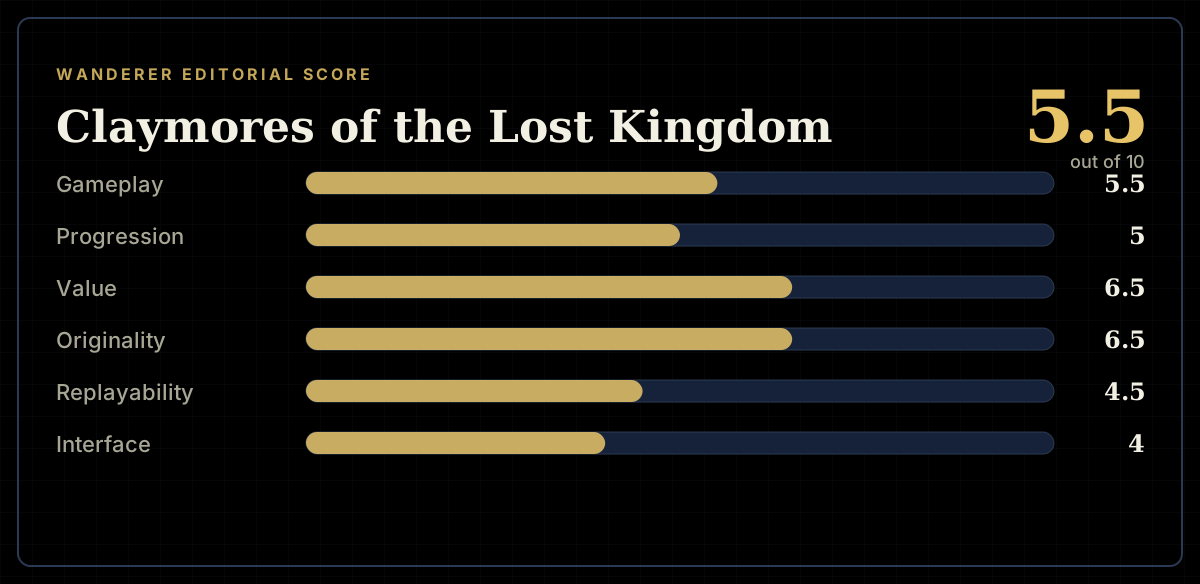
How the review scores each part of the gameWanderer Editorial -
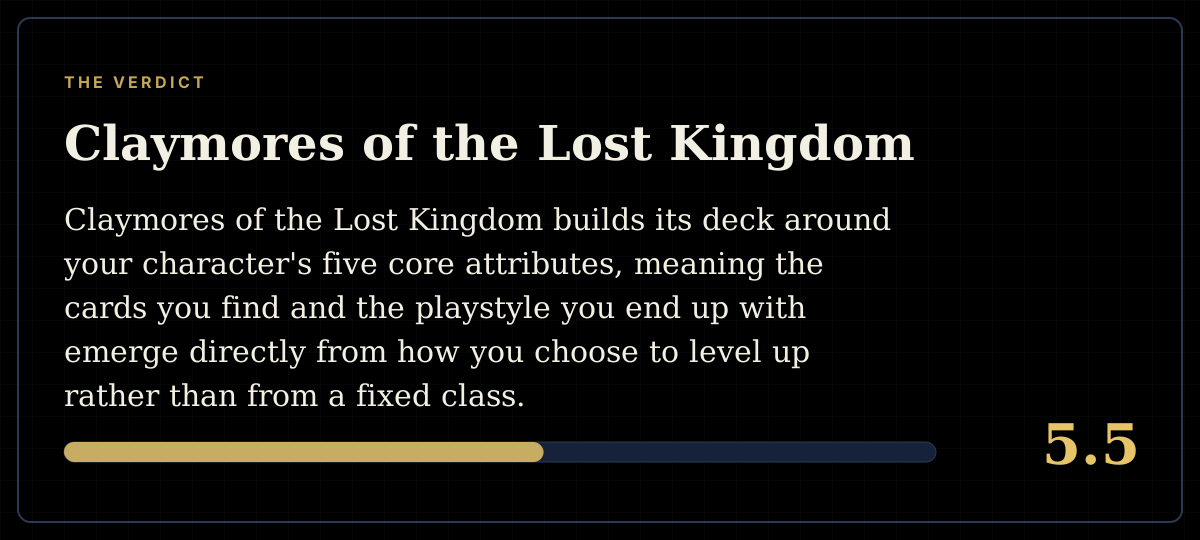
The short versionWanderer Editorial