Game review
Dungeon Infinite
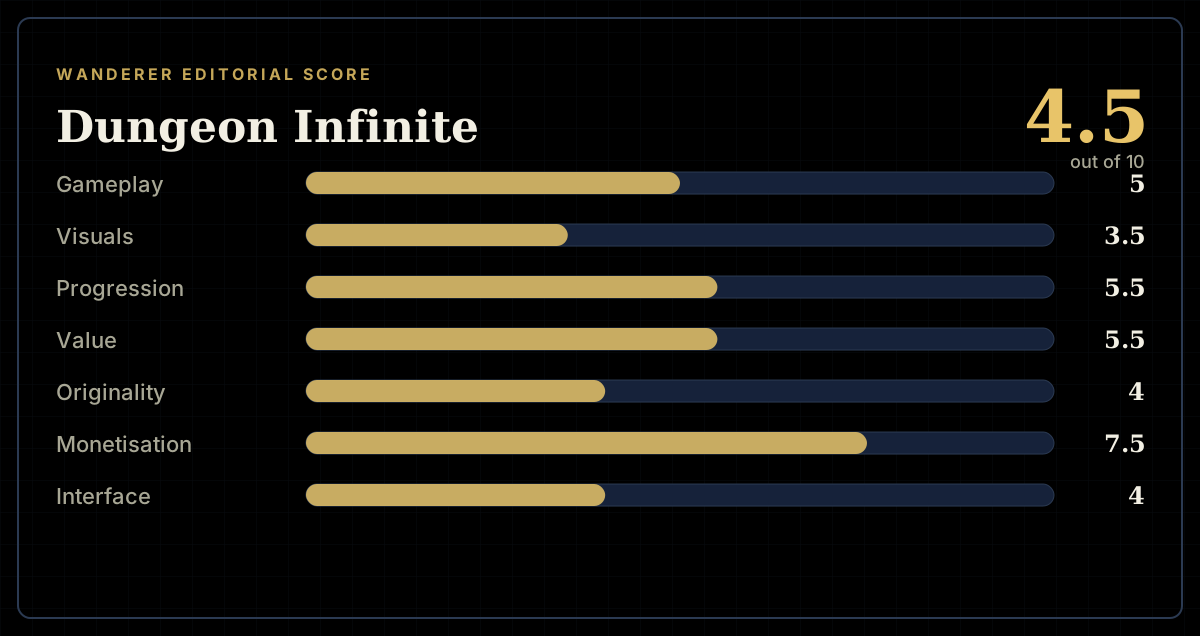
4.5 / 10
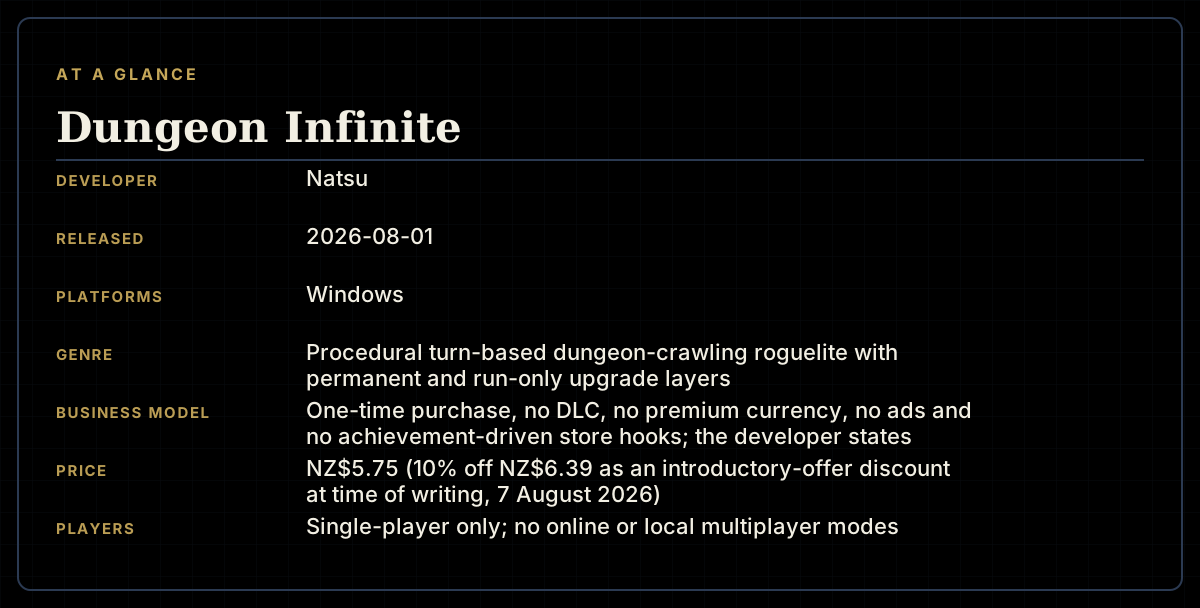
- Developer
- Natsu
- Publisher
- Natsu
- Released
- 1 August 2026
- Platforms
- Windows
- Genre
- Procedural turn-based dungeon-crawling roguelite with permanent and run-only upgrade layers
- Monetisation
- One-time purchase, no DLC, no premium currency, no ads and no achievement-driven store hooks; the developer states plainly that the asking price will rise in steps as more content ships
- Players
- Single-player only; no online or local multiplayer modes
The short version
Dungeon Infinite is a first game, and it plays like one. A knight fights through procedurally arranged rooms of reused, recoloured enemy sprites toward a stated Room 100 goal, banking bones and coins to buy permanent stat upgrades from a main-menu shop and spending gold mid-run on temporary power cards from wandering merchants. That dual economy is a genuinely sound roguelite skeleton, and the developer — a self-described student building their first complete Unity project — says so themselves in the Early Access FAQ, asking players directly to be forgiving and to send feedback. Six days after a launch that entered Early Access with no separate demo-to-1.0 gap, the store page's own minimum system requirement lists 4 MB of RAM, the developer's own FAQ says the UI may be poorly adjusted for some screen sizes, and Steam records zero user reviews and zero concurrent players. None of that makes the loop bad on its own terms. It does make it something nobody outside the studio has yet been able to confirm holds up.
Biggest strengths
- A two-layer economy — permanent stat upgrades bought between runs with banked bones and coins, plus temporary power cards bought mid-run from merchants — gives the roguelite loop a real reason to keep both currencies flowing
- A stated Room 100 challenge target and an estimated 5-10 hour first pass give newcomers a concrete goal rather than an open-ended grind
- Clean one-time-purchase monetisation with no DLC, no premium currency, no ads and no forced account or online requirement
Biggest weaknesses
- Every enemy visible across five official screenshots, from the opening room to a Room 22 capture, is a recolour of the same three or four base sprites (a skeleton, a red variant, a white armoured statue, an orange armoured statue), so the promised procedural variety reads as palette-swapped repetition rather than new content
- Steam's review API and the store page itself both report zero user reviews, and the current-player API returned a concurrent count of 0 at the time of writing, six days after launch — there is no outside signal yet on whether the loop holds up past the opening rooms
- The Steam news feed's only post is a pre-launch demo patch note from 6 July 2026; nothing has been published since the 1 August Early Access launch itself, despite the developer's FAQ promising active, feedback-driven development
Who it's for: Roguelite completionists happy to bankroll a transparent solo first-timer at a low price and revisit in a year, rather than players who want a finished loop today.
Our recommendation: At under six New Zealand dollars there is very little to lose financially, and the developer is unusually upfront about what is and isn't here yet. But the developer's own words are that pricing will rise as content is added, so buying now buys the smallest, least-tested version of the game this listing will ever have — and there is no review, no player count and no patch since launch to say whether the six-hour loop underneath holds up.
4.5 / 10
A knight walks into a procedurally generated dungeon to rescue a kidnapped princess, fighting through room after room of skeletons and armoured statues toward a stated goal of Room 100. That's the whole pitch of Dungeon Infinite, and on its own terms it's a perfectly serviceable roguelite premise. What makes this review different from most of the ones sitting either side of it in this library is who's telling you that pitch: the Early Access FAQ on the store page is signed by a single developer describing this as their first complete, playable game, built to learn Unity, and asking players directly to "be forgiving." That framing has to be the spine of any fair review of it, because six days into a launch the developer says will run for roughly a year before a 1.0, there is no one else's opinion to weigh against it yet.
What's actually in the build
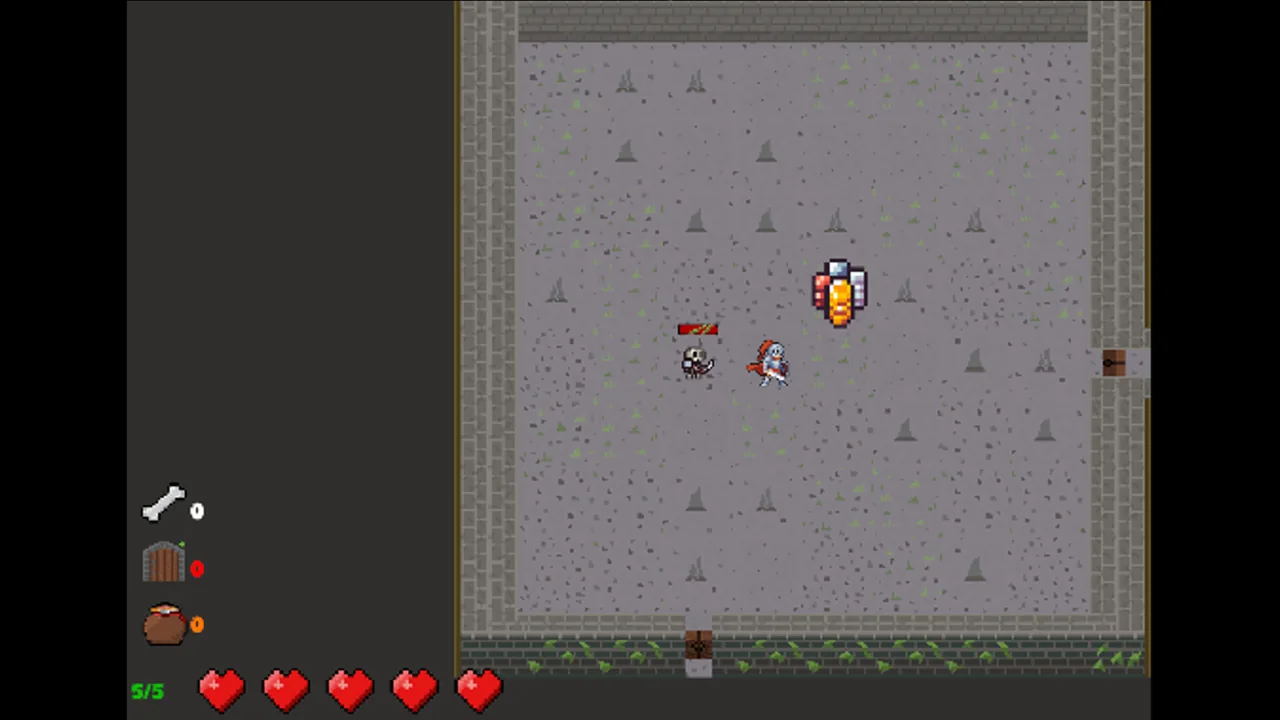
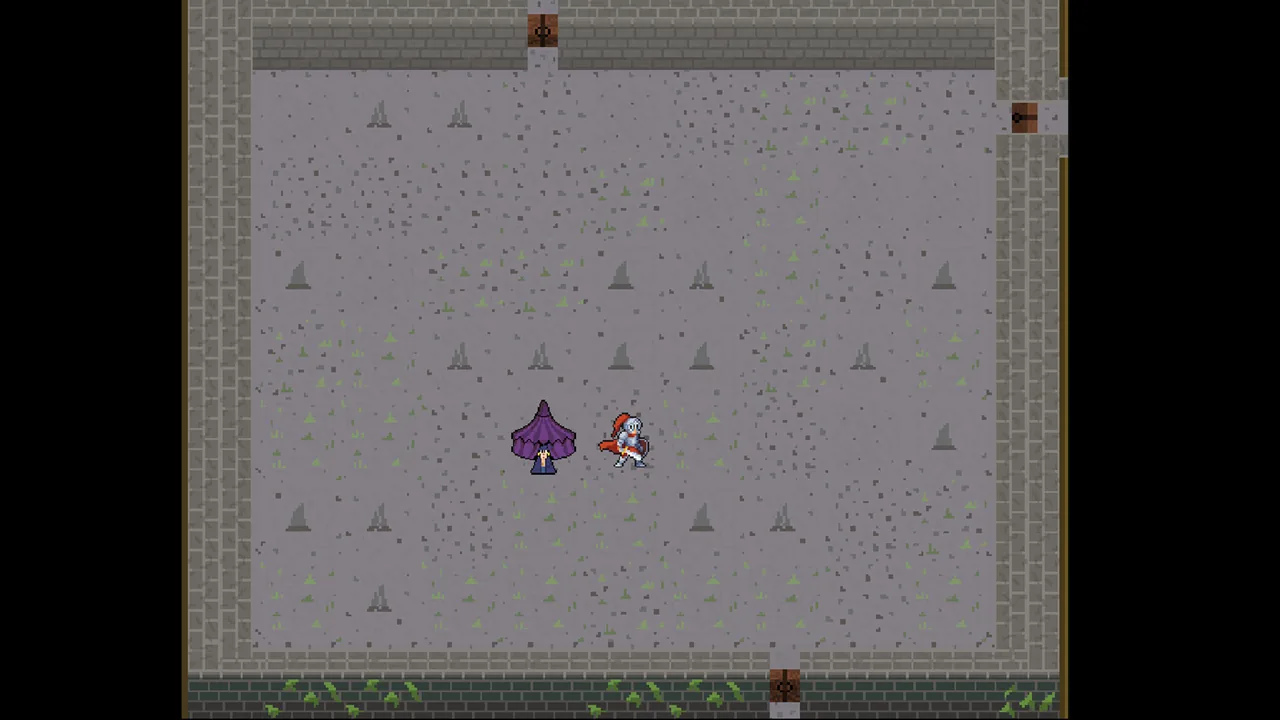
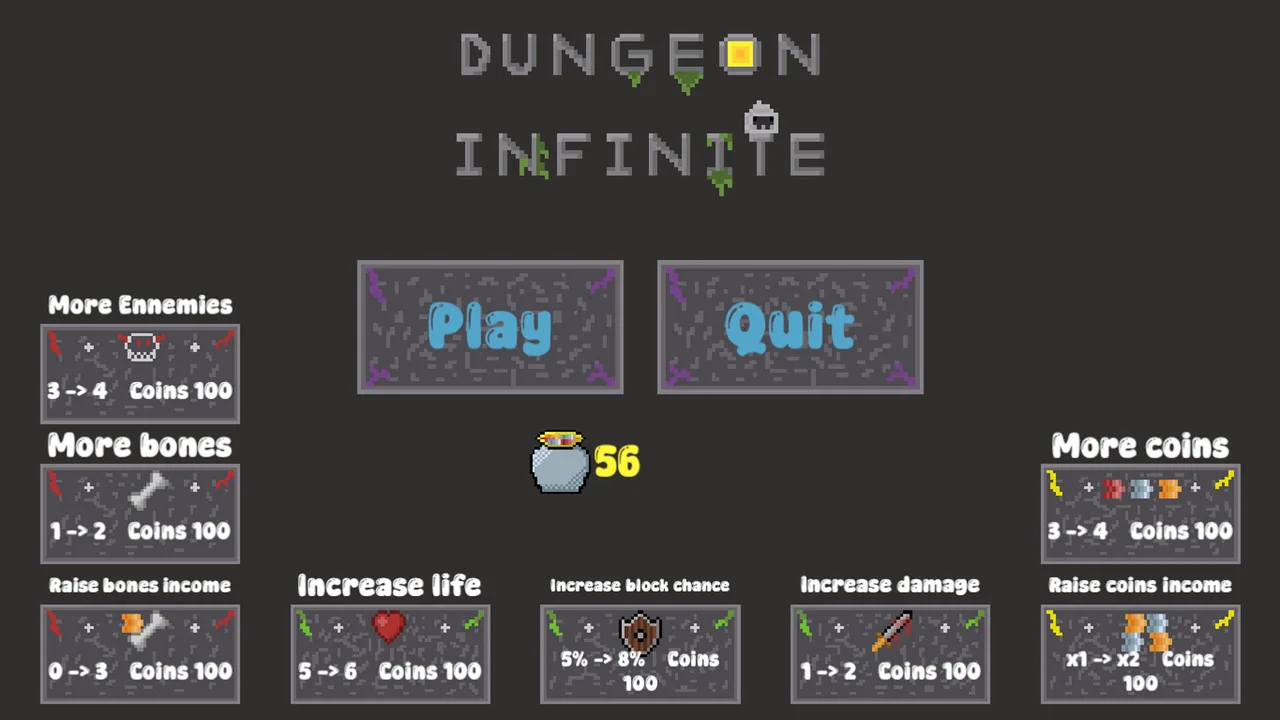
Strip away the marketing and the shape underneath is a fairly standard roguelite double economy. Runs earn two currencies — bones and coins, tracked by icon counters in the bottom-left HUD across every official screenshot — and both currencies do different jobs. Bones and coins banked at the end of a run buy permanent stat increases from a shop built directly into the main menu: "More Enemies," "Raise bones income," "Increase life," "Increase block chance," "Increase damage," "More coins," each shown in the developer's own capture as a numbered step (health 5 → 6, damage 1 → 2, block chance 5% → 8%) at a flat cost of 100 coins per tier in that particular screenshot. Gold earned inside a single run, separately, buys temporary power cards from merchant NPCs encountered mid-dungeon — one capture shows a hooded merchant offering four card choices that boost the same stats as the permanent shop, except for coin generation, plus one-off effects the store description names as invisibility, invincibility and freezing enemies. That's a real design idea, not a cosmetic one: it gives a run two separate reasons to fight cleanly rather than one, and it's the strongest thing in the build.
Structurally, the dungeon is a maze in the literal sense the store page describes: each room is generated on entry, and the only way back the way you came is through the exact same doors in reverse. The screenshots bear that out with door-shaped exits on multiple walls, sometimes three per room, laid over otherwise sparse grey stone floors dotted with the same handful of decorative rock and grass tiles repeated at low density. A HUD counter tracks the room number directly — one capture shows 22 rooms cleared, another the game's title screen quoting the Room 100 target as the headline challenge. The developer's own estimate for a first playthrough is five to ten hours, with one to two hours of that being "constant discovery," which reads honestly as "the rest is repetition once the mechanics have been shown to you."
The enemy roster is thinner than the room count suggests
Here's where the procedural framing runs into trouble. Comparing the earliest combat screenshot against the Room 22 capture, the enemy roster hasn't grown — it's been recoloured. Every combat screenshot in the official gallery shows the same three or four base silhouettes: a small skeleton, a red palette-swap of that skeleton, and two sizes of an armoured, statue-like enemy in white and orange variants. The Room 22 screenshot packs roughly thirty enemies into a single arena-style encounter, arranged in a loose grid with health bars floating over the ones already engaged, and every one of those thirty sprites still traces back to the same handful of base assets. The developer's own store description names "regular skeleton, mutant skeleton, superior skeleton" as the enemy set, which matches what the screenshots show — a single reskin ladder rather than a growing bestiary. That's a defensible scope decision for a solo first project, and it's the kind of thing the FAQ's own roadmap addresses directly: a planned garden biome is described as bringing "different" enemies with "new combat styles" later in Early Access. Right now, though, the room counter climbs a great deal faster than the cast does, and thirty near-identical silhouettes on screen at once reads more like density padding than a hard fight.
A candid roadmap, and an admitted rough edge
Credit where it's due: the Early Access FAQ is one of the more transparent ones this library has read. Asked why Early Access at all, the developer answers plainly: "Because it's my first real game, and I want it to be as enjoyable as possible for players. To do that, I need feedback from players to improve it along the way." Asked how long Early Access will run, the answer is "For one year," with an explicit acknowledgement of inexperience: "I don't know much about all areas of game creation, so I want to take my time." Asked what's rough right now, the answer names it directly: "the UI or HUD may be poorly adjusted for certain screen sizes." None of that is spin. It's also corroborated by the listing itself in a smaller, funnier way — the minimum system requirement field lists 4 MB of RAM and the recommended tier lists 8 MB, several orders of magnitude below anything a 2026 Unity build could plausibly need, and clearly an unedited placeholder rather than a real number. Small on its own, but consistent with a store page that hasn't had a full proofreading pass, on a game whose developer says exactly that about the UI too.
The roadmap itself has real content in it, not just "more stuff": new room events gated behind room counts (including a specific Room 50 event and ladder-accessed secret rooms), and a new garden biome that reskins the dungeon's bricks and stone into greenery with a matching new enemy set. Both are concrete and checkable against future updates, which is more than most Early Access FAQs offer.
Pricing plan, and what "buy now" actually means
The developer answers the pricing question directly too: "I plan to gradually increase the price as I deliver new content and features." At the time of writing the game sits at NZ$5.75, a 10% discount off a NZ$6.39 base as a time-limited introductory offer. Combined with the year-long Early Access plan, that answer has a specific, honest implication worth spelling out for a buyer: the version on sale today is deliberately the cheapest and the least-featured this game will ever be. That's not a trick — it's the standard, fair way to run Early Access pricing, and it rewards early adopters for tolerating a thinner build. But it does mean price-to-content value can't really be assessed as a fixed ratio the way it can for a finished release; it's a bet on a roadmap, priced accordingly low, made by someone who has been unusually clear that it is exactly that.
Nobody else has weighed in yet
There's normally a section here built from what other players are saying, and for Dungeon Infinite there's nothing to draw on. Steam's review API returns a query_summary of zero reviews for the full sample, matching the store page's own "No user reviews" label. The current-player-count endpoint returned 0 twice in a row at the time of writing. The achievement-percentage API returns an empty response rather than a populated curve, meaning the app has no achievement schema at all — this library's usual proxy for where players actually stop playing simply doesn't exist here yet. Steam's community tag list does show substantial vote weight (Early Access sits at 236 applications, Action Roguelike at 214, Exploration at 208), which is a measure of how many visiting accounts have applied a tag to the page — a lighter action than writing a review — so it isn't inconsistent with zero reviews and a near-zero player count, but it does mean the honest genre signal (Action Roguelike, Exploration and Dungeon Crawler all voted well ahead of "Beat 'em up" and "Simulation," a useful correction to the visible genre pills) is coming from browsers and wishlisters rather than people who have actually finished a run. Most tellingly, the developer's own news feed has exactly one post on record, a demo patch note from 6 July 2026 — three and a half weeks before this Early Access build even launched. Nothing has gone out since. For a developer whose own FAQ promises active, feedback-driven updates, six days of silence immediately after launch isn't damning on its own, but it's the first data point worth watching, not the last.
Final verdict
Dungeon Infinite earns a 4.5. The two-currency, permanent-plus-temporary upgrade loop is a sound piece of roguelite design, the pricing plan is honest about what buying early actually means, and the developer's own FAQ is more candid about the game's rough edges than most studios manage even after a full launch. But the build in front of players right now is thin — a handful of recoloured enemy sprites standing in for thirty-plus room's worth of variety, a system-requirements field that reads as an unedited placeholder, an admitted UI scaling problem, and not one outside voice yet to confirm the loop stays fun once the novelty of Room 1 wears off. At under six dollars the financial risk is genuinely small, and this is a reasonable way to support a transparent first-time developer if that's what you're looking to do. It's a much harder case for anyone shopping for a finished six hours of dungeon-crawling today.
Pros and cons
Pros
- A two-layer economy — permanent stat upgrades bought between runs with banked bones and coins, plus temporary power cards bought mid-run from merchants — gives the roguelite loop a real reason to keep both currencies flowing
- A stated Room 100 challenge target and an estimated 5-10 hour first pass give newcomers a concrete goal rather than an open-ended grind
- Clean one-time-purchase monetisation with no DLC, no premium currency, no ads and no forced account or online requirement
- Full voice-acted dialogue in both supported languages (English and French) is unusually thorough audio work for a solo debut project
- The developer's Early Access FAQ is candid rather than promotional, naming specific known issues (UI/HUD scaling) and specific planned content (a room-50 secret-room event, a later garden biome) instead of vague "more content coming" language
Cons
- Every enemy visible across five official screenshots, from the opening room to a Room 22 capture, is a recolour of the same three or four base sprites (a skeleton, a red variant, a white armoured statue, an orange armoured statue), so the promised procedural variety reads as palette-swapped repetition rather than new content
- Steam's review API and the store page itself both report zero user reviews, and the current-player API returned a concurrent count of 0 at the time of writing, six days after launch — there is no outside signal yet on whether the loop holds up past the opening rooms
- The Steam news feed's only post is a pre-launch demo patch note from 6 July 2026; nothing has been published since the 1 August Early Access launch itself, despite the developer's FAQ promising active, feedback-driven development
- The store page's own minimum system requirement lists 4 MB of RAM against a recommended 8 MB, and the developer's FAQ states the UI or HUD "may be poorly adjusted for certain screen sizes" — both point to a listing and a build that haven't had a proofreading or QA pass yet
- The developer states outright that the price will rise in steps as content is added, so the version on sale now is deliberately the cheapest and thinnest this game will ever be, which is honest but also means today's price tag isn't really pricing today's content against tomorrow's
Screenshots
-
Dungeon InfiniteImage: Natsu via Steam -
Dungeon InfiniteImage: Natsu via Steam -
Dungeon InfiniteImage: Natsu via Steam -
The game at a glanceWanderer Editorial -
How the review scores each part of the gameWanderer Editorial -
The short versionWanderer Editorial