
Game review
Artisan TD
6 / 10
- Developer
- 4rtisans
- Publisher
- Unexpected
- Released
- 22 July 2024
- Platforms
- Windows
- Genre
- Maze-building tower defense
- Monetisation
- One-time purchase, no in-game store or additional currency purchases
- Players
- Single-player only
The short version
Artisan TD asks players to build tower mazes across 30 entirely handcrafted maps, explicitly rejecting procedural generation in favour of levels its small team designed by hand. That choice produces a genuinely striking, unusually consistent review sample: a large and vocal share of players describe the game not as a traditional tower defense at all, but as a rigid puzzle wearing a tower defense's clothing, where each map has a single intended solution and any meaningful deviation ends in failure. A comparably sized, equally passionate group of reviewers pushes back hard against that framing, arguing the perceived rigidity is really about learning the game's real rules rather than the genre's usual assumptions, and that flexible retry options and multiple difficulty tiers offer more room to breathe than the critics acknowledge. Both camps are describing the same underlying design accurately; they simply disagree about whether that design is a bait-and-switch or a deliberate, well-executed departure from genre convention.
Biggest strengths
- Visual presentation is consistently praised across the review sample, with reviewers specifically highlighting clean, efficient interface design and appealing stylized 3D art
- The maze-building mechanic, where players reshape the enemy path using tower and wall placement, is repeatedly singled out as a genuinely distinctive centerpiece more central to the design than in most tower defense games
- Flexible retry options, including the ability to rewind to an earlier wave rather than restarting a full level from scratch, are specifically praised by multiple reviewers as a meaningful quality-of-life feature that softens the game's difficulty
Biggest weaknesses
- The single most repeated complaint across the negative sample is that the game plays more like a rigid logic puzzle than a traditional tower defense, with reviewers describing narrow, near-singular winning solutions per level rather than the genre's usual room for varied strategies
- Several reviewers specifically criticise unpredictable design elements, including enemies that don't grant resources and levels with hidden or hard-to-anticipate spawn behaviour, as working against the "figure it out yourself" puzzle framing rather than supporting it
- There is no meta-progression system beyond unlocking new towers, an absence at least one reviewer specifically flags as a missing genre convention
Who it's for: Puzzle-minded strategy fans who enjoy discovering one precise, elegant solution per level and don't mind restarting a wave repeatedly to find it. A poor fit for players who want the genre's usual freeform strategic experimentation and build variety.
Our recommendation: Worth it specifically for players who enjoy tower defense as a logic puzzle rather than an open sandbox — read the negative reviews closely before buying if you're expecting a traditional, flexible tower defense experience, since the mismatch in expectations is the single biggest factor in how much you'll enjoy this.
6 / 10
Artisan TD makes an unusual promise right on its store page: no procedural statistics, no computer-generated waves, just 30 maps its small team designed entirely by hand. For a genre built almost entirely around replayable, semi-randomised challenge, that's a genuinely bold departure — and it produces one of the more sharply divided review samples covered in this lane, not because reviewers disagree about what the game does, but because they disagree fundamentally about whether what it does is good design or a broken promise.
A maze-builder that means it
The central mechanic is refreshingly literal: rather than placing towers along a fixed path, you build the path itself, using towers and walls to funnel enemies through whatever route best serves your strategy. Reviewers across both camps agree this is executed well — "similar to the old Warcraft 3 TD mod," one writes approvingly, name-checking the genre's community-mod roots directly. The visual presentation earns near-universal praise too, with reviewers repeatedly calling out clean interface design and appealing stylised 3D art as genuine strengths regardless of how they feel about the underlying difficulty philosophy.
The complaint that defines the negative sample
Where the sample splits hard is on what that maze-building actually demands of the player. "There's a right way to finish each level and a wrong way," one reviewer writes, a sentiment echoed with striking consistency across dozens of independent negative reviews. "It's a puzzle game themed as towers, which just doesn't feel good," another states, arguing the game denies the genre's usual instant-gratification satisfaction. A particularly detailed account frames the core disappointment precisely: "Resources are so limited that you're forced to find the one optimal solution instead of experimenting and having fun with your own approach." This isn't a handful of confused newcomers — several of these reviewers explicitly identify as longtime tower defense fans specifically disappointed that the genre label didn't prepare them for what they found.
A comparably strong defense from experienced fans
Set directly against that criticism, a meaningfully sized group of equally experienced players makes the opposite case with real specificity. "I don't really understand the bad reviews, claiming there are only one exact way on winning every map. This is absolutely wrong," one reviewer states, having completed the game's hardest Nightmare mode with full stars and perfect health — about as strong a credibility claim as this genre's reviews tend to offer. Another self-described "TD junkie" with over 700 hours in Bloons TD 6 alone frames the game's rigidity as intentional and well-tuned rather than broken: "well defined rules, restricted boundaries, predictable progression... it's really tricky to successfully capture a threshold of difficulty where success feels earned," crediting Artisan TD with hitting that balance where many genre peers don't. This isn't a case of one side being simply wrong — both groups are accurately describing a genuinely demanding, low-margin-for-error design; they disagree about whether that demand is the game failing its own genre or succeeding at a harder one.
Real quality-of-life, and a real gap
To the game's credit, several reviewers specifically praise a meaningful concession to the difficulty: rather than forcing a full level restart after a failed wave, players can rewind to an earlier point and adjust their maze without losing all progress. That's a real, specific design choice that softens what would otherwise be an even harsher trial-and-error loop. What the game doesn't offer, and what at least one reviewer specifically flags as a missing genre convention, is any meta-progression beyond unlocking new towers — no persistent upgrades, no currency to carry between levels, which reinforces the sense that each of the 30 maps is meant to be solved as a standalone puzzle rather than built toward as part of a longer campaign arc.
What the achievement data shows about the real difficulty
Steam's own completion figures offer a useful, independent read on this dispute. Early milestones sit comfortably above 85%, but achievements tied to perfect economy management and precise maze construction on later maps fall as low as 1.8% completion. That's a steep, genuine difficulty curve, and it's consistent with both camps' accounts: most players who try the game do engage meaningfully with its opening hours, but very few achieve the exacting, single-solution mastery the negative reviewers describe as required and the positive reviewers describe as the actual, rewarding point of the exercise.
A studio that has kept building on a divisive foundation
Whatever side of that divide a given player lands on, this review can confirm the developer hasn't treated the disagreement as a reason to walk away. The partner-events feed documents a dense launch-week hotfix cluster addressing early platform-specific issues, followed by two substantial content updates — "The Floating Ruins" in October 2024 and "The Prince Mode" in February 2025 — plus Steam Deck verification in mid-2025 and continued hotfixes into December 2025. That's a genuinely sustained commitment for a small independent team, and notably, the additions have leaned into more of the same handcrafted-puzzle philosophy rather than walking it back toward looser, more traditional tower defense design. That's either reassuring or concerning depending entirely on which side of this review's central divide you fall on, which is itself a fair summary of the whole experience.
Final verdict
Artisan TD is a well-made, handsomely presented tower defense that asks something unusual of its players: treat each of its 30 handcrafted maps as a precise logic puzzle with a real, discoverable solution, rather than an open sandbox for freeform strategic experimentation. Its review sample is split almost entirely along that exact fault line, and both sides are, in their own terms, correct about what the game demands — they simply disagree about whether that demand is a feature or a mismatch with the genre's usual promise. If the idea of a tower defense that plays like a puzzle box appeals to you specifically, this delivers that experience with real craft. If you want the genre's usual freedom to find your own path to victory, look elsewhere.
Pros and cons
Pros
- Visual presentation is consistently praised across the review sample, with reviewers specifically highlighting clean, efficient interface design and appealing stylized 3D art
- The maze-building mechanic, where players reshape the enemy path using tower and wall placement, is repeatedly singled out as a genuinely distinctive centerpiece more central to the design than in most tower defense games
- Flexible retry options, including the ability to rewind to an earlier wave rather than restarting a full level from scratch, are specifically praised by multiple reviewers as a meaningful quality-of-life feature that softens the game's difficulty
- The developer has sustained a dense, multi-year support cadence, including two major content updates and Steam Deck verification, running from the July 2024 launch through patches in early 2026
- Steam achievement data confirms real, substantial long-term challenge, with several of the hardest economy- and maze-focused unlocks sitting below 3%, backing up reviewers' accounts of a genuinely demanding late-game
Cons
- The single most repeated complaint across the negative sample is that the game plays more like a rigid logic puzzle than a traditional tower defense, with reviewers describing narrow, near-singular winning solutions per level rather than the genre's usual room for varied strategies
- Several reviewers specifically criticise unpredictable design elements, including enemies that don't grant resources and levels with hidden or hard-to-anticipate spawn behaviour, as working against the "figure it out yourself" puzzle framing rather than supporting it
- There is no meta-progression system beyond unlocking new towers, an absence at least one reviewer specifically flags as a missing genre convention
- A meaningful and vocal minority of reviewers push back directly against the "one true solution" criticism, arguing it reflects a failure to learn the game's specific rules rather than an actual design flaw, creating real disagreement in the review sample about whether the core criticism is even valid
- The refund-window-length complaint appears repeatedly, with several reviewers noting the game's true difficulty and design philosophy only become clear well past Steam's standard two-hour refund limit
Screenshots
-

Artisan TDImage: Unexpected via Steam -

Artisan TDImage: Unexpected via Steam -

Artisan TDImage: Unexpected via Steam -
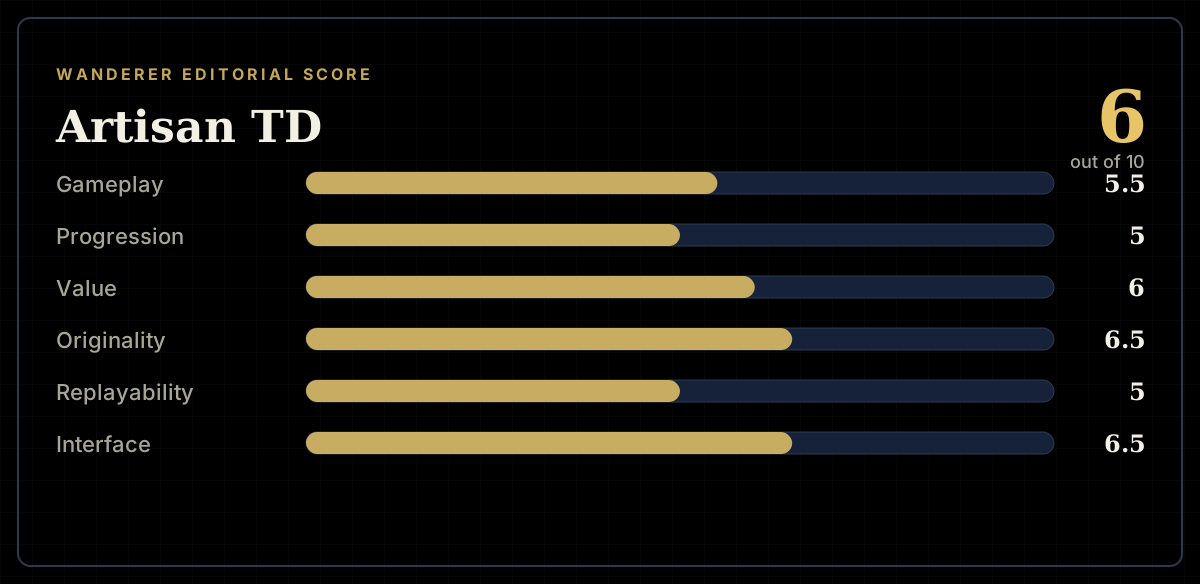
How the review scores each part of the gameWanderer Editorial -
The short versionWanderer Editorial