
Game review
From Glory To Goo
7 / 10
- Developer
- Stratagem Blue
- Publisher
- Stratagem Blue
- Released
- 2 April 2024
- Platforms
- Windows
- Genre
- Horde-defense colony-building RTS
- Monetisation
- One-time purchase, no in-game store or additional currency purchases
- Players
- Single-player only
The short version
From Glory To Goo drops a colony ship into a hostile alien world and asks you to expand, fortify, and hold back an escalating alien menace — the "Goo" — that grows more dangerous the more territory you claim, a structure reviewers immediately and repeatedly recognise from They Are Billions. What's genuinely notable about this review's sample is how many experienced players of that specific genre describe this as not merely a worthy imitator but an outright improvement: deeper faction variety, meaningful captain progression, and a base-building layer with real strategic weight. The developer has backed that reception with one of the most sustained, transparent Early Access support records this lane has documented, patching on a near-weekly cadence for well over two years without interruption. The real, consistent complaint running through the sample concerns presentation and interface rather than design: rough, inconsistent pixel art that several reviewers find genuinely hard to parse, and specific, reproducible UI bugs around building placement and unit selection that get in the way of an otherwise excellent strategic core.
Biggest strengths
- The core horde-defense loop is repeatedly and specifically praised by experienced genre fans as a genuine improvement on They Are Billions, with reviewers citing deeper faction variety, more strategic depth, and meaningful captain-based progression
- Multiple distinct playable factions and captains, each with their own units, skills, and playstyles, give real build variety across different runs rather than a single dominant strategy
- The developer has sustained an exceptionally dense, transparent Early Access update cadence, with numbered content updates and beta-branch previews running on a near-monthly rhythm for well over two years without a significant gap
Biggest weaknesses
- Pixel art quality and consistency draw the single most repeated complaint in the review sample, with reviewers describing some assets as clear and well-crafted while others are described as difficult to identify at a glance, undermining visual clarity during hectic combat
- Multiple reviewers report specific, reproducible UI bugs, including drag-select and building-placement commands registering at the wrong location, requiring manual cleanup that disrupts otherwise smooth play
- Limited unit vision range is a specific, repeated complaint, with reviewers describing frustration at being ambushed from just outside a very small field of view, compounded by a scouting ability that only reveals an area briefly
Who it's for: Fans of They Are Billions-style horde-defense strategy who want a deeper, more varied take on that specific formula, and who are comfortable with genuinely long, tense sessions per map. Less suited to players sensitive to rough pixel-art presentation or expecting a fully polished interface from an Early Access title.
Our recommendation: A strong recommendation for horde-defense strategy fans specifically, offering genuine depth and variety at a price well below the genre's bigger names, with an unusually trustworthy Early Access track record behind it. Go in aware the visual presentation is a real, recurring point of friction for a meaningful share of players.
7 / 10
From Glory To Goo doesn't hide its inspiration: a colony ship crashes into hostile alien territory, and every square of ground you claim draws more of a relentless, escalating alien horde called the Goo down on your base. That's a structure any fan of They Are Billions will recognise instantly, and this review's sample is unusually direct about naming that comparison rather than dancing around it. What's genuinely striking is how often that comparison resolves in this game's favour — reviewers with deep, specific experience in the genre repeatedly describe not a clone, but a meaningful evolution of the formula.
A genre favourite, according to the people who'd know
The praise here isn't generic enthusiasm — it comes with real comparative specificity. "This is like They Are Billions, but already better!!" one reviewer with over 18,700 minutes logged writes, following up after fifty hours to call it "one of those legendary indie titles that pops-up every so often." Another frames the appeal precisely: "did you ever wish you could play a better version of They Are Billions that isn't abandonware for way less the cost and more content? ENTER GOO." A separate account draws a different, equally specific comparison: "RTS Helldivers, starcraft 2 style ground units with hero units, orbital support that you have to improve and expand." That range of comparisons — all specific, all coming from reviewers clearly steeped in the genre — points to a game that's successfully synthesising several well-loved strategy traditions rather than simply reskinning one of them.
Where the presentation lets the design down
Set against that praise, the review sample is remarkably consistent about where the game currently falls short, and it's almost entirely about visual clarity rather than design. "Usually I like Pixel art games, but this here are just pixels without any art. The grade and quality of pixelation varies randomly," one reviewer writes, a complaint echoed by several others describing units that become visually indistinguishable at certain zoom levels. This is a fair and specific criticism — a horde-defense game lives or dies on a player's ability to quickly read the battlefield, and several reviewers describe genuine gameplay frustration stemming directly from visual inconsistency rather than difficulty itself.
Real, reproducible interface friction
Beyond the art style, multiple reviewers report concrete UI bugs rather than vague dissatisfaction. "There are bugs when drag and select and when building, the cursor thinks I'm building way out where I'm pointing. I will then have to del the buildings one by one," one reviewer writes, describing a specific, repeatable annoyance that adds real friction to base management. A separate, equally specific complaint concerns vision range: "your units have a tiny little field of view and you get bombarded from outside your vision all the time. Even the relay ability to reveal an area lasts for like 3 seconds," one reviewer writes, describing a design choice that several find tips over from tense into simply frustrating.
A controversial addition, and a developer who listens anyway
At least one long-session reviewer changed their recommendation to negative specifically over an optional new magic-themed faction, arguing it clashes with the game's established science-fiction tone even though it's not mandatory to engage with. That's a legitimate tonal preference worth naming, though it's worth noting explicitly that the feature is opt-in rather than forced on every playthrough. More broadly, reviewers credit the developer directly with responsiveness to community feedback — "Great Dev who listens to feedback. He has fixed many issues that the community has brought up such as readability," one writes — a claim this review can independently support given the partner-events feed's unusually dense and consistent update history.
An exceptionally well-documented Early Access track record
This review can confirm directly that Stratagem Blue has maintained one of the most sustained, transparent Early Access support records covered in this lane: 97 documented posts running from a November 2023 pre-launch alpha build through a September 2026 patch, with numbered content updates consistently previewed on a beta branch before their full release, and no significant gaps in visible development across the entire period. For an Early Access purchase, that's about as strong a trust signal as this review can independently verify — a real, ongoing commitment rather than a promise made once at launch and left unfulfilled.
What the achievement data says about how far a run actually goes
Steam's own completion figures add a useful independent angle on the game's difficulty and pacing. An early map-clear achievement sits at 55.8%, meaning a solid majority of buyers do successfully complete at least one map, but the curve drops off steeply from there, with several of the rarest captain-unlock achievements sitting below 2%. That's consistent with the review sample's account of a game with real, escalating difficulty across its later factions and hardest maps — not merely a matter of a few reviewers struggling, but a genuine, wide gap between finishing an early map and mastering the game's full roster of captains and biomes.
Worth weighing against session length expectations
It's worth being direct about pacing before recommending this to everyone equally. At least one reviewer reports a single map taking roughly five hours to complete, with a serious late-run mistake capable of costing that entire investment in one horde wave. That's a real, structural feature of the genre this game belongs to — They Are Billions and its peers are built around exactly this kind of high-stakes, long-form tension — but it's worth naming clearly for readers used to shorter session-based strategy games, since the time commitment and loss-aversion here are considerably higher than most other titles covered in this lane.
Final verdict
From Glory To Goo earns genuinely enthusiastic, specific praise from experienced horde-defense strategy fans who describe it as matching or exceeding the genre's most famous name, backed by an unusually well-documented and sustained Early Access development record. Its real weakness is presentation rather than design — inconsistent pixel art and reproducible UI friction that a meaningful share of reviewers find genuinely disruptive to an otherwise excellent strategic core. Worth a strong recommendation for genre fans specifically, especially given the price and the trustworthiness of its ongoing support — just go in aware the visual clarity isn't there yet for everyone.
Pros and cons
Pros
- The core horde-defense loop is repeatedly and specifically praised by experienced genre fans as a genuine improvement on They Are Billions, with reviewers citing deeper faction variety, more strategic depth, and meaningful captain-based progression
- Multiple distinct playable factions and captains, each with their own units, skills, and playstyles, give real build variety across different runs rather than a single dominant strategy
- The developer has sustained an exceptionally dense, transparent Early Access update cadence, with numbered content updates and beta-branch previews running on a near-monthly rhythm for well over two years without a significant gap
- Reviewers specifically credit the developer with actively listening to and acting on community feedback, citing concrete examples like readability improvements made in direct response to player complaints
- At its price, value draws consistent, strong praise, with multiple reviewers explicitly stating they would pay significantly more given the amount of content and quality of design on offer
Cons
- Pixel art quality and consistency draw the single most repeated complaint in the review sample, with reviewers describing some assets as clear and well-crafted while others are described as difficult to identify at a glance, undermining visual clarity during hectic combat
- Multiple reviewers report specific, reproducible UI bugs, including drag-select and building-placement commands registering at the wrong location, requiring manual cleanup that disrupts otherwise smooth play
- Limited unit vision range is a specific, repeated complaint, with reviewers describing frustration at being ambushed from just outside a very small field of view, compounded by a scouting ability that only reveals an area briefly
- At least one long-session reviewer changed their recommendation to negative after the developer introduced an optional magic-themed faction, arguing it clashes tonally with the game's established science-fiction setting, even though the addition is not mandatory
- Individual maps can run extremely long, with at least one reviewer reporting roughly five hours to complete a single map and describing a single misstep as capable of costing that entire investment, a real barrier for players with limited session time
Screenshots
-

From Glory To GooImage: Stratagem Blue via Steam -

From Glory To GooImage: Stratagem Blue via Steam -

From Glory To GooImage: Stratagem Blue via Steam -
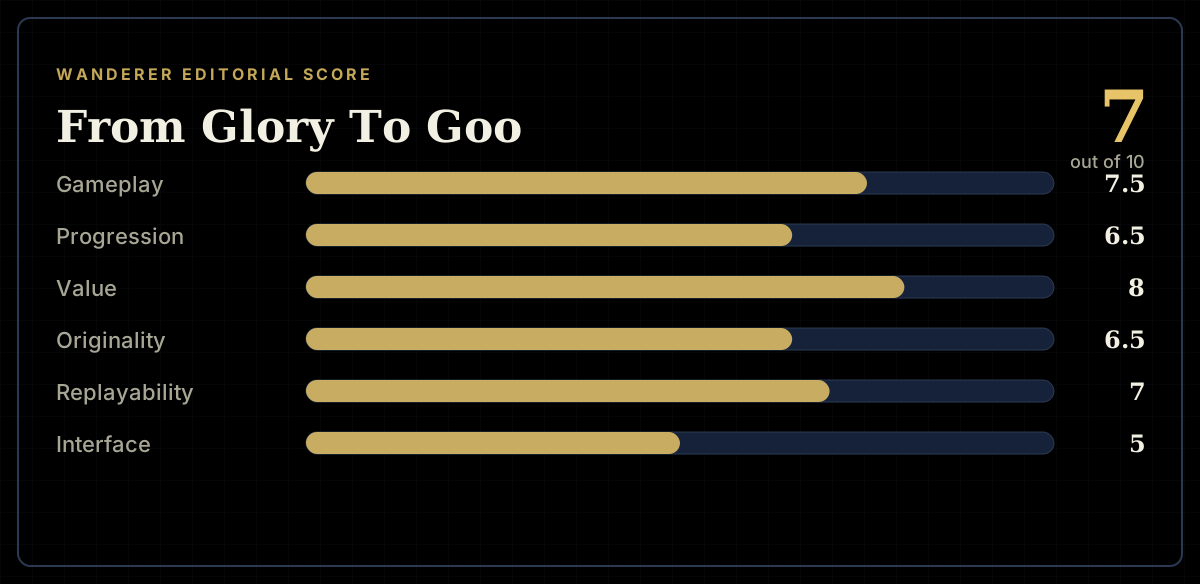
How the review scores each part of the gameWanderer Editorial -
The short versionWanderer Editorial