
Game review
JudgeSim
7 / 10
- Developer
- DelusionArt Studio
- Publisher
- DelusionArt Studio
- Released
- 16 July 2024
- Platforms
- Windows
- Genre
- Text-based courtroom simulation with narrative branching
- Monetisation
- One-time purchase, no in-game store or additional currency purchases
- Players
- Single-player only
The short version
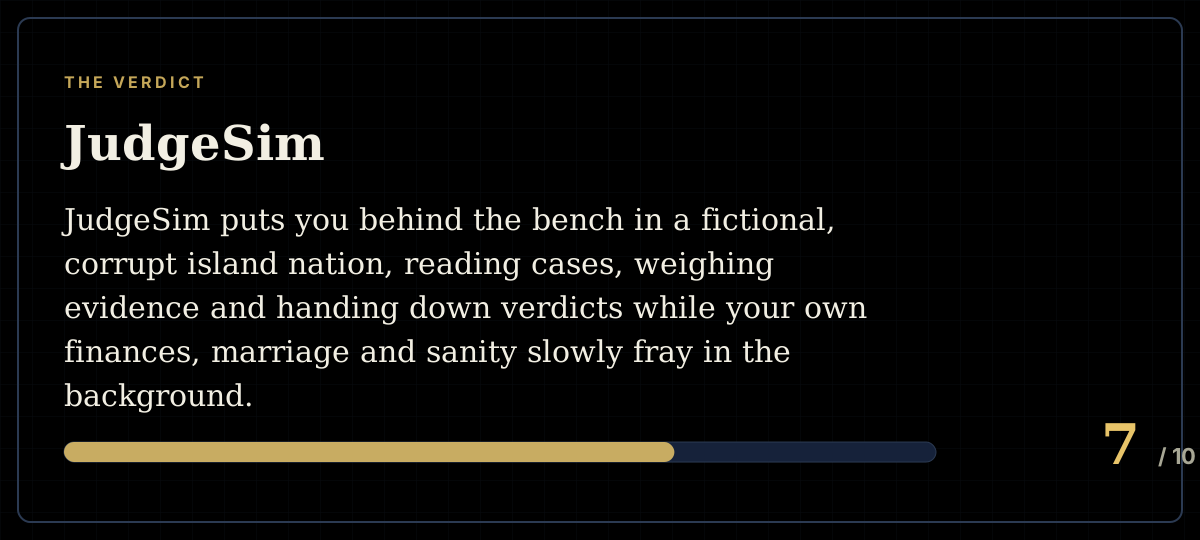
JudgeSim puts you behind the bench in a fictional, corrupt island nation, reading cases, weighing evidence and handing down verdicts while your own finances, marriage and sanity slowly fray in the background. It's a debut project from a small studio, and the writing carries it a long way — reviewers repeatedly place it alongside Papers, Please and This Is the Police as a worthy addition to the genre. What drags the score down is a single, specific mechanic: a dice-roll system governing whether you get arrested or assassinated that a large share of reviewers, positive and negative alike, single out as disconnected from the actual choices you make, and Steam's own achievement data confirms over 40% of the entire playerbase has been arrested by it at least once.
Biggest strengths
- Case writing and the underlying "Banana Republic" satire draw consistent, specific comparisons to Papers, Please, This Is the Police and 60 Seconds, with multiple reviewers calling the narrative the game's strongest element
- A first-time solo studio shipped a genuine year-plus support cadence — over a dozen hotfixes in the first two weeks after launch, a full "I'm the Law" mode addition in October 2024 built from real cases and true crime, and further bugfixes through mid-2025 — directly contradicting a reviewer claim that the developer abandoned the game after launch
- Family and mental-health management systems (an expensive spouse, an alcohol-dependent sanity mechanic) give the core judging loop real pressure beyond simply picking the "correct" verdict each case
Biggest weaknesses
- A dice-roll system determining arrest or assassination risk is the single most repeated complaint across the review sample, described as unconnected to the player's actual choices and as turning the back half of the game into repeated save-reloads rather than meaningful decision-making
- Steam's own achievement data confirms the scale of this: 40.8% of the entire playerbase has triggered the arrest achievement, a remarkably high share for a mechanic reviewers say feels arbitrary rather than earned
- At least one reviewer explicitly disputes that the branching choices matter as much as advertised, reporting only two practical endings despite the narrative's dilemma-driven framing
Who it's for: Fans of Papers, Please, This Is the Police, or 60 Seconds who want a text-heavy moral-dilemma simulator with real narrative stakes, and who can tolerate a save-scumming workaround for a mechanic several long-time players consider the game's one serious flaw.
Our recommendation: Recommended for the writing and the case-by-case judgment loop alone, which is strong enough to have driven genuine word-of-mouth attention via streamers. Go in prepared to save frequently once your arrest or assassination percentage climbs, since the dice-roll system it's attached to is the most consistently criticised part of an otherwise well-received debut.
7 / 10
JudgeSim's setup reads like a checklist of the genre it's borrowing from: a fictional, crumbling nation called Banana Republic, a civil servant trying to do an honest job inside a corrupt system, and a slow accumulation of pressure — financial, marital, psychological — that eventually determines how the story ends. That's the Papers, Please and This Is the Police formula almost beat for beat, and reviewers say so openly. What makes JudgeSim worth discussing on its own terms is how much of that formula it executes well for a first project from a small studio, and how one specific design decision — a literal dice roll standing between you and arrest or assassination — has become the single thing almost every reviewer, positive or negative, wants to talk about.
Reading a case, weighing a verdict
The core loop is straightforward on paper: read a case file, examine the evidence presented, question the accused, and hand down a verdict and sentence within the bounds of Banana Republic's law. Reviewers consistently praise the writing behind this loop specifically — one calls the judgments "fun, varied, and interesting," crediting the game for introducing "just enough new rules... every so often that it stays interesting but not so many that it becomes overwhelming." Side litigation covering divorce, custody, inheritance and compensation disputes adds texture between the game's larger criminal cases, framed by the developer's own description as deliberately ambiguous moral territory rather than clear-cut right-and-wrong scenarios. Multiple reviewers place the writing specifically alongside 60 Seconds!, Papers, Please and the horror-adjacent That's Not My Neighbor as genre company it earns rather than simply imitates.
A judge with a mortgage and a marriage
What elevates the loop above a simple case-by-case quiz is the pressure layered underneath it: a demanding spouse who pushes for purchases the player's salary can't comfortably support, an escalating cost of living, and a mental-health mechanic that's managed largely through alcohol — itself getting more expensive over the course of the story. One reviewer sums up the effect bluntly: "your wife's expensive tastes are the most deadly aspect of this game... she's ready, willing and able to rocket you to the poorhouse and tank your sanity." Another describes struggling to keep mental health up "without being an alcoholic," and notes the escalating price of whiskey as a specific, deliberately punishing design choice rather than an oversight. These systems give consequence to decisions beyond simply picking the legally "correct" verdict in each case, and several reviewers cite them as what kept them invested across sessions running well past the ten-hour mark, with logged playtimes as high as 38 and 50 hours among the most dedicated reviewers.
The dice roll almost everyone brings up
Set against that, one mechanic draws sustained, specific criticism across nearly the entire sample: a percentage-based dice roll that determines whether the player character gets arrested or assassinated, seemingly independent of the actual verdicts and choices made in-game. One reviewer calls it out directly: "the chance to be assassinated and/or arrested doesn't feel linked to anything I did... the dice roll adds nothing to the game." Another, more pointed, describes reaching a state where they had "an 85% to die/get arrested," forcing them to restart the same in-game day repeatedly just to progress, and concludes that "the dice mini-game makes the game almost unplayable towards the end." A third reviewer who otherwise enjoys the writing says plainly they "cannot progress because I have a 90% chance of getting arrested." This isn't a minority complaint confined to negative reviews — it shows up inside multiple reviews that still recommend the game overall, which is the clearest sign of how widely felt it is. Steam's own achievement data backs the scale of the complaint with a hard number: 40.8% of the entire tracked playerbase has triggered the arrest achievement, an unusually high rate for a fail-state mechanic that so many reviewers describe as arbitrary rather than earned through play.
Endings, and a dispute about how much choice actually matters
The store page promises that "the decisions you make will affect the story's ending," and most of the sample takes that promise at face value, treating the narrative as genuinely responsive to play. At least one reviewer pushes back hard on this specific claim, arguing the game "could've been a Papers Please-like game where your actions ultimately determine the end of the story," but that in practice it offers "pretty much only two endings" layered on top of the RNG-driven arrest and assassination system rather than meaningful branching from case decisions themselves. Steam's achievement data offers some support for real ending variety — a "Mad" ending achievement sits at 28.6% and a separate "Elegance" ending at 27.3%, suggesting multiple distinct outcomes are genuinely reachable — but it doesn't resolve whether those outcomes are earned through case-by-case choices or largely determined by the same dice mechanic reviewers already distrust.
A debut the developer kept supporting
One negative review makes a specific, checkable claim worth addressing directly: that JudgeSim is "very clearly a pump and dump from the developer who has no intention of updating the game beyond what it already is." Steam's own partner-events feed for the game disproves this plainly. DelusionArt Studio shipped roughly a dozen numbered hotfixes in the first two weeks after the 16 July 2024 launch, followed by substantial content updates through August and September, and then a genuinely new mode — "I'm the Law," built from real cases and true-crime material — in late October 2024, three months after release. Bugfixes continued into July 2025, and as recently as June 2026 the studio posted a further JudgeSim bugfix on the same day it announced a new project, Space Savory, showing continued attention to this game rather than a clean handoff to something else. Whatever the arrest-dice complaint says about the game's design, the abandonment claim specifically does not hold up against the public record.
A tutorial that assumes too much
A smaller but recurring complaint concerns onboarding rather than any single system: multiple reviewers mention the tutorial failing to explain a mechanic that becomes important later in a playthrough, leaving players to discover it through trial, error, or community discussion rather than in-game guidance. One reviewer who otherwise calls the game "fantastic" flags this specifically as a fixable gap rather than a fundamental flaw, noting the mechanic "is really not obvious at first" and can cause real frustration before a player works out what's happening.
Final verdict
JudgeSim earns its Very Positive standing on the strength of its writing and its willingness to layer real financial and psychological pressure onto what could have been a simple right-or-wrong verdict quiz — a genuinely accomplished debut for a small studio, backed by more than a year of real, verifiable post-launch support rather than the launch-and-abandon pattern one reviewer alleges. What keeps it from scoring higher is a single, well-documented mechanic: an arrest-and-assassination dice roll that a wide cross-section of its own audience, including many who recommend the game overall, calls disconnected from the choices the rest of the game asks you to care about. If that one system gets tuned or removed, this is a considerably stronger game than its current review sample already rates it; as it stands, it's a strong recommendation with an asterisk attached to its back half.
Pros and cons
Pros
- Case writing and the underlying "Banana Republic" satire draw consistent, specific comparisons to Papers, Please, This Is the Police and 60 Seconds, with multiple reviewers calling the narrative the game's strongest element
- A first-time solo studio shipped a genuine year-plus support cadence — over a dozen hotfixes in the first two weeks after launch, a full "I'm the Law" mode addition in October 2024 built from real cases and true crime, and further bugfixes through mid-2025 — directly contradicting a reviewer claim that the developer abandoned the game after launch
- Family and mental-health management systems (an expensive spouse, an alcohol-dependent sanity mechanic) give the core judging loop real pressure beyond simply picking the "correct" verdict each case
- Reviewers report deep engagement once invested, several logging 35-50 hours and describing the game as "immersive" with rewarding attention to lore detail for a debut project
- The game found real organic reach through streamer coverage (multiple reviewers name Caseoh and Paluten specifically as their reason for buying), a rare, verifiable word-of-mouth success story for a small studio's first release
Cons
- A dice-roll system determining arrest or assassination risk is the single most repeated complaint across the review sample, described as unconnected to the player's actual choices and as turning the back half of the game into repeated save-reloads rather than meaningful decision-making
- Steam's own achievement data confirms the scale of this: 40.8% of the entire playerbase has triggered the arrest achievement, a remarkably high share for a mechanic reviewers say feels arbitrary rather than earned
- At least one reviewer explicitly disputes that the branching choices matter as much as advertised, reporting only two practical endings despite the narrative's dilemma-driven framing
- One reviewer with legal-adjacent knowledge calls the case writing itself shoddy on points of actual law, a specific counterpoint to the many reviews praising the writing in general terms
- A frequently mentioned tutorial gap leaves at least one core late-game mechanic unexplained until players stumble onto it themselves, a source of reported frustration even among reviewers who otherwise recommend the game
Screenshots
-

JudgeSimImage: DelusionArt Studio via Steam -

JudgeSimImage: DelusionArt Studio via Steam -

JudgeSimImage: DelusionArt Studio via Steam -
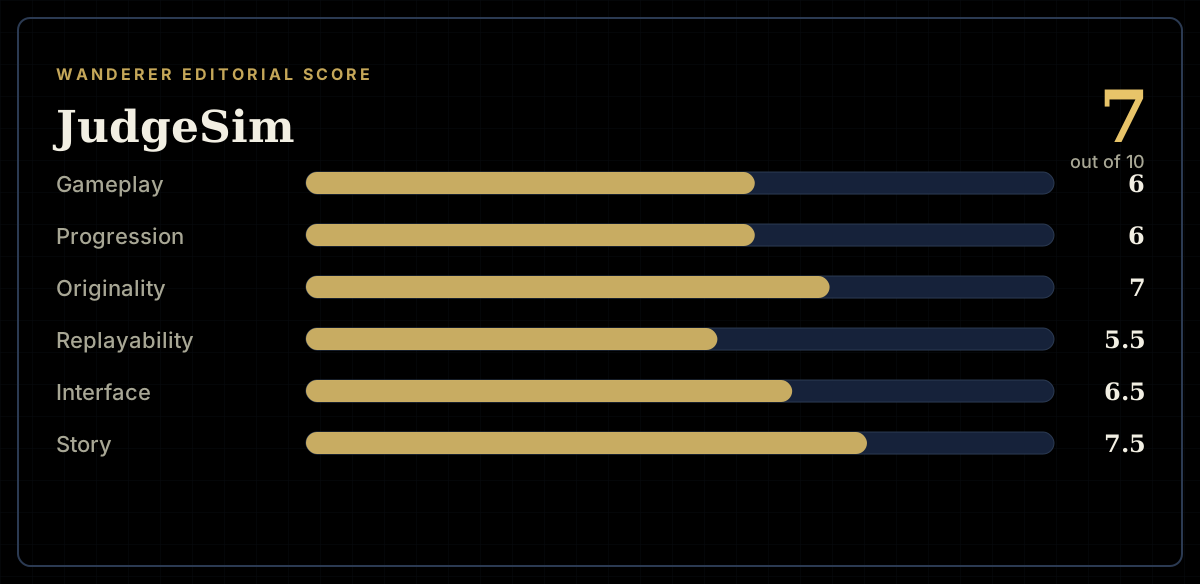
How the review scores each part of the gameWanderer Editorial -
The short versionWanderer Editorial