
Game review
Happy Sheepies
5 / 10
- Developer
- Berker Games
- Publisher
- Berker Games
- Released
- 8 July 2024
- Platforms
- Windows
- Genre
- Drag-and-drop farming and crafting business sim
- Monetisation
- One-time purchase, no in-game store or additional currency purchases
- Players
- Single-player only
The short version
Happy Sheepies asks you to feed, breed, and harvest from a growing flock of sheep, dragging resources between stations to craft ever more profitable goods and expand a small farming business. The art and sound design draw genuine, consistent praise, and the demo's popularity before launch — over a million plays — speaks to real early appeal. What dominates the review sample once players get past that first charming hour, though, is a specific and remarkably consistent set of complaints: near-total absence of automation forcing constant, tiring manual interaction; a rigidly linear quest structure with almost no player freedom; and a mandatory requirement to slaughter sheep to progress that a meaningful number of players describe as genuinely upsetting given the game's cute, cozy framing. A separate, widely repeated claim across many independent reviews accuses the game of closely cloning Stacklands, a well-known indie card-based settlement game, in its art style, sound, and core mechanics.
Biggest strengths
- Art style and sound design draw sustained, specific praise across nearly the entire review sample, described repeatedly as "cute," "charming," and well-composed regardless of how a given reviewer felt about the underlying gameplay
- The free public demo reached over a million plays before the full release, a genuinely large and verifiable signal of early interest in the core concept
- Several reviewers describe a genuinely addictive first few hours, with at least one reporting nine hours spent in a single sitting without noticing the time pass
Biggest weaknesses
- A striking number of independent reviewers, across both positive and negative reviews, accuse the game of closely cloning Stacklands, a well-known indie card-based settlement game, citing similarities in art style, music, sound effects, and core mechanics specifically enough that this reads as a genuine, repeated concern rather than an isolated grievance
- The near-universal complaint across the entire sample is a lack of automation, with reviewers describing constant, unbroken manual dragging and clicking that several say left their fingers physically sore and made the advertised "relaxing" framing feel inaccurate
- Progressing through the game's quests is reported as rigidly linear, locking players into completing objectives in a fixed order rather than allowing free exploration of the systems on offer, with multiple reviewers describing the entire experience as feeling like an extended tutorial
Who it's for: Players drawn specifically to the cute art style and short session length who don't mind constant active management rather than a relaxing background loop, and who are comfortable with a farming game that requires killing its own mascot animals to finish.
Our recommendation: Worth trying the free demo first given how directly it represents the full game's pacing and systems. Go in aware that "relaxing" is not how a large share of the game's own reviewers describe playing it, and that progressing requires slaughtering sheep regardless of an in-game toggle some reviewers say doesn't fully remove the underlying dependency on meat products.
5 / 10
Happy Sheepies looks, on its store page, exactly like what its name promises: a cute, drag-and-drop farming game about keeping a flock of sheep content while building a small crafting business around them. Its free demo reached over a million plays before the full release, a genuinely substantial signal that the pitch works on first impression. What the review sample argues about at length, and in remarkably consistent terms across both its positive and negative halves, is what happens once that first impression wears off.
Charm that almost everyone agrees on
Whatever else divides the review sample, art and sound direction don't. Reviewers across the board call the presentation "cute," "charming," and well-composed, and this praise shows up as often in negative reviews explaining why they still can't recommend the game as it does in five-star raves. Several reviewers describe a genuinely addictive early stretch — one reports losing nine hours in a single sitting, surprised at how much time had passed. That's a real, specific strength, and it's consistent with why the demo drew as much attention as it did before launch.
The complaint almost nobody disagrees with
Set against that shared appreciation for the presentation is an equally shared complaint about the moment-to-moment gameplay: there's very little automation, and the game asks for near-constant manual dragging and clicking as a result. This isn't confined to the negative reviews — it shows up just as clearly inside reviews that ultimately recommend the game. "I would advise for more automation," one positive reviewer writes plainly. Another, also recommending the game, describes the toll directly: "the constant clicking and dragging... my fingers even ended up slightly sore from the repetitive motions." A third sums up the resulting mismatch between marketing and experience bluntly: "the days pass by way too quickly for the game to be relaxing." For a game explicitly pitched as a "relaxing sheep farming game," having this specific complaint recur across reviewers who otherwise like the game is a stronger signal than if it only came from people bouncing off early.
A structure with almost no give
A related complaint concerns how rigidly the game gates its own content. Multiple reviewers describe being locked into completing quests in a fixed order, unable to explore the crafting systems on their own terms even once they're technically unlocked. "The entire game feels like it is in tutorial mode," one reviewer writes; another states plainly that "everything is locked until you complete the orders in order." This compounds the automation complaint rather than standing apart from it — a linear structure combined with constant manual interaction means there's rarely a moment where a player gets to simply watch their farm run and enjoy what they've built, which several reviewers specifically say is what they'd expected from the genre.
A specific, emotionally loaded requirement
The most pointed and recurring complaint in the sample concerns a specific mechanic: progressing through certain quests and achievements requires slaughtering sheep. For a game built entirely around cute, named animals the player is encouraged to grow attached to, this lands hard for a meaningful number of reviewers. "I am super disappointed that murdering sheepies is required to progress in-game," one writes, describing having "grown so attached" before being asked to kill their first sheep. Another calls it directly: "you cannot progress in the game if you do not murder your sheepies." The game does include a "butchery" toggle in its settings, and at least one reviewer confirms this exists and works to some degree — but the same reviewer adds a specific caveat: "the game is still very dependent on meat and meat byproducts even with the butchery setting turned off," meaning the toggle appears to soften rather than remove the underlying design tension between the game's cozy branding and its mechanical requirements.
A specific, repeated accusation worth reporting plainly
A separate, serious claim recurs often enough across independent reviewers to warrant direct attention rather than a passing mention: a striking number of reviewers accuse the game of closely cloning Stacklands, a well-regarded indie card-based settlement game, citing specific similarities in art style, music, sound effects, and core mechanics. "This game is tit for tat a copy of Stacklands," one reviewer writes; another, more pointed, calls the developers "thieves, not developers." This review cannot independently verify a claim of direct asset or code copying, and it's worth noting the two games are mechanically distinct in meaningful ways — Stacklands is card-based, while Happy Sheepies uses direct drag-and-drop placement without stacking. But the volume and specificity of the comparison, coming from reviewers who clearly know Stacklands well enough to draw detailed parallels, is a genuine and repeated concern rather than an isolated grievance, and it's worth reporting as exactly that: a widely-held reviewer perception this review could not confirm or refute.
Accounts of confrontational developer conduct
A final, separate concern involves how the developer has responded to critical reviews. One reviewer describes being contacted directly on the developer's public Discord channel, with the developer expressing being "hurt" by their review. Another reviewer, updating a review over a year after posting it, states the developer responded by "trying to claim I'm lying and misleading," using the word "gaslight" to describe the exchange. This review cannot independently verify either account beyond what the reviewers themselves describe, but two separate, specific reports of the developer directly disputing or emotionally confronting reviewers over negative feedback is worth flagging plainly for buyers who weigh developer conduct as part of a purchase decision.
Final verdict
Happy Sheepies has real, genuine charm in its art and sound, and enough short-term addictive pull to explain why its free demo reached over a million plays before launch. But the review sample — including reviewers who ultimately recommend the game — describes a remarkably consistent set of problems once that charm has to carry a full playthrough: near-total absence of automation turning a cozy premise into repetitive manual labour, a rigidly linear structure with little room for player freedom, and a mandatory animal-slaughter requirement that sits uneasily against the game's own cute branding. Layered on top of that is a widely repeated, unverified accusation of cloning a better-known game, and specific accounts of the developer responding combatively to criticism. Try the free demo first — it's an accurate representation of what the full game asks of you — and weigh the concerns above honestly before deciding whether the charm is worth the trade-offs.
Pros and cons
Pros
- Art style and sound design draw sustained, specific praise across nearly the entire review sample, described repeatedly as "cute," "charming," and well-composed regardless of how a given reviewer felt about the underlying gameplay
- The free public demo reached over a million plays before the full release, a genuinely large and verifiable signal of early interest in the core concept
- Several reviewers describe a genuinely addictive first few hours, with at least one reporting nine hours spent in a single sitting without noticing the time pass
- The core drag-and-drop crafting-chain concept, when it works, draws praise for feeling "deceptively complex" without becoming overwhelming, giving early business decisions real weight
- The developer has continued supporting the game well past launch, with a version 1.0.221 update in November 2025 and a "500 Reviews" community milestone post in March 2026, showing continued attention over roughly two years
Cons
- A striking number of independent reviewers, across both positive and negative reviews, accuse the game of closely cloning Stacklands, a well-known indie card-based settlement game, citing similarities in art style, music, sound effects, and core mechanics specifically enough that this reads as a genuine, repeated concern rather than an isolated grievance
- The near-universal complaint across the entire sample is a lack of automation, with reviewers describing constant, unbroken manual dragging and clicking that several say left their fingers physically sore and made the advertised "relaxing" framing feel inaccurate
- Progressing through the game's quests is reported as rigidly linear, locking players into completing objectives in a fixed order rather than allowing free exploration of the systems on offer, with multiple reviewers describing the entire experience as feeling like an extended tutorial
- A specific, emotionally significant complaint recurs throughout the sample: slaughtering sheep is mandatory to progress certain quests and achievements, and while a "butchery" toggle exists in settings, at least one reviewer reports the game remains dependent on meat and meat byproducts even with it enabled
- Multiple reviewers describe direct, confrontational responses from the developer to their negative reviews, including one account of being contacted on Discord about how "hurt" the developer was by a review, and a separate account of the developer publicly disputing a reviewer's year-old review as "lying and misleading"
Screenshots
-

Happy SheepiesImage: Berker Games via Steam -

Happy SheepiesImage: Berker Games via Steam -

Happy SheepiesImage: Berker Games via Steam -
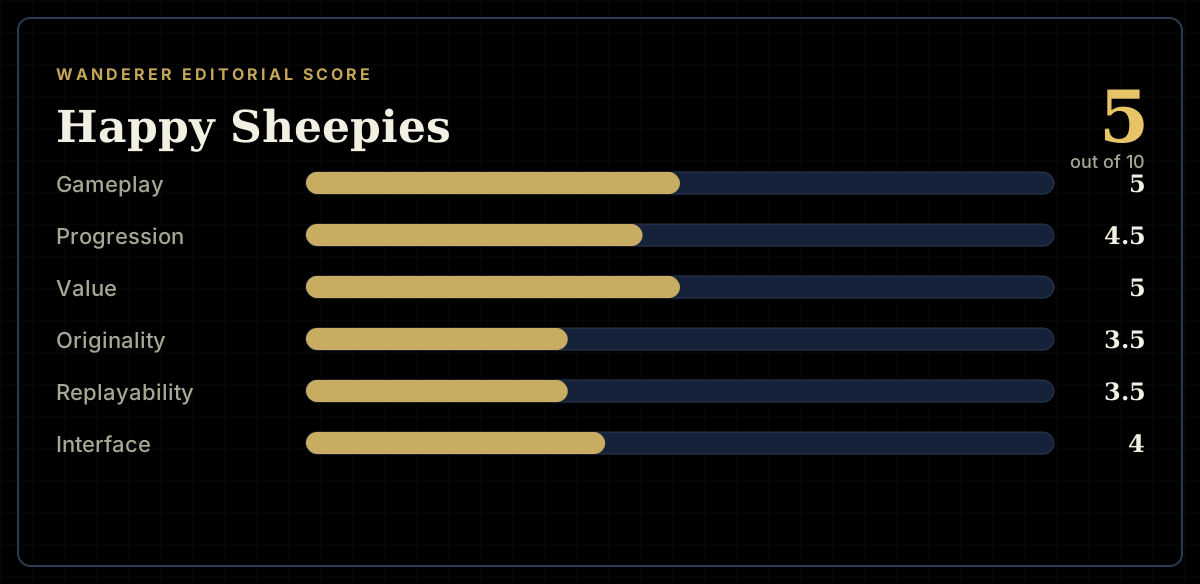
How the review scores each part of the gameWanderer Editorial -
The short versionWanderer Editorial