
Game review
Cronos: The New Dawn
6.5 / 10
- Developer
- Bloober Team
- Publisher
- Bloober Team SA
- Released
- 5 September 2025
- Platforms
- Windows
- Genre
- Survival Horror
- Monetisation
- One-time purchase, optional Deluxe Edition upgrade
- Players
- Single-player
The short version
Cronos: The New Dawn casts you as a Traveler jumping between a ravaged future wasteland and 1980s Poland, harvesting souls from the past to prevent an apocalyptic future while burning down monsters before they can Merge — absorbing the corpses of the fallen to grow faster, tougher and more dangerous. It's Bloober Team's first wholly original survival-horror property since the studio's well-received Silent Hill 2 remake, and reviewers consistently credit the atmosphere, sound design and the Merge system itself as genuinely distinctive strengths, with several describing surprising, sustained engagement across 15-to-21-hour playthroughs. Set against that praise is a technical problem the studio has now been called out for twice in a row: severe stuttering and frame-rate drops reported even on top-tier hardware like an RTX 4090 paired with a 7800X3D, a near-identical complaint to the one that dogged Bloober's own Silent Hill 2 remake. A second, more subjective complaint concerns the writing, which a substantial minority call generic science-fiction dressing over a story that doesn't earn its runtime.
Biggest strengths
- The Merge system — where unburned enemy corpses can be absorbed by other monsters to become faster, tougher and more dangerous — draws specific, repeated praise as a genuinely inventive twist on survival-horror's usual resource-and-threat management, forcing real tactical urgency around finishing kills properly
- Atmosphere, sound design and visual art direction are close to universally praised even by the game's harshest critics, with reviewers specifically struck by how much visual fidelity the game achieves in a comparatively small install size
- Multiple reviewers report genuine, sustained engagement across full playthroughs in the 15-to-21-hour range, completed in just a handful of sittings — a meaningful signal of pacing that holds attention despite the writing criticism levelled elsewhere
Biggest weaknesses
- A large number of reviewers report severe stuttering and frame-rate drops during world traversal, including specifically on top-tier hardware such as an RTX 4090 paired with a 7800X3D — hardware that should comfortably run a game at this visual tier, and a near-identical complaint pattern to the one that affected Bloober Team's own Silent Hill 2 remake
- A substantial minority of reviewers call the science-fiction writing and terminology "aggressively generic," citing a pattern of vague capitalised proper nouns (The Traveler, The Awakening, The Essence) that several say substitutes stock genre dressing for genuine world-building
- Multiple reviewers independently report broken controller input, with certain button presses failing to register reliably, despite the game's own official recommendation to play with a controller rather than mouse and keyboard
Who it's for: Survival-horror fans specifically drawn to a genuinely novel core mechanic — the Merge system's escalating enemy threat — and willing to either have strong hardware or actively manage graphics settings to work around reported performance issues. Less of a fit for anyone who needs crisp, original science-fiction writing to stay engaged, or who can't tolerate stuttering on a capable PC.
Our recommendation: Worth playing for the atmosphere, sound design and the Merge mechanic specifically, but budget time to tune graphics settings carefully or watch a community optimisation guide first — and go in with modest expectations for the story, which even sympathetic reviewers describe as generic beneath its time-travel dressing.
6.5 / 10
Bloober Team's own IP, after Silent Hill 2
Cronos: The New Dawn is Bloober Team's first wholly original survival-horror property since the studio earned widespread acclaim remaking Silent Hill 2, and the pitch is distinctive on its own terms: you play a Traveler working for an enigmatic organisation called the Collective, jumping between a ravaged future wasteland and 1980s Poland to harvest souls from the past in an attempt to prevent the apocalyptic "Change" that destroyed humanity. The setting's specific visual identity — Eastern European brutalism fused with retro-futurist technology — draws consistent praise as a genuine departure from survival horror's more familiar contemporary-American and Japanese aesthetic touchstones, and reviewers across the spectrum credit the atmosphere and sound design as some of the strongest elements of the whole package.
The game's most genuinely inventive mechanical idea is its Merge system: enemies you fail to properly finish off don't simply stay dead, they get absorbed by other monsters in a process that makes those survivors faster, tougher and more dangerous. That forces a specific, tactical urgency onto every encounter — burning corpses becomes as important as landing the killing blow in the first place — and reviewers consistently single this system out as the freshest idea in a genre that can otherwise feel formulaic. Several detailed reviewers report genuinely sustained engagement across full 15-to-21-hour playthroughs completed in just a handful of sittings, a real signal that the pacing holds attention even where other elements draw criticism.
The stutter that followed the studio
Set against those strengths is a technical problem that carries an uncomfortable echo of Bloober Team's own recent history. A large number of reviewers report severe stuttering and frame-rate drops during world traversal — one specifically naming an RTX 4090 paired with a 7800X3D, about as capable a gaming PC as currently exists, as still suffering the same performance problems reported by players on much more modest hardware. That reviewer explicitly draws the comparison themselves: "it suffers from the same issues as Silent Hill 2," the studio's own prior release. For a developer to hit essentially the same Unreal Engine 5 performance complaint twice in a row is a pattern worth naming directly rather than treating as an isolated launch hiccup. On the more encouraging side, several reviewers reference community-created optimisation guides that break down which specific graphics settings cause the worst slowdowns, suggesting the problem — while real — may be more manageable with the right configuration than the raw complaint volume implies.
Generic dressing over a real structure
The other substantial critical thread concerns the writing. A meaningful minority of reviewers call the science-fiction terminology "aggressively generic," pointing to a pattern of vaguely mystical capitalised proper nouns — The Traveler, The Awakening, The Essence, The Terminal — that several argue stands in for genuine world-building rather than delivering it. One reviewer reads the game's central time-travel conceit as "an incredibly obvious allegory" whose politics they found simplistic rather than thought-provoking. A related, more structural complaint from several detailed reviews argues that Cronos's individual ideas — its time-travel loop, its survival-resource management, even the Merge system itself — are each explored only on a surface level, adding up to a game the reviewers describe as a "series of ideas and mechanics that aren't fully fleshed out" rather than a fully realised whole.
A separate, more straightforwardly technical complaint concerns controller support: multiple reviewers independently report specific inputs failing to register reliably, a notable problem given the game's own official recommendation to play with a controller rather than mouse and keyboard.
A difficulty debate, and a price debate
Beyond the technical and narrative complaints, a smaller but distinct thread concerns difficulty and value. At least one reviewer pushes back specifically against what they characterise as an unwillingness among some players to call out frustrating design choices, arguing that a segment of positive reviews conflate "frustratingly difficult" with "good" rather than judging the combat and resource-scarcity balance on its own merits. That's a genuinely contested framing rather than a settled fact — this review can't adjudicate whether the difficulty is well-tuned or simply punishing, but the disagreement itself is worth noting as part of the game's overall reception rather than glossing over.
The price question is more straightforwardly checkable. At NZ$100.95, Cronos launched at a premium tier well above the conventional full-price band most single-player releases occupy, with an optional Deluxe Edition upgrade sitting above even that. Several reviewers explicitly connect this pricing decision to their overall dissatisfaction, arguing that performance issues and writing shortcomings that might be shrugged off at a more standard price point become harder to excuse when the game is asking for a genuine premium up front.
The verdict
Cronos: The New Dawn succeeds at exactly what a studio transitioning from remake work to original IP most needs to prove: it has real, distinctive ideas — the Merge system chief among them — wrapped in atmosphere and sound design strong enough to draw praise even from its critics. What holds it back from a stronger recommendation is a performance problem uncomfortably similar to the one that already dogged Bloober Team's prior release, plus writing a meaningful share of reviewers find generic beneath its striking visual surface. At its premium asking price, those shortcomings land harder than they would on a more conventionally-priced release — but for survival-horror fans willing to tune settings carefully and meet the story on its atmosphere rather than its prose, there's a genuinely worthwhile 15-to-20-hour experience here.
Pros and cons
Pros
- The Merge system — where unburned enemy corpses can be absorbed by other monsters to become faster, tougher and more dangerous — draws specific, repeated praise as a genuinely inventive twist on survival-horror's usual resource-and-threat management, forcing real tactical urgency around finishing kills properly
- Atmosphere, sound design and visual art direction are close to universally praised even by the game's harshest critics, with reviewers specifically struck by how much visual fidelity the game achieves in a comparatively small install size
- Multiple reviewers report genuine, sustained engagement across full playthroughs in the 15-to-21-hour range, completed in just a handful of sittings — a meaningful signal of pacing that holds attention despite the writing criticism levelled elsewhere
- The Eastern European brutalism-meets-retro-futurism setting is credited by reviewers as a distinctive visual identity that stands apart from the genre's more common contemporary-American or Japanese survival-horror settings
- Community-shared optimisation guides, referenced approvingly by multiple reviewers, suggest that with the right settings tuned specifically for this engine's behaviour, a meaningful share of the reported performance problems can be substantially mitigated
Cons
- A large number of reviewers report severe stuttering and frame-rate drops during world traversal, including specifically on top-tier hardware such as an RTX 4090 paired with a 7800X3D — hardware that should comfortably run a game at this visual tier, and a near-identical complaint pattern to the one that affected Bloober Team's own Silent Hill 2 remake
- A substantial minority of reviewers call the science-fiction writing and terminology "aggressively generic," citing a pattern of vague capitalised proper nouns (The Traveler, The Awakening, The Essence) that several say substitutes stock genre dressing for genuine world-building
- Multiple reviewers independently report broken controller input, with certain button presses failing to register reliably, despite the game's own official recommendation to play with a controller rather than mouse and keyboard
- Some detailed reviewers argue the game's individual ideas — the time-travel structure, the survival-resource loop, the Merge system — are each explored only on a surface level rather than being fully developed, describing the overall experience as competent but "very mediocre" relative to its ambitions
- At its NZ$100.95 asking price — reflecting a premium collector's-tier release rather than a standard full-price title — several reviewers argue the performance issues and writing shortcomings are harder to excuse than they would be at a more conventional price point
Screenshots
-

Cronos: The New DawnImage: Bloober Team SA via Steam -

Cronos: The New DawnImage: Bloober Team SA via Steam -

Cronos: The New DawnImage: Bloober Team SA via Steam -
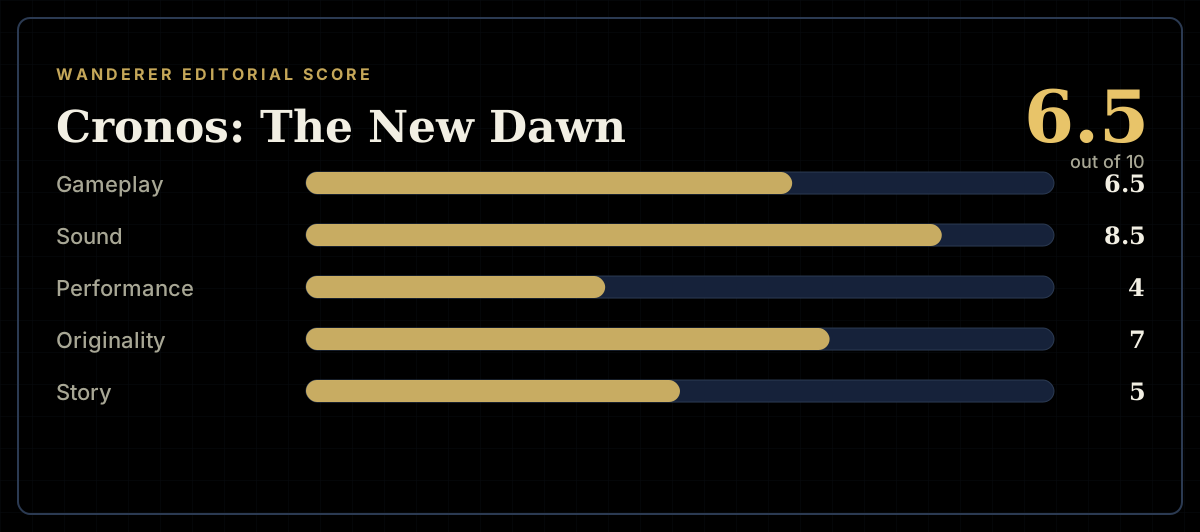
How the review scores each part of the gameWanderer Editorial -
The short versionWanderer Editorial